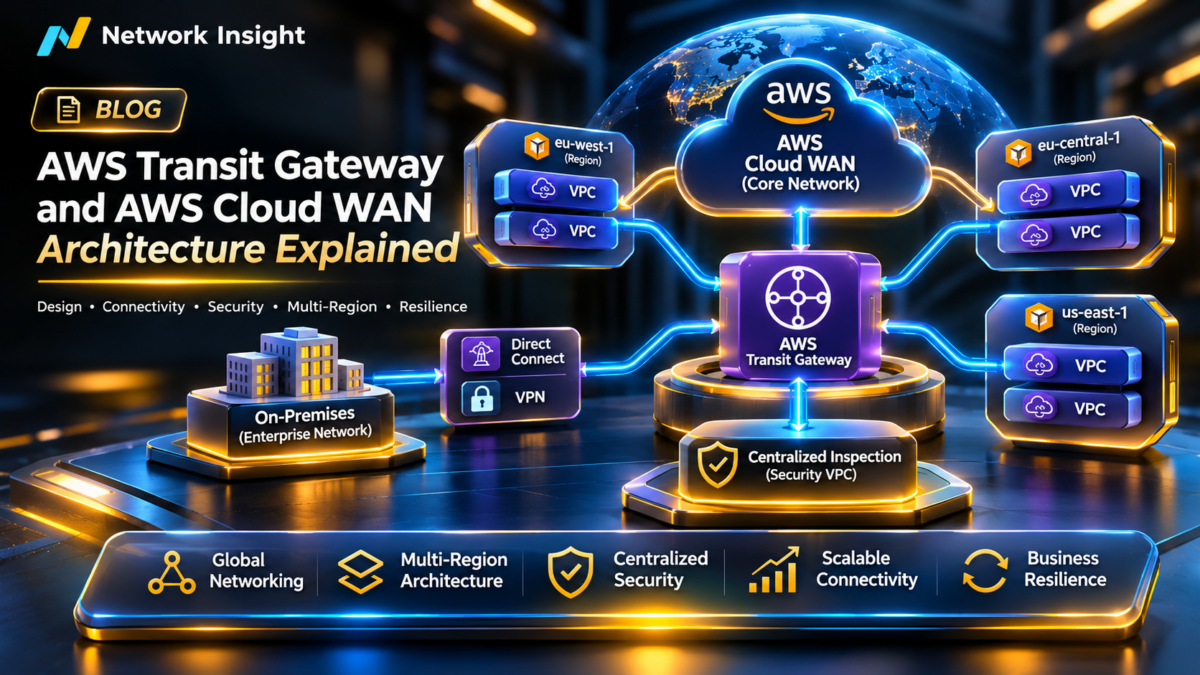
AWS Transit Gateway
& AWS Cloud WAN
Architecture Explained
Modern enterprise networks no longer operate inside a single data centre or AWS Region. Applications span multiple VPCs, Regions, on-premises environments and distributed branches. Engineering these networks requires more than connectivity: it requires predictable routing, controlled segmentation, scalable transit, resilient hybrid integration and security inspection that preserves traffic symmetry.
This engineering guide explores the architecture behind AWS Transit Gateway and AWS Cloud WAN, from attachment routing and route-table propagation to global core network policies, inspection architectures and production troubleshooting.
AWS Global Network Topology
Select an engineering scenario
Observe the logical path and inspect the corresponding routing decision.
Control-plane interpretation
Why AWS Transit Architecture Matters
An enterprise may begin with two VPCs and a simple peering connection. As the environment grows, however, application networks, shared services, security boundaries and hybrid connectivity create a much more complicated routing problem.
Point-to-point connectivity can become operationally difficult to manage. Engineers need to understand which networks may communicate, which transit route tables control forwarding, where security inspection occurs, and how regional or global connectivity is established.
AWS Transit Gateway provides a regional transit hub connecting supported attachments, including VPCs and VPNs. Its route tables control how traffic arriving from an attachment is forwarded toward reachable destinations.
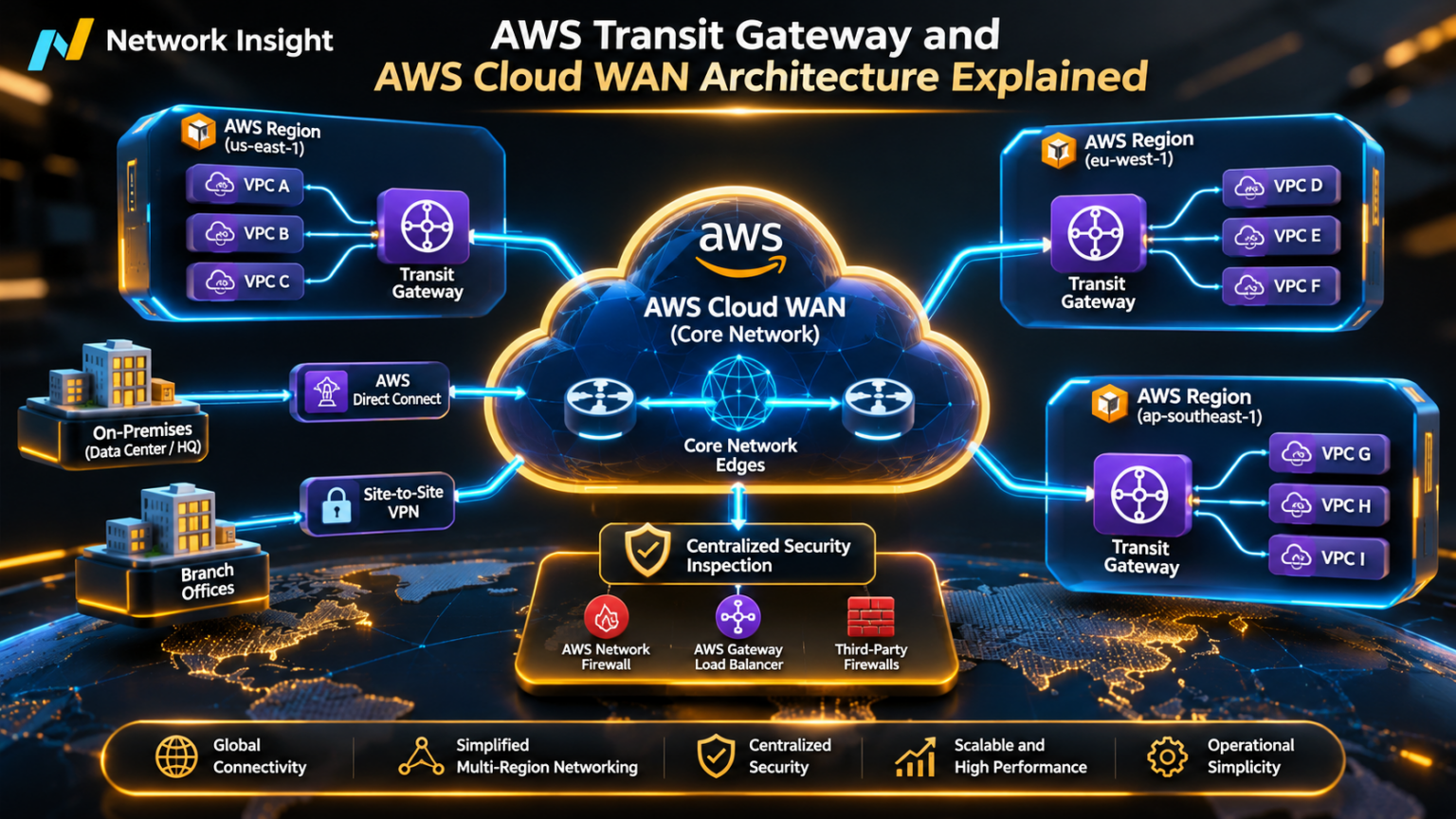
AWS Cloud WAN introduces a policy-driven global core network. Core network edges operate in selected AWS Regions, and segments establish logical routing domains across the network. Connectivity and isolation are determined by the core network policy and the attachment configuration.
Connectivity
Design VPC attachments, regional transit, hybrid connectivity and multi-region communication without creating unnecessary point-to-point network relationships.
Routing Control
Understand route table association, route propagation, static routing, policy-based segmentation and the interaction between VPC routing and the transit network.
Security and Resilience
Engineer inspection boundaries, routing symmetry, segmentation, fault isolation, regional resilience and predictable failure recovery.
Transit Gateway vs AWS Cloud WAN
Both services can be part of enterprise AWS networking, but they expose different architectural abstractions. Understanding this distinction is essential before choosing a connectivity model.
AWS Transit Gateway
A regional hub that connects supported network attachments and forwards traffic using Transit Gateway route tables.
- Regional transit hub
- Attachment-to-route-table associations
- Static routes and supported propagation
- Route-table-based segmentation
- Inter-Region connectivity through TGW peering
- Explicit VPC route-table integration
AWS Cloud WAN
A managed global core network that uses policies, segments and regional core network edges to coordinate connectivity.
- Multi-Region core network
- Core network policy configuration
- Logical network segments
- Segment sharing and isolation controls
- Regional core network edges
- Centralised network visibility and management
Connectivity does not imply reachability. An attachment can exist and be operational while traffic still fails because the source route table, transit routing domain, destination route table, security policy or return path is incorrect.
What You Will Engineer in This Guide
The following sections build from fundamental transit connectivity to advanced production investigation. Each major architecture concept is paired with an interactive engineering exercise.
Explore the AWS Transit Architecture
Navigate the engineering foundations of AWS Transit Gateway and AWS Cloud WAN — from regional VPC connectivity and route selection to global core networks, segmentation, firewall inspection, hybrid routing and production troubleshooting. Select any of the nine engineering sections below.
Explore the Nine Engineering Sections
SELECT A SECTION TO NAVIGATETransit Gateway Architecture Fundamentals
Regional hub-and-spoke networking, attachments, VPC routing and the AWS transit forwarding model.
EXPLORE ARCHITECTURE →Transit Gateway Route Tables and Routing Decisions
Attachment associations, route propagation, static routes, blackhole routes and route selection.
EXPLORE ROUTING →VPC Attachments and Inter-VPC Connectivity
Attachment subnets, Availability Zones, source and destination route tables, and complete packet paths.
EXPLORE PACKET PATHS →AWS Cloud WAN Core Network Architecture
Global networks, regional core edges, attachments, segments and centralised network policy.
EXPLORE GLOBAL CORE →Network Segmentation and Security Boundaries
Transit Gateway route-table isolation, Cloud WAN segments, shared services and controlled network reachability.
EXPLORE SEGMENTATION →Centralised Inspection and AWS Network Firewall
Inspection VPCs, Gateway Load Balancer, stateful firewall routing, appliance mode and service insertion.
EXPLORE INSPECTION →Hybrid Networking: Direct Connect and VPN
Enterprise WAN connectivity, Direct Connect gateways, BGP advertisements and VPN failover.
EXPLORE HYBRID ROUTING →Multi-Region Networking and Resilience
Transit Gateway peering, Cloud WAN regional edges, failure domains and recovery design.
EXPLORE RESILIENCE →Production Troubleshooting and Validation
Missing routes, policy failures, firewall asymmetry, hybrid incidents and systematic network fault isolation.
EXPLORE TROUBLESHOOTING →
AWS Transit Gateway
Architecture Fundamentals
AWS Transit Gateway provides a regional network transit architecture that connects Amazon VPCs and supported hybrid network attachments through a central routing hub. It replaces many point-to-point connectivity relationships with an attachment-based forwarding model governed by Transit Gateway route tables.
Understanding Transit Gateway requires separating three concerns: network attachment, route-table control, and packet forwarding. A connected attachment is not automatically reachable from every other attachment. Reachability depends on routing configuration, segmentation and the return path.
From VPC Peering to a Transit Hub
VPC peering is useful for direct communication between two VPCs, but it does not provide transitive routing. A VPC cannot use an ordinary peering connection as a transit path to reach another peer.
As an enterprise expands to many application VPCs, shared-services VPCs and hybrid networks, a large collection of peering relationships can become operationally complex.
Transit Gateway introduces a central transit resource. Each participating VPC connects using a Transit Gateway VPC attachment. Traffic can then be forwarded between attachments when the relevant route tables permit it.
Engineering principle: Transit Gateway simplifies connectivity topology, but it does not eliminate routing design. Engineers must still configure VPC routes, Transit Gateway route tables, attachment associations and any required security controls.
The Three Fundamental Building Blocks
Transit Gateway
The regional transit resource that forwards traffic between supported network attachments. It provides the central connectivity point for the transit architecture.
Attachments
Logical connections between Transit Gateway and supported resources, including VPCs, VPN connections, Direct Connect gateway associations and Transit Gateway peering.
Transit Route Tables
Routing domains that determine which destination attachment receives traffic arriving through an associated ingress attachment.
A Transit Gateway can have multiple route tables. Each attachment is associated with one Transit Gateway route table for forwarding decisions, while its routes may be propagated into multiple route tables where propagation is supported and enabled.
This separation is central to network segmentation. Production, development and shared-services attachments can use different ingress route tables, even though they connect to the same Transit Gateway.
How a Packet Traverses Transit Gateway
Consider a packet sent from an application instance in 10.10.0.0/16 toward a service in 10.20.0.0/16.
The source subnet route table must direct the destination prefix toward Transit Gateway. The packet then enters the Transit Gateway through the source VPC attachment.
Transit Gateway performs a destination route lookup using the route table associated with the ingress attachment. If a usable route exists, the selected destination attachment receives the traffic.
The destination VPC must have the necessary subnet routing and security configuration. The reverse direction is evaluated independently, which makes return-path design particularly important.
Route Association vs Route Propagation
These two mechanisms are frequently confused during Transit Gateway troubleshooting.
| Mechanism | Purpose | Engineering Meaning |
|---|---|---|
| Association | Selects the Transit Gateway route table used for traffic entering through an attachment. | Determines the ingress forwarding domain. |
| Propagation | Adds supported attachment routes into selected Transit Gateway route tables. | Controls route visibility in those tables. |
| Static Route | Explicitly defines a destination route and attachment target. | Provides deliberate forwarding control. |
| Blackhole Route | Discards traffic matching the selected destination. | Can enforce explicit route-level blocking. |
A useful mental model is that association determines which table is consulted, while propagation determines which supported routes appear in a table. Propagation does not, by itself, guarantee end-to-end reachability.
Important distinction: Transit Gateway route propagation does not automatically populate the subnet route tables inside attached VPCs. VPC route tables must be configured separately for traffic that should use the Transit Gateway.
VPC Attachment Subnets and AZ Reachability
When creating a Transit Gateway VPC attachment, engineers select attachment subnets in the required Availability Zones. A VPC attachment uses one selected subnet per Availability Zone.
The attachment subnet selection matters because Transit Gateway connectivity is enabled through the selected Availability Zones. Workloads in other Availability Zones may require additional attachment subnet coverage to use the transit connection.
For production architectures, engineers should evaluate multi-AZ attachment placement, subnet route tables, network ACLs, inspection placement and failure-domain resilience.
Engineering Principles for Scalable Transit
Separate Routing Domains
Use dedicated Transit Gateway route tables to separate application environments, restricted networks and shared-services connectivity.
Engineer Return Paths
Validate bidirectional routing. Stateful firewalls and inspection architectures require consistent traffic paths.
Design for Failure
Consider Availability Zones, attachment states, regional dependencies, hybrid routing and operational observability.
The most reliable Transit Gateway deployments treat route tables as an explicit part of the network security architecture, not simply as a mechanism for connecting VPCs.
This foundation becomes essential when introducing centralised inspection, Direct Connect, VPN connectivity, Transit Gateway peering and Cloud WAN integration.
The Transit Gateway Forwarding Model
AWS Transit Gateway centralises regional network connectivity, but forwarding remains dependent on explicitly engineered routing relationships.
The critical operational sequence is: source subnet route → ingress attachment → associated Transit Gateway route table → destination attachment → destination subnet → return path.
Next engineering concept: Section 2 examines Transit Gateway route tables in greater depth, including association, propagation, static routes, blackhole routes, route selection and segmentation failures.
AWS Transit Gateway Architecture Explorer
Investigate the regional transit hub connecting application, database, and shared-services VPCs. Select source and destination networks, inspect attachment associations, trace route lookups, and introduce production-style failures.
Regional Transit Architecture
AWS Region: eu-west-1 · Example CIDRs
Traffic Engineering Console
Forwarding Investigation
Transit Gateway Control Plane
Example lab route table. Attachment association determines which TGW route table processes packets arriving from that attachment.
| Destination | Target | Type | Status |
|---|
Lab simplification: all attachments initially associate with one TGW route table, with propagation enabled. Route-table isolation changes the source association in the model.
Attachment & Diagnostic Console
| Attachment | Association | State |
|---|
Simulated Diagnostic Output
Engineering Interpretation
AWS Transit Gateway is a regional Layer 3 transit service. VPC attachments provide connectivity into the hub, but connectivity also depends on VPC subnet route tables, Transit Gateway route-table associations, route entries, and return-path routing.
Educational model only. This widget does not query AWS, modify infrastructure, or perform live packet forwarding. Security groups, NACLs, DNS, AZ-specific attachment behavior, and stateful inspection are outside this first lab's forwarding model.
AWS Transit Gateway Route Tables and Routing Decisions
AWS Transit Gateway route tables define the forwarding behaviour of the regional transit network. They determine which destination attachments can be reached by traffic entering through a particular source attachment, providing both connectivity control and logical network segmentation.
A functioning Transit Gateway attachment does not guarantee connectivity. The decisive question is whether the route table associated with the ingress attachment contains a usable route toward the destination, and whether the surrounding VPC and hybrid networks have consistent forwarding and return paths.
Transit Gateway Route Tables as Routing Domains
Each Transit Gateway route table represents an independent routing domain. Attachments can be associated with different route tables, allowing engineers to separate production, development, shared-services and restricted environments.
A Transit Gateway attachment is associated with one route table for ingress forwarding. Routes from eligible attachments may be propagated into one or more route tables, while static routes allow engineers to define explicit forwarding relationships.
Engineering principle: Route-table association controls the forwarding context for traffic entering Transit Gateway. Route propagation controls route visibility in supported route tables. These are separate operations and should be validated independently.
Association, Propagation, Static Routes and Blackholes
Route Table Association
Determines which Transit Gateway route table evaluates traffic entering from an attachment. Each attachment has at most one active association.
Route Propagation
Allows supported attachment routes to appear dynamically in selected Transit Gateway route tables. Propagation behaviour depends on attachment type and configuration.
Static and Blackhole Routes
Static routes define explicit attachment targets. Blackhole routes deliberately discard traffic matching their destination prefix when selected.
VPC attachment route propagation is not equivalent to running BGP between a VPC and Transit Gateway. VPC CIDR information can be propagated through the AWS-managed attachment mechanism. BGP is relevant to supported VPN and Direct Connect routing arrangements.
| Routing Function | Configuration | Operational Effect |
|---|---|---|
| Association | Attachment → TGW route table | Selects the ingress lookup domain. |
| Propagation | Eligible attachment → selected route tables | Introduces supported reachable prefixes. |
| Static route | Prefix → attachment | Explicitly determines the next attachment for a matching route. |
| Blackhole route | Prefix → blackhole | Discards matching traffic when that route wins selection. |
| VPC subnet route | Prefix → TGW | Directs workload traffic into the transit network. |
How Transit Gateway Selects a Destination Attachment
The forwarding decision begins with the source VPC subnet route table, not the Transit Gateway route table. The VPC must first direct traffic to Transit Gateway. Once traffic enters through an attachment, Transit Gateway evaluates the associated route table.
Transit Gateway uses longest-prefix matching. When routes have the same prefix length, AWS-defined route priorities and route types affect selection. A static route generally takes precedence over a propagated route for the same destination prefix; AWS also defines attachment-specific priorities for competing propagated routes.
Important: A blackhole route is not a universal deny rule. A more-specific matching route can win longest-prefix selection. For security isolation, route tables should be designed carefully and combined with appropriate security controls.
Using Multiple Transit Gateway Route Tables
Network segmentation is achieved by associating different groups of attachments with separate route tables and controlling the destination routes available in each table.
For example, production and development attachments can each access a shared-services VPC while remaining isolated from one another. This requires carefully designed forwarding and return-path routing. The shared-services attachment's associated route table must contain the appropriate return routes.
| Ingress Routing Domain | Permitted Destinations | Isolated Destinations |
|---|---|---|
| Production-RT | Production, Shared Services, approved Hybrid | Development, Restricted |
| Development-RT | Development, Shared Services | Production, Restricted |
| Shared-RT | Approved Production and Development prefixes | Restricted |
| Restricted-RT | Restricted and explicitly approved inspection paths | All unapproved networks |
Transit Gateway segmentation operates at the routing layer. It does not replace security groups, network ACLs, firewall inspection, identity controls or application-level authorisation.
Longest Prefix, Route Priority and Failure Behaviour
Consider a Transit Gateway route table containing a broad route to a hybrid network and a more-specific route to a different attachment. The more-specific prefix is selected for matching traffic, regardless of the broader route's type.
Operational failures may occur when propagated routes disappear, static routes target unavailable attachments, attachment associations change or overlapping prefixes create unexpected forwarding decisions.
Missing Route
The ingress route table has no matching destination prefix. Traffic cannot be forwarded toward the required attachment.
Wrong Association
The source attachment uses a different route table than expected, causing the packet to follow an unintended routing policy.
Asymmetric Routing
Forward and reverse traffic take different inspection paths, potentially breaking stateful firewall sessions.
Diagnosing Transit Gateway Routing Failures
Troubleshooting should follow the packet's forwarding sequence rather than assuming that an available attachment implies connectivity.
Production investigation rule: Trace both directions of a flow. A correct outbound route does not prove that the destination can return traffic, and successful routing does not prove that a firewall or security policy will permit the session.
Routing Policy Defines Transit Reachability
Transit Gateway route tables provide the central forwarding and segmentation mechanism for regional AWS transit architectures. Attachment association chooses the ingress routing domain, propagation and static configuration populate route entries, and destination-prefix matching determines the selected route.
The next architectural layer is the VPC attachment itself: subnet selection, Availability Zone enablement, workload route tables and bidirectional packet forwarding.
Next section: AWS VPC Attachments and Inter-VPC Connectivity — attachment subnets, Availability Zone behaviour, packet paths, routing symmetry and troubleshooting failed communication between VPCs.
Transit Gateway Route Table Simulator
Engineer routing decisions across three VPC attachments, two Transit Gateway route tables, propagated routes, static entries and blackhole policies. Change the control plane, then trace how packets are forwarded or dropped.
Interactive TGW Control-Plane Architecture
Select an attachment to inspect its association. Animated links highlight the selected forwarding path.
Routing Engineering Console
Forwarding Decision Pipeline
Route Table Associations & Propagation
Change the route table associated with each attachment. Toggle propagation to control which propagated routes appear in each table.
| Attachment | Association | Main Prop. | Isolated Prop. |
|---|
Live TGW Route Table
Viewing tgw-rt-main
| Destination | Target | Type | Action |
|---|
Add Static or Blackhole Route
Simulated Route Lookup Diagnostics
Engineering Interpretation
Production Engineering Notes
AWS Transit Gateway routing is controlled by attachment associations, route propagation, static routes, and blackhole entries. A packet arriving through an attachment is evaluated against the TGW route table associated with that ingress attachment.
This laboratory models TGW route selection, not complete VPC forwarding. Actual connectivity additionally requires correct VPC subnet routes, destination attachment subnet coverage, security groups, network ACLs, and return paths. Static routes take precedence over propagated routes for identical prefixes; more-specific prefixes take precedence over less-specific ones.
Educational simulation: no AWS API calls or live network changes. This model uses VPC attachments, IPv4 prefixes, deterministic route selection and simplified route propagation. It does not model equal-prefix propagated-route priority across attachment types, appliance mode, or all AWS control-plane constraints.
AWS VPC Attachments and Inter-VPC Connectivity
Transit Gateway VPC attachments connect individual Amazon VPCs to the regional transit network. They provide the attachment interfaces through which packets enter and leave Transit Gateway, but successful communication requires coordinated subnet routing, attachment Availability Zone coverage, Transit Gateway route tables and return-path configuration.
A VPC attachment is not simply a logical checkbox enabling communication. Its subnet placement, route-table integration and forwarding behaviour are critical elements of production network design.
How VPCs Connect to Transit Gateway
A Transit Gateway VPC attachment connects one VPC to a Transit Gateway in the same AWS Region. During attachment creation, engineers select subnets from the Availability Zones that require transit connectivity. Only one subnet per Availability Zone can be selected for a particular VPC attachment.
These selected subnets provide the Transit Gateway attachment interfaces. Workload subnets do not have to be the same subnets used for attachment, but their route tables must direct the appropriate destination prefixes toward Transit Gateway.
The architecture therefore separates workload subnet placement, attachment subnet placement, and transit forwarding policy.
Engineering principle: An attachment subnet enables Transit Gateway connectivity for its Availability Zone. Workload subnet routes, attachment subnet route tables, Transit Gateway routing and security policy must all be evaluated when investigating connectivity.
Workload Subnets vs Attachment Subnets
A common misconception is that every workload subnet must be selected during Transit Gateway attachment creation. Instead, the attachment uses selected subnets to establish connectivity for the corresponding Availability Zones.
Workload subnet route tables direct packets toward Transit Gateway. Attachment subnet route tables must also support the intended forwarding paths within the VPC, particularly when traffic arrives from the transit network and must reach a destination subnet or inspection appliance.
Workload Subnet
Hosts application instances and services. Its route table determines whether traffic destined for another network is sent toward Transit Gateway.
Attachment Subnet
Contains the Transit Gateway attachment interface for an enabled Availability Zone. Its routing configuration influences traffic entering the VPC from Transit Gateway.
Transit Routing Domain
The Transit Gateway route table associated with the ingress attachment determines the destination attachment selected for forwarding.
| Routing Location | Example Destination | Target | Purpose |
|---|---|---|---|
| Application workload subnet | 10.20.0.0/16 | Transit Gateway | Send remote VPC traffic into transit. |
| Production TGW route table | 10.20.0.0/16 | Shared Services attachment | Select destination VPC. |
| Shared Services attachment subnet | 10.20.0.0/16 | Local VPC route | Reach destination services inside the VPC. |
| Shared Services workload subnet | 10.10.0.0/16 | Transit Gateway | Provide return routing. |
| Shared Services TGW ingress table | 10.10.0.0/16 | Application attachment | Complete reverse transit forwarding. |
Tracing a Packet Between Two VPCs
Consider an application instance at 10.10.1.25 communicating with a shared service at 10.20.1.40. Both VPCs are attached to the same Transit Gateway, and their routing domains permit communication.
A successful forward path does not prove that a session can be established. The return path must independently pass its VPC routing, Transit Gateway route-table lookup and security controls.
Multi-AZ Attachment Placement and Resilience
Transit Gateway VPC attachment connectivity is enabled through the selected attachment subnets. Selecting attachment subnets in multiple Availability Zones provides connectivity coverage for workloads distributed across those zones.
An engineer should not assume that an attachment subnet selected in one Availability Zone automatically enables equivalent transit access for workloads in every other Availability Zone. Transit Gateway's VPC attachment AZ behaviour must be considered explicitly.
Production designs typically select attachment subnets across the Availability Zones hosting workloads that require transit connectivity. Routing, security policies and appliance placement must then be validated for each relevant zone.
Production design rule: Multi-AZ connectivity is not merely a high-availability checkbox. Attachment subnet selection, routing policy and inspection design determine which failure scenarios the architecture can tolerate.
Why Return Paths Matter
Inter-VPC routing can be technically correct while applications still fail because of security group rules, network ACLs, host firewalls or stateful inspection.
When a central inspection VPC is introduced, traffic may be deliberately steered through firewall appliances. The return path must traverse the appropriate stateful inspection context. Transit Gateway appliance mode can help maintain flow symmetry for supported appliance VPC attachment architectures, but it does not automatically correct every routing or firewall design error.
| Failure Condition | Likely Symptom | Engineering Investigation |
|---|---|---|
| Missing source VPC route | Traffic never reaches TGW. | Inspect source subnet route table. |
| Incorrect TGW association | Unexpected destination lookup or no route. | Verify ingress attachment association. |
| Missing destination route | Packet cannot reach the destination attachment. | Inspect associated TGW route table. |
| Missing return route | One-way traffic or session timeout. | Trace reverse VPC and TGW forwarding. |
| Security group or NACL denial | Traffic dropped despite valid routes. | Inspect security policy and flow logs. |
| Asymmetric inspection | Stateful firewall drops return traffic. | Check appliance mode, AZ selection and inspection routes. |
Diagnosing Failed Inter-VPC Connectivity
A disciplined investigation begins at the source workload and follows the complete forwarding chain. Engineers should avoid starting with Transit Gateway route tables before confirming that the source VPC is actually sending traffic to Transit Gateway.
VPC Flow Logs and Transit Gateway Flow Logs provide useful evidence, but they should be interpreted with awareness of their visibility and collection limitations. Flow-log acceptance alone does not prove that an application successfully completed a session.
Attachments Are the Foundation of Transit Connectivity
AWS Transit Gateway VPC attachments connect workload networks to the regional transit architecture. Their Availability Zone placement determines connectivity coverage, while VPC route tables and Transit Gateway route tables jointly determine forwarding.
The essential engineering sequence is: workload subnet route → attachment AZ connectivity → Transit Gateway route lookup → destination attachment → destination subnet → reverse forwarding path.
Next section: AWS Cloud WAN Core Network Architecture — global networks, core network edges, policy-driven routing, segments, attachments and multi-region connectivity.
AWS VPC Packet Path Explorer
Trace packets from an EC2 application workload, through a VPC subnet route table and Transit Gateway attachment, into the regional transit fabric, and onward to a database VPC. Validate the return path and investigate Availability Zone, routing, and security failures.
End-to-End AWS Packet Forwarding Architecture
The diagram shows two VPCs, regional TGW connectivity, attachment subnets, and two Availability Zones. Select components to inspect their forwarding responsibilities.
Packet Path Engineering Console
Network Control Plane
VPC and Transit Gateway Route Tables
Inspect the logical forwarding entries required for application-to-database connectivity.
| Route table | Destination | Target | Status |
|---|
Routes are simplified to the prefixes relevant to this exercise. Real VPC route tables also contain local routes and may include more-specific routes, endpoints, NAT gateways, and other targets.
Packet Forwarding Pipeline
Production Diagnostic Console
Engineering Investigation
Production Architecture: Important AWS Constraints
A Transit Gateway VPC attachment uses selected subnets, with at most one attachment subnet per Availability Zone. Attachment subnet selection controls the Availability Zones through which the TGW can forward traffic for that VPC. Workload subnet route tables must direct remote destinations to the TGW, and attachment subnet routing must also be considered.
A workload in an Availability Zone without an attachment subnet may not be able to send traffic to the TGW through that VPC attachment. Availability Zone identifiers can differ between AWS accounts, so AZ IDs are more reliable than AZ names when coordinating multi-account designs.
Security groups are stateful, whereas network ACLs are stateless. Network ACLs must permit the relevant forward and return traffic, including ephemeral ports where applicable.
This is an educational simulation, not a live AWS network emulator. The diagram abstracts the internal TGW data plane, attachment ENIs, AZ-specific destination selection, and security processing. It does not query AWS or change infrastructure.
AWS Cloud WAN Core Network Architecture
AWS Cloud WAN provides a managed global network architecture for connecting and segmenting enterprise networks across multiple AWS Regions, VPCs, branches and hybrid environments. Instead of configuring every regional routing relationship independently, engineers define a core network policy that controls network segments, attachment relationships and connectivity behaviour.
The central architectural components are global networks, core networks, core network edges, network segments and attachments. Together, these provide a policy-driven approach to multi-region connectivity.
From Regional Transit to a Global Core Network
AWS Transit Gateway operates as a regional transit resource. Multi-region architectures using Transit Gateway commonly require explicit inter-region peering and coordinated routing configuration.
AWS Cloud WAN introduces a global core network abstraction. Engineers specify the AWS Regions in which core network edges are deployed and define a core network policy describing the intended network segmentation and connectivity.
The Cloud WAN service manages the underlying core network infrastructure according to the deployed policy. Attachments connect supported networks to the regional core network edges.
Engineering principle: AWS Cloud WAN does not automatically make every connected VPC reachable from every other VPC. Segment membership, attachment configuration, routing policy and security controls determine which paths are available.
The Five Building Blocks of AWS Cloud WAN
Global Network
A global network provides an organisational and monitoring framework for the enterprise network, including Cloud WAN core networks and supported network resources.
Core Network
The managed connectivity infrastructure that spans configured AWS Regions and applies the deployed core network policy.
Core Network Edge
A regional component of the core network that provides connectivity for supported attachments in the corresponding Region.
Network Segment
A logical routing domain used to separate networks and define permitted connectivity relationships.
Core Network Policy
The declarative configuration describing regional edges, segments, attachment policies and supported routing controls.
Attachments
Connections between the core network and supported resources such as VPCs, VPNs, Connect attachments and Transit Gateway route table attachments.
Segments as Global Routing Domains
Network segments provide a central mechanism for logical isolation. An enterprise can define segments such as Production, Development, Shared Services and Restricted.
Attachments are associated with segments according to the core network policy. By default, separate segments are isolated, unless supported policy mechanisms explicitly permit connectivity between them.
Segment sharing can allow selected routing domains to exchange connectivity, but it should be designed carefully to avoid unintended network reachability.
| Segment | Typical Attachments | Connectivity Objective |
|---|---|---|
| Production | Production application VPCs | Controlled multi-region production connectivity. |
| Development | Development and testing VPCs | Isolated non-production routing domain. |
| Shared Services | DNS, identity and operations VPCs | Approved access from selected segments. |
| Restricted | Regulated or sensitive workloads | Strictly controlled connectivity and inspection. |
Security architecture: Routing segmentation limits network reachability, but it does not replace AWS security groups, network ACLs, firewall inspection or application authorisation.
How Core Network Policies Define Connectivity
Cloud WAN uses a declarative core network policy to define the intended network architecture. Engineers can specify regional edge locations, segments and attachment policies rather than manually configuring every individual regional transit relationship.
Policy changes are evaluated and deployed through the Cloud WAN policy workflow. Operational validation should confirm that the deployed policy version matches the intended architecture.
In production, engineers should manage policy versions through infrastructure-as-code workflows, controlled change reviews and automated validation wherever practical.
How Traffic Traverses the Cloud WAN Core
Consider an application in a production VPC in Region A communicating with another production VPC in Region C.
The source VPC route table must direct the destination prefix toward its Cloud WAN attachment. The regional core network edge then forwards traffic according to the effective routing and segment policy.
Connecting Branches and On-Premises Networks
Cloud WAN can participate in hybrid network architectures connecting AWS workloads with enterprise data centres and distributed branch environments.
Depending on the chosen attachment architecture, connectivity can involve supported VPN, Connect, Transit Gateway and Direct Connect integration patterns.
Engineers must understand which services exchange routes, how BGP operates across the hybrid boundary, and how on-premises prefixes become reachable within the intended Cloud WAN segments.
Site-to-Site VPN
Encrypted connectivity for supported hybrid network attachments, subject to the selected VPN architecture and routing configuration.
Direct Connect Integration
Private hybrid connectivity through supported Direct Connect gateway and transit integration designs.
Branch Routing
Dynamic routing and controlled prefix advertisement between enterprise networks and AWS transit infrastructure.
Diagnosing Cloud WAN Connectivity Failures
Cloud WAN introduces a managed global routing architecture, but engineers still need to validate attachment states, effective segment membership, deployed policy versions, route visibility and bidirectional connectivity.
Production investigation rule: Separate policy intent from effective forwarding state. A policy can define a permitted relationship while a missing attachment, route or VPC configuration still prevents actual communication.
Cloud WAN as a Policy-Driven Global Transit Architecture
AWS Cloud WAN provides a managed global connectivity model built around regional core network edges, network segments, attachments and declarative policy.
The essential engineering model is: source VPC routing → regional attachment → core network edge → segment policy and route selection → global core forwarding → destination attachment → return path.
This model enables scalable multi-region architecture while retaining the need for explicit routing design, segmentation, security and operational validation.
Next section: Network Segmentation and Security Boundaries — Transit Gateway route table isolation, Cloud WAN segments, shared-services access, restricted routing domains and policy-driven security architecture.
AWS Cloud WAN Global Topology Designer
Explore a policy-driven global network connecting AWS Regions through Cloud WAN core network edges. Assign VPC attachments to segments, control segment sharing, inspect route reachability, and simulate multi-Region forwarding failures.
Global Core Network Architecture
Three illustrative AWS Regions connected by a managed Cloud WAN core network. Select a regional edge or attachment to inspect it.
Cloud WAN Policy Engineering Console
Cloud WAN Segment & Attachment Inventory
| Attachment | Region | Segment | State |
|---|
Segment assignment is modeled as a policy decision. In AWS, attachment policies and tags can determine attachment association with Cloud WAN segments.
Cloud WAN Forwarding Pipeline
Global Network Diagnostic Console
Architecture Interpretation
Production Engineering Notes
AWS Cloud WAN uses a global network, core network, core network policy, regional core network edges, segments, and attachments to provide managed connectivity across AWS Regions and external networks. The core network policy determines segment definitions, edge locations, attachment association behavior, and segment sharing.
Segment sharing controls route visibility between segments according to the configured policy. It should not be interpreted as an automatic firewall rule or universal permission for all traffic. VPC subnet routes, attachment state, security controls, and route availability must also be validated.
This is an educational Cloud WAN topology and policy simulator, not an AWS API-connected network emulator. Regional edge availability, segment sharing, and attachment failures are simplified. The visual core links are logical representations, not physical AWS backbone paths.
Network Segmentation and Security Boundaries
Network segmentation is one of the most important design objectives in enterprise AWS transit architectures. Connectivity must be deliberately controlled so that production, development, shared-services and restricted environments communicate only through approved routing and security relationships.
AWS Transit Gateway and AWS Cloud WAN provide different mechanisms for building these boundaries. Transit Gateway uses attachment associations and route tables, while Cloud WAN uses segments and core network policies. Both require careful routing, return-path validation and complementary security controls.
Building Isolated Routing Domains
A segmented enterprise network separates workloads into logical routing domains. Production systems may require access to shared identity, DNS and monitoring services, while development environments should remain isolated from sensitive production resources.
The architectural challenge is to provide approved connectivity without creating unrestricted transitive reachability between environments.
Engineering principle: Network segmentation should be designed around explicitly permitted communication relationships. A shared transit hub does not require every attached network to communicate with every other network.
Route Table Isolation with AWS Transit Gateway
Transit Gateway route tables act as separate forwarding domains. Each attachment is associated with a Transit Gateway route table, and traffic entering through that attachment is evaluated against the routes in the associated table.
Production and development attachments can be associated with different route tables. Routes to shared services may be installed in both tables, while routes between production and development remain absent.
| Transit Gateway Route Table | Associated Attachments | Permitted Routes | Isolation Objective |
|---|---|---|---|
| Production-RT | Production VPC attachments | Production and Shared Services | No direct Development or Restricted routes. |
| Development-RT | Development VPC attachments | Development and Shared Services | No direct Production or Restricted routes. |
| Shared-RT | Shared Services attachments | Approved Production and Development prefixes | Controlled return connectivity. |
| Restricted-RT | Restricted workload attachments | Restricted networks and approved inspection paths | Strictly limited reachability. |
This design requires deliberate route propagation and static route configuration. Route visibility must be evaluated in both directions, particularly when multiple environments access a shared service.
Important security consideration: A shared-services VPC with routes to multiple environments can become a transit point if it contains forwarding appliances or hosts configured to route traffic. Routing isolation should therefore be combined with host, firewall and network security controls.
Global Isolation Through Cloud WAN Segments
AWS Cloud WAN introduces policy-driven segmentation across the global core network. Segments provide logical routing domains that can span multiple configured AWS Regions.
Attachments are associated with segments according to core network policy rules. Separate segments remain isolated unless supported policy configuration explicitly permits route sharing or other approved connectivity.
This model enables an enterprise to apply consistent routing-domain definitions across multiple Regions rather than independently reproducing every regional Transit Gateway route-table relationship.
Production
Contains production VPCs and approved production connectivity across Regions. Access to other segments is explicitly controlled through policy.
Development
Provides a separate routing domain for non-production workloads, reducing unintended connectivity to production environments.
Shared Services
Hosts central services such as DNS, identity and operations platforms. Connectivity is permitted through deliberate segment policy.
Cloud WAN policy changes should be reviewed as network security changes. Segment-sharing configuration can expand reachability across multiple Regions, making unintended route exposure particularly significant.
Controlled Access Without Full Mesh Connectivity
Shared-services networks commonly host central DNS, identity, monitoring, patch management, logging and operational systems.
Production and development workloads may require access to selected services without requiring direct network connectivity to one another.
Engineers should distinguish routing reachability from service-level authorisation. A route to a shared-services VPC does not mean every application should be permitted to access every service in that VPC.
| Traffic Relationship | Routing Decision | Security Requirement |
|---|---|---|
| Production → DNS | Approved Shared Services route | Permit required DNS traffic. |
| Development → Monitoring | Approved Shared Services route | Restrict to authorised endpoints and ports. |
| Production → Development | No direct route | Maintain isolation and prevent unintended transit. |
| Restricted → Shared Services | Explicitly approved path only | Apply enhanced inspection and access controls. |
Routing Isolation Is Not a Complete Security Boundary
Transit Gateway and Cloud WAN provide powerful routing-domain isolation, but network security requires additional enforcement mechanisms.
Security groups control permitted traffic to supported AWS resources. Network ACLs provide subnet-level stateless filtering. Centralised inspection architectures can introduce stateful firewall policy and threat detection.
Routing Segmentation
Limit destination reachability through Transit Gateway route tables or Cloud WAN segments.
Network Security Policy
Use security groups, network ACLs and firewalls to restrict traffic between authorised workloads and services.
Identity and Application Controls
Enforce workload identity, authentication, authorisation and application-level access restrictions independently of network reachability.
Zero Trust design principle: Being connected to the same AWS transit architecture should not establish implicit trust. Each communication relationship should be explicitly justified, constrained and observable.
How Security Boundaries Fail in Production
Routing-domain segmentation can fail when route propagation is enabled unintentionally, attachments are associated with incorrect route tables, or Cloud WAN policy changes expose routes to unintended segments.
| Failure | Impact | Investigation |
|---|---|---|
| Incorrect TGW association | Attachment uses an unintended routing domain. | Inspect attachment-to-route-table association. |
| Unexpected propagation | Additional destination prefixes become visible. | Audit propagated routes and propagation settings. |
| Broad static route | Traffic may reach an unintended transit attachment. | Inspect longest-prefix matching and route targets. |
| Cloud WAN segment sharing error | Unintended cross-segment route visibility. | Compare intended policy with deployed policy and effective routes. |
| Shared-services transit | Forwarding appliances bridge isolated environments. | Inspect forwarding, firewall rules and return paths. |
| Inspection bypass | Traffic avoids intended security controls. | Trace the complete forwarding and return paths. |
Validating Network Segmentation End to End
Segmentation validation should include both positive and negative tests. Engineers must prove that approved communication works and that unapproved communication is blocked.
Production validation rule: A segmentation design is not proven simply because permitted traffic succeeds. Negative testing is essential to demonstrate that prohibited paths remain unreachable.
Segmentation Defines the Security Architecture
AWS Transit Gateway uses route-table association and route visibility to establish regional routing domains. AWS Cloud WAN uses policy-driven segments to establish routing domains across the global core network.
Both approaches support controlled connectivity, but neither should be treated as a replacement for security inspection, workload identity or application-level authorisation.
The essential design objective is: permit only approved routes, enforce appropriate security controls, validate return paths, and continuously detect unintended connectivity.
Next section: Centralised Inspection and AWS Network Firewall — inspection VPCs, Gateway Load Balancer, Transit Gateway appliance mode, Cloud WAN service insertion, symmetric routing and stateful firewall troubleshooting.
Network Segmentation Policy Lab
Compare Transit Gateway route-table segmentation with AWS Cloud WAN segment-based connectivity. Define which environments may exchange routes, investigate accidental route leaks, and validate intended isolation between production, development, and shared services.
Interactive Segmentation Architecture
Three security domains connect to a common transit architecture. The forwarding policy determines whether their routes are visible.
Segmentation Engineering Console
TGW Route Visibility
Toggle destination routes installed in the ingress attachment's associated route table.
Cloud WAN Directional Route Sharing
Each control represents route visibility from one segment into another segment's routing domain.
Live Directional Connectivity Matrix
Each cell shows whether a modeled route exists from the row's source domain toward the column's destination domain.
A permitted route does not guarantee bidirectional application connectivity. Return routing and security policies must also be validated.
Security Boundary Validation
Segmentation Diagnostic Console
Engineering Interpretation
Production Engineering Notes
Transit Gateway segmentation is typically implemented using separate TGW route tables, attachment associations, controlled propagation, and static routes where appropriate. A route-table association determines the forwarding table used by traffic entering through that attachment.
AWS Cloud WAN segments provide logical routing domains. Core network policy defines segments, attachment association, and route sharing. Directional route sharing can create asymmetric route visibility, so engineers should verify both forwarding directions.
Shared-services architectures require careful design. Providing route reachability to a shared-services VPC does not automatically authorize application traffic or permit transitive connectivity between isolated environments.
Educational model: controls represent effective route visibility, not literal AWS API configuration. TGW association and propagation are abstracted, and Cloud WAN policy behavior is simplified. The lab does not simulate every AWS routing precedence rule, service-insertion option, firewall policy, or packet-processing detail.
Centralised Inspection and AWS Network Firewall
Centralised inspection introduces security enforcement into AWS transit architectures. Rather than allowing every VPC to communicate directly through the transit network, selected traffic flows can be steered through dedicated inspection infrastructure where firewall policies, threat detection and stateful session controls are applied.
Production inspection designs must coordinate Transit Gateway route tables, inspection VPC routing, AWS Network Firewall, Gateway Load Balancer, appliance mode and, where applicable, Cloud WAN service insertion. The central challenge is maintaining predictable, symmetric forwarding through stateful security devices.
Centralised Security Inspection in AWS
A common enterprise design uses a dedicated inspection VPC connected to Transit Gateway. Application VPC traffic is routed through the inspection attachment before reaching its destination.
The inspection VPC may use AWS Network Firewall endpoints or a third-party firewall architecture integrated through Gateway Load Balancer. These are distinct inspection approaches: AWS Network Firewall is a managed firewall service, while Gateway Load Balancer distributes traffic to compatible virtual network appliances.
Engineering principle: A centralised firewall is effective only when the intended traffic actually traverses the inspection path. Route tables, attachment behaviour and return-path symmetry must be validated together.
Managed Stateful Inspection
AWS Network Firewall provides managed network traffic filtering using stateless and stateful rule processing. Firewall endpoints are deployed into selected subnets and Availability Zones within a VPC.
Traffic must be routed through the relevant firewall endpoints for inspection. Firewall policies can evaluate traffic based on supported network and application attributes, depending on the rule configuration.
Stateless Rules
Evaluate packets using stateless matching criteria and configured actions before applicable stateful processing.
Stateful Rules
Track supported network sessions and enforce stateful filtering, including rules based on protocol and application traffic characteristics.
Logging and Visibility
Generate supported alert and flow logs for security analysis, incident investigation and operational monitoring.
Stateful inspection depends on session consistency. If forward traffic passes through one firewall endpoint while return traffic unexpectedly traverses another stateful inspection context, the return packets may be dropped.
Third-Party Firewall Appliance Integration
Gateway Load Balancer provides an architecture for deploying and scaling compatible virtual network appliances. It can distribute traffic across registered appliance targets and support transparent insertion into network forwarding paths.
In contrast to AWS Network Firewall, Gateway Load Balancer is not itself a managed firewall rule engine. Security inspection is performed by the compatible appliances behind the load balancer.
| Capability | AWS Network Firewall | Gateway Load Balancer |
|---|---|---|
| Primary role | Managed network firewall inspection. | Traffic distribution and insertion for compatible appliances. |
| Security rules | Configured through Network Firewall policies. | Implemented by the third-party appliance. |
| Scaling model | AWS-managed firewall service architecture. | Registered appliance targets with load-balancing integration. |
| Routing requirement | Traffic must traverse firewall endpoints. | Traffic must traverse the appropriate GWLB endpoint and appliance path. |
Preserving Stateful Traffic Symmetry
Transit Gateway appliance mode is an attachment option used in supported appliance VPC architectures. It helps maintain consistent Availability Zone selection for both directions of a flow traversing a stateful appliance attachment.
Without appropriate appliance-mode and routing design, forward and return packets may traverse different inspection paths, particularly in multi-AZ architectures.
Critical distinction: Appliance mode helps preserve flow symmetry at the Transit Gateway attachment level. It does not automatically guarantee that every internal firewall path or appliance session is symmetric.
Policy-Driven Inspection in Global Networks
AWS Cloud WAN supports service insertion capabilities for supported network architectures. These allow engineers to define traffic steering through approved inspection or network function attachments using core network policy.
This approach can reduce the need to maintain independent inspection routing configurations across multiple regional transit networks. However, the effective behaviour depends on supported attachment types, policy configuration, regional deployment and routing.
Inspection Segment
A dedicated routing domain associated with security inspection infrastructure.
Service Insertion Policy
Supported policy configuration determines which traffic relationships require inspection.
Regional Inspection
Inspection placement and attachment design influence latency, resilience and forwarding symmetry.
Engineers should verify supported service insertion patterns and regional availability before adopting a design. Not every firewall deployment or attachment combination has identical service insertion behaviour.
From Workload to Firewall to Destination
A production inspection architecture must ensure that both directions of a stateful session traverse the intended security controls. This includes verifying Transit Gateway or Cloud WAN routing, inspection VPC subnet routes, firewall endpoint placement and destination return routing.
Common Centralised Inspection Failures
| Failure | Symptom | Investigation |
|---|---|---|
| Inspection bypass | Traffic reaches destination without expected inspection. | Review transit routes and service insertion policy. |
| Asymmetric forwarding | Stateful firewall drops return packets. | Inspect appliance mode, AZ routing and firewall session paths. |
| Missing firewall endpoint route | Traffic fails inside inspection VPC. | Review inspection subnet route tables and endpoint targets. |
| Incorrect firewall policy | Legitimate application sessions are denied. | Inspect firewall rule evaluation and alert logs. |
| GWLB appliance health failure | Reduced inspection capacity or interrupted flows. | Inspect target health and appliance availability. |
| Cloud WAN insertion policy error | Unexpected inspection path or missing connectivity. | Validate deployed core network policy and effective routing. |
Validating a Secure Inspection Architecture
Production validation rule: A successful connection does not prove that the intended firewall inspected the traffic. Validate the actual forwarding path and correlate it with inspection logs.
Secure Transit Requires Controlled Inspection Paths
Centralised inspection introduces a security enforcement layer into AWS transit networking. Transit Gateway route tables, appliance mode, inspection VPC routing and firewall endpoint placement must operate together.
AWS Cloud WAN can extend this model through supported policy-driven service insertion architectures. Regardless of the implementation, engineers must preserve traffic steering, firewall policy enforcement, stateful symmetry and operational visibility.
Next section: Hybrid Networking with AWS Direct Connect and Site-to-Site VPN — Direct Connect gateways, Transit Gateway integration, BGP route exchange, branch connectivity, hybrid failover and production troubleshooting.
Stateful Firewall Traffic Flow Simulator
Investigate centralised AWS traffic inspection through a Transit Gateway-connected inspection VPC. Explore AWS Network Firewall, Gateway Load Balancer appliance paths, stateful session tracking, appliance mode, and symmetric return routing.
Dual-AZ Centralised Inspection Architecture
The topology illustrates source and destination VPCs, a regional Transit Gateway, and an inspection VPC containing two inspection zones.
Stateful Inspection Engineering Console
Inspection Routing Controls
TCP Session State Machine
Inspection Routing and Session Table
| Flow | Inspection zone | Decision |
|---|
Stateful inspection requires compatible forward and return paths. Appliance mode supports flow affinity for supported Transit Gateway appliance architectures, but correct route tables remain essential.
Firewall Diagnostic Console
Engineering Interpretation
Production Engineering Notes
AWS Network Firewall is a managed, stateful network security service deployed using firewall endpoints in selected Availability Zones. A centralised inspection design requires routing that steers relevant traffic through these endpoints.
Gateway Load Balancer is a separate service-insertion architecture for deploying compatible third-party virtual appliances. It distributes traffic to appliance targets and supports flow stickiness. It should not be treated as the same service as AWS Network Firewall.
Transit Gateway appliance mode helps maintain flow affinity to a selected Availability Zone through an appliance VPC attachment. It does not automatically correct missing VPC routes, incorrect TGW route tables, or all asymmetric-routing problems.
Educational simulation only. The model represents a simplified stateful inspection workflow. It does not emulate actual AWS Network Firewall endpoint selection, Suricata rule evaluation, GWLB GENEVE encapsulation, appliance target selection, TCP retransmissions, or AWS control-plane behavior.
Hybrid Networking: AWS Direct Connect and Site-to-Site VPN
Hybrid AWS networking connects enterprise data centres, branch offices and private infrastructure to cloud workloads through dedicated connectivity, encrypted VPN tunnels and dynamic routing.
AWS Direct Connect and Site-to-Site VPN serve different connectivity requirements. Direct Connect provides dedicated connectivity into AWS, while Site-to-Site VPN provides encrypted IPsec tunnels over supported transport networks. Both can integrate with AWS transit architectures to provide access to multiple VPCs and AWS Regions.
Production hybrid design requires understanding Direct Connect gateways, transit virtual interfaces, BGP routing, Transit Gateway, Cloud WAN integration and failover behaviour.
Connecting Enterprise Networks to AWS Transit
A common enterprise hybrid architecture uses a customer router connected to AWS Direct Connect. A transit virtual interface can connect to a Direct Connect gateway, which in turn can associate with supported Transit Gateway resources.
Site-to-Site VPN can provide an alternative connectivity path. VPN routing can use BGP where supported and configured, allowing route exchange between the enterprise network and AWS.
Engineering principle: Direct Connect and VPN provide transport connectivity, but end-to-end hybrid reachability still depends on BGP advertisements, Transit Gateway or Cloud WAN routing, VPC subnet routes and return-path configuration.
Dedicated Private Connectivity to AWS
AWS Direct Connect provides dedicated network connectivity between an enterprise environment and AWS. It can support private access patterns without relying exclusively on internet-based VPN transport.
For Transit Gateway integration, a common design uses a transit virtual interface associated with a Direct Connect gateway. The Direct Connect gateway can associate with supported Transit Gateway resources, subject to AWS routing and association rules.
Direct Connect Connection
Dedicated physical connectivity between the customer network and AWS Direct Connect infrastructure.
Transit Virtual Interface
Logical interface used for supported Transit Gateway connectivity through a Direct Connect gateway.
Direct Connect Gateway
Provides a connectivity abstraction for supported private and transit gateway association architectures.
Direct Connect is not inherently encrypted end to end. Organisations requiring encryption should evaluate supported MACsec, VPN-over-Direct-Connect or application-layer encryption designs as appropriate.
Encrypted Hybrid Connectivity
AWS Site-to-Site VPN establishes encrypted IPsec connectivity between a customer gateway and a supported AWS VPN termination architecture.
Transit Gateway VPN attachments can provide hybrid access to multiple attached VPCs when the routing configuration permits it.
Dynamic VPN routing commonly uses BGP to advertise reachable network prefixes and respond to route changes. Static routing is also supported in appropriate VPN configurations.
| Characteristic | Direct Connect | Site-to-Site VPN |
|---|---|---|
| Transport | Dedicated connectivity into AWS. | IPsec tunnels over supported transport. |
| Encryption | Not inherently encrypted end to end. | IPsec encryption. |
| Routing | BGP over supported virtual interfaces. | BGP or supported static routing. |
| Typical role | Primary private hybrid connectivity. | Primary or alternative hybrid connectivity. |
| Resilience | Requires deliberate redundant connection design. | Multiple tunnels and suitable routing design. |
Route Advertisements and Prefix Control
BGP enables route exchange between supported AWS hybrid networking services and enterprise routers. The on-premises router advertises reachable enterprise prefixes, while AWS advertises permitted cloud network prefixes according to the chosen service architecture.
Engineers must distinguish BGP route learning from Transit Gateway route-table association and propagation. These are different routing mechanisms that interact within the overall hybrid forwarding architecture.
BGP engineering rule: An established BGP session does not guarantee end-to-end connectivity. Verify advertised prefixes, accepted routes, Transit Gateway route tables, VPC routes and the reverse path.
Extending Hybrid Connectivity Across Regions
Cloud WAN can provide a global transit architecture for hybrid-connected environments. Supported VPN, Connect and Transit Gateway integration patterns can connect external networks into the core network.
Direct Connect integration requires a supported connectivity architecture rather than assuming every Direct Connect gateway attaches directly to Cloud WAN in the same way as a Transit Gateway.
Cloud WAN segments can then define which regional workloads may reach the hybrid network. This provides a policy-driven model for controlling enterprise network connectivity across multiple AWS Regions.
Regional Hybrid Entry
External connectivity enters the AWS architecture through a supported regional attachment or transit integration.
Global Core Forwarding
Cloud WAN provides managed multi-region transit according to effective routing and segment policies.
Segment-Based Access
Production, development and restricted segments can receive different hybrid routing permissions.
Direct Connect and VPN Failover Design
Hybrid resilience requires more than configuring a second connectivity path. Engineers must understand route selection, tunnel state, BGP advertisements, failover timing and return-path behaviour.
A common architecture uses Direct Connect as the preferred path and Site-to-Site VPN as an alternative path. However, the exact preference is determined by supported AWS route priorities and the configured routing policy.
Diagnosing Hybrid AWS Connectivity Failures
| Failure | Symptom | Investigation |
|---|---|---|
| Direct Connect physical failure | Primary hybrid path unavailable. | Inspect connection state and physical connectivity. |
| BGP session failure | Hybrid routes missing or withdrawn. | Inspect BGP neighbour state and advertisements. |
| Missing TGW propagation | On-premises prefix absent from required route table. | Inspect attachment propagation configuration. |
| Missing VPC route | Cloud workload cannot reach enterprise network. | Inspect source subnet route table. |
| VPN tunnel failure | Alternative connectivity unavailable. | Inspect tunnel status, IKE/IPsec and routing. |
| Asymmetric hybrid routing | Sessions fail despite partial connectivity. | Compare AWS and enterprise return paths. |
Production investigation rule: Hybrid connectivity failures should be traced across the complete path: physical or VPN transport, BGP control plane, AWS transit routing, VPC routing, security policy and enterprise return routing.
Hybrid AWS Networking Is a Multi-Layer Routing System
AWS Direct Connect and Site-to-Site VPN provide complementary methods for connecting enterprise networks to AWS.
Direct Connect gateways, Transit Gateway routing, Cloud WAN integration and BGP route exchange determine how hybrid networks become reachable across AWS environments.
The essential design model is: transport connectivity → BGP route exchange → transit route selection → VPC routing → security enforcement → return-path validation.
Next section: Multi-Region Networking and Resilience — Transit Gateway peering, Cloud WAN regional core edges, global routing, failure domains, route convergence and production failover investigation.
Hybrid AWS Connectivity Simulator
Explore hybrid connectivity from an enterprise data centre to AWS through Direct Connect, Direct Connect gateways, Transit Gateway, and Site-to-Site VPN. Investigate BGP route advertisements, preferred paths, failover, and missing-route incidents.
Enterprise Hybrid Connectivity Architecture
The logical topology includes an on-premises enterprise router, a primary Direct Connect path, a backup Site-to-Site VPN path, and AWS Transit Gateway connectivity.
Hybrid Routing Engineering Console
Hybrid Control Plane
Hybrid BGP Route Table
| Prefix | Path | BGP state | Selection |
|---|
The preference selector models an intended enterprise routing policy. Real path selection depends on AWS routing behavior, prefix specificity, route origin, BGP attributes, and supported service-specific route priorities.
Hybrid Packet Forwarding Pipeline
Hybrid Network Diagnostic Console
Engineering Interpretation
Production Engineering Notes
AWS Direct Connect provides dedicated network connectivity to AWS. A transit virtual interface connects to a Direct Connect gateway, which can be associated with supported Transit Gateway resources. Direct Connect gateway associations and allowed prefixes must be configured correctly for the intended architecture.
AWS Site-to-Site VPN commonly provides two IPsec tunnels for resilience. Dynamic routing can use BGP to exchange prefixes between a customer gateway and the AWS VPN endpoint.
Failover depends on route availability, service-specific route priorities, routing policy, tunnel health, and convergence behavior. A VPN backup does not guarantee seamless failover without correct routing and operational validation.
Educational simulation only. The preference selector abstracts AWS route priority and BGP policy. This lab does not implement actual AWS Direct Connect BGP decision rules, tunnel negotiation, DX gateway allowed-prefix processing, or control-plane convergence timers.
Multi-Region Networking and Resilience
Multi-region AWS networking extends enterprise connectivity beyond a single regional transit architecture. Organisations use multiple AWS Regions to improve availability, distribute applications geographically and support disaster recovery requirements.
AWS Transit Gateway and AWS Cloud WAN provide different approaches to multi-region connectivity. Transit Gateway supports inter-region peering, while Cloud WAN provides a managed global core network with regional core network edges and policy-driven routing.
Resilience depends on more than connecting Regions. Engineers must consider failure domains, route propagation, traffic steering, application recovery, inspection placement and return-path consistency.
Connecting Regional AWS Networks
A multi-region transit design typically includes independent VPCs and regional networking resources. Transit Gateway peering can connect regional transit gateways, while Cloud WAN can provide managed inter-region connectivity through its core network edges.
The appropriate architecture depends on operational scale, routing complexity, segmentation requirements, supported services and resilience objectives.
Engineering principle: Multi-region connectivity and multi-region resilience are different capabilities. Connectivity enables routing between Regions, while resilience requires redundant paths, suitable routing policies and recoverable applications.
Inter-Region Connectivity with Transit Gateway
Transit Gateway peering connects two Transit Gateways in supported peering architectures, including inter-region connectivity.
Peering attachments provide a forwarding relationship between the two transit gateways, but route propagation across Transit Gateway peering attachments is not automatic.
Engineers must configure appropriate static routes in the relevant Transit Gateway route tables and ensure that VPC subnet routes support the intended forwarding paths.
Important routing limitation: Transit Gateway peering is not a general-purpose transitive routing mechanism. Engineers should not assume that a chain of peered Transit Gateways provides automatic connectivity between non-adjacent Regions.
Managed Multi-Region Connectivity
AWS Cloud WAN provides a managed global core network with regional core network edges. The core network policy defines regional locations, network segments, attachment relationships and supported routing controls.
This architecture can simplify the management of global connectivity compared with independently maintaining multiple Transit Gateway peering relationships.
However, Cloud WAN does not eliminate the need for routing validation. Effective segment membership, attachment state, VPC route tables and security policy still determine end-to-end reachability.
| Characteristic | Transit Gateway Peering | AWS Cloud WAN |
|---|---|---|
| Architecture | Regional Transit Gateways connected through peering. | Managed global core network with regional edges. |
| Routing management | Regional route-table configuration and explicit peering routes. | Core network policy and segment-based routing. |
| Segmentation | Transit Gateway route tables. | Global core network segments. |
| Operational model | Regional resource and peering management. | Centralised global policy management. |
| Resilience | Requires explicit architecture and failure planning. | Managed core infrastructure, with application and attachment resilience still required. |
Designing for Regional and Network Failures
Multi-region resilience begins by identifying failure domains. These can include individual Availability Zones, VPC attachments, transit resources, hybrid connectivity paths and entire AWS Regions.
A regional application failure does not necessarily mean the global network has failed. Similarly, a healthy global transit network does not guarantee that applications remain available.
Availability Zone
Attachment subnet placement, firewall endpoint coverage and application distribution affect AZ-level resilience.
Regional Transit
Regional Transit Gateway resources and Cloud WAN core network edges require suitable architectural recovery planning.
Application Region
Recovery requires suitable application deployment, data replication, endpoint selection and traffic redirection.
Resilience design rule: Redundant network connectivity cannot compensate for an application that has no recoverable deployment in the secondary Region.
From Primary Region to Recovery Region
Regional failover requires coordination between network routing and application recovery mechanisms.
Engineers must determine whether recovery involves switching application endpoints, changing routing advertisements, updating service discovery or redirecting users to a secondary deployment.
Understanding Control-Plane and Data-Plane Recovery
Network convergence is the process through which routing systems adapt to topology or connectivity changes.
In AWS transit architectures, convergence behaviour depends on the affected service, attachment type, route configuration and supported routing mechanisms.
BGP-based hybrid connections may withdraw or update routes following failures. Static Transit Gateway peering routes do not automatically behave like dynamic BGP advertisements.
Cloud WAN manages parts of the global core network control plane, but engineers must still validate application traffic recovery and effective routing state.
| Recovery Layer | Primary Concern | Validation Method |
|---|---|---|
| Physical / Transport | Connectivity path availability. | Connection, tunnel and interface health. |
| Control Plane | Route withdrawal and selection. | BGP state, route tables and effective policy. |
| Data Plane | Packet forwarding and return paths. | Traffic tests and flow telemetry. |
| Security | Firewall and inspection continuity. | Policy validation and firewall logs. |
| Application | Service availability and recovery. | Health checks and application transactions. |
Investigating Multi-Region Network Failures
Production investigation rule: Separate network connectivity failure from application availability failure. A reachable secondary Region does not prove that the application has successfully failed over.
Multi-Region Resilience Requires Coordinated Design
AWS Transit Gateway peering enables explicit connectivity between regional transit networks, while Cloud WAN provides a managed global core network architecture.
Both approaches require deliberate routing, segmentation, attachment placement, inspection and recovery design.
The essential resilience model is: regional connectivity → route availability → security continuity → application recovery → operational validation.
Next section: Production Troubleshooting and Architecture Validation — missing routes, asymmetric forwarding, attachment failures, Cloud WAN policy errors, inspection bypass, hybrid connectivity incidents and systematic AWS network fault isolation.
Multi-Region Failure Investigation Lab
Compare AWS Transit Gateway inter-Region peering with AWS Cloud WAN core network connectivity. Investigate regional outages, missing routes, segmentation failures, and recovery through an alternate application deployment.
Global Multi-Region Network Architecture
Three AWS Regions contain application, database, and disaster-recovery environments connected through the selected transit architecture.
Multi-Region Resilience Console
Regional Routing Controls
Multi-Region Route and Edge Inventory
| Region | Prefix | Edge | Route |
|---|
Transit Gateway inter-Region peering requires appropriate static routing toward peering attachments. Cloud WAN uses core network policy and segment route propagation rather than identical TGW peering route-table configuration.
Regional Failure Investigation Pipeline
Multi-Region Diagnostic Console
Engineering Interpretation
Production Engineering Notes
AWS Transit Gateway supports inter-Region peering between Transit Gateways. Routing through a peering attachment requires appropriate route-table configuration; TGW peering does not automatically provide transitive routing across an arbitrary mesh of Transit Gateways.
AWS Cloud WAN provides a managed global core network with regional edges and segment-based routing. Its policy-driven model can simplify connectivity management across multiple Regions, but route propagation and segment boundaries still require careful design.
Multi-Region disaster recovery requires more than network connectivity. Application readiness, data replication, DNS or traffic steering, dependency recovery, security policy, and return routing must be validated before a DR environment can serve production traffic.
Educational simulation only. Regional availability and path selection are simplified. The model does not represent actual AWS backbone paths, TGW route precedence, Cloud WAN route evaluation, service health, replication state, or real convergence timing.
Production Troubleshooting and Architecture Validation
Production AWS transit networking requires engineers to understand not only how connectivity is designed, but how to investigate failures across multiple routing domains, attachments, Regions, security controls and hybrid connections.
A successful troubleshooting methodology separates control-plane state, data-plane forwarding, security enforcement and application availability. Each layer must be validated independently before the complete end-to-end path can be considered healthy.
This final section brings together Transit Gateway routing, Cloud WAN segments, VPC attachments, AWS Network Firewall, Direct Connect, VPN and multi-region resilience into a single operational investigation framework.
Following the Complete AWS Packet Path
Effective network troubleshooting begins with a clearly defined source, destination and expected application behaviour. Engineers then trace the actual forwarding path, validating every routing and security decision along the way.
In AWS transit architectures, the path can cross VPC route tables, Transit Gateway attachments, Cloud WAN core network edges, inspection VPCs and hybrid routing boundaries.
Engineering principle: Never assume that an attachment in an available state, an established BGP session or a deployed Cloud WAN policy proves successful end-to-end forwarding. Each layer requires separate validation.
The Five-Layer AWS Network Investigation Model
This investigation model prevents engineers from confusing route visibility with actual forwarding. It also encourages systematic validation of return traffic, which is frequently overlooked in complex transit environments.
Select a Production Failure Scenario
The following examples illustrate common AWS transit failures. Select an incident to review its symptoms, likely causes and recommended investigation.
Missing Transit Gateway Route
Symptom: Source VPC traffic cannot reach a destination VPC.
Likely cause: The ingress attachment's associated Transit Gateway route table lacks the required destination prefix.
Investigation: Verify source subnet routing, attachment association, destination route visibility and the reverse path.
Identifying Missing and Incorrect Routes
AWS routing failures can occur at several different forwarding boundaries. The correct troubleshooting approach depends on where the packet stops.
| Failure Location | Typical Symptom | Validation |
|---|---|---|
| Source VPC route table | Packet does not enter transit. | Inspect destination route and target. |
| TGW route table association | Unexpected routing-domain lookup. | Identify ingress attachment's associated table. |
| TGW propagation / static routes | Destination prefix absent or incorrect. | Inspect effective route entries and attachment targets. |
| Cloud WAN segment policy | Cross-segment connectivity missing or unintended. | Inspect deployed policy and segment route visibility. |
| Inspection VPC | Packet dropped or bypasses intended firewall. | Trace endpoint routes, firewall logs and return path. |
| Hybrid routing | On-premises prefixes missing or asymmetric. | Inspect BGP, DX/VPN state and route filtering. |
| Destination VPC | Traffic reaches destination network but session fails. | Inspect subnet routing, SGs, NACLs and host state. |
A Repeatable Fault-Isolation Workflow
Policy Intent Versus Effective Routing State
Cloud WAN introduces a declarative global routing model, but the intended policy and deployed routing state must be examined separately.
A core network policy may define a segment-sharing relationship, but a missing attachment, incorrect association or absent route can still prevent connectivity.
Policy Deployment
Confirm the intended core network policy version was deployed successfully.
Attachment Association
Verify attachments belong to the expected segments and regional core edges.
Effective Route Visibility
Inspect route tables and segment-sharing behaviour to validate actual forwarding reachability.
Evidence-Driven Network Troubleshooting
Production troubleshooting should use available telemetry to distinguish packet forwarding, routing decisions, security drops and application failures.
| Tool / Data Source | Primary Purpose |
|---|---|
| VPC Flow Logs | Observe supported network-interface traffic metadata. |
| Transit Gateway Flow Logs | Analyse supported traffic flow metadata across TGW attachments. |
| VPC Reachability Analyzer | Analyse supported network paths and configuration constraints. |
| Network Firewall Logs | Investigate firewall alert and flow information. |
| CloudWatch Metrics | Monitor supported networking service health and traffic indicators. |
| CloudTrail | Review recorded AWS API and configuration activity. |
| Hybrid Router Logs | Investigate BGP state, route changes and transport failures. |
Observability principle: A flow log entry does not necessarily prove end-to-end application success. Correlate network telemetry with firewall decisions and application-level evidence.
Case Study: Inter-VPC Connectivity Failure
This example demonstrates why attachment availability and VPC routing are insufficient to prove transit connectivity. The associated Transit Gateway route table must contain the intended destination route.
Production Validation Before Deployment
From Transit Connectivity to Production Engineering
AWS Transit Gateway and AWS Cloud WAN provide complementary approaches to enterprise cloud networking. Transit Gateway delivers regional transit routing with attachment and route-table controls, while Cloud WAN provides a managed global core network with policy-driven segmentation and connectivity.
Production architectures must coordinate VPC routing, transit routing, segmentation, firewall inspection, hybrid connectivity and multi-region recovery.
The complete engineering model is: architecture design → route policy → attachment connectivity → security enforcement → traffic validation → incident investigation → resilience testing.
Engineering Guide 20 completed: AWS Transit Gateway and AWS Cloud WAN Architecture Explained — nine editorial sections covering regional transit, global core networking, segmentation, inspection, hybrid connectivity, resilience and production troubleshooting.
AWS Network Incident Investigation Engine
Investigate production-style AWS networking incidents across Transit Gateway, Cloud WAN, VPC routing, inspection, and hybrid connectivity. Inspect control-plane evidence, identify the failure domain, apply repairs, and validate recovery using an interactive packet trace.
Production Network Investigation Topology
The architecture connects application and database workloads through Transit Gateway, a central inspection VPC, and hybrid enterprise connectivity.
Incident Response Engineering Console
Active Incident Description
Control-Plane Evidence Inspector
| Component | Evidence | Status |
|---|
Incident Investigation Workflow
Production Diagnostic Console
Root Cause and Recovery Analysis
Production Engineering Notes
AWS network troubleshooting requires distinguishing control-plane problems from data-plane failures. A healthy Transit Gateway attachment does not guarantee that the correct route is installed in the associated TGW route table or the VPC subnet route tables.
Cloud WAN segmentation failures may involve attachment association, segment policy, or route propagation. Centralised inspection failures may involve firewall policy, endpoint availability, asymmetric routing, or incorrect traffic steering.
Hybrid connectivity incidents should include Direct Connect and VPN health, BGP session state, advertised prefixes, Direct Connect gateway associations, route preference, and return-path validation.
This is a deterministic educational incident simulator. Evidence is generated from predefined scenarios rather than retrieved from AWS APIs. Repairs change the simulated state only and do not modify any real AWS infrastructure.

- AI Model Serving Performance Engineering Explained - November 20, 2026
- NVIDIA InfiniBand Networking Architecture Explained - November 20, 2026
- Azure Kubernetes Service Networking Architecture Explained - November 20, 2026