
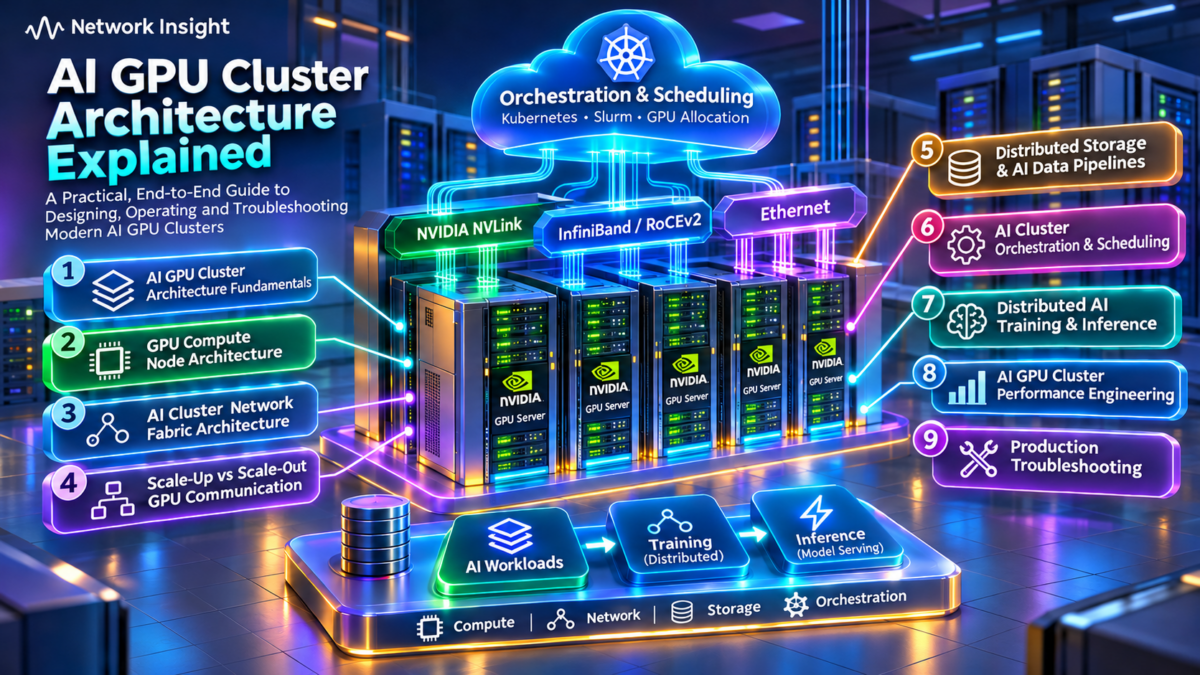
Inside an AI GPU Cluster: Compute, Networking, Storage and Distributed Workloads
An AI GPU cluster is a coordinated infrastructure system that combines accelerated compute nodes, high-performance networking, distributed storage, orchestration and workload software. Its purpose is to execute demanding AI workloads across multiple GPUs and, when required, multiple servers and racks.
The architecture extends far beyond the GPU itself. Cluster performance depends on how effectively model data moves through storage, compute and communication systems—and how efficiently workloads are scheduled across available resources.
Complete AI GPU Cluster
An AI GPU cluster integrates compute nodes, high-performance networking, distributed storage and orchestration into a coordinated infrastructure system.
AI cluster performance depends on how efficiently the infrastructure operates as a complete system.
What Is an AI GPU Cluster?
An AI GPU cluster is a collection of accelerator-equipped compute systems connected through networking and supported by storage and management infrastructure.
Clusters enable workloads to scale beyond the resources of a single server. They are commonly used for distributed model training, large-scale inference and high-performance computing.
Why Cluster Architecture Matters
AI applications depend on more than GPU arithmetic performance. They require data movement, memory management, synchronization, workload placement and reliable infrastructure operation.
A poorly balanced cluster can experience GPU idle time, network contention, slow data loading or inefficient distributed execution.
Architecture principle: Scale-up communication connects GPUs within supported local domains, while scale-out networking connects compute systems across servers and racks. These communication layers serve different purposes and must be designed together.
From AI Request to Distributed Execution
A typical AI workload begins with an application or job submission. The orchestration system identifies suitable resources and places the workload on available compute nodes.
GPU servers execute the workload, obtain model data from local or distributed storage and communicate with other nodes when distributed processing is required.
For training, the system may exchange gradients or model state and write checkpoints. For inference, the system may load model weights, manage request batches and return generated outputs.
The architecture is illustrative. Actual GPU count, server topology, storage connectivity, management design and network segmentation depend on the deployment. The diagram simplifies physical connections and does not imply that all storage traffic must traverse the GPU compute fabric.
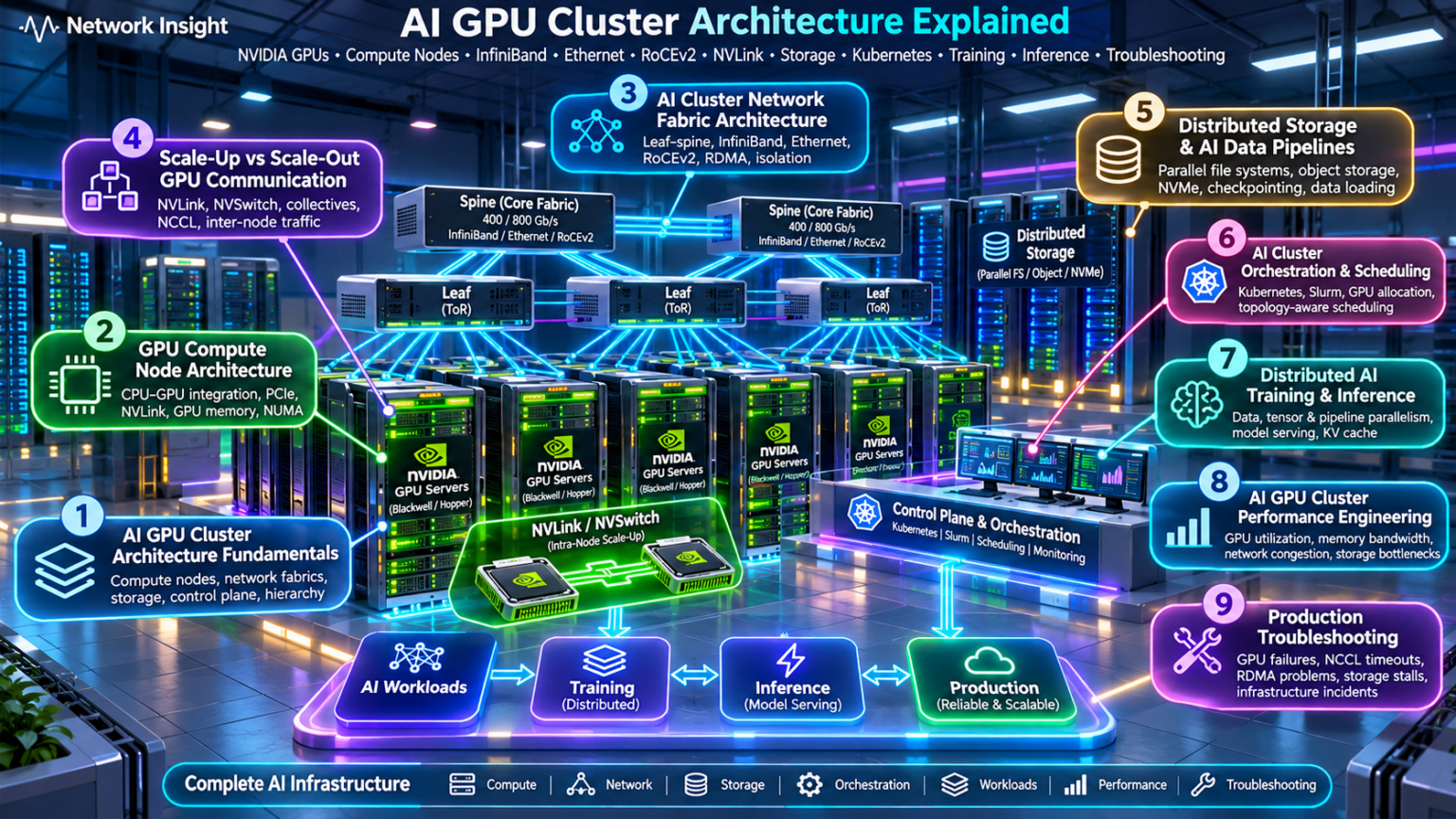
Explore the AI GPU Cluster Architecture
Navigate nine engineering layers, from GPU compute infrastructure and network fabrics to distributed training, performance engineering and production troubleshooting. Select an architecture module to inspect it, then jump directly to its section.
AI GPU Cluster Architecture Fundamentals
Explore the major architectural components of a production AI GPU cluster.
Understanding AI GPU Cluster Architecture: Compute Nodes, Network Fabrics, Storage and Cluster Control
AI GPU clusters combine accelerated computing systems, high-performance communication networks, distributed storage and workload orchestration into a unified infrastructure platform. Their architecture determines how efficiently training and inference workloads can scale beyond a single GPU or server.
Understanding the cluster hierarchy is essential for designing reliable AI infrastructure. Engineers must consider how GPUs are grouped into compute nodes, how nodes communicate across racks, how data is supplied to workloads and how cluster management coordinates resources.
Complete GPU Cluster Hierarchy
AI GPU clusters organize accelerators into compute nodes, connect nodes through networking and coordinate workloads through management and storage infrastructure.
The cluster hierarchy determines how AI workloads scale and how efficiently infrastructure resources are utilized.
1. The AI GPU Cluster Hierarchy
AI GPU clusters are organized into multiple infrastructure layers. At the lowest level, GPU accelerators provide computational resources. These accelerators are integrated into compute nodes containing CPUs, system memory, network interfaces and local storage.
Compute nodes are installed within racks and connected through high-performance networking. Storage and orchestration systems provide the additional services required for distributed workloads.
2. Compute, Communication and Control
AI cluster architecture can be understood through three major responsibilities: executing computations, moving data and coordinating workloads.
GPU servers perform accelerated processing, network fabrics support communication and management systems allocate resources, schedule jobs and monitor operational health.
Architecture principle: The GPU is only one component of an AI cluster. A production design must coordinate accelerator placement, memory capacity, network topology, storage throughput, workload scheduling and operational reliability.
3. GPU Accelerator Resources
GPU accelerators execute parallel operations used in AI training and inference. Their capabilities include high-throughput computation, accelerator memory and support for specialized numerical processing.
GPU memory capacity and bandwidth influence the size and performance of supported workloads. Accelerator interconnects can also influence multi-GPU execution efficiency.
4. GPU Compute Nodes
Compute nodes integrate GPUs with host CPUs, system memory, PCIe connectivity, network interfaces and local storage. Depending on the platform, GPUs may also communicate through dedicated scale-up interconnects.
Node architecture influences workload placement, CPU–GPU data movement, memory locality and network access.
5. Rack-Level Architecture
GPU compute nodes are installed within racks alongside network equipment, power distribution and cooling infrastructure. Rack density and platform design influence power, thermal and cabling requirements.
Rack-level organization can also affect network topology and the placement of distributed workloads.
6. AI Network Fabric
High-performance networking connects compute nodes across the cluster. Ethernet and InfiniBand are common choices for scale-out communication, while RDMA-capable networking can reduce data movement overhead in supported configurations.
Leaf-spine designs are frequently used to provide predictable connectivity and multiple paths between compute systems.
7. Distributed Storage Architecture
AI workloads require access to datasets, model weights, checkpoints and application artifacts. Storage systems may include parallel file systems, object storage and local NVMe devices.
Storage throughput, latency and data locality influence how efficiently compute nodes receive the information required for execution.
8. Cluster Control and Orchestration
Cluster management systems coordinate resource allocation, workload scheduling, monitoring and lifecycle operations. Kubernetes and Slurm are common technologies used in AI and high-performance computing environments.
Topology-aware scheduling can help place distributed workloads near the communication resources they require.
| Architecture layer | Primary components | Engineering responsibility |
|---|---|---|
| GPU accelerator | Compute engines, accelerator memory | Execute AI model operations |
| Compute node | CPU, GPUs, memory, NICs, local storage | Integrate accelerated processing resources |
| Rack | GPU servers, network equipment, power, cooling | Provide physical compute infrastructure |
| Network fabric | Leaf-spine switches, NICs, high-speed links | Support distributed communication |
| Storage | Parallel storage, object storage, NVMe | Supply datasets and persist model state |
| Cluster control | Schedulers, controllers, management services | Allocate resources and coordinate workloads |
9. Engineering Takeaway
AI GPU cluster architecture is a system-level engineering discipline. Effective designs must coordinate accelerator resources, compute nodes, network fabrics, storage and workload management.
Understanding these architectural layers provides the foundation for investigating GPU node design, network topology, distributed communication, storage performance and production troubleshooting.
The architecture diagram is conceptual. Physical network connectivity, accelerator counts, rack organization and management-plane placement vary by deployment. The illustration does not imply that storage must connect through the same fabric as distributed GPU communication.
AI GPU Cluster Architecture Explorer
Investigate the complete infrastructure hierarchy of an AI GPU cluster. Explore GPU compute racks, leaf-spine fabrics, distributed storage, cluster management and the paths followed by training and inference workloads.
AI GPU cluster — interactive logical architecture
Select a GPU rack, leaf switch, spine switch, storage service or management controller to inspect its role.
Choose a workload and trace its execution through the cluster.
The compute, network, storage and management layers work together to deliver distributed AI workloads. A fault in one layer can affect the entire workload.
Inside an AI GPU Server: CPUs, PCIe, NVLink, GPU Memory, NUMA and High-Speed Network Interfaces
The GPU compute node is the fundamental execution building block of an AI cluster. It integrates accelerator processors with host CPUs, system memory, high-speed I/O, local storage and network interfaces into a coordinated computing platform.
Its internal topology determines how efficiently data moves between the host and accelerators, how GPUs communicate with one another and how distributed workloads access external network and storage resources.
Complete GPU Compute Node
A GPU server integrates host CPUs, accelerator processors, memory, I/O connectivity, networking and storage.
GPU server performance depends on both accelerator capabilities and the efficiency of the surrounding system architecture.
1. Understanding GPU Compute Nodes
GPU compute nodes are accelerator-equipped servers designed to execute compute-intensive workloads. They integrate GPUs with host CPUs, system memory, networking and local storage.
The node provides the hardware environment in which AI frameworks allocate memory, launch accelerator kernels and coordinate communication.
2. CPU–GPU Integration
Host CPUs coordinate operating system services, workload execution, data preparation and interactions with accelerator runtimes.
GPU devices execute highly parallel operations. Efficient CPU–GPU coordination is important for reducing data transfer overhead and maintaining accelerator utilization.
Architecture principle: GPU compute performance depends on the complete node topology. CPU placement, PCIe connectivity, accelerator interconnects, memory locality and network adapter placement all influence workload behavior.
3. PCIe Architecture and Device Connectivity
PCI Express provides connectivity between host processors and peripheral devices, including many GPUs, network adapters and storage controllers.
PCIe bandwidth and topology can affect data movement between host memory, GPUs and I/O devices. The number of intermediate switches and the placement of devices within the system may influence communication performance.
4. GPU Accelerators and HBM Memory
GPU accelerators contain execution resources designed for highly parallel processing. Accelerator-attached memory provides high-bandwidth access to model weights, activations and intermediate data.
Memory capacity and bandwidth influence the size of workloads that can execute efficiently and the frequency of data movement between memory tiers.
5. NVLink and Local GPU Communication
Supported NVIDIA platforms may use NVLink and NVSwitch to provide high-bandwidth communication between GPUs. These technologies form a scale-up communication domain that can support distributed processing within a server or larger supported system.
The exact topology and available bandwidth depend on the GPU generation and system configuration.
6. NUMA and Memory Locality
Non-Uniform Memory Access describes systems in which memory access cost depends on the relationship between processors and memory resources.
In multi-socket GPU servers, the placement of GPUs, NICs and memory relative to CPU sockets can influence application performance.
NUMA-aware workload placement can reduce unnecessary cross-socket traffic in applicable configurations.
7. High-Speed Network Interfaces
Network interfaces connect GPU compute nodes to the cluster fabric. Ethernet and InfiniBand adapters are commonly used in high-performance AI infrastructure.
RDMA-capable networking can support efficient data movement between systems when the platform, software and network configuration support it.
8. Local NVMe Storage
Local NVMe devices may provide scratch storage, caching and temporary data staging for AI workloads.
Local storage can reduce repeated access to remote storage systems, although persistent datasets and checkpoints may still depend on shared infrastructure.
| Component | Architecture role | Engineering consideration |
|---|---|---|
| Host CPU | Application coordination and system services | CPU utilization and NUMA placement |
| PCIe | Host and peripheral connectivity | Topology and available bandwidth |
| GPU accelerator | Parallel AI computation | Compute utilization and execution efficiency |
| HBM memory | High-bandwidth accelerator memory | Capacity, bandwidth and working-set behavior |
| NVLink / NVSwitch | Supported local GPU scale-up communication | Communication topology and contention |
| Network interface | Inter-node communication | Link bandwidth, placement and RDMA support |
| NVMe storage | Local caching and scratch storage | Data staging and I/O throughput |
9. Engineering Takeaway
The GPU compute node is a complete accelerated computing system rather than a collection of independent GPUs. Its performance depends on the interaction between compute resources, memory, I/O connectivity and communication paths.
Understanding the internal topology provides the foundation for investigating distributed communication, network design, data movement and GPU workload performance across the wider AI cluster.
This diagram is conceptual. It does not represent a specific NVIDIA server SKU or guarantee direct GPU–NIC connectivity, NVSwitch availability or a particular PCIe layout. Validate physical topology using the documentation and tools appropriate to the deployed platform.
GPU Compute Node Builder
Construct a conceptual AI GPU server. Configure CPU sockets, GPU accelerators, PCIe connectivity, NUMA placement and GPU memory. Validate the resulting architecture against common performance and locality considerations.
GPU server motherboard — logical hardware topology
Select a CPU, GPU, PCIe fabric or NVLink domain to inspect its architectural role.
Adjust the hardware settings and build the server topology.
GPU server performance depends on accelerator placement, host memory locality, communication topology and the workload's compute-to-data ratio.
AI Cluster Networking: Leaf-Spine Fabrics, InfiniBand, Ethernet, RoCEv2, RDMA and Congestion Control
High-performance networking is a fundamental component of distributed AI infrastructure. GPU clusters depend on network fabrics to exchange model parameters, gradients, activations and other data between compute nodes.
Network architecture influences communication latency, throughput, congestion behavior and the scaling efficiency of distributed training and inference workloads. Engineers must understand the relationship between physical topology, transport technologies, RDMA and workload communication patterns.
AI Cluster Network Fabric
A leaf-spine network provides high-bandwidth connectivity between GPU compute nodes across racks.
Distributed AI performance depends on the network fabric's ability to sustain communication between GPU nodes.
1. Why AI GPU Clusters Need High-Performance Networking
Distributed AI workloads frequently exchange large volumes of data between accelerators. Training may require gradient synchronization, parameter exchange and activation transfers across multiple nodes.
The network must provide sufficient bandwidth and predictable communication behavior to prevent accelerators from spending excessive time waiting for data.
2. Leaf-Spine Network Architecture
Leaf-spine networking uses leaf switches to connect servers and spine switches to provide connectivity between leaf domains.
Multiple paths can improve aggregate capacity and resiliency. Ethernet deployments commonly use ECMP to distribute eligible flows across available paths.
Architecture principle: AI networking is not simply about link speed. Topology, oversubscription, congestion control, transport behavior and workload communication patterns all influence distributed GPU performance.
3. InfiniBand Networking
InfiniBand is a high-performance interconnect technology commonly used in HPC and AI environments. It supports RDMA communication and provides fabric mechanisms designed for high-throughput, low-latency workloads.
InfiniBand deployments require appropriate fabric management, addressing, routing and operational monitoring.
4. Ethernet and RoCEv2
Ethernet provides a widely adopted networking foundation for AI clusters. RoCEv2 enables RDMA communication over routable IP networks carried by Ethernet.
RoCEv2 performance depends on correct end-to-end configuration, including network congestion management, traffic prioritization and suitable transport behavior.
5. RDMA Data Movement
Remote Direct Memory Access enables supported systems to transfer data between registered memory regions with reduced involvement from remote CPU software in the data path.
RDMA is valuable for distributed AI communication because it can reduce software overhead and support efficient high-throughput transfers.
Actual GPU-direct data movement depends on the accelerator, NIC, driver, memory registration and software configuration.
6. Congestion Control and Queue Management
AI workloads can generate synchronized communication bursts that place pressure on network links and switch buffers.
Congestion engineering may involve ECN, endpoint congestion-control mechanisms, queue management and selective use of priority flow control in RoCE environments.
PFC is not a substitute for congestion control. Poor configuration can introduce head-of-line blocking and other network-wide problems.
7. Network Isolation
Production AI clusters may separate management, storage, service and accelerator communication traffic through physical fabrics, logical segmentation or a combination of both.
Isolation helps engineers apply appropriate security, reliability and performance policies to different traffic classes.
8. Collective Communication Patterns
Distributed training commonly uses collective operations such as AllReduce, AllGather and ReduceScatter. These operations can create communication patterns that span multiple nodes and racks.
Network topology and transport behavior influence the efficiency of collective operations, particularly as the number of participating accelerators increases.
| Technology | Primary role | Engineering consideration |
|---|---|---|
| Leaf-spine | Interconnect GPU compute nodes | Topology, path diversity and oversubscription |
| InfiniBand | High-performance RDMA fabric | Fabric management, routing and link health |
| Ethernet | General and high-performance cluster networking | Switching, routing and traffic engineering |
| RoCEv2 | RDMA over routable Ethernet/IP | Congestion control and end-to-end configuration |
| ECMP | Multipath forwarding | Flow distribution and path utilization |
| ECN | Congestion notification | Queue thresholds and endpoint response |
| PFC | Priority-based pause mechanism | Careful deployment and head-of-line blocking risk |
| RDMA | Efficient remote memory communication | NIC, memory and software support |
9. Engineering Takeaway
The AI cluster network fabric is a critical part of distributed accelerated computing. Its architecture must support the communication requirements of training and inference workloads while maintaining operational reliability.
Understanding leaf-spine topology, InfiniBand, Ethernet, RoCEv2, RDMA and congestion behavior provides the foundation for designing scalable GPU clusters and diagnosing communication bottlenecks.
The network paths shown are illustrative. Actual InfiniBand routing, Ethernet ECMP forwarding, RDMA behavior and congestion-control mechanisms depend on the hardware, software and network configuration.
AI Network Fabric Topology Explorer
Design a GPU cluster interconnect and trace RDMA communication through a leaf-spine fabric. Compare InfiniBand with Ethernet/RoCEv2, inspect congestion and investigate the effect of a fabric link failure.
GPU cluster leaf-spine network fabric
Select a GPU node, leaf switch or spine switch to inspect its architectural role.
Configure a network path and start the investigation.
AI network fabrics must support high-bandwidth, low-latency communication and manage contention from distributed GPU workloads.
GPU Communication Architecture: NVLink, NVSwitch, RDMA, NCCL and Distributed Collective Operations
Distributed AI workloads depend on efficient communication between GPUs. Communication can occur within a scale-up domain through local accelerator interconnects or across compute nodes using a scale-out network fabric.
Understanding the difference between these communication domains is essential for designing AI clusters, selecting parallelism strategies and diagnosing performance bottlenecks.
GPU Communication Hierarchy
Distributed AI workloads use local accelerator interconnects and scale-out networking to exchange data between GPUs.
Efficient distributed AI execution depends on matching communication patterns to the available interconnect topology.
1. Understanding GPU Communication Domains
Distributed AI applications require GPUs to exchange data during training and inference. Communication can occur between accelerators within a local scale-up domain or between compute systems through a scale-out network.
These communication domains differ in topology, bandwidth characteristics, latency and the software mechanisms used to coordinate transfers.
2. Scale-Up GPU Communication
Scale-up communication connects GPUs within a supported accelerator domain. NVIDIA systems may use NVLink and NVSwitch to provide high-bandwidth GPU communication.
Scale-up fabrics are particularly important for workloads that require frequent exchanges between tightly coupled accelerators.
Architecture principle: Scale-up and scale-out are complementary. Scale-up interconnects connect accelerators within supported local domains, while scale-out networks extend distributed communication across nodes, racks and potentially larger cluster boundaries.
3. Scale-Out GPU Communication
Scale-out networking connects compute nodes through Ethernet or InfiniBand fabrics. RDMA-capable communication can reduce software overhead and support efficient data movement between systems.
Scale-out performance depends on network topology, transport configuration, congestion behavior and the communication patterns of distributed workloads.
4. NCCL Communication Architecture
The NVIDIA Collective Communications Library (NCCL) provides collective communication operations used by distributed GPU workloads.
NCCL can select communication algorithms and transport paths based on supported hardware and runtime topology. The actual behavior depends on the platform and software configuration.
5. AllReduce
AllReduce combines values from participating processes using a reduction operation and distributes the resulting values to every participant.
It is commonly used for gradient synchronization in distributed training.
6. AllGather
AllGather collects data contributions from participating processes and makes the combined result available to every participant.
It is used in distributed processing patterns that require each participant to obtain data held by other participants.
7. ReduceScatter
ReduceScatter performs a reduction across participating data and distributes portions of the reduced result among participants.
It can be useful in communication-efficient distributed training strategies, including certain forms of sharded computation.
8. Communication Topology and Performance
Communication efficiency depends on the relationship between algorithm selection, message size, participating GPU count and interconnect topology.
Workloads that communicate frequently across slower or congested paths may experience reduced scaling efficiency even when GPU compute resources remain available.
| Communication mechanism | Purpose | Engineering consideration |
|---|---|---|
| NVLink | Supported high-bandwidth GPU communication | Topology and available bandwidth |
| NVSwitch | Switching within supported GPU scale-up domains | Fabric design and communication patterns |
| PCIe | Host and device connectivity | Topology and transfer overhead |
| Ethernet / InfiniBand | Inter-node communication | Network bandwidth and congestion |
| RDMA | Efficient remote memory communication | Hardware and software support |
| NCCL | Collective communication | Algorithm and transport selection |
| AllReduce | Reduction with result distribution | Synchronization and communication volume |
| AllGather | Gather data from all participants | Data volume and memory requirements |
| ReduceScatter | Reduction with partitioned output | Data partitioning and communication efficiency |
9. Engineering Takeaway
GPU communication architecture is central to distributed AI performance. Efficient systems combine local scale-up interconnects with high-performance scale-out networking and appropriate collective communication algorithms.
Understanding NVLink, NVSwitch, RDMA, NCCL and collective operations provides the foundation for designing scalable training and inference infrastructure.
The diagram illustrates conceptual communication domains and collective patterns. Actual NCCL algorithms, GPU interconnect boundaries and network paths vary by platform and workload.
GPU Communication Path Analyzer
Compare GPU-to-GPU communication inside a compute node and across a distributed AI cluster. Explore peer transfers, collective operations, scale-up interconnects and scale-out networking using a simplified communication model.
GPU communication architecture
Select a communication operation to explore how GPUs exchange data.
Configure the workload and analyze its communication cost.
Collective communication performance depends on message size, participant count, algorithm choice, network topology and contention.
AI GPU Cluster Storage Architecture: Parallel File Systems, Object Storage, NVMe, Data Loading and Checkpointing
AI GPU clusters require storage infrastructure capable of supplying large datasets, model weights and intermediate artifacts to distributed compute workloads. Storage performance influences accelerator utilization, training throughput and the reliability of long-running AI jobs.
Production designs commonly combine persistent storage, distributed file systems, object storage, local NVMe caching and workload-specific data pipelines. These systems must work together to provide efficient data access and durable model-state management.
Complete AI Storage Pipeline
AI GPU clusters combine persistent storage, shared file systems, data pipelines and local caching to supply workloads with data.
Storage performance directly influences GPU utilization and the efficiency of distributed AI workloads.
1. Why AI GPU Clusters Need High-Performance Storage
AI workloads depend on large datasets, model weights and intermediate artifacts. Training systems repeatedly access data while inference systems require efficient model loading and access to supporting resources.
Storage infrastructure must supply data at sufficient throughput to prevent GPU compute resources from becoming idle while waiting for I/O.
2. The AI Data Pipeline
A typical AI data pipeline includes ingestion, preprocessing, storage, staging and delivery to compute resources.
Different stages may use different storage technologies depending on durability, throughput, access patterns and cost requirements.
Architecture principle: AI storage should be designed around workload access patterns. Large sequential reads, many small files, distributed checkpoint writes and repeated model loading can place very different demands on storage systems.
3. Object Storage Architecture
Object storage provides scalable storage for datasets, model artifacts and other persistent resources. It is commonly used as a durable source of training data and model assets.
Object storage access patterns differ from conventional file systems. Workloads may require staging, caching or specialized data loaders to achieve suitable performance.
4. Parallel File Systems
Parallel file systems provide shared access to data across multiple compute nodes and are commonly used in high-performance computing environments.
They can distribute I/O across multiple storage resources to support demanding aggregate throughput requirements.
5. Local NVMe Storage
Local NVMe devices can provide high-speed scratch space, temporary data staging and caching for AI workloads.
Local storage may reduce repeated remote reads and improve data locality, but its contents may not provide the same durability guarantees as persistent shared storage.
6. Data Loading and GPU Utilization
Data loaders retrieve, decode, transform and batch input data before delivering it to training or inference processes.
Slow data loading can cause accelerator idle time. Efficient pipelines may use prefetching, parallel workers, caching and suitable data formats.
7. Training Checkpoints
Training checkpoints preserve model and optimizer state so long-running jobs can resume after interruption.
Checkpointing can generate significant write traffic, especially when many distributed workers persist state within a short interval.
8. Recovery and Durability
Checkpoint recovery depends on the availability and integrity of persisted state. Storage architecture must account for failures, consistency requirements and recovery objectives.
Local scratch storage may improve performance, but important checkpoints should be persisted to storage with appropriate durability guarantees.
| Storage component | Primary purpose | Engineering consideration |
|---|---|---|
| Object storage | Durable datasets and model artifacts | Access patterns, throughput and staging |
| Parallel file system | Shared high-throughput file access | Aggregate I/O, metadata and concurrency |
| Local NVMe | Scratch storage and caching | Data locality and temporary capacity |
| Data loader | Prepare and supply workload input | Prefetching, parallelism and CPU overhead |
| Checkpoint storage | Persist model and optimizer state | Write bursts, consistency and durability |
| Recovery pipeline | Restore workload state | Recovery time and checkpoint integrity |
9. Engineering Takeaway
Storage architecture is a major contributor to AI GPU cluster performance. Effective designs combine persistent storage, high-throughput shared access, local caching and reliable checkpointing.
Understanding the AI data pipeline helps engineers identify I/O bottlenecks, improve accelerator utilization and design resilient distributed workloads.
The architecture is illustrative. Actual storage paths, caching mechanisms, data formats and checkpoint strategies depend on the deployed platform and workload. Persistent storage and local scratch storage may use separate networks and different durability models.
AI Storage Pipeline Explorer
Trace training data from shared storage to GPU workers, investigate the effect of local NVMe caching, and estimate how storage and network throughput constrain dataset ingestion and checkpoint completion.
Distributed AI storage architecture
Select a storage service, network fabric, local NVMe cache or GPU worker.
Configure a workload and analyze its storage pipeline.
The end-to-end pipeline is constrained by the available throughput of its participating stages.
GPU Cluster Scheduling: Kubernetes, Slurm, Resource Allocation, Topology Awareness and Distributed Job Placement
AI GPU clusters require orchestration systems to allocate accelerator resources, coordinate distributed workloads and manage the lifecycle of training and inference jobs.
Scheduling becomes increasingly important as clusters grow. GPU availability, network topology, memory capacity, workload priority and resource quotas all influence how efficiently compute infrastructure can be utilized.
GPU Cluster Orchestration
Cluster orchestration systems coordinate workload placement, resource allocation and execution across available GPU nodes.
Effective GPU scheduling improves resource utilization and can reduce communication overhead for distributed workloads.
1. Why GPU Clusters Need Orchestration
AI GPU clusters often execute multiple workloads with different resource requirements. Some jobs require a single accelerator, while distributed training may require multiple GPUs across several compute nodes.
Orchestration systems coordinate resource allocation, workload placement, execution and lifecycle management.
2. The Cluster Control Plane
The control plane maintains information about available resources, workload requirements and scheduling policies.
Schedulers evaluate resource availability and placement constraints before assigning workloads to suitable execution environments.
Architecture principle: GPU scheduling is not simply assigning an available accelerator. Distributed workloads may require coordinated placement across multiple nodes, suitable network topology, sufficient memory and compatible software environments.
3. Kubernetes for AI Workloads
Kubernetes provides container orchestration capabilities for deploying and managing workloads across clusters. GPU resources are typically exposed through vendor device plugins and related platform integrations.
Distributed AI jobs may use additional operators, controllers or scheduling extensions to coordinate multi-node execution.
4. Slurm for GPU and HPC Scheduling
Slurm is a workload manager widely used in high-performance computing environments. It supports resource allocation, job queues and scheduling policies for compute clusters.
Slurm can coordinate jobs requiring multiple nodes and accelerator resources, making it relevant to distributed AI training environments.
5. GPU Resource Allocation
GPU allocation requires the scheduler to identify available accelerator resources and match them to workload requests.
Resource management may include whole-GPU allocation, supported partitioning mechanisms and policies that control how accelerators are shared.
6. Topology-Aware Scheduling
Distributed workloads may benefit from placement that accounts for communication locality. GPUs within the same server or rack may have different communication characteristics from GPUs located across the cluster.
Topology-aware scheduling can reduce communication overhead when the platform exposes sufficient topology information and the workload can benefit from locality.
7. Quotas, Priorities and Multi-Tenancy
Shared AI clusters often require resource quotas, scheduling priorities and access controls to prevent individual workloads from monopolizing infrastructure.
Multi-tenant designs may also require workload isolation, namespace or partition policies and appropriate security controls.
8. Distributed Job Lifecycle
A distributed AI job typically progresses through submission, queueing, scheduling, resource allocation, execution, monitoring and completion.
Failures may require retry policies, checkpoint recovery or workload rescheduling depending on the application and orchestration platform.
| Scheduling capability | Purpose | Engineering consideration |
|---|---|---|
| Resource discovery | Identify available compute resources | Accurate GPU and node inventory |
| GPU allocation | Assign accelerators to workloads | Capacity, compatibility and sharing policies |
| Topology awareness | Improve workload locality | NUMA, GPU interconnect and network topology |
| Queue management | Control pending workloads | Fairness and scheduling latency |
| Quotas | Limit resource consumption | Multi-tenancy and capacity management |
| Priority | Influence scheduling order | Policy, fairness and preemption behavior |
| Lifecycle management | Coordinate execution and recovery | Retries, monitoring and checkpoint support |
9. Engineering Takeaway
Cluster orchestration is essential for efficiently operating shared GPU infrastructure. Kubernetes, Slurm and related scheduling systems coordinate resource allocation, workload placement and execution.
Understanding GPU scheduling, topology awareness and workload lifecycle management provides the foundation for improving cluster utilization and diagnosing distributed job placement problems.
The scheduler diagram is illustrative. Kubernetes and Slurm have different scheduling architectures and are not interchangeable implementations. Specific features such as gang scheduling, GPU partitioning and topology-aware placement depend on the deployed software and configuration.
GPU Cluster Scheduler
Submit AI jobs into a simulated GPU cluster. Explore scheduling decisions, GPU fragmentation, multi-node placement and topology-aware allocation using simplified Kubernetes and Slurm scheduling concepts.
GPU cluster resource allocation
Submit a workload to begin resource allocation.
GPU scheduling requires both sufficient total capacity and a feasible placement across compute nodes.
Distributed AI Workload Flow Explorer
Investigate how data, tensor and pipeline parallelism distribute AI computation across GPUs. Follow execution stages, collective synchronization and inference requests through a simplified distributed workload model.
Distributed GPU execution architecture
Select a parallelism strategy to investigate its compute and communication characteristics.
Configure the distributed workload and begin execution.
Parallelism improves scalability but introduces communication, synchronization and workload-balancing overhead.
Distributed AI Workloads: Data Parallelism, Tensor Parallelism, Pipeline Parallelism, Model Serving and KV Cache
Distributed AI systems execute workloads across multiple accelerators to increase computational capacity, support larger models and improve throughput. Training and inference introduce different requirements for memory, communication, scheduling and workload coordination.
Engineers must understand how models and data are partitioned, how GPUs exchange intermediate results and how inference services manage requests, model weights and runtime memory.
Distributed AI Execution
Distributed AI workloads partition computation and data across multiple accelerators to support larger models and higher throughput.
Effective distributed AI execution requires balancing computation, memory and communication across available GPUs.
1. Distributed AI Workload Architecture
Distributed AI workloads execute across multiple accelerators to increase computational capacity and support models that exceed the resources of a single GPU.
Training and inference require different execution strategies, communication patterns and memory management approaches.
2. Training vs Inference
Training updates model parameters through repeated forward and backward computation. Distributed training often requires communication to synchronize gradients or exchange intermediate results.
Inference uses trained model parameters to process requests. Its performance is influenced by latency, throughput, batching and runtime memory usage.
Architecture principle: Distributed AI performance depends on how models, data and execution stages are partitioned across GPUs. The best strategy depends on model size, memory capacity, communication topology and workload objectives.
3. Data Parallelism
Data parallelism replicates model computation across participating workers while dividing input data among them.
Training workers typically synchronize gradients or parameter updates using distributed communication mechanisms.
4. Tensor Parallelism
Tensor parallelism partitions model operations or tensors across multiple accelerators.
It enables larger computations to be distributed but introduces communication requirements between participating GPUs.
5. Pipeline Parallelism
Pipeline parallelism partitions model layers or stages across multiple devices. Microbatches can move through the pipeline while different stages execute concurrently.
Pipeline efficiency depends on stage balance, communication overhead and pipeline scheduling.
6. Hybrid Parallelism
Large distributed training systems may combine data, tensor and pipeline parallelism.
Hybrid strategies allow engineers to balance model memory requirements, communication costs and available accelerator topology.
7. Distributed Inference Serving
Inference systems load model weights and execute requests through one or more model-serving workers.
Serving architectures may use batching, model partitioning and request routing to balance latency and throughput.
8. KV Cache Architecture
Transformer inference commonly uses key-value caching to retain attention-related state from previously processed tokens.
KV-cache memory consumption can become significant as context length and the number of active sequences increase. Cache management therefore influences concurrency, memory utilization and serving performance.
| Execution strategy | Primary purpose | Engineering consideration |
|---|---|---|
| Data parallelism | Distribute training data across workers | Gradient synchronization and batch size |
| Tensor parallelism | Partition model operations | Communication frequency and topology |
| Pipeline parallelism | Partition model stages | Stage balance and pipeline bubbles |
| Hybrid parallelism | Combine multiple strategies | Memory, topology and scaling efficiency |
| Inference serving | Execute model requests | Latency, batching and throughput |
| KV cache | Retain attention state | Memory capacity and sequence concurrency |
9. Engineering Takeaway
Distributed AI execution requires careful coordination of compute resources, model partitioning, memory usage and communication.
Understanding data, tensor and pipeline parallelism, together with inference serving and KV-cache management, provides the foundation for designing efficient training and inference platforms.
The workload paths are conceptual. Actual distributed frameworks, collective algorithms, model partitioning and inference memory layouts depend on the deployed model, software and hardware configuration.
Distributed AI Workload Flow Explorer
Investigate how data, tensor and pipeline parallelism distribute AI computation across GPUs. Follow execution stages, collective synchronization and inference requests through a simplified distributed workload model.
Distributed GPU execution architecture
Select a parallelism strategy to investigate its compute and communication characteristics.
Configure the distributed workload and begin execution.
Parallelism improves scalability but introduces communication, synchronization and workload-balancing overhead.
GPU Cluster Performance: Utilization, Memory Bandwidth, Network Congestion, Storage Bottlenecks and Scaling Efficiency
High-performance AI infrastructure requires more than powerful GPUs. Effective cluster performance depends on the interaction between accelerator compute, memory systems, network fabrics, storage pipelines and distributed software.
Performance engineering identifies where execution time is spent, distinguishes compute limitations from communication and I/O bottlenecks, and evaluates how efficiently workloads scale across additional accelerators.
Healthy Performance Baseline
The workload exhibits high GPU activity without an obvious dominant communication or storage bottleneck.
Performance analysis requires correlated measurements. A single utilization percentage cannot establish the root cause of a slowdown.
Illustrative GPU Execution Timeline
A simplified sequence of workload phases, not a measured GPU profiler trace.
1. Understanding AI GPU Cluster Performance
GPU cluster performance depends on the ability of compute, memory, networking, storage and software to operate efficiently together. A bottleneck in one component can limit the throughput of the complete distributed workload.
Performance engineering therefore requires measurements from multiple infrastructure layers rather than relying on GPU utilization alone.
2. GPU Compute Utilization
GPU activity metrics help identify whether accelerators are executing work, but they do not necessarily indicate how efficiently arithmetic units are being used.
Kernel profiling, achieved compute throughput, occupancy and execution timelines provide additional evidence when investigating compute limitations.
Performance engineering principle: A busy GPU is not necessarily an efficient GPU. High utilization may coexist with poor memory access patterns, synchronization overhead or low achieved computational throughput.
3. GPU Memory Bandwidth Bottlenecks
Memory-bound workloads spend a significant portion of execution time moving data rather than performing useful arithmetic. The relationship between arithmetic intensity and achievable memory bandwidth is important when analyzing kernel performance.
GPU profilers can help identify memory stalls, cache behavior and achieved bandwidth. High memory bandwidth use may indicate a limiting resource, but should be interpreted alongside kernel-level measurements.
4. Network Congestion and Collective Communication
Distributed training depends on efficient collective communication. Network congestion, packet loss or transport-level recovery can increase the time spent exchanging gradients and intermediate data.
Engineers should correlate collective operation duration with NIC counters, switch queue telemetry, ECN markings, pause events where relevant and network path utilization.
5. Storage and Data Loading Bottlenecks
Storage performance affects how quickly training workers receive input data and how efficiently checkpoints can be written. Poor metadata performance, small-file workloads, remote storage latency and insufficient caching can reduce training throughput.
Data loader profiling should distinguish storage delays from CPU decoding, transformation and batching overhead.
6. Synchronization and Straggler Effects
Distributed jobs often require coordination between workers. A slow worker can delay others at collective operations or synchronization points.
Potential causes include hardware differences, CPU contention, network asymmetry, storage delays and imbalanced workload partitioning.
7. Distributed Scaling Efficiency
Adding GPUs increases available compute capacity, but application throughput does not necessarily increase proportionally. Communication, synchronization and workload imbalance introduce scaling overhead.
For strong scaling, a fixed workload is distributed across more resources. For weak scaling, workload size increases with the number of resources. The appropriate efficiency calculation depends on the experiment.
8. Performance Investigation Methodology
A structured investigation starts with a known workload baseline, measures end-to-end throughput and identifies where execution time is spent. Engineers then correlate application traces with GPU, network, CPU and storage telemetry.
Changes should be tested one at a time where practical, with repeated measurements under comparable workload conditions.
| Performance area | Useful measurements | Possible bottleneck |
|---|---|---|
| GPU compute | Kernel time, achieved throughput, SM activity | Compute saturation or inefficient kernels |
| GPU memory | Achieved bandwidth, memory stalls, cache metrics | Memory bandwidth or latency |
| Network fabric | NIC throughput, switch queues, ECN and errors | Congestion or path imbalance |
| Collectives | Operation latency, synchronization time | Communication overhead or slow workers |
| Storage | Read latency, throughput, metadata operations | Storage or data loading delays |
| Scaling | Throughput, speedup and efficiency | Communication, imbalance and serial overhead |
9. Engineering Takeaway
AI GPU cluster performance engineering requires a system-wide view. GPU compute, accelerator memory, network communication, storage access and distributed synchronization must all be considered.
Correlating application-level measurements with infrastructure telemetry enables engineers to identify bottlenecks, improve workload efficiency and make informed scaling decisions.
Dashboard values are synthetic examples. GPU activity, bandwidth utilization and workload timelines are simplified for education. Production conclusions require hardware-specific metrics, profiler evidence and workload-aware interpretation.
AI Cluster Performance Investigator
Investigate GPU compute, memory, network, storage and power constraints. Inject a performance bottleneck, compare resource pressure and evaluate how infrastructure optimization changes the limiting subsystem.
AI cluster performance telemetry
Configure the cluster and inject a performance condition to inspect the limiting subsystem.
Run an investigation to calculate synthetic resource pressure.
Optimizing one subsystem may expose a different bottleneck elsewhere in the cluster.
AI GPU Cluster Troubleshooting: GPU Failures, NCCL Timeouts, RDMA Faults, Network Congestion and Training Recovery
Production AI GPU clusters combine accelerators, high-speed networks, distributed storage, orchestration platforms and training software. Failures in one infrastructure layer can propagate through the workload and appear as errors in another.
Effective troubleshooting requires engineers to correlate hardware health, network telemetry, distributed communication logs, scheduler events and application-level behavior before identifying a root cause.
GPU Hardware Fault
A distributed training job reports a GPU error and one worker stops making progress.
GPU faults can propagate into distributed communication errors. Investigate the earliest relevant hardware or runtime event before treating later NCCL failures as independent causes.
Simulated Production Event Timeline
Events are synthetic examples for engineering education, not live monitoring output.
1. Why GPU Cluster Troubleshooting Is Complex
Distributed AI infrastructure consists of multiple dependent systems. A single training job may rely on GPUs, CPUs, network adapters, switches, storage services and orchestration software.
An infrastructure fault can trigger secondary symptoms elsewhere. For example, a failed worker may cause collective communication to stall, resulting in timeout messages on otherwise healthy nodes.
2. A Structured Investigation Method
Effective troubleshooting begins with the observed workload failure, its timestamp and the affected resources.
Engineers should establish a timeline, identify the earliest abnormal events, compare affected and healthy workers, and collect evidence before changing production configuration.
Incident response principle: A timeout identifies an operation that did not complete within the expected interval. It does not, by itself, identify whether the root cause is a network fault, failed GPU, stalled process, software error or overloaded storage system.
3. GPU Hardware and Driver Failures
GPU failures may involve device errors, driver problems, memory faults, thermal conditions or hardware instability.
Useful evidence includes accelerator health telemetry, driver logs, NVIDIA Xid events where applicable, ECC counters and the timing of application failures.
Hardware errors should be interpreted using vendor guidance because individual event codes do not always imply permanent hardware failure.
4. NCCL Timeouts and Collective Failures
NCCL-related timeouts may occur when participating workers fail to complete collective operations within configured limits.
Possible causes include worker failure, mismatched collective execution, network problems, resource starvation and software-level deadlocks.
Correlating logs across all participating ranks is often more useful than examining only the rank that reports the timeout.
5. RDMA Connectivity and Transport Failures
RDMA failures can involve network adapter configuration, routing, fabric connectivity, access permissions, transport configuration or congestion-related behavior.
Investigation should examine the relevant network interfaces, transport errors, port status, device configuration and switch telemetry.
RoCEv2 and InfiniBand environments require different operational checks, so troubleshooting procedures should match the deployed transport.
6. Network Congestion and Performance Incidents
Congestion can increase collective latency and reduce distributed training throughput. Depending on the transport, engineers may observe queue growth, ECN marking, packet drops or pause activity.
Congestion analysis should correlate switch and NIC telemetry with workload communication patterns rather than treating high utilization alone as proof of a fault.
7. Storage Stalls and Data Pipeline Failures
Training workers may stall when input data cannot be retrieved or checkpoint operations take longer than expected.
Potential causes include storage latency, metadata contention, insufficient throughput, network problems and overloaded preprocessing workers.
Engineers should distinguish storage access delays from application-level data loading and transformation overhead.
8. Worker Failures and Checkpoint Recovery
Distributed jobs can fail when individual workers terminate, lose connectivity or become unresponsive.
Recovery may require rescheduling workers, restarting the distributed job and restoring a valid checkpoint.
Checkpoint recovery procedures should verify data integrity, compatible model configuration and the required optimizer or training state before resuming execution.
| Incident | Evidence | Engineering investigation |
|---|---|---|
| GPU fault | Device errors, driver logs, health counters | Correlate hardware events with workload failure |
| NCCL timeout | Collective logs, rank timelines, process state | Identify the earliest stalled or failed participant |
| RDMA failure | NIC status, transport errors, fabric telemetry | Validate connectivity and transport configuration |
| Network congestion | Queues, ECN, drops, pause metrics where relevant | Locate hotspots and correlate collective latency |
| Storage stall | I/O latency, throughput, data loader logs | Separate storage delays from preprocessing delays |
| Worker failure | Scheduler events, process exits, host telemetry | Determine why the worker terminated or stalled |
| Checkpoint recovery | Checkpoint metadata, integrity and restore logs | Verify persisted state before restarting |
9. Engineering Takeaway
Production GPU cluster troubleshooting requires a system-wide investigation methodology. Hardware, networking, storage, orchestration and distributed software must be analyzed together.
By correlating events across infrastructure layers and identifying the earliest relevant failure, engineers can reduce diagnosis time, avoid unnecessary configuration changes and restore distributed workloads more reliably.
The incident scenarios are educational examples. Production diagnostics and recovery actions should follow the deployed platform's operational procedures, vendor guidance and change-control requirements.
AI Cluster Incident Investigation Lab
Investigate production GPU cluster failures using simulated telemetry, command-line diagnostics and architecture inspection. Collect evidence, identify the root cause and apply the correct remediation.
AI GPU cluster production architecture
Select a GPU node, network fabric, storage service or orchestration controller.
Choose a scenario and start the investigation.
Start by inspecting symptoms, then collect diagnostic evidence before selecting a root cause.

- AI Inference Serving Architecture Explained - November 17, 2026
- Distributed AI Training Architecture Explained - November 17, 2026
- AI GPU Cluster Architecture Explained - November 17, 2026