
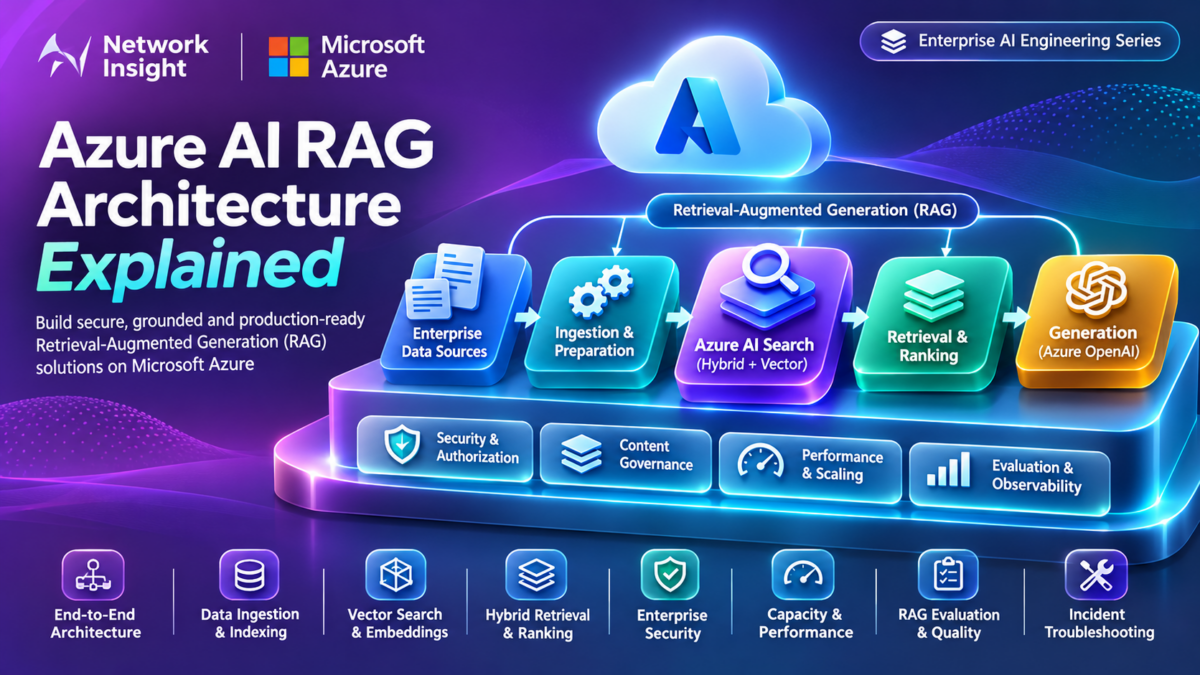
Azure AI RAG Architecture Explained
Designing enterprise Retrieval-Augmented Generation systems with Azure AI Search, vector embeddings, hybrid retrieval, semantic ranking, knowledge ingestion pipelines, and production evaluation.
Retrieval-Augmented Generation (RAG) connects large language models to external knowledge sources, allowing applications to retrieve relevant enterprise information and incorporate that evidence into generated responses.
However, production RAG architecture extends far beyond connecting a language model to a vector database. Engineers must design reliable ingestion pipelines, select appropriate chunking strategies, manage embedding models, configure retrieval algorithms, enforce document-level access controls, and evaluate whether generated answers are supported by trustworthy evidence.
Inside an Azure Enterprise RAG Architecture
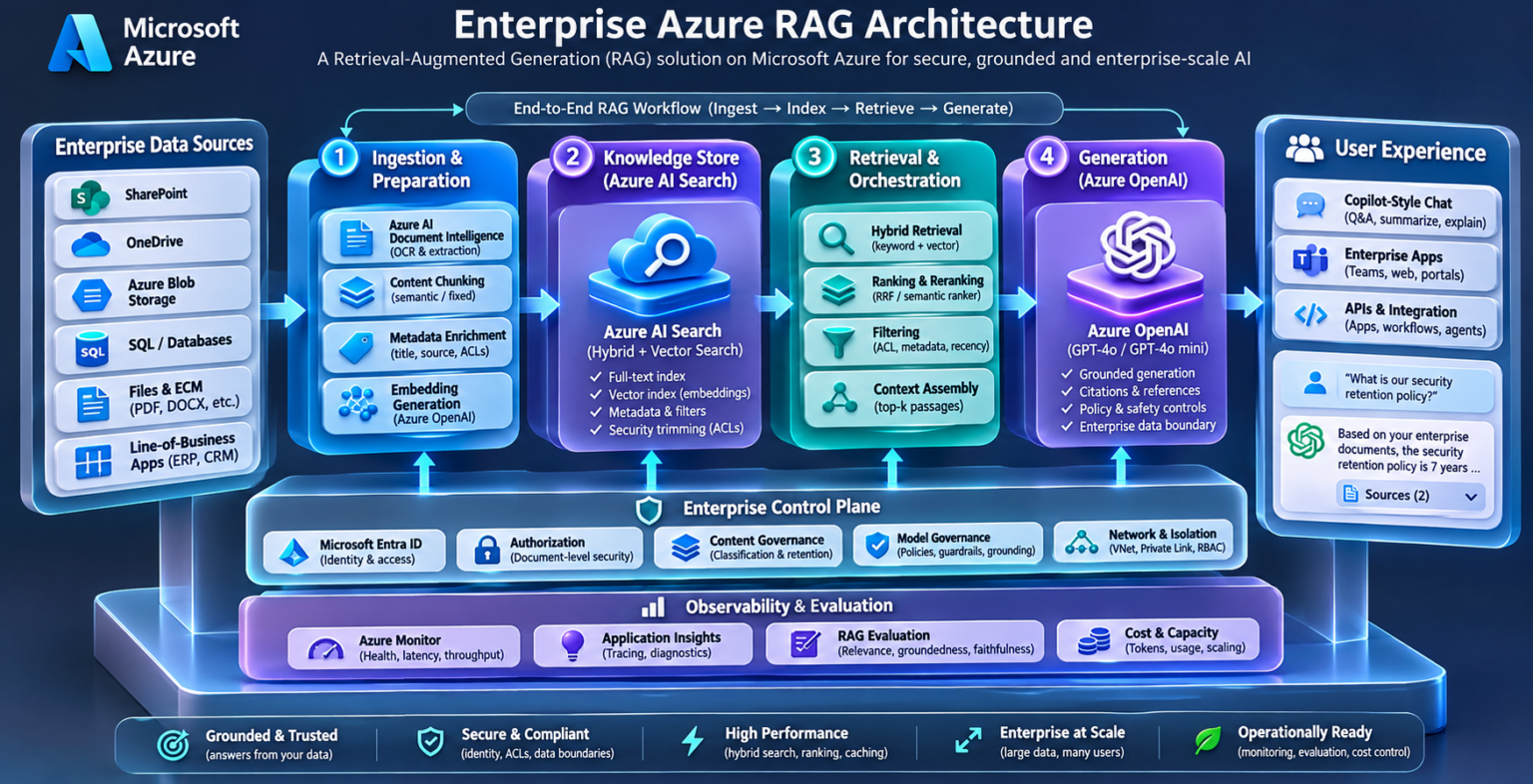
An enterprise RAG platform combines two connected workflows: a knowledge ingestion pipeline that prepares searchable enterprise information, and a runtime retrieval pipeline that finds relevant evidence for each user query.
Azure AI Search can provide the indexing and retrieval layer, while an application orchestration service coordinates query processing, context assembly, model inference, and response generation.
Enterprise search indexes, document metadata, text fields, and vector fields
The retrieval system determines which evidence reaches the model. Even a capable language model can produce unreliable answers when the search index is stale, retrieval ranking is poor, or critical source documents are missing.
Why Enterprise AI Requires Retrieval-Augmented Generation
Language models learn general patterns during training, but their training data does not automatically include an organization's current operational documentation, internal procedures, architecture decisions, or proprietary knowledge.
RAG introduces a controlled retrieval mechanism that allows applications to reference relevant information at request time without retraining the underlying model whenever documents change.
This separation between model capabilities and enterprise knowledge is especially important for cloud infrastructure, network operations, security investigations, technical support, and knowledge-intensive enterprise workflows.
Current Enterprise Knowledge
Retrieve updated policies, technical documentation, operational runbooks, and internal knowledge.
Evidence-Based Responses
Supply source passages that support generated answers and enable verification.
Search Engineering Control
Optimize indexing, retrieval algorithms, ranking strategies, and metadata filtering.
Enterprise Data Protection
Apply identity-aware authorization and document access enforcement.
Production Performance
Engineer retrieval latency, concurrency, indexing throughput, and model usage.
Operational Evaluation
Measure relevance, groundedness, answer quality, citation accuracy, and task success.
RAG Is a Distributed Information Retrieval System
A production RAG deployment should be treated as an interconnected system of data pipelines, search infrastructure, model inference, application orchestration, security controls, and telemetry.
Failures can originate at any stage. Incorrect document parsing may remove essential information. Poor chunking may separate related concepts. Embedding changes may reduce retrieval relevance. Missing access controls may expose unauthorized documents.
Engineers therefore need to understand the entire request and data lifecycle rather than optimizing only the language model.
This guide develops a complete understanding of Azure RAG infrastructure: from enterprise ingestion and indexing, through vector search and hybrid retrieval, to security enforcement, performance engineering, evaluation, and production troubleshooting. Each section combines architectural explanation with a dedicated interactive engineering experience.
Explore the Azure RAG Architecture
Follow the complete engineering journey from enterprise knowledge ingestion and vector retrieval to secure inference, production evaluation, and incident diagnosis. Select any architecture node to jump directly to its section.
Azure RAG Architecture Fundamentals
A production Retrieval-Augmented Generation architecture combines enterprise knowledge ingestion, search indexing, retrieval orchestration, model inference, and evidence-based response generation.
The central engineering challenge is ensuring that the right information is extracted, indexed, retrieved, authorized, and supplied to the language model at the correct point in the request lifecycle.
Understanding the Two Planes of Enterprise RAG
A production RAG platform can be understood through two logical planes: the ingestion plane and the runtime retrieval plane.
The ingestion plane transforms enterprise knowledge into a searchable representation. The runtime plane receives user queries, retrieves relevant evidence, assembles model context, and generates responses.
Knowledge Ingestion Plane
Extracts source documents, processes metadata, creates chunks and embeddings, and maintains search indexes.
Runtime Retrieval Plane
Processes queries, retrieves authorized evidence, constructs context, invokes models, and returns grounded answers.
Ingestion and retrieval have different performance requirements. Ingestion is concerned with freshness, completeness, and indexing throughput. Runtime retrieval is concerned with relevance, authorization, latency, and answer quality.
Inside the Azure RAG Ingestion and Retrieval Planes
Separating Search Infrastructure from Model Inference
Azure AI Search and the language model perform different functions in the RAG architecture.
Azure AI Search indexes and retrieves information. The language model interprets the user request and generates a response using the supplied context.
| Component | Primary Responsibility | Engineering Concern |
|---|---|---|
| Enterprise Sources | Provide authoritative business information | Freshness, completeness and permissions |
| Ingestion Pipeline | Extract, enrich, chunk and transform content | Parsing accuracy and update reliability |
| Embedding Model | Convert text into vector representations | Model compatibility and semantic quality |
| Azure AI Search | Index and retrieve relevant information | Relevance, latency and filtering |
| RAG Orchestrator | Manage queries, evidence and model context | Context selection and workflow control |
| Language Model | Generate responses from instructions and context | Groundedness, cost and output quality |
Vector search does not generate an answer. It retrieves candidates based on similarity. The language model generates the response, and application-level validation determines whether that response is adequately supported by the retrieved evidence.
Following a User Query Through the RAG Pipeline
At runtime, the RAG application executes a sequence of operations to convert a user question into an evidence-supported response.
The sequence is logical rather than mandatory. Some architectures perform query rewriting, multiple retrieval passes, or additional validation before generation.
Constructing the Evidence Supplied to the Model
Retrieval alone does not guarantee a useful model response. The application must decide which retrieved passages to include, how to order them, and how to preserve source attribution.
Evidence Selection
Choose relevant passages while excluding unrelated or low-quality results.
Context Budgeting
Allocate available model context across instructions, conversation state, and retrieved evidence.
Source Attribution
Preserve document identifiers, titles, locations, and references for citation.
Instruction Boundaries
Treat retrieved documents as untrusted data rather than executable instructions or authorization policies.
A grounded answer should be supported by the retrieved source material. Including citations in a response is not sufficient unless the cited passages actually support the corresponding claims.
Applying Identity and Authorization Across RAG
Enterprise RAG systems frequently retrieve information that has different access requirements across departments, users, projects, and security groups.
The application must enforce authorization before protected content reaches the model. Depending on the design, this may involve identity-aware query filtering, supported document permission mechanisms, and application-side validation.
A language model must not decide which confidential documents a user is allowed to access. Authorization should be enforced through trusted identity, retrieval, and application controls. Prompt instructions alone are not an access-control mechanism.
Balancing Retrieval Quality, Latency, and Cost
Production RAG engineering requires tradeoffs between retrieval completeness, response latency, context size, infrastructure cost, and answer quality.
| Design Choice | Potential Benefit | Tradeoff |
|---|---|---|
| Larger Retrieval Set | More candidate evidence | Greater ranking and context processing overhead |
| Smaller Chunks | More focused retrieval units | Potential loss of surrounding context |
| Hybrid Retrieval | Combines lexical and semantic matching | Additional tuning and query complexity |
| Semantic Reranking | Potentially improved result ordering | Additional processing latency and service cost |
| Frequent Index Updates | Fresher enterprise knowledge | More ingestion activity and operational overhead |
RAG for Network Operations and Infrastructure Troubleshooting
Consider an enterprise network operations assistant that helps engineers investigate BGP routing incidents using internal runbooks, architecture diagrams, incident records, and operational documentation.
RAG retrieves documented knowledge; it does not automatically observe live network state. Real-time troubleshooting requires separate authorized telemetry or tool integrations.
Designing a Reliable Azure RAG Foundation
A reliable RAG architecture depends on more than model selection. It requires consistent data preparation, appropriate search indexes, retrieval quality controls, secure evidence access, context management, and systematic evaluation.
Separating the ingestion plane from the runtime retrieval plane makes it easier to reason about performance, freshness, security, and failure isolation.
Azure AI Search provides the retrieval infrastructure, while the RAG orchestration layer manages query processing, evidence selection, model context, and response validation. The quality of the generated answer depends on the entire pipeline: source integrity, indexing, retrieval, authorization, context construction, and model inference.
Enterprise RAG Architecture Explorer
Trace an enterprise question through Azure AI Search, retrieval orchestration, context assembly and Microsoft Foundry model inference to a grounded answer.
Configure the Enterprise RAG Request
Azure Enterprise RAG Reference Architecture
Follow the runtime query path. The document ingestion and indexing pipeline operates separately and prepares searchable enterprise knowledge.
Enterprise Knowledge Sources
RAG Architecture Execution Trace
Inspect retrieval, authorization, context assembly and generation events.
Retrieved Enterprise Evidence
Grounded Response Assessment
Enterprise Data Ingestion and Indexing
Production RAG begins with transforming enterprise documents, databases, and knowledge repositories into structured, searchable, and continuously maintained search indexes.
Azure AI Search provides indexers, skillsets, enrichment pipelines, vector fields, and search index management capabilities that can support enterprise knowledge ingestion. Custom pipelines can also prepare content before indexing.
Why Enterprise RAG Requires a Knowledge Ingestion Pipeline
Enterprise information rarely arrives in a format that can be searched effectively without transformation. Documents may contain tables, headings, images, metadata, duplicate passages, and inconsistent formatting.
The ingestion pipeline extracts usable content, enriches it with metadata, divides it into retrieval units, generates embeddings where required, and writes the resulting records into a search index.
Content Extraction
Parse documents, preserve useful structure, and identify source metadata.
Knowledge Transformation
Normalize text, segment documents, and enrich content for retrieval.
Search Index Construction
Create searchable fields, vector representations, and metadata filters.
Index Maintenance
Process updates, detect failures, and manage document freshness and deletion.
Inside the Seven-Stage Enterprise Knowledge Pipeline
Document Cracking, Skillsets, and Integrated Vectorization
Azure AI Search indexers can automate data extraction from supported data sources and populate search indexes.
During indexing, document cracking extracts supported content and metadata. Skillsets can then perform enrichment operations, including text splitting and embedding generation when appropriately configured.
| Component | Role | Engineering Consideration |
|---|---|---|
| Data Source | Defines a supported content repository | Connectivity, permissions and supported formats |
| Indexer | Extracts and processes source records | Scheduling, change detection and failures |
| Skillset | Defines enrichment transformations | Skill dependencies, inputs and outputs |
| Embedding Skill | Generates vector representations | Model deployment, dimensions and capacity |
| Index Projections | Maps enriched child records into an index | Parent-child relationships and field mappings |
| Search Index | Stores searchable content and vector fields | Schema, filtering and query performance |
Integrated vectorization can automate parts of the indexing workflow, including chunking and embedding generation. It does not eliminate the need to design an appropriate index schema, verify source permissions, or evaluate retrieval quality.
Designing Retrieval Units from Enterprise Documents
Chunking divides large documents into smaller units that can be independently retrieved.
Chunk size influences retrieval precision, surrounding context, index size, embedding usage, and the amount of text supplied to the model.
Fixed-Size Chunking
Divide content using consistent token or character boundaries. Simple to implement, but may split related concepts.
Overlapping Chunks
Preserve neighboring context by repeating a controlled amount of text between adjacent chunks.
Structure-Aware Chunking
Use headings, paragraphs, sections, and document structure to preserve meaningful boundaries.
Semantic Chunking
Segment content around conceptual boundaries. Requires additional processing and evaluation.
Smaller chunks may improve focused retrieval but lose surrounding context. Larger chunks preserve more context but can reduce precision and increase model input consumption. Chunking should be evaluated against real enterprise queries.
Designing Fields for Text, Vectors, Metadata, and Security
A well-designed search index preserves the information needed for retrieval, source attribution, filtering, and downstream answer generation.
| Example Field | Purpose | Design Consideration |
|---|---|---|
| chunk_id | Unique key for each indexed chunk | Stable identity and update handling |
| parent_id | Connects a chunk to its source document | Parent-child relationships |
| content | Stores extracted text | Searchability and retrieval output |
| content_vector | Stores embedding values | Vector dimensions and search configuration |
| source_uri | References the original document | Source attribution and controlled access |
| updated_at | Records content freshness metadata | Refresh policies and filtering |
| allowed_principals | Example application-managed access metadata | Trusted authorization enforcement |
These are illustrative field names, not mandatory Azure AI Search schema definitions. Actual field types and attributes must be configured for the intended retrieval, filtering, and vector search behavior.
Maintaining Fresh Enterprise Knowledge
Enterprise knowledge changes continuously. New documents are created, existing records are updated, and outdated information is removed.
An ingestion architecture should support reliable update detection, controlled reprocessing, and appropriate deletion handling.
Source deletion does not automatically guarantee immediate removal from every index configuration. Deletion detection and propagation must be designed and tested for the chosen source and ingestion mechanism.
Monitoring Indexer Failures and Pipeline Health
Ingestion failures may originate from source connectivity, unsupported document content, enrichment errors, embedding service limits, or index schema mismatches.
| Failure | Possible Cause | Diagnostic Action |
|---|---|---|
| Document Missing | Source access or extraction failure | Inspect source permissions and indexer execution |
| Embedding Failure | Model error, throttling or invalid input | Inspect enrichment errors and deployment capacity |
| Indexing Rejection | Field type or schema mismatch | Validate index schema and mapped fields |
| Stale Search Results | Delayed updates or missed change detection | Check source timestamps and indexing history |
| Duplicate Chunks | Unstable identifiers or update logic | Review chunk keys and replacement behavior |
Building a Network Operations Knowledge Index
Consider a network engineering knowledge repository containing BGP troubleshooting guides, routing policies, configuration standards, and incident records.
Designing a Reliable Azure RAG Ingestion Foundation
Enterprise ingestion is not simply a document upload operation. It is a continuously managed data engineering workflow.
Reliable production systems require consistent extraction, suitable chunking, compatible embeddings, carefully designed index schemas, controlled updates, and ongoing ingestion monitoring.
Azure AI Search can provide managed indexing, enrichment, and vectorization capabilities, while custom pipelines offer additional transformation control. The quality and freshness of enterprise RAG answers depend heavily on the completeness, structure, security, and maintenance of the underlying knowledge index.
Knowledge Ingestion & Indexing Pipeline Builder
Configure an enterprise ingestion pipeline and investigate how documents become searchable, enriched, vectorized knowledge in Azure AI Search.
Configure the Enterprise Ingestion Pipeline
Azure Enterprise Knowledge Ingestion Architecture
Observe the transformation from raw enterprise content to searchable vector and metadata fields in Azure AI Search.
Ingestion Pipeline Execution Trace
Inspect extraction, enrichment, chunking, vector generation and indexing events.
Index Engineering Assessment
Index Construction Details
Embeddings and Vector Search Architecture
Vector search enables Azure RAG systems to retrieve information based on semantic similarity rather than relying exclusively on exact keyword matches.
Embedding models transform text into numerical vectors. Azure AI Search stores those vectors in configured vector fields and supports similarity search over indexed enterprise content.
How Embedding Models Represent Enterprise Knowledge
An embedding is a numerical representation generated by a model from text or another supported input modality.
Embedding models are trained so that related content can occupy nearby regions in a high-dimensional vector space. Similarity calculations can then identify candidate documents related to a query.
Document Embeddings
Represent indexed document chunks as vectors for similarity search.
Query Embeddings
Transform user queries into vectors compatible with the indexed embedding space.
Vector Dimensions
Define the number of numerical components in each embedding.
Similarity Metrics
Compare vectors using a configured distance or similarity function.
Query and document embeddings must be compatible. Mixing unrelated embedding models or inconsistent preprocessing can significantly reduce retrieval quality.
Visualizing Semantic Relationships Between Documents
A vector index organizes numerical representations of content so that related information can be discovered through similarity search.
Cosine Similarity, Dot Product, and Euclidean Distance
Vector search compares query and document embeddings using mathematical similarity or distance metrics.
| Metric | Interpretation | Engineering Consideration |
|---|---|---|
| Cosine Similarity | Compares vector direction | Useful for many text embedding models |
| Dot Product | Measures vector inner product | Influenced by vector magnitude unless normalized |
| Euclidean Distance | Measures straight-line distance | Smaller distance indicates closer vectors |
For nonzero vectors A and B, cosine similarity is calculated as:
cosine(A,B) = (A · B) / (||A|| × ||B||)
Azure AI Search vector indexes support configured similarity metrics. The metric should match the embedding model's recommended retrieval configuration.
Exact Search Versus Approximate Nearest Neighbors
Exact nearest-neighbor search evaluates candidate vectors to identify the closest matches. This can become computationally expensive as the vector collection grows.
Approximate nearest-neighbor algorithms trade some retrieval exactness for faster search and improved scalability.
Exhaustive KNN
Evaluates the relevant vector collection without relying on approximate graph traversal. Useful as an accuracy baseline.
Approximate KNN
Uses an index structure to locate likely nearest neighbors with lower query processing cost.
Approximate search may miss some of the exact nearest neighbors. Retrieval recall, latency, memory usage, and index construction costs should be measured against representative workloads.
How Hierarchical Navigable Small World Search Works
Hierarchical Navigable Small World (HNSW) organizes vectors into a multilayer proximity graph.
Search begins at a sparse upper layer, navigates toward promising candidates, and progressively descends through denser graph layers.
HNSW parameters influence index construction, graph connectivity, query latency, memory consumption, and retrieval recall.
| Parameter | Purpose | Tradeoff |
|---|---|---|
| m | Controls graph connectivity | Higher values generally increase memory and construction cost |
| efConstruction | Controls candidate exploration during graph construction | Higher values can improve graph quality at greater indexing cost |
| efSearch | Controls candidate exploration during search | Higher values can improve recall with additional query work |
The diagram is a simplified representation of layered search. Real HNSW graphs contain proximity-based connections rather than a fixed linear chain.
Designing Vector Fields and Search Profiles
Azure AI Search vector configuration connects vector fields to search profiles, algorithms, and optional vectorization configurations.
| Configuration | Purpose | Engineering Check |
|---|---|---|
| Vector Field | Stores numerical embeddings | Correct field type and dimensions |
| Vector Profile | Associates a field with vector search configuration | Correct algorithm reference |
| Algorithm | Defines HNSW or exhaustive search behavior | Metric and performance settings |
| Vectorizer | Supports query-time vectorization where configured | Embedding model compatibility |
| Vector Compression | Can reduce vector storage or memory requirements | Recall and rescoring behavior |
The vector field's configured dimensions must match the embeddings written into that field. Query vectors must also use compatible dimensions and embedding semantics.
Optimizing Vector Search for Enterprise RAG
Vector search quality depends on more than the nearest-neighbor algorithm. Engineers must also consider embedding selection, chunk quality, filtering, and representative evaluation datasets.
Vector Search for Network Infrastructure Knowledge
Consider an enterprise knowledge index containing routing documentation, BGP incident reports, network design guides, and operational runbooks.
Building a Reliable Vector Retrieval Foundation
Embeddings enable semantic retrieval by representing enterprise content in numerical vector spaces.
Azure AI Search provides vector indexing and nearest-neighbor retrieval capabilities, while engineering decisions determine how effectively those capabilities support production RAG applications.
Effective vector search requires compatible embeddings, appropriate similarity metrics, well-designed vector indexes, and systematic evaluation. HNSW supports scalable approximate retrieval, but the overall quality of an enterprise RAG system still depends on source content, chunking, filtering, ranking, and context construction.
Vector Similarity Geometry Lab
Explore how query embeddings are compared with document vectors, how similarity metrics change retrieval ranking, and why vector geometry matters for Azure AI Search.
Configure the Vector Search Experiment
Interactive Embedding Space
Drag the gold query point. The chart shows document embeddings and highlights the top-K results.
Nearest-Neighbor Ranking
Results are ranked by the selected mathematical metric.
Vector Search Execution Trace
Engineering Interpretation
Hybrid Search and Semantic Ranking
Hybrid retrieval combines keyword-based search with vector similarity to improve the discovery of relevant enterprise knowledge.
Azure AI Search can execute lexical and vector retrieval together, combine ranked result sets using Reciprocal Rank Fusion, and optionally apply semantic reranking to eligible results.
Why Enterprise RAG Needs More Than Vector Search
Vector search can identify semantically related content, even when a document does not contain the exact wording used in the query.
However, enterprise knowledge often includes exact identifiers, error codes, device names, configuration commands, and technical terminology that benefit from keyword-based retrieval.
Keyword Retrieval
Uses lexical matching and ranking to find documents containing relevant query terms.
Vector Retrieval
Uses embedding similarity to find content related to the meaning of the query.
Hybrid Retrieval
Combines lexical and vector candidate lists to improve retrieval coverage.
Semantic Reranking
Uses a language-based ranking model to reassess candidate relevance.
Keyword search is often valuable for exact technical identifiers, while vector search can discover semantically related explanations. Hybrid retrieval allows both signals to contribute to candidate selection.
Inside the Azure AI Search Hybrid Retrieval Pipeline
How Lexical Search Identifies Relevant Documents
BM25 is a probabilistic lexical ranking function that considers query-term occurrences, document length, and term frequency across the indexed collection.
It is particularly useful for enterprise queries involving specific names, error messages, identifiers, and configuration terminology.
| Signal | Purpose | Example |
|---|---|---|
| Term Frequency | Considers occurrences of a query term | Repeated references to a BGP prefix |
| Document Frequency | Reflects how common a term is across documents | Rare error codes may be informative |
| Document Length | Normalizes scoring across document lengths | Short runbook versus long operations manual |
| Field Configuration | Controls which fields participate in text search | Content, titles and selected metadata |
Combining Keyword and Vector Results with RRF
Reciprocal Rank Fusion combines ranked result lists without requiring the underlying search scores to share the same numerical scale.
A document appearing near the top of multiple result lists can receive a stronger combined ranking signal.
RRF(document) = Σ [1 / (k + rank)] across contributing ranked lists. The rank is one-based, and k is a smoothing constant.
RRF scores are fusion ranking signals, not probabilities that a document is correct or relevant. Their values depend on the number of contributing ranked lists and the fusion configuration.
Using Semantic Ranking to Refine Retrieval Results
Semantic ranking applies additional language-based relevance analysis to eligible candidate documents.
Rather than relying only on lexical or embedding similarity, a semantic ranker evaluates the relationship between the query and document content more deeply.
Candidate Retrieval
Keyword and vector search produce an initial result set.
Semantic Analysis
A semantic model evaluates eligible candidate content for query relevance.
Reranked Results
Candidate documents receive semantic ranking signals and may change order.
RAG Context Selection
The application selects evidence from the returned results.
Semantic reranking operates on retrieved candidates. It cannot recover a relevant document that was never retrieved into its candidate set.
Interpreting BM25, RRF, and Semantic Ranking Signals
Azure AI Search can expose different scoring signals depending on the retrieval pipeline.
Engineers should distinguish initial retrieval scores from semantic reranker scores and avoid treating these values as interchangeable.
| Signal | Meaning | Engineering Guidance |
|---|---|---|
| BM25 Search Score | Lexical relevance signal | Interpret within the keyword retrieval context |
| Vector Similarity | Similarity under the configured vector metric | Do not assume it is a calibrated relevance probability |
| RRF @search.score | Combined ranking signal for hybrid queries | Depends on contributing retrieval lists |
| @search.rerankerScore | Semantic reranking relevance score | Use as an additional relevance signal, not proof of correctness |
Optimizing Hybrid Search for Enterprise Knowledge
Hybrid retrieval should be tuned using representative enterprise queries and known relevant documents.
A retrieval configuration that performs well for general questions may fail on exact technical identifiers. Evaluate both semantic questions and precision-sensitive engineering queries.
Hybrid Retrieval for BGP Troubleshooting Knowledge
Consider a network engineering assistant investigating a missing BGP route.
Hybrid search can combine exact prefix matching with broader routing-policy knowledge. The final answer still requires source verification and, where appropriate, separate live network diagnostics.
Designing Reliable Hybrid Retrieval Pipelines
Keyword retrieval, vector similarity, rank fusion, and semantic reranking provide complementary mechanisms for identifying relevant enterprise knowledge.
The correct retrieval configuration depends on the structure of the source content, the expected query patterns, and the application's relevance and latency requirements.
Azure AI Search hybrid retrieval combines lexical and vector search using Reciprocal Rank Fusion. Optional semantic reranking can improve the ordering of eligible candidates. Production engineers should evaluate retrieval relevance, exact-match coverage, latency, and evidence quality rather than relying on ranking scores alone.
Hybrid Retrieval & Semantic Ranking Workbench
Compare keyword retrieval, vector similarity, reciprocal rank fusion and semantic reranking to understand how Azure AI Search selects evidence for enterprise RAG applications.
Configure the Retrieval Ranking Experiment
Azure AI Search Hybrid Retrieval Architecture
Trace parallel keyword and vector retrieval through rank fusion, semantic reranking and final evidence selection.
Keyword Ranking
Vector Ranking
Fusion / Final Ranking
Retrieval Execution Trace
Inspect rank positions, RRF contributions, reranking and evidence selection.
Ranking Engineering Assessment
Ranking Mathematics
Advanced RAG Retrieval Strategies
Production Retrieval-Augmented Generation systems often require more sophisticated retrieval strategies than a single vector search request.
Query rewriting, decomposition, multi-query retrieval, metadata filtering, parent-child retrieval, and contextual expansion can improve the ability of RAG applications to discover relevant enterprise evidence.
Moving Beyond Basic Top-K Retrieval
A basic RAG pipeline converts a user query into a search request, retrieves a fixed number of results, and supplies those results to a language model.
This approach may struggle with ambiguous questions, complex multi-part requests, technical terminology, and documents that require surrounding context to interpret.
Query Understanding
Interpret user intent, resolve ambiguity, and prepare queries for retrieval.
Retrieval Expansion
Generate alternative queries or subquestions to improve candidate coverage.
Context Expansion
Retrieve related sections or parent documents to preserve necessary context.
Multi-Stage Selection
Combine candidate retrieval, ranking, filtering, and evidence assembly.
Advanced retrieval should solve a measurable problem. Additional query generation and retrieval stages can increase latency, model usage, and orchestration complexity.
Inside a Multi-Strategy Enterprise RAG Pipeline
Improving Retrieval Through Query Transformation
Query rewriting transforms a user question into a form that may be better suited to the underlying search index.
Rewriting can normalize terminology, expand abbreviations, resolve conversational references, or produce a more focused retrieval query.
| Technique | Example | Purpose |
|---|---|---|
| Terminology Expansion | BGP RR → BGP route reflector | Improve terminology coverage |
| Conversational Rewriting | Why did it fail? → Why did the BGP session fail? | Resolve missing context |
| Query Simplification | Long incident narrative → focused retrieval query | Reduce irrelevant query content |
| Synonym Expansion | Route filtering → prefix filtering | Retrieve alternative terminology |
Query rewriting must preserve critical identifiers, security context, and user intent. Incorrect rewriting can remove exact technical terms or introduce unsupported assumptions.
Breaking Complex Questions into Focused Retrieval Tasks
Query decomposition divides a complex request into smaller questions that can be searched independently.
This is useful when a user asks for several related explanations or when evidence must be collected from multiple document categories.
Original Question
Why is a BGP route missing, and how should export policy and route reflector behavior be checked?
Subquery A
What conditions prevent BGP route advertisement?
Subquery B
How do route maps and prefix lists affect export policy?
Subquery C
Which route reflector rules influence iBGP propagation?
Decomposition may improve evidence coverage, but multiple retrieval operations can increase latency and introduce duplicate or conflicting results.
Increasing Candidate Coverage with Alternative Queries
Multi-query retrieval generates several formulations of the same underlying information need.
Each query can retrieve different candidate documents, which are then combined, deduplicated, and ranked.
| Query Variant | Retrieval Focus | Potential Evidence |
|---|---|---|
| Missing BGP route | General troubleshooting | Operational runbooks |
| BGP prefix advertisement failure | Route propagation | Protocol documentation |
| BGP outbound route-map deny | Policy filtering | Configuration standards |
| iBGP route reflector propagation rules | Reflection behavior | Architecture guides |
Multi-query retrieval may increase the number of search operations and any model calls used to generate query variants. Evaluate whether the additional candidates improve retrieval metrics enough to justify the cost.
Restricting Retrieval Using Structured Enterprise Attributes
Metadata filtering narrows search results using structured fields such as document type, environment, business unit, source, or publication date.
In Azure AI Search, filters operate on fields configured as filterable. Vector retrieval supports different filtering behaviors depending on the query configuration.
| Filter | Example | Purpose |
|---|---|---|
| Document Type | runbook | Retrieve operational procedures |
| Environment | production | Exclude laboratory-only documentation |
| Technology | BGP | Restrict to relevant engineering content |
| Updated Date | Recent documentation | Support freshness requirements |
| Authorization Metadata | Trusted principal or group attributes | Support access-controlled retrieval |
Metadata filtering alone is not automatically a complete authorization system. Security filters must be derived from trusted identity and permission data, with enforcement appropriate to the application's security model.
Recovering Document Context After Chunk Retrieval
Chunk-based retrieval improves search granularity but can separate an explanation from surrounding context.
Parent-child retrieval addresses this by searching smaller child chunks and using document relationships to recover broader context.
Child Chunk
A focused passage about BGP route-map filtering.
Parent Document
The complete routing policy runbook containing the retrieved passage.
Context Expansion
Retrieve relevant surrounding sections and related configuration notes.
Context Assembly
Select sufficient evidence while controlling model input size.
Parent-child retrieval generally requires document relationship metadata and orchestration logic to retrieve or reconstruct the desired surrounding content.
Building a Controlled Retrieval and Evidence Selection Pipeline
Multi-stage retrieval separates broad candidate discovery from later relevance refinement and context selection.
Azure AI Search can provide search, filtering, hybrid retrieval, and supported semantic ranking capabilities. More complex query orchestration, parent retrieval, and context assembly may be implemented in application services.
Advanced Retrieval for a Complex BGP Incident
Consider an engineer investigating why an expected route is missing from a network edge router.
Advanced RAG retrieval strategies improve the ability of enterprise systems to locate relevant evidence for complex questions. Query rewriting, decomposition, multi-query retrieval, metadata filtering, and contextual expansion should be selected based on measured retrieval improvements, authorization requirements, latency, and operational cost.
Advanced Retrieval Strategy Decision Lab
Design retrieval workflows using query rewriting, decomposition, metadata filtering and multi-stage retrieval. Investigate evidence coverage, latency and context consumption.
Configure the Enterprise Retrieval Workflow
Adaptive Enterprise Retrieval Architecture
Observe how query processing changes the retrieval path before context assembly.
Retrieval Strategy Execution Trace
Inspect transformed queries, candidate retrieval, filtering and context construction.
Retrieval Engineering Assessment
Query Transformation Details
Enterprise RAG Security Architecture
Enterprise RAG systems must protect identities, retrieval infrastructure, indexed documents, model connections, and the evidence supplied to language models.
Azure provides identity, networking, encryption, and authorization capabilities that can be combined into a defense-in-depth architecture. Secure RAG also requires application-level controls over document access, retrieved content, and model output.
Defining Trust Boundaries Across the RAG Pipeline
A production RAG application connects several systems with different security responsibilities.
Users authenticate to the application, the application accesses search infrastructure, and retrieved evidence may be sent to an inference endpoint.
Identity Boundary
Authenticate users, workloads, and service identities.
Application Boundary
Enforce application authorization, request validation, and retrieval policies.
Data Boundary
Protect documents, indexes, embeddings, and retrieved content.
Model Boundary
Control the context and data supplied to inference services.
Access to one RAG component must not automatically imply permission to access every document or downstream service.
Identity, Application, Search, and Data Security Layers
Authenticating Users and RAG Workloads
Microsoft Entra ID provides identity and authentication capabilities for enterprise users and Azure workloads.
A RAG application should distinguish the authenticated end-user identity from the identity used by the application to call backend services.
| Identity | Purpose | Security Responsibility |
|---|---|---|
| End User | Accesses the RAG application | Authentication and document entitlement |
| Managed Identity | Authenticates Azure-hosted workloads | Service-to-service access |
| Service Principal | Represents an application identity | Controlled application permissions |
| Azure RBAC | Assigns supported resource permissions | Least-privilege service authorization |
A backend managed identity having access to an Azure AI Search index does not automatically mean every application user is authorized to view every indexed document.
Securing Service-to-Service RAG Connections
Managed identities allow supported Azure-hosted workloads to authenticate to Azure services without storing long-lived application credentials.
Where supported, Microsoft Entra-based authentication and appropriately scoped Azure roles can reduce dependence on shared API keys.
Search Query Identity
Grant only the permissions required to execute authorized queries.
Indexing Identity
Separate ingestion permissions from runtime query permissions.
Model Access Identity
Restrict inference permissions to approved deployments and workloads.
Storage Identity
Limit source document access to authorized ingestion services.
Preventing Unauthorized Knowledge Retrieval
Enterprise RAG indexes frequently contain documents with different access restrictions.
Document-level authorization must prevent users from retrieving or receiving content beyond their permissions.
Depending on the supported Azure AI Search features and deployment, document access may use built-in permission-aware capabilities or application-managed security filters. The design must enforce trusted entitlements and fail closed.
Protecting RAG Connectivity with Private Endpoints
Azure Private Link and private endpoints can provide private network connectivity to supported Azure services.
A secure RAG deployment may use private connectivity for search, storage, and model inference endpoints.
| Component | Network Control | Engineering Check |
|---|---|---|
| Azure AI Search | Private endpoint and public access configuration | Validate private DNS and client routing |
| Azure Storage | Storage private endpoints | Check required storage subresources |
| Model Endpoint | Supported private connectivity options | Validate endpoint access and DNS resolution |
| RAG Application | Private network integration | Check outbound routes and access restrictions |
Private networking reduces public exposure but does not replace authentication, authorization, document-level permissions, or protection against malicious retrieved content.
Controlling Sensitive Data Across Retrieval and Generation
Sensitive enterprise content may appear in source documents, indexed chunks, retrieved passages, prompts, generated responses, and operational logs.
A secure design should control where information is stored, transmitted, processed, and exposed.
Retrieved documents are untrusted content. Instructions embedded in retrieved passages must not override application policy, tool permissions, or higher-trust instructions.
Tracing an Authorized Enterprise RAG Request
Designing a Defense-in-Depth Enterprise RAG Platform
Enterprise RAG security requires coordinated controls across identity, networking, search authorization, source data, model access, and application behavior.
Microsoft Entra ID, managed identities, Azure RBAC, private endpoints, and supported document-level access mechanisms provide important security building blocks.
A secure Azure RAG architecture must authenticate users and workloads, enforce least privilege, restrict document retrieval, protect service connectivity, and prevent unauthorized evidence from entering model context. Network isolation and service-level permissions are necessary controls, but they do not replace application-level authorization and output protection.
Enterprise Document Authorization Boundary Lab
Investigate identity-aware document retrieval, tenant isolation, ACL enforcement and the security boundaries protecting enterprise RAG knowledge.
Configure the RAG Security Investigation
Enterprise RAG Authorization Architecture
Follow identity context and document authorization decisions through the retrieval and model-context boundaries.
Document Access Decision Inspector
Inspect which retrieved documents are allowed, denied or exposed.
Security Execution Trace
Security Engineering Assessment
RAG Performance and Scaling
Production Retrieval-Augmented Generation systems must deliver relevant enterprise evidence and generated responses within acceptable latency, throughput, and cost constraints.
Performance engineering requires understanding the complete request lifecycle, including query processing, embedding generation, search execution, context assembly, and model inference.
Understanding End-to-End RAG Latency
RAG request latency is not determined by the language model alone.
Query preparation, embedding generation, search execution, semantic reranking, and context assembly can all contribute to the overall response time.
Retrieval Latency
Time required to locate and rank relevant knowledge.
Inference Latency
Time spent processing model input and generating output.
Throughput
Number of concurrent requests the platform can sustain.
Cost Efficiency
Balance search capacity, model usage, and infrastructure cost.
Optimize the end-to-end application experience. Improving one component may have limited impact if another stage dominates the request latency.
Mapping Latency Across the Retrieval and Generation Path
Identifying the Dominant RAG Performance Bottleneck
A latency budget assigns expected response-time contributions to individual stages.
This helps engineers identify where optimization work is likely to deliver the greatest benefit.
The bars are scaled relative to the slowest stage, not to total request time. In this example, model inference accounts for approximately 73% of the illustrated sequential stage latency.
Planning Search Capacity for Enterprise Retrieval Workloads
Azure AI Search capacity planning considers index size, query volume, retrieval complexity, and indexing activity.
Search service partitions and replicas contribute different scaling characteristics.
| Resource | Primary Role | Engineering Consideration |
|---|---|---|
| Partitions | Distribute index storage and workload | Consider index size and indexing/search demands |
| Replicas | Provide additional query-serving capacity and availability | Evaluate concurrency, latency, and SLA requirements |
| Index Design | Defines searchable, vector, filterable, and other fields | Control field complexity and storage overhead |
| Vector Configuration | Controls vector retrieval behavior | Evaluate dimensions, algorithms, and recall |
| Semantic Ranking | Additional relevance processing | Account for service limits and additional latency |
Adding search capacity does not guarantee proportional performance gains. Workload characteristics, service tier, query complexity, and indexing activity influence actual results.
Managing Token Processing, Throughput, and Concurrency
Model inference latency depends on factors including model selection, input token volume, output token volume, deployment capacity, and concurrent workload demand.
Input Tokens
Retrieved context increases the amount of text the model must process.
Output Tokens
Longer generated answers increase generation work and often total latency.
Concurrency
Multiple simultaneous requests compete for deployment capacity and service limits.
Streaming
Streaming can improve perceived responsiveness without necessarily reducing total generation time.
Scaling Enterprise Document Ingestion Separately from Queries
Document ingestion introduces a separate performance workload from online query processing.
Extraction, chunking, embedding generation, enrichment, and indexing may each introduce throughput constraints.
| Stage | Potential Bottleneck | Optimization Direction |
|---|---|---|
| Extraction | Large or complex source files | Batch processing and appropriate parallelism |
| Chunking | High document volume | Efficient parsing and deterministic chunking |
| Embedding | Model request limits and token volume | Batching, throttling, and retry controls |
| Index Updates | Write throughput and index processing | Controlled batch sizes and backpressure |
| Freshness | Delay between source change and searchable content | Incremental updates and freshness monitoring |
Consider separating ingestion scheduling and resource management from latency-sensitive retrieval requests. Both workloads can still affect shared search infrastructure.
Reducing Repeated Work Without Compromising Knowledge Freshness
Caching can reduce repeated embedding, retrieval, or generation work for suitable requests.
However, enterprise RAG caching must account for document updates, user permissions, and changing retrieval results.
Embedding Cache
Reuse query embeddings when the normalized input and model configuration are equivalent.
Retrieval Cache
Cache appropriate search results with authorization and freshness controls.
Context Optimization
Remove redundant passages and limit unnecessary model input.
Response Cache
Reuse responses only when permission scope, data freshness, and query semantics allow.
A cached answer can become incorrect or unauthorized after source updates or permission changes. Cache design must include appropriate isolation and invalidation.
Diagnosing a Slow Enterprise RAG Application
Consider an enterprise RAG application whose response latency increases during periods of high usage.
Designing Scalable, Cost-Efficient RAG Infrastructure
Reliable RAG performance requires capacity planning across both retrieval infrastructure and model inference deployments.
Search scaling, ingestion throughput, token optimization, caching, and request concurrency should be measured together rather than optimized independently.
Production Azure RAG systems should measure stage-level latency, throughput, indexing freshness, model token consumption, and operating cost. Effective scaling begins by identifying the dominant bottleneck and validating that each optimization preserves retrieval relevance and answer quality.
RAG Latency & Capacity Engineering Lab
Investigate end-to-end retrieval latency, model inference capacity, concurrency, indexing workload and scaling decisions in enterprise Azure RAG infrastructure.
Configure the Production RAG Workload
End-to-End RAG Latency Waterfall
Estimated sequential processing time across the RAG request path.
Service Capacity & Utilization
Identify which service becomes the limiting resource.
Performance Engineering Trace
Bottleneck Diagnosis & Scaling Advice
RAG Evaluation and Observability
A production RAG application must be evaluated not only for whether it returns an answer, but whether it retrieves relevant evidence, uses that evidence correctly, and produces reliable, traceable responses.
Retrieval evaluation, groundedness assessment, citation validation, answer correctness, and production telemetry provide complementary views of RAG system quality.
Why RAG Quality Requires Multiple Evaluation Layers
RAG quality depends on both retrieval and generation. A model cannot reliably use relevant evidence that was never retrieved.
Equally, retrieving correct evidence does not guarantee that the generated answer will interpret or cite it accurately.
Retrieval Relevance
Determine whether returned documents address the information need.
Groundedness
Check whether answer claims are supported by supplied evidence.
Answer Correctness
Compare generated answers against validated reference information.
Citation Accuracy
Verify that cited sources support the associated claims.
A fluent answer is not necessarily correct. Evaluation should distinguish retrieval relevance, evidence support, factual correctness, and source attribution.
Inside a Production RAG Quality Evaluation Pipeline
Measuring Whether Azure AI Search Returns the Right Evidence
Retrieval evaluation measures the quality of documents or chunks returned for a known set of queries.
A useful evaluation dataset identifies relevant documents or passages for each query, allowing engineers to compare retrieval configurations.
| Metric | Meaning | Engineering Use |
|---|---|---|
| Precision@K | Fraction of the top K results judged relevant | Measure evidence concentration |
| Recall@K | Fraction of known relevant results retrieved within K | Measure candidate coverage |
| MRR | Mean reciprocal rank of the first relevant result | Measure how quickly relevant evidence appears |
| NDCG@K | Ranking quality using graded relevance judgments | Compare ordering of results |
| Context Relevance | Relevance of selected model-context passages | Evaluate post-retrieval evidence selection |
Retrieval metrics depend on the completeness and consistency of relevance judgments. Missing labels can make an otherwise useful retrieval result appear irrelevant.
Checking Whether Answers Are Supported by Retrieved Evidence
Groundedness evaluates whether generated claims are supported by the evidence supplied to the model.
A grounded answer should avoid introducing unsupported facts or conclusions beyond what the retrieved content establishes.
Supported Claim
The answer states that a prefix list denies a route, and the cited configuration confirms it.
Unsupported Claim
The answer attributes a routing failure to a device outage without supporting evidence.
An answer can be faithful to a retrieved document that is outdated or incorrect. Groundedness evaluates evidence support; factual correctness requires additional validation.
Comparing Generated Responses with Validated Reference Answers
Answer correctness assesses whether the generated response accurately addresses the question according to trusted reference information.
Evaluation can involve human review, deterministic checks, or model-assisted scoring against reference answers.
| Evaluation Type | Example | Limitation |
|---|---|---|
| Exact Match | Expected configuration value or identifier | May reject semantically equivalent wording |
| Reference Comparison | Compare an answer with a validated runbook explanation | Requires reliable reference material |
| Model-Assisted Evaluation | Score answer quality using an evaluator model | Judgments may vary and require calibration |
| Human Review | Network engineer validates a troubleshooting answer | More expensive and slower to scale |
Validating Source Attribution and Evidence Traceability
Citations allow users to inspect the source material supporting generated answers.
However, simply displaying a source link does not prove that the cited passage supports the associated claim.
Source Existence
Verify that the cited document and reference location are valid.
Claim Support
Confirm the cited passage actually supports the statement.
Source Freshness
Check whether the cited information remains current and applicable.
Access Control
Ensure citation links do not expose documents beyond user permissions.
Tracking RAG Quality Across Multiple Dimensions
A quality scorecard can combine separate retrieval and generation metrics to highlight regressions and improvement opportunities.
Monitoring RAG Quality and Reliability in Azure
Offline evaluation measures application behavior against controlled test datasets.
Production observability complements this by collecting operational telemetry and detecting changes in live workloads.
| Telemetry | Engineering Purpose | Possible Azure Integration |
|---|---|---|
| Request Traces | Correlate query, retrieval, and inference stages | Application Insights and OpenTelemetry |
| Search Metrics | Observe query latency, errors, and search workload | Azure Monitor and Azure AI Search diagnostics |
| Model Metrics | Track token usage, latency, and throttling | Supported model deployment monitoring |
| Quality Evaluation | Detect relevance and groundedness regressions | Microsoft Foundry evaluation capabilities or custom evaluators |
| Application Events | Investigate failures and user-reported issues | Application logs and Azure Monitor |
Prompts, retrieved passages, and generated responses may contain sensitive information. Apply appropriate redaction, retention, access control, and data-handling policies before storing evaluation or tracing data.
Investigating a RAG Quality Regression
Consider an enterprise assistant that begins returning less relevant troubleshooting answers after a knowledge index update.
Production RAG evaluation should measure retrieval relevance, groundedness, answer correctness, and citation support independently. Azure monitoring and application telemetry provide operational visibility, while controlled evaluation datasets and regression testing help engineers detect and correct quality degradation before it becomes widespread.
RAG Quality Evaluation & Observability Workbench
Evaluate retrieval relevance, groundedness, answer correctness and citation fidelity. Compare candidate RAG configurations against a production baseline and investigate quality regressions.
Configure the RAG Evaluation Run
Enterprise RAG Evaluation Architecture
Trace evaluation cases through retrieval inspection, answer assessment, citation verification and release gating.
RAG Quality Scorecard
Inspect the modeled quality dimensions used in the release decision.
Evaluation Case Inspector
Evaluation & Observability Trace
Quality Regression Assessment
Production RAG Troubleshooting
Troubleshooting enterprise RAG applications requires tracing failures across document ingestion, search indexes, retrieval configuration, identity controls, model inference, and application orchestration.
A successful investigation identifies the failing component, explains the resulting user-visible symptom, and validates recovery without introducing new relevance, security, or performance regressions.
Why RAG Failures Are Often Difficult to Isolate
RAG systems combine multiple independently operating services and processing stages.
A user may receive an incorrect answer even when every infrastructure component is technically available.
Infrastructure Failure
Network connectivity, authentication, service availability, or resource limits prevent normal processing.
Retrieval Failure
Relevant evidence exists but is missing, filtered out, or ranked poorly.
Knowledge Failure
Source documents are outdated, incomplete, incorrectly chunked, or not indexed.
Generation Failure
The model misinterprets evidence, omits important details, or generates unsupported claims.
Separate system availability from answer quality. A successful HTTP response does not establish that the retrieved documents or generated answer are correct.
Mapping Failure Domains Across the RAG Pipeline
Recognizing Common Production RAG Failure Patterns
Incident classification helps narrow the investigation before engineers change infrastructure or retrieval configuration.
| Symptom | Possible Fault Domain | First Investigation |
|---|---|---|
| Missing Document | Source ingestion or index updates | Check source presence, indexer status, and indexed document fields |
| Outdated Answer | Source freshness, indexing, or caching | Compare source revision with indexed and cached versions |
| Poor Search Relevance | Embedding, query, or ranking configuration | Inspect candidate results, filters, and ranking stages |
| 403 Authorization Error | Identity or service permissions | Validate principal, token audience, roles, and authorization policy |
| Unauthorized Evidence | Document-level authorization | Verify permission enforcement before model context assembly |
| Unsupported Answer | Context assembly or model generation | Compare generated claims with retrieved evidence |
| High Latency | Search, embeddings, inference, or orchestration | Inspect stage-level traces and capacity metrics |
| 429 Throttling | Service limits or workload capacity | Identify the throttling service and examine request rates |
Investigating Missing or Outdated Enterprise Documents
Knowledge freshness problems occur when source documents change but the searchable representation does not reflect those changes.
Engineers should trace the complete path from source modification through extraction, chunking, embedding generation, and index updates.
Source Verification
Confirm the document exists and contains the expected revision.
Indexer Execution
Inspect indexer status, execution history, warnings, and processing errors.
Index Inspection
Check indexed content, timestamps, identifiers, and vector field population.
Deletion Handling
Validate that removed or revoked content is no longer retrievable.
An indexing operation completing successfully does not prove that every expected document was extracted, transformed, or indexed correctly. Validate representative records and content fields.
Diagnosing Poor Hybrid Search and Vector Retrieval
A retrieval failure can occur even when the relevant document is present in Azure AI Search.
The document may be excluded by filters, poorly represented by embeddings, or ranked below the context selection threshold.
| Configuration Area | Failure Example | Diagnostic Check |
|---|---|---|
| Embedding Model | Query and document vectors use incompatible embedding spaces | Verify model version and vector dimensions |
| Hybrid Search | Useful keyword matches receive insufficient influence | Compare lexical, vector, and fused results |
| Security Filters | Authorized documents are incorrectly excluded | Validate trusted entitlement filters |
| Semantic Ranking | Reranked results do not match expected relevance | Inspect candidate set and semantic configuration |
| Top-K Selection | Relevant evidence falls outside selected candidates | Compare results at different candidate depths |
| Chunking | Relevant facts are separated from essential context | Inspect chunk boundaries and parent-document relationships |
Change one retrieval variable at a time and compare results against a known evaluation dataset. Relevance improvements should not weaken authorization or introduce unacceptable latency.
Troubleshooting Identity, Private Endpoints, and Access Controls
Azure RAG services may depend on managed identities, Azure role assignments, private endpoints, and correctly configured DNS.
Security and connectivity incidents should be investigated without bypassing protective controls.
Authentication
Verify workload identity, token validity, and target service audience.
Authorization
Inspect relevant Azure RBAC assignments and application-level document permissions.
Private Connectivity
Check private endpoint status, network routing, and private DNS resolution.
Data Exposure
Investigate whether unauthorized content entered retrieved results or generated responses.
Do not resolve production incidents by disabling document authorization or broadly exposing protected services. Use controlled diagnostic access and restore least-privilege behavior.
Tracing Unsupported Answers Back to Retrieved Evidence
A model may generate an incorrect response because relevant evidence was missing, truncated, contradictory, or misinterpreted.
The investigation should compare the user query, retrieved candidates, selected context, generated answer, and citations.
If the correct evidence never reaches the model, investigate retrieval and context selection first. If correct evidence is present but the answer remains unsupported, investigate generation instructions, model behavior, and answer validation.
Case Study: An Incorrect BGP Troubleshooting Answer
Incident: Outdated BGP Route-Policy Guidance
A network engineer asks an enterprise RAG assistant why a BGP prefix is not being advertised to an external peer.
The assistant recommends a route-map change based on an older configuration document, even though the current operational runbook contains a different procedure.
Building a Repeatable Production RAG Troubleshooting Method
Reliable RAG troubleshooting begins with observable evidence and clear fault-domain boundaries.
Engineers should correlate source revisions, indexing events, retrieval results, authorization decisions, model context, and generated answers to establish a defensible root cause.
Production Azure RAG troubleshooting should follow a structured investigation: reproduce the symptom, identify the affected stage, inspect the supporting evidence, correct the underlying fault, and validate recovery against security, relevance, correctness, freshness, and performance requirements. A successful fix restores both operational reliability and trustworthy answers.
Enterprise RAG Incident Investigation Lab
Investigate production failures across Azure AI Search, ingestion pipelines, vector schemas, authorization and model grounding. Diagnose the root cause, apply remediation, and verify service recovery.
Configure the Production Incident
Enterprise Azure RAG Service Health
Inspect the simulated production architecture to identify the affected service boundary.
Production Diagnostic Console
Run simulated operational commands to inspect telemetry and failure indicators.
Incident Investigation Assessment
Incident Evidence
Root Cause & Recovery
Engineering Learning Objective
show rag health are simulated
investigation commands, not Azure CLI commands.
The telemetry is synthetic and does not
connect to Azure Monitor, Azure AI Search,
Microsoft Foundry or production services.
In real deployments, troubleshooting uses
service diagnostics, application traces,
indexer execution history, model telemetry,
access logs and evaluation datasets.

- Azure Machine Learning Architecture Explained - November 15, 2026
- Azure GPU Infrastructure and AI Compute Explained - November 15, 2026
- Azure AI RAG Architecture Explained - November 15, 2026