
Computer case

Openstack Neutron Security Groups

OpenStack Neutron Security Groups

OpenStack Neutron Security Groups provide a virtual network security control for workloads connected to OpenStack networks. They apply traffic rules to virtual ports and can control which connections are permitted to and from instances and other resources.

A security group can be thought of as a distributed, policy-based firewall associated with one or more Neutron ports. Instead of placing a separate physical firewall in front of every workload, security policies can be applied close to the virtual network interface where the workload connects to the cloud network.

Security group rules commonly define traffic using attributes such as direction, protocol, port or port range, and remote IP address or security group. This allows administrators to express policies such as permitting HTTPS traffic to a web tier, allowing database connections only from an application tier, or restricting administrative access to specific management networks.

Security groups are associated with Neutron ports rather than being purely an instance-level concept. This is important because a virtual machine can have multiple network interfaces, and each interface can have its own networking and security context. The resulting policy is therefore applied at the virtual network attachment point.

Security groups are commonly used as a stateful security mechanism. For permitted connections, the return traffic is handled as part of the connection state rather than requiring administrators to manually create an independent rule for every response packet. The exact implementation depends on the Neutron networking backend.

A typical application architecture might therefore use separate security policies for web, application and database tiers. Public-facing interfaces may permit HTTPS, application interfaces may accept traffic only from the web tier, and database interfaces may permit connections only from designated application workloads. This creates segmentation without requiring every traffic decision to be implemented through a central physical firewall.

Effective rule design is more important than simply creating a large number of rules. Broad rules such as allowing all protocols from all addresses increase the attack surface and make the security policy difficult to understand and audit. Rules should instead be based on clearly defined application and operational requirements.

A useful principle is least privilege: permit the smallest set of traffic required for the workload to operate. Where appropriate, use restricted source networks or security groups rather than broad address ranges, and avoid exposing management services unnecessarily.

Security groups should also be reviewed as part of the wider cloud security lifecycle. Unused rules, obsolete workloads and temporary exceptions can accumulate over time. Regular auditing helps identify unnecessary access and keeps the effective security policy aligned with the intended architecture.

It is also important to understand what security groups do not provide. They are not a complete replacement for network firewalls, application-layer security controls, identity systems, vulnerability management or host-based security. Security groups operate primarily at the virtual network access-control layer and should form part of a defence-in-depth architecture.

Integration with the wider OpenStack environment is therefore important. Keystone provides identity and authentication services, while Neutron provides the networking model and ports to which security policies are applied. The underlying networking implementation then enforces those policies in the virtual data plane.

Troubleshooting security groups requires following the actual packet path. Engineers may need to examine the instance interface, Neutron port, applied security groups, rule direction, protocol and port, source and destination addressing, routing, network namespaces, virtual switching, overlay connectivity and any additional firewall controls. A packet being blocked does not necessarily mean the security-group rule itself is the only possible cause.

For OpenStack engineers, the key concept is that Neutron Security Groups provide distributed, policy-based traffic control at the virtual network edge. When combined with least-privilege rules, segmentation, identity controls, host security and appropriate network firewalls, they form an important layer of defence for cloud workloads.

OpenStack Neutron · Security Groups

How a Security Group Evaluates Traffic

Select a traffic flow and see how a Neutron security-group policy is evaluated at the workload's network port.

PORT-LEVEL POLICY
Traffic Evaluation Path Inbound request
◉
Internet External source
→
⌁
Neutron Port Attached to workload
→
◆
Security Group Rule evaluation
→
▣
Web Server Application endpoint
Security Group: web-tier Illustrative policy
INBOUND RULES
TCP 443 Source: Internet
ALLOW
TCP 80 Source: Internet
ALLOW
TCP 22 Source: Trusted Admin Subnet
ALLOW
All other inbound traffic No matching allow rule
DENY
OUTBOUND POLICY
Any protocol / destination Web tier egress policy
ALLOW
Evaluation Result READY
?
Ready to evaluate Configure the traffic flow, then run the security-group evaluation.
Port —
Rule Match —
Decision —
Exposure —
Networking Insight Security groups are a policy layer associated with network ports. The exact enforcement mechanism depends on the Neutron deployment.
Evaluation Console LIVE TRACE
[00:00] Security group web-tier attached.
[00:00] Waiting for traffic evaluation...
Conceptual simulation for learning. It illustrates the security-group decision process rather than a specific Neutron backend implementation.

Highlights: OpenStack Neutron Security Groups

What is OpenStack Neutron?

OpenStack Neutron is a networking service that provides on-demand network connectivity for cloud-based applications and services. It acts as a virtual network infrastructure-as-a-service (IaaS) platform, allowing users to create and manage networks, routers, subnets, and more. By abstracting the underlying network infrastructure, Neutron provides flexibility and agility in managing network resources within an OpenStack cloud environment.

OpenStack Neutron offers a wide range of features that empower users to build and manage complex network topologies. Some of the key features include:

1. Network Abstraction: Neutron allows users to create and manage virtual networks, enabling multi-tenancy and isolation between different projects or tenants.

2. Routing and Load Balancing: Neutron provides routing functionalities, allowing traffic to flow between different networks. It also supports load balancing services, distributing traffic across multiple instances for improved performance and reliability.

3. Security Groups: With Neutron, users can define security groups that act as virtual firewalls, controlling inbound and outbound traffic for instances. This enhances the security posture of cloud-based applications.

Neutron Security Groups

Neutron Security Groups serve as virtual firewalls, controlling inbound and outbound traffic to instances within an OpenStack cloud environment. They allow administrators to define and manage firewall rules, thereby enhancing the overall security posture of the network. By grouping instances with similar security requirements, Neutron Security Groups simplify the management of network access policies.

Implementing Security Groups:

To configure Neutron Security Groups, start by creating a security group and defining its rules. These rules can specify protocols, ports, and IP ranges for both inbound and outbound traffic. By carefully crafting these rules, administrators can enforce granular security policies and restrict access to specific resources or services.

Once Neutron Security Groups are configured, they can be easily applied to instances within the OpenStack cloud. By associating instances with specific security groups, administrators can ensure that only authorized traffic is allowed to reach them. This provides an additional layer of protection against potential threats and unauthorized access attempts.

Security Groups Advanced Features:

Neutron Security Groups offer advanced features that further enhance network security. These include the ability to define security group rules based on source and destination IP addresses, as well as the option to apply security groups at the port level. Additionally, Neutron Security Groups support the use of security group logging and can integrate with other OpenStack networking services for seamless security management.

Best Practices:

To maximize the effectiveness of Neutron Security Groups, it is crucial to follow certain best practices. Firstly, adopting a least-privilege approach is recommended, ensuring that only necessary ports and protocols are allowed. Regularly reviewing and updating the security rules is also vital to maintain an up-to-date and secure environment. Additionally, leveraging security groups in conjunction with other OpenStack security features, such as firewalls and intrusion detection systems, can provide a multi-layered defense strategy.

Virtual Networks

A monolithic plugin configured the virtual network in the early days of OpenStack Neutron (formerly known as Quantum). As a result, virtual networks could not be created using gear from multiple vendors. Even when single network vendor devices were used, virtual switches or virtual network types could not be selected. Prior to the Havana release, the Linux bridge and OpenvSwitch plugins could not be used simultaneously. As a result of the creation of the ML2 plugin, this limitation has been addressed

**Open vSwitch & Linux Bridge**

Both OVS and Linux bridge-based virtual switch configurations are supported by ML2 plugins. For network segmentation, it also supports VLANs, VXLANs, and GRE tunnels. In addition to writing drivers, it allows you to implement new types of networks. ML2 drivers fall into two categories: type drivers and mechanism drivers. The type drivers implement the network isolation types VLAN, VXLAN, and GRE. Mechanism drivers implement mechanisms for orchestrating physical or virtual switches:

With OpenStack, virtual networks are protected by network security.A virtual network’s security policies can be self-serviced, just like other network services.Using security groups, firewalls provide security services at the network boundary or at the port level.

Incoming and outgoing traffic are subject to security rules based on match conditions, which include:

  • Source and destination addresses should be subject to security policies
  • Source and destination ports of network flows
  • Traffic direction, egress/ingress

**Security groups**

Network access rules can be configured at the port level with Neutron security groups. Tenants can set access policies for resources within the virtual network using security groups. IPtables uses security groups to filter traffic.

**Network-as-a-Service**

The power of open-source cloud environments is driven by Liberty OpenStack and the Neutron networks forming network-as-a-service. OpenStack can now be used with many advanced technologies – Kubernetes network namespace, Clustering, and Docker Container Networking. By default, Neutron handles all the networking aspects for OpenStack cloud deployments and allows the creation of network objects such as routers, subnets, and ports.

For example, Neutron creates three subnets and defines the conditions for tier interaction with a standard multi-tier application with a front, middle, and backend tier. The filtering is done centrally or distributed with tenant-level firewall OpenStack security groups.

**OpenStack is Modular**

OpenStack is very modular, which allows it to be enhanced by commercial and open-source network technologies. The plugin architecture allows different vendors to strengthen networking and security with advanced routers, switches, and SDN controllers. Every OpenStack component manages a resource made available and virtualized to the user as a consumable service, creating a network or permitting traffic with ingress/egress rule chains. Everything is done in software – a powerful abstraction for cloud environments.


OpenStack Neutron · Policy Design Lab

Build a Least-Privilege Security Group

Start with a small rule set, add only the flows the application needs, then test the resulting policy against realistic traffic.

DESIGN · TEST · HARDEN
Security Group Rule Builder 0 rules
Application Traffic Model Frontend → App → Database
◎
Frontend Web tier
→
◆
Application API tier
→
▣
Database Data tier
Policy Rules 0
Allowed Flows 0 / 4
Unnecessary Exposure Unknown
Posture Not tested
Policy Assessment READY
Least-Privilege Score —
Build your policy, then test the application flows.
Security Event Console LIVE
[00:00] Policy builder ready.
[00:00] Add only required application flows.
Engineering Insight Least privilege is not simply “deny everything”. The useful policy is the smallest rule set that permits the required application behaviour.
Conceptual learning simulation. Neutron security-group enforcement can vary with the networking backend and deployment architecture.

OpenStack Neutron Security Groups

Security Groups

Security groups are essential for maintaining access to instances. They permit users to create inbound and outbound rules that restrict traffic to and from models based on specific addresses, ports, protocols, and even other security groups.

Neutron creates default security groups for every project, allowing all outbound communication and restricting inbound communication to instances in the same default security group. Following security groups are locked down even further, allowing only outbound communication and not allowing any inbound traffic at all unless modified by the user.

Benefits of OpenStack Neutron Security Groups:

1. Granular Control: With OpenStack Neutron Security Groups, administrators can define specific rules to control traffic flow at the instance level. This granular control enables the implementation of stricter security measures, ensuring that only authorized traffic is allowed.

2. Enhanced Security: By utilizing OpenStack Neutron Security Groups, organizations can strengthen the security posture of their cloud environments. Security Groups help mitigate risks by preventing unauthorized access, reducing the surface area for potential attacks, and minimizing the impact of security breaches.

3. Simplified Management: OpenStack Neutron Security Groups offer a centralized approach to managing network security. Administrators can define and manage security rules across multiple instances, making it easier to enforce consistent security policies throughout the cloud infrastructure.

4. Dynamic Adaptability: OpenStack Neutron Security Groups allow dynamic adaptation to changing network requirements. As instances are created or terminated, security rules can be automatically applied or removed, ensuring that security policies remain up-to-date and aligned with the evolving infrastructure.

Security Group Implementation Example:

To illustrate the practical implementation of OpenStack Neutron Security Groups, let’s consider a scenario where an organization wants to deploy a multi-tier web application in its OpenStack cloud. They can create separate security groups for each tier, such as web servers, application servers, and database servers, with specific access rules for each group. This segregation ensures that traffic is restricted to only the necessary ports and protocols, reducing the attack surface and enhancing overall security.

OpenStack Neutron Security Groups: The Components

Control, Network, and Compute

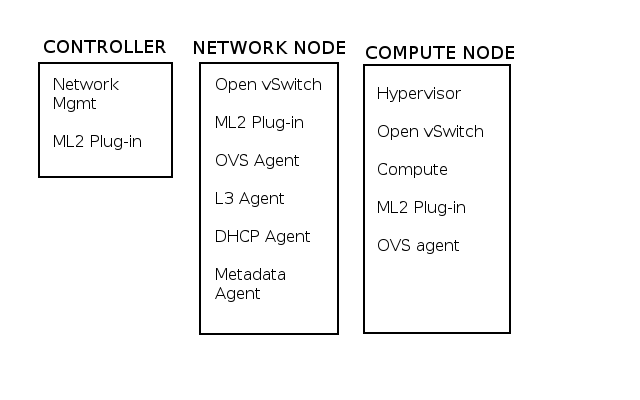
The OpenStack architecture for network-as-a-service Neutron-based clouds is divided into Control, Network, and Compute components. At a very high level, the control tier runs the Application Programming Interfaces (API), compute is the actual hypervisor with various agents, and the network component provides network service control.

All these components use a database and message bus. Examples of databases include MySQL, PostgreSQL, and MariaDB; for message buses, we have RabbitMQ and Qpid. The default plugins are Modular Layer 2 (ML2) and Open vSwitch. 
Openstack Neutron Security Groups

Ports, Networks, and Subnets

Neutrons’ network-as-a-service core and the base for the API are elementary. It consists of Ports, Networks, and Subnets. Ports hold the IP and MAC address and define how a VM connects to the network. They are an abstraction for VM connectivity.

A network is a Layer 2 broadcast domain represented as an external network (reachable from the Internet), provider network (mapped to an existing network), and tenant network, created by cloud users and isolated from other tenant networks. Layer 3 routers connect networks; subnets are the subnet spaces attached to networks. 

OpenStack Neutron: Components

OpenStack networking with Neutron provides an API to create various network objects. This powerful abstraction allows the creation of networks in software and the ability to attach multiple subnets to a single network. The Neutron Network is isolated or connected with Layer 3 routers for inter-network connectivity.

Neutron employs floating IP, best understood as a 1:1 NAT translation. The term “floating” comes from the fact that it can be modified on the fly between instances.

It may seem that floating IPs are assigned to instances, but they are actually assigned to ports. Everything gets assigned to ports—fixed IPs, Security Groups, and MAC addresses. SNAT (source NAT) or DNAT (destination NAT) enables inbound and outbound traffic to and from tenants. DNAT modifies the destination’s IP address in the IP packet header, and SNAT modifies the sender’s IP address in IP packets. 

Open vSwitch and the Linux bridge

Neutrons can be integrated for switching functionality with Open vSwitch and Linux bridge. By default, it integrates with the ML2 plugin and Open vSwitch. Open vSwitch and Linux bridges are virtual switches orchestrating the network infrastructure.

For enhanced networking, the virtual switch can be controlled outside Neutron by third-party network products and SDN controllers via plugins. The Open vSwitch may also be replaced or used in parallel. Recently, many enhancements have been made to classic forwarding with Open vSwitch and Linux Bridge.

We now have numerous high availability options with L3 High Availability & VRRP and Distributed Virtual Routing (DVR) feature. DVR essentially moves to route from the Layer 3 agent to compute nodes. However, it only works with tunnels and L2pop enabled, requiring the compute nodes to have external network connectivity.

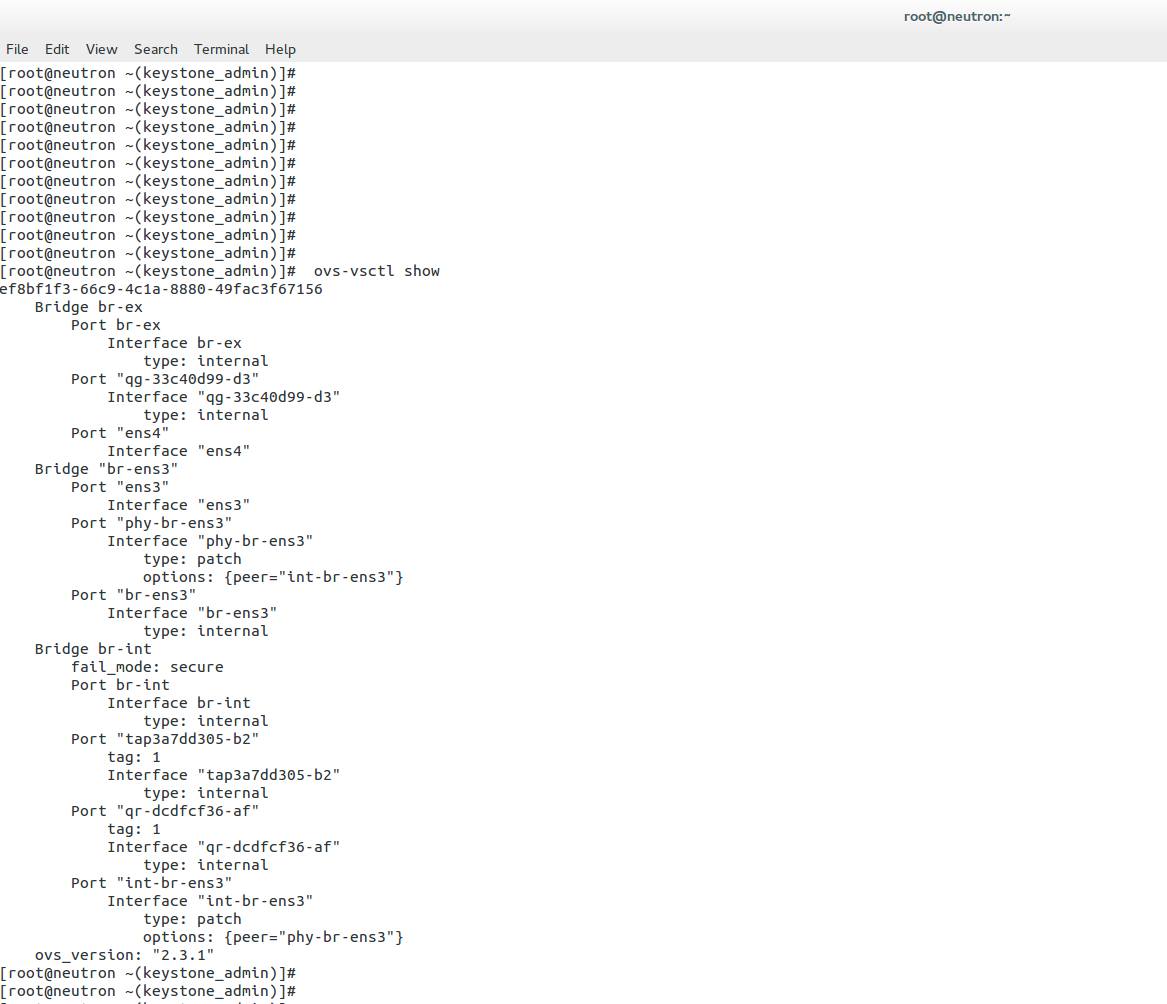
For production environments, these HA features are a welcomed update. The following shows three bridges created in Open vSwitch – br-ex, br-ens3, and br-int. The br-int is the main integration bridge; all others connect via particular patch ports.
Openstack Neutron Security Groups

Network-as-a-service and agents

Neutron has several parts backed by a relationship database. The Neutron server is the API, and the RPC service talks to the agents (L2 agent, L3 agent, DHCP agent, etc.) via the message queue. The Layer 2 agent runs on the compute and communicates with the Neutron server with RPC. Some deployments don’t have an L2 agent, for example, if you are using an SDN controller.

Also, if you deploy the Linux bridge instead of the Open vSwitch, you don’t have the Open vSwitch agent; instead, use the standard Linux Bridge utilities. The Layer 3 agent runs on the Neutron network node and uses Linux namespaces to implement multiple copies of the IP stack. It also runs the metadata agent and supports static routing. 

Linux Namespaces

An integral part of Neutron networking is the Linux namespace for object isolation. Namespaces enable multi-tenancy and allow overlapping IP address assignment for tenants – an essential requirement for many cloud environments. Every network and network service a user creates is a namespace.

For example, the qdhcp namespace represents the DHCP services, qrouter namespace represents the router namespace and the qlbaas represents the load balance service based on HAProxy. The qrouter namespaces provide routing amongst networks – north-south and east-west traffic. It also performs SNAT and DNAT in classic non-DVR scenarios. For certain cases with DVR, the snat namespaces perform SNAT for north-south network traffic.

 OpenStack Neutron Security Groups

OpenStack has the concept of OpenStack Neutron Security Groups. They are a tenant-level firewall enabling Neutron to provide distributed security filtering. Due to the limitations of Open vSwitch and iptables, the Linux bridge controls the security groups. Neutron security groups are not directly added to the Integration bridge. Instead, they are implemented on the Linux bridge that connects to the integrated bridge.

The reliance on the Linux bridge stems from Neutron’s inability to place iptable rules on tap interfaces connected to the Open vSwitch. Once a Security Group has been applied to the Neutron port, the rules are translated into iptable rules, which are then applied to the node hosting the respective instance.

Neutron also can protect instances with perimeter firewalls, known as Firewall-as-a-service.

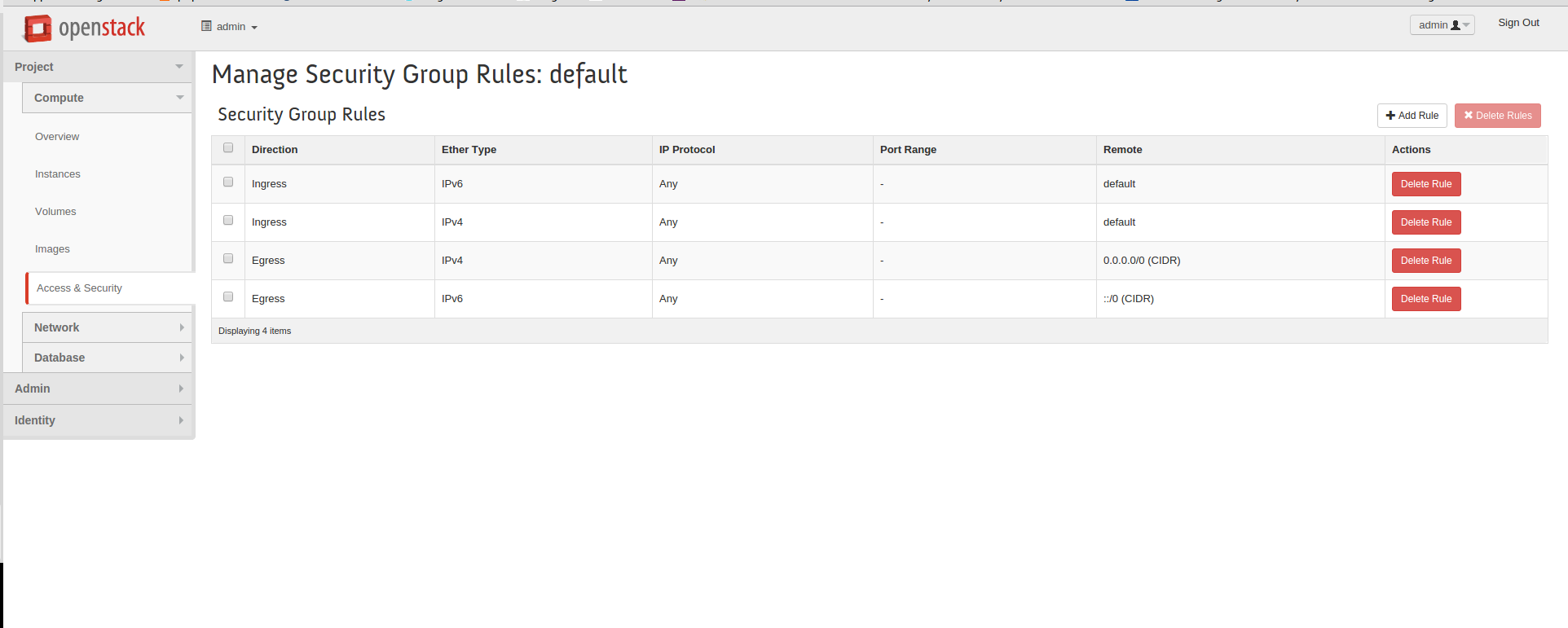
Firewall rules implemented with perimeter firewalls utilizing iptables within a Neutron routers namespace instead of configuring on every compute host. The following diagram displays ingress and egress rules for the default security group. Tenants that don’t have a security group are placed in the default security group.
 

Openstack Neutron Security Groups

Closing Points on OpenStack Neutron Security Groups

In the realm of cloud computing, security is paramount. OpenStack, a popular open-source cloud platform, offers various components to ensure robust security within its environment. One of the core elements of this security architecture is Neutron Security Groups. These act as virtual firewalls, providing a layer of protection for instances by controlling inbound and outbound traffic at the network interface level. But what exactly are Neutron Security Groups, and how do they function?

Neutron Security Groups in OpenStack are designed to enhance the security of your cloud infrastructure. They are essentially sets of IP filter rules that define networking access to the instances. Each instance can be associated with one or more security groups, and each group contains a collection of rules that specify the type of traffic allowed to and from instances.

These rules are based on IP protocols, source, and destination IP ranges, and port numbers. By default, a security group allows all outbound traffic and denies all inbound traffic. Users can then customize the rules to fit their specific security needs, providing a flexible and dynamic security solution.

To effectively use Neutron Security Groups, one must understand how to create and manage them within the OpenStack environment. Creating a security group involves defining a set of rules that determine the traffic allowed to reach the associated instances. This is done through the Horizon dashboard or OpenStack CLI, where users can specify the security protocols and port ranges.

Managing these groups involves regularly updating the rules to adapt to changing security requirements. This might include adding new rules, modifying existing ones, or deleting those that are no longer necessary. Effective management ensures that the cloud environment remains secure while allowing necessary traffic to pass through.

Implementing best practices when using Neutron Security Groups can significantly enhance your cloud’s security posture. First, it’s crucial to follow the principle of least privilege, allowing only the necessary traffic to and from your instances. Regular audits of security group rules help identify and eliminate redundancies or outdated rules that might expose vulnerabilities.

Additionally, documenting each rule’s purpose and the rationale behind it can aid in maintaining a clear security strategy. It’s also advisable to automate security group updates and monitoring using tools and scripts, ensuring real-time responsiveness to potential threats.

OpenStack Neutron · Incident Investigation

Why Can't the Application Reach the Database?

Use the evidence to identify the security-group fault. Think like an engineer: follow the traffic path before changing infrastructure.

INCIDENT · DIAGNOSE
Incident Evidence PRODUCTION ALERT
!
api-01 cannot connect to db-01 The application tier is healthy and can reach the tenant network, but TCP/5432 connections to the database fail.
API Instance api-01 · ACTIVE
Database Instance db-01 · ACTIVE
Network Reachability api-01 → gateway OK
Application Test TCP/5432 → TIMEOUT
Database Port 5432 · LISTENING
Recent Change db security group modified
Traffic Path TRACE READY
◆
api-01 Application
→
⌁
Neutron Network Tenant L2/L3 path
→
◆
db-01 Security Group Port policy
→
▣
db-01 TCP/5432
Choose Your Diagnosis ONE BEST ANSWER
Investigation Result READY
—
Awaiting diagnosis Select the action you would take first.
Evidence points toward a policy problem rather than an instance, routing, or physical-network failure.
Incident Console LIVE TRACE
[00:00] Incident loaded.
[00:00] api-01 → db-01 TCP/5432 timeout detected.
[00:00] Awaiting engineer diagnosis...
Engineering Insight When an instance is healthy, the destination service is listening, and the network path is otherwise reachable, inspect the policy boundary before rebuilding infrastructure.
Conceptual troubleshooting scenario. Exact Neutron enforcement and backend components vary by deployment.
Matt Conran
Latest posts by Matt Conran (see all)

Comments are closed.