
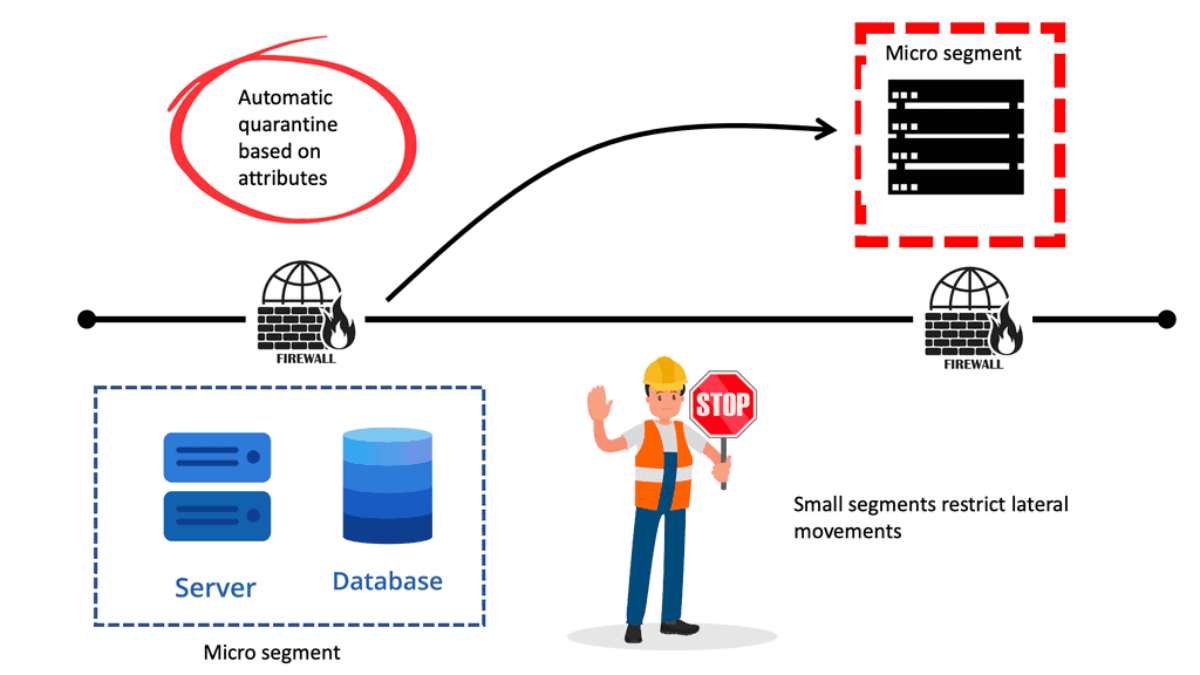
rsz_1dc_secreu_5

Data Center Security

Data Center Security — Engineering Guide

Modern data centers are no longer simple collections of physical servers connected to a small number of network segments.

They host business-critical applications, databases, APIs, virtual machines, containers, distributed platforms, cloud-connected services, and increasingly dynamic workloads.

As application architectures have become more distributed, the security model has had to evolve with them.

Traditional security architectures often relied heavily on perimeter firewalls, VLANs, IP addressing, and manually maintained access-control lists. These mechanisms remain important, but they are no longer sufficient by themselves.

Modern applications generate large amounts of east-west traffic between workloads inside the data center.

A web application may communicate with application services.

Application services may communicate with databases.

Microservices may communicate with dozens of other services.

Containers may appear and disappear dynamically.

Cloud workloads may communicate with on-premises infrastructure.

Management, monitoring, backup, identity, and security systems create additional communication relationships.

The result is a highly interconnected environment in which the traditional concept of a single security perimeter becomes increasingly difficult to apply.

From Network Security to Workload Security

Modern data center security therefore needs to answer a different question.

Instead of asking:

Which network is this server connected to?

we increasingly need to ask:

Which workload is this, what does it need to communicate with, and why?

This is the foundation of application-centric security.

Security policy can be associated with applications, workloads, identities, relationships, and risk rather than being permanently tied to physical network locations.

Cisco Application Centric Infrastructure (ACI) provides one example of this approach.

ACI allows application requirements to become part of the network policy model. Endpoint groups, contracts, filters, micro-segmentation, and Layer 4–Layer 7 service integration can be used to express and enforce communication relationships across the fabric.

Security as a Layered Architecture

Modern data center security should not be treated as a single technology.

It is better understood as a series of complementary layers:

Security architecture

↓

Segmentation

↓

Policy

↓

Enforcement

↓

Deep inspection

↓

Telemetry

↓

Detection

↓

Response

Each layer addresses a different problem.

Physical and infrastructure controls protect the underlying environment.

Segmentation reduces the size of security boundaries.

Policy defines authorised relationships.

Distributed enforcement prevents unauthorised communication.

Firewalls and other Layer 4–Layer 7 services provide deeper inspection.

Telemetry provides visibility into what is actually happening.

Analytics identify abnormal behaviour.

Response mechanisms allow compromised workloads to be contained.

The Data Center Security Engineering Model

This guide develops that model across four sections.

Section 1 — Security Architecture

Examines the different security layers that protect modern data centers, including physical, network, compute, storage, application, cloud, identity, observability, and resilience controls.

Section 2 — Segmentation and Policy

Explores how security requirements become enforceable communication relationships using concepts such as EPGs, ESGs, contracts, filters, and micro-segmentation.

Section 3 — Enforcement and L4–L7 Services

Examines how authorised and unauthorised traffic is enforced within the fabric and how deeper inspection can be integrated through firewalls, IPS, load balancers, service graphs, and policy-based redirect.

Section 4 — Visibility, Detection and Adaptive Defence

Moves beyond preventative controls into telemetry, behavioural analysis, security analytics, incident investigation, risk-based enforcement, containment, and adaptive security.

The Core Principle

The objective is not simply to prevent every possible connection.

The objective is to create an environment where:

Required communication is explicitly permitted, unnecessary communication is restricted, abnormal behaviour is visible, and compromised workloads can be contained before they become a larger incident.

That is the foundation of a modern, policy-driven data center security architecture.


Engineering Guide Structure

1. Security Architecture

Understand the layers that protect the modern data center.

2. Segmentation and Policy

Define which workloads should communicate and under what conditions.

3. Enforcement and L4–L7 Services

Enforce those relationships and introduce deeper inspection where required.

4. Visibility, Detection and Adaptive Defence

Observe the environment, identify abnormal behaviour, investigate incidents, and respond to changing risk.

The Complete Security Loop

Understand → Segment → Enforce → Inspect → Observe → Detect → Respond

Data Center Security Architecture

Engineering Guide · Data Center Security Interactive Contents

From Segmentation to Adaptive Defense

Use the four engineering sections below to move from security foundations and policy design through distributed enforcement, visibility, incident response and adaptive defense.

01
ARCHITECT
Build the security foundation
02
SEGMENT
Define workload relationships
03
ENFORCE
Apply distributed security policy
04
DETECT & RESPOND
Investigate and contain threats
Engineering path: Architect the environment → segment workloads → enforce policy → detect, contain and recover.
SECTION 01 · SECURITY FOUNDATIONS
Engineering Guide
Data Center Security Techniques
Build Security as a Layered Control System

Data center security is not a single firewall, ACL or security product. It is a layered engineering model spanning physical infrastructure, network segmentation, workloads, applications, identity, telemetry and incident response.

01
Protect
Physical infrastructure and critical assets
02
Segment
Reduce unnecessary workload communication
03
Verify
Use identity, context and behaviour
04
Observe
Detect, investigate and respond
What You Will Learn

How modern data center security combines segmentation, least privilege, identity, workload protection, observability and resilience rather than relying on a single perimeter control.

Engineering Focus

The objective is to make every communication path intentional, observable and enforceable — from physical infrastructure through application workloads.

Engineering Question
If a workload is compromised inside the data center, what prevents the attacker from moving laterally to the next application, database or security boundary?

1. Data Center Security Architecture

Data center security is not a single control or appliance.

A modern data center requires multiple security layers working together to protect physical infrastructure, networks, workloads, applications, data, identities, and operational processes.

The objective is to prevent unauthorised access, reduce the attack surface, detect abnormal behaviour, limit lateral movement, and maintain resilience when security controls fail or an incident occurs.

A useful way to approach data center security is to consider the environment as a series of interconnected security domains.

1.1 The Security Layers

A modern data center can include:

  • Physical security

  • Network security

  • Segmentation

  • Compute security

  • Storage security

  • Application security

  • Cloud and hybrid security

  • Identity and access control

  • Observability

  • Threat detection

  • Incident response

  • Resilience and recovery

These layers should not operate independently.

A compromised workload may generate network traffic.

Network telemetry may identify the behaviour.

Identity telemetry may identify the associated user or service.

Endpoint security may provide additional evidence.

Security analytics can correlate the events.

A response system can then contain the workload.

This is the basis of layered defence.

1.2 Physical Security

The physical environment remains the first security boundary.

Controls can include:

  • Controlled facility access

  • Badge authentication

  • Biometrics

  • Surveillance

  • Security personnel

  • Restricted data center areas

  • Rack security

  • Tamper detection

  • Secure cabling

  • Environmental monitoring

Physical security is particularly important because compromise of the physical infrastructure can undermine otherwise strong logical controls.

An attacker who gains direct access to infrastructure may be able to bypass network-based assumptions.

1.3 Network Security

The network provides the communication foundation for the data center.

Traditional controls include:

  • VLAN segmentation

  • VRF isolation

  • ACLs

  • Firewalls

  • Routing policy

  • Network security zones

  • IDS/IPS

  • VPNs

  • Encryption

  • Network telemetry

However, modern applications increasingly require security controls that understand workloads and application relationships rather than only addresses and interfaces.

1.4 East-West Security

Traditional perimeter security focuses heavily on north-south traffic.

Modern data centers also require strong east-west security.

For example:

WEB → APP

APP → DB

APP → CACHE

SERVICE → SERVICE

MONITORING → WORKLOAD

If an attacker compromises one workload, east-west controls determine how easily that attacker can move to other systems.

This makes internal segmentation a fundamental security requirement.

1.5 Compute Security

The compute layer introduces additional security boundaries.

Virtualisation platforms such as:

  • VMware ESXi

  • Microsoft Hyper-V

  • KVM

can provide workload isolation, but the hypervisor itself must also be protected.

Important controls include:

  • Secure boot

  • Host hardening

  • Patch management

  • Hypervisor security

  • VM isolation

  • Privileged-access controls

  • Host monitoring

Containerised environments introduce additional controls.

These can include:

  • Container image security

  • Runtime protection

  • Namespace isolation

  • Kubernetes network policy

  • Workload identity

  • Runtime behaviour monitoring

The objective is to ensure that compromise of one workload does not automatically provide unrestricted access to others.

1.6 Storage Security

Storage frequently contains the most valuable information in the environment.

Security controls can include:

  • Encryption at rest

  • Encryption in transit

  • Access control

  • Storage segmentation

  • Immutable backups

  • Protected snapshots

  • Replication

  • Backup isolation

  • Recovery testing

Ransomware resilience is particularly important.

A backup that is accessible through the same credentials and security boundaries as production systems may be vulnerable to the same compromise.

Security therefore needs to extend into the recovery architecture.

1.7 Application Security

Applications introduce another security layer.

Controls can include:

  • Web Application Firewalls

  • API gateways

  • Application authentication

  • Secret management

  • Secure CI/CD

  • Dependency scanning

  • Code security testing

  • Runtime protection

  • Application logging

Application security and network security should complement one another.

A secure network cannot compensate for an insecure application, and an application security control cannot replace appropriate network segmentation.

1.8 Cloud and Hybrid Security

Modern data centers increasingly operate across:

On-premises infrastructure

  •  

Private cloud

  •  

Public cloud

  •  

Kubernetes

  •  

SaaS

Security policy therefore has to extend beyond the physical data center.

Cloud environments introduce controls such as:

  • VPC/VNet segmentation

  • Security groups

  • Cloud firewalls

  • IAM

  • Workload identity

  • Private connectivity

  • Cloud logging

  • Cloud security posture management

  • Service-to-service policy

The important principle is consistency.

A workload should not become significantly less protected simply because it has moved from an on-premises environment into a cloud environment.

1.9 Zero Trust

Zero Trust changes the assumption that internal network location automatically implies trust.

Instead of:

Internal network = trusted

the model becomes:

Access must be explicitly authorised.

Important principles include:

  • Least privilege

  • Explicit authentication

  • Continuous verification

  • Identity-aware policy

  • Device posture

  • Workload identity

  • Encryption

  • Deny-by-default principles

Zero Trust therefore complements segmentation.

Segmentation limits communication.

Identity determines who or what is requesting access.

Risk determines whether the communication should remain trusted.

1.10 Identity-Driven Security

Identity provides context that IP addresses cannot.

A network address tells us where traffic is coming from.

Identity can tell us:

  • Which user is involved

  • Which workload is involved

  • Which service account is involved

  • Which device is involved

  • Which application is involved

  • What privileges are associated with the request

This enables more contextual security decisions.

For example:

User identity

  •  

Device posture

  •  

Application

  •  

Network location

  •  

Risk

can produce a much stronger security decision than IP address alone.

1.11 Observability

Security requires visibility.

Important telemetry sources include:

  • NetFlow

  • IPFIX

  • Packet capture

  • Firewall logs

  • DNS logs

  • Authentication logs

  • Endpoint telemetry

  • Application logs

  • Cloud logs

  • Kubernetes telemetry

  • Distributed tracing

Tools and platforms can include:

  • SIEM

  • SOAR

  • EDR/XDR

  • Prometheus

  • Grafana

  • OpenTelemetry

The objective is not to collect every possible event.

The objective is to collect enough meaningful evidence to understand:

What happened?

Who or what was involved?

What changed?

What was affected?

What should happen next?

1.12 Incident Response and Resilience

Prevention will never be perfect.

A mature security architecture therefore assumes that incidents will occur and prepares for them.

Important capabilities include:

  • Incident response plans

  • Security runbooks

  • Automated containment

  • Backup and recovery

  • Disaster recovery

  • Tabletop exercises

  • Recovery testing

  • Crisis communication

  • Forensic evidence collection

The architecture should allow security teams to move from:

Detection

to

Investigation

to

Containment

to

Recovery

without requiring the network to be redesigned during the incident.

1.13 Security Analytics

Modern environments generate too many events for manual analysis alone.

Analytics can identify:

  • Unexpected communication

  • Lateral movement

  • Privilege escalation

  • Abnormal traffic

  • Unusual authentication

  • Misconfiguration

  • Excessive permissions

  • Unused policy

  • Shadow workloads

  • Unexpected exposure

The value comes from correlation.

A single unusual connection may be harmless.

The same connection combined with:

  • unusual authentication

  • abnormal process activity

  • unexpected DNS queries

  • increased traffic

may become a high-value security signal.

1.14 Adaptive Security

Modern security architectures increasingly need to respond to changing conditions.

For example:

Normal workload

→ normal policy

Suspicious workload

→ increased monitoring

High-risk workload

→ restricted communication

Compromised workload

→ quarantine

This introduces a feedback loop between security telemetry and enforcement.

1.15 Engineering Model

A useful architecture is:

Physical security

↓

Network security

↓

Segmentation

↓

Workload security

↓

Application security

↓

Identity

↓

Observability

↓

Detection

↓

Response

↓

Recovery

No individual layer is sufficient.

The strength of the architecture comes from how these controls work together.

1.16 Section 1 Engineering Principle

The modern data center should therefore be treated as a distributed security system, not simply a collection of network devices.

The architecture must understand:

  • Where workloads are located

  • What those workloads represent

  • Who or what can access them

  • Which services they require

  • How they communicate

  • What normal behaviour looks like

  • How abnormal behaviour will be detected

  • How compromised workloads will be contained

This provides the foundation for the next stage:

How do we turn these security requirements into enforceable communication policy?

ENGINEERING EXPLORER · DATA CENTER SECURITY
Trace a Workload Through the Security Architecture
Follow a workload from identity and segmentation through policy enforcement, inspection, telemetry and response. Step through the architecture to see where each security decision is made.
Security Control Path
Stage 1 of 8
01
Workload
The application workload generates traffic toward another service.
ACTIVE
02
Identity
Workload identity, role and contextual attributes establish who is communicating.
WAITING
03
Segmentation
The workload is classified into the appropriate security boundary or group.
WAITING
04
Policy
Application relationship, contract, rule or security policy determines whether communication is permitted.
WAITING
05
Inspection
Selected traffic can be redirected through firewall, IDS/IPS, WAF or other security services.
WAITING
06
Telemetry
Flow, packet, endpoint, identity and application signals provide evidence about the communication.
WAITING
07
Detection & Decision
Correlation and analytics determine whether the observed behaviour remains trusted.
WAITING
08
Response
The architecture can allow, monitor, block, isolate or quarantine the workload.
WAITING
Current Security Layer
Workload

The workload is the starting point for the security decision. Modern data-center security begins by understanding what is communicating, rather than relying only on its IP address or VLAN.

Control
Workload classification
Security Question
What is this workload?
Evidence
Workload attributes
Decision
Identify
Architecture Progress 12%
Live Security Readout
Source WEB-01
Destination APP-01
Traffic HTTPS / TCP 443
Trust State Unknown
Action Classify
Security Decision Timeline
Live execution
Workload
Identity
Segmentation
Policy
Inspection
Telemetry
Decision
Response
NORMAL TRAFFIC

WEB-01 is making an expected HTTPS request to APP-01. The security architecture evaluates the communication progressively.

Anomalous east-west behaviour detected. The architecture must now evaluate risk and determine whether the workload should be monitored, blocked or isolated.

Segmentation and Security Policy

SECTION 02 · POLICY & SEGMENTATION
Engineering Guide
Segmentation, Policy and Security Enforcement
Turn Application Relationships into Security Policy

Modern data center security increasingly moves beyond the question of which subnet or VLAN a workload occupies. The engineering problem is to define which workloads should communicate, under which conditions, and what happens when that relationship is not permitted.

01 · CLASSIFY
Identify Workloads
Group endpoints according to application, role, identity and security context.
02 · DEFINE
Define Relationships
Specify the communication paths an application actually requires.
03 · ENFORCE
Apply Policy
Permit, restrict, inspect or isolate traffic according to explicit policy.
What You Will Learn

How EPGs, contracts, filters, security groups, micro-segmentation and cloud security boundaries translate application requirements into enforceable policy.

Engineering Focus

Good segmentation is not about creating as many zones as possible. It is about creating clear security boundaries with explicit communication relationships that can be understood, tested and maintained.

Engineering Question
If WEB, APP and DB workloads belong to different security groups, what explicit policy should allow — or prevent — each communication path between them?

2. Segmentation and Security Policy

Once the security architecture has been established, the next engineering question is:

Which workloads should be allowed to communicate, and why?

Traditional data center security often relied on VLANs, IP subnets, interfaces and ACLs.

These mechanisms remain useful, but modern applications require a more expressive model.

An application may contain multiple workload types, and those workloads may move across the infrastructure.

Security policy therefore needs to follow the application relationship, rather than simply the physical location of a server.

2.1 From Network Segmentation to Policy Segmentation

Traditional segmentation might look like:

VLAN 10 → Web

VLAN 20 → Application

VLAN 30 → Database

This creates useful boundaries, but it does not automatically define which communication is permitted.

A more complete model is:

WEB

↓

Application policy

↓

APP

↓

Application policy

↓

DB

The important question becomes:

What relationship exists between these workloads?

2.2 Designing Segmentation Around Application Relationships

Consider a three-tier application:

Web

↓

Application

↓

Database

The security policy may require:

  • Web can communicate with application services

  • Application can communicate with databases

  • Web cannot directly access databases

  • Management systems can access approved administrative interfaces

  • Monitoring systems can collect telemetry

  • Backup systems can access protected storage

This is much more precise than simply defining three VLANs.

The security architecture is now based on relationships.

2.3 Micro-Segmentation

Large security zones can create excessive trust.

If hundreds of workloads share the same security boundary, compromise of one workload may provide an attacker with many possible lateral-movement paths.

Micro-segmentation reduces these trust relationships.

Instead of:

Production → Production

we can define:

WEB → APP

APP → DB

MONITORING → WORKLOAD

BACKUP → STORAGE

Each relationship can be independently controlled.

2.4 Policy as the Security Contract

A useful way to think about security policy is as a contract between workloads.

The policy states:

This workload is allowed to communicate with that workload using these services.

For example:

APP → DB

Allowed:

TCP/5432

Not automatically allowed:

SSH

RDP

SMB

Other unnecessary services

This produces a least-privilege communication model.

2.5 Cisco ACI and Policy-Based Segmentation

Cisco ACI provides an application-centric policy framework.

Rather than configuring every security rule independently on physical interfaces, administrators can define groups of endpoints and relationships between those groups.

Important constructs include:

  • Endpoint Groups

  • Contracts

  • Filters

  • Endpoint Security Groups

  • Micro-segmentation

  • L3Out policy

  • Layer 4–Layer 7 service integration

These constructs allow policy to be represented in terms of applications and workloads.

2.6 Endpoint Groups

An Endpoint Group, or EPG, provides a mechanism for grouping endpoints that share common policy requirements.

An EPG can represent a logical application tier such as:

WEB-EPG

APP-EPG

DB-EPG

Security policy can then be applied to the relationships between these groups.

This provides a more scalable model than individually managing every endpoint.

2.7 Contracts

Contracts define communication relationships between EPGs.

For example:

WEB-EPG

↓

WEB-TO-APP contract

↓

APP-EPG

The contract can reference filters describing the traffic that is permitted.

This allows the policy to express both:

  • Who may communicate

  • What traffic is allowed

2.8 Filters and Least Privilege

A filter defines traffic characteristics such as protocol and ports.

For example:

TCP/443

or:

TCP/5432

The security model can therefore become:

Group

→ Contract

→ Filter

→ Permitted traffic

This is more meaningful than simply allowing an entire subnet to communicate.

2.9 EPGs, Contracts and the Security Boundary

The relationship between the endpoint group and contract becomes the security boundary.

For example:

WEB-EPG

can communicate with:

APP-EPG

because a contract exists.

However:

WEB-EPG

cannot directly communicate with:

DB-EPG

unless an appropriate policy relationship exists.

This creates an explicit application communication model.

2.10 Endpoint Security Groups

Endpoint Security Groups, or ESGs, provide an additional security-oriented abstraction within ACI.

They allow security classification to be separated from some of the forwarding relationships that historically constrained EPG-based designs.

This can provide greater flexibility when applying security policy across workloads.

The important concept is:

Security classification does not always have to map directly to a traditional network segment.

This becomes increasingly valuable in environments containing dynamic workloads.

2.11 Micro-Segmentation Across Distributed Workloads

Micro-segmentation becomes particularly useful when workloads that appear similar from a network perspective require different security treatment.

For example:

Production APP

and

Development APP

may share infrastructure but should not necessarily share identical security policy.

Similarly:

Windows workloads

and

Linux workloads

may require different treatment during a security incident.

Micro-segmentation provides additional classification mechanisms that can support these requirements.

2.12 L4–L7 Security Service Integration

Segmentation determines whether communication should occur.

Sometimes that is not enough.

A security architecture may also require:

  • Firewall inspection

  • IPS

  • Load balancing

  • Application security

  • Other L4–L7 services

This introduces a second question:

If the traffic is permitted, does it also require deeper inspection?

That distinction becomes the focus of Section 3.

2.13 Cloud Security Perimeters

Segmentation is not limited to the physical data center.

Cloud environments require similar principles.

For example, Google Cloud VPC Service Controls can establish security perimeters around supported cloud resources to help reduce the risk of unauthorised data movement.

The important principle is that cloud security boundaries should complement:

  • IAM

  • Network controls

  • Workload identity

  • Logging

  • Application security

No single cloud perimeter replaces identity or application-level authorisation.

2.14 Cloud Edge Protection

Cloud environments may also require edge protection.

Cloud security services can provide capabilities such as:

  • DDoS protection

  • WAF

  • Security policy

  • Threat detection

  • Edge traffic controls

These controls protect applications before traffic reaches the workload environment.

2.15 Hybrid Security

Hybrid architectures may contain:

Data center

↓

Cloud connectivity

↓

Cloud VPC

↓

Managed services

↓

Internet-facing applications

The security model therefore has to remain consistent across these boundaries.

Security policy should identify:

  • Which workloads communicate

  • Which services are exposed

  • Which identities are trusted

  • Which traffic is permitted

  • Where deeper inspection is required

2.16 Private Service Connectivity

Private connectivity mechanisms such as Private Service Connect can provide private access to supported services without requiring workloads to use public IP paths for that service relationship.

However, private connectivity should not be confused with authorisation.

A private connection answers:

How does the traffic reach the service?

Security policy still needs to answer:

Is this workload authorised to use the service?

Connectivity and authorisation are separate security concerns.

2.17 Traditional ACL-Based Security

Traditional ACLs remain useful.

They are particularly appropriate for:

  • Infrastructure filtering

  • Management-plane protection

  • Simple protocol restrictions

  • Layer 2 controls

  • Specific interface requirements

The problem occurs when ACLs become the only mechanism used to represent complex application security.

At that point, the configuration can become difficult to understand and maintain.

2.18 MAC ACLs

MAC-based filtering can be useful for Layer 2 security requirements.

It can control traffic based on source or destination MAC information.

This is a more granular mechanism than simply trusting an entire VLAN, but it remains a relatively low-level security control.

2.19 VLAN ACLs

VLAN-based access controls can provide filtering for traffic associated with particular VLANs.

They remain useful for specific infrastructure requirements, but they do not provide the same application-centric abstraction as workload groups and contracts.

2.20 Policy as a Layered Enforcement Model

A mature security architecture can therefore combine:

Traditional ACLs

  •  

EPGs

  •  

ESGs

  •  

Contracts

  •  

Filters

  •  

Micro-segmentation

  •  

L4–L7 services

The controls are complementary.

The objective is not to eliminate traditional networking controls.

The objective is to place each control at the appropriate architectural layer.

2.21 Engineering Design Principles

A modern segmentation architecture should follow several principles.

Start with communication requirements

Determine which workloads actually need to communicate.

Apply least privilege

Permit only the protocols and services required.

Minimise security zones

Avoid unnecessarily large trust boundaries.

Make policy application-centric

Express policy in terms of workloads and application relationships where possible.

Separate segmentation from deep inspection

A communication relationship being permitted does not mean that the traffic requires no further inspection.

Design for mobility

Policy should remain meaningful as workloads move.

Build quarantine capability

Compromised workloads should be capable of being isolated.

2.22 The Result: Policy-Driven Segmentation

The traditional security model can be represented as:

Interface → ACL → IP address → Rule

The application-centric model becomes:

Workload → Group → Contract → Filter → Enforcement

This allows the security architecture to follow the workload rather than simply following the physical topology.

The key engineering question becomes:

Who should communicate, what should they communicate with, and which traffic is actually required?

Once that policy has been established, the next challenge is enforcing it and introducing deeper inspection where necessary.

ENGINEERING LAB · MICRO-SEGMENTATION
Build the Security Policy
Select the workload relationship, application context and security controls. The policy engine evaluates the resulting communication and explains why traffic should be allowed, denied, inspected or quarantined.
Policy Builder
Construct communication intent
Source Workload
WEB-01
EPG: WEB
Role: Front-End
→
Destination Workload
APP-01
EPG: APP
Role: Application Tier
APP-WEB-CONTRACT
ACTIVE
Source classification WEB EPG
Application relationship HTTPS
Security context Trusted
Enforcement Permit
Policy Engine Decision
ALLOW
Expected WEB → APP HTTPS communication matches the security policy.
Risk Score 18 / 100
Decision Evidence
Source Group WEB
Destination APP
Application HTTPS
Identity Web Role
Context Trusted
Policy Path

The communication is evaluated against identity, segmentation, application relationship and risk before the final action is applied.

IDENTITY
→
SEGMENT
→
CONTRACT
→
RISK
→
DECISION
Security policy has detected a communication pattern that does not match the expected workload relationship.
Engineering Principle

Micro-segmentation is not simply creating more VLANs. The objective is to express which workloads may communicate, under which conditions, and with which security controls.

Data Center Security with Cisco ACI

SECTION 03 · ENFORCEMENT & INSPECTION
Engineering Guide
Data Center Security with Cisco ACI
From Security Policy to Distributed Enforcement

Once security relationships have been defined, the next engineering challenge is enforcement. Cisco ACI provides a policy-driven fabric model for segmentation and communication control, while dedicated security services can provide deeper inspection where required.

01 · CLASSIFY
Endpoint Groups
Represent workloads according to application and security role.
02 · AUTHORISE
Contracts
Define which communication relationships are permitted.
03 · ENFORCE
Fabric Policy
Apply distributed policy close to the relevant endpoints.
04 · INSPECT
Security Services
Steer selected traffic through firewalls or inspection services.
What You Will Learn

How EPGs, contracts, filters, micro-segmentation, uSeg/µEPG concepts and service graphs can be combined to enforce application-aware security policy.

Engineering Focus

ACI segmentation should not be treated as a replacement for every security appliance. Use the fabric for segmentation and policy enforcement, and dedicated security services when deeper inspection is required.

Engineering Question
Which traffic should be controlled directly by the fabric, and which traffic should be deliberately redirected through a firewall, IDS/IPS or other L4–L7 security service?

3. Data Center Security with Cisco ACI

Cisco ACI provides a policy-driven framework for implementing segmentation and security enforcement across the data center fabric.

Sections 1 and 2 established the architecture and policy model.

This section moves to the next question:

How is that policy actually enforced, and when do we need deeper security inspection?

ACI can enforce communication relationships between groups of endpoints through constructs such as EPGs, ESGs, contracts, and filters.

However, segmentation and policy enforcement should not be confused with complete deep-packet or application security inspection.

A modern architecture can therefore combine:

Workload identity → Segmentation → Contract → Filter → Traffic steering → Security service → Application

3.1 Application-Centric Security

Traditional security often begins with the physical or logical location of a device.

Application-centric security begins with the workload.

Instead of asking:

Which VLAN is this server connected to?

we ask:

What workload is this, what application does it belong to, and what should it communicate with?

ACI allows these application relationships to become part of the infrastructure policy model.

3.2 The ACI Allowlist Model

ACI uses an allowlist-oriented policy model.

Communication between endpoint groups requires appropriate policy.

For example:

WEB → APP

Allowed:

TCP/443

The existence of a policy relationship does not mean that all traffic between the workloads should be permitted.

Filters can restrict the relationship to the services actually required.

This supports least-privilege communication.

3.3 Segmentation Is Not a Next-Generation Firewall

This distinction is important.

ACI provides distributed policy enforcement inside the fabric.

It can determine:

  • Which endpoint groups are communicating

  • Whether a policy relationship exists

  • Which traffic is permitted

  • Which protocols and ports are allowed

However, deeper security functions may require dedicated services.

These can include:

  • Next-generation firewalls

  • IPS

  • Application security

  • Load balancers

  • Other L4–L7 services

Therefore:

ACI segmentation ≠ complete security inspection

Instead:

ACI segmentation + security services = layered enforcement

3.4 Contracts as Enforcement Policy

A contract establishes the policy relationship between endpoint groups.

For example:

APP-EPG

↓

APP-TO-DB

↓

DB-EPG

The contract can reference filters that define the permitted traffic.

This separates:

Relationship

from

Traffic definition

The policy therefore becomes easier to understand and reuse.

3.5 The Challenge with Static ACLs

Traditional ACLs can become increasingly complex as applications grow.

Rules may contain:

  • Source addresses

  • Destination addresses

  • Protocols

  • Ports

  • Interfaces

  • Exceptions

  • Temporary rules

As the environment changes, administrators may add additional rules without removing old ones.

This creates policy accumulation.

Over time, the ACL may still function but become difficult to understand.

A security policy that cannot be easily understood is difficult to audit and maintain.

3.6 Topology-Independent Policy

One of the important advantages of an application-centric policy model is that security relationships are not permanently tied to individual interfaces.

The conceptual model becomes:

Endpoint → Group → Policy → Contract → Filter

rather than:

Interface → ACL → Address → Rule

This allows policy to remain meaningful as workloads move within the fabric.

3.7 Micro-Segmentation

Large security zones can create excessive trust.

If hundreds of workloads share the same broad security boundary, compromise of one workload can provide an attacker with opportunities for lateral movement.

Micro-segmentation reduces these trust relationships.

Instead of:

Production → Production

we can define:

WEB → APP

APP → DB

MONITORING → WORKLOAD

BACKUP → STORAGE

3.8 EPGs and ESGs

EPGs provide a fundamental mechanism for grouping endpoints and applying common policy.

ESGs provide an additional security-oriented abstraction that can offer greater flexibility when classifying workloads for security policy.

The important engineering principle is that security classification does not always need to map directly onto a single traditional network segment.

3.9 Micro-Segmentation with Additional Endpoint Attributes

ACI micro-segmentation capabilities can provide more granular classification of endpoints.

This can be useful when workloads inside the same broader application environment require different security treatment.

For example:

Production APP

and

Development APP

may require different security policies.

Similarly:

Windows workloads

and

Linux workloads

may require different treatment during an incident.

3.10 Example: Workload Quarantine

Imagine an application environment containing both Windows and Linux workloads.

A security team identifies a vulnerability affecting the Windows workload population.

Instead of manually modifying policies for every individual host, the affected workloads can be classified into a more restrictive security policy where the architecture supports the required classification.

The resulting model is:

Normal workload

↓

Normal application policy

After compromise:

Affected workload

↓

Restricted communication

↓

Security / remediation services

This demonstrates an important security principle:

Containment should reduce the blast radius without requiring the entire application architecture to be redesigned.

3.11 L4–L7 Security Services

Segmentation determines whether communication should occur.

Deep inspection determines whether permitted traffic is safe or appropriate according to additional security criteria.

Potential security services include:

  • Firewalls

  • IPS

  • Load balancers

  • Application security platforms

  • Other L4–L7 services

This introduces the next layer of the architecture.

3.12 Cisco Secure Firewall Integration

Cisco security platforms can be integrated into ACI-based architectures where deeper inspection is required.

A dedicated firewall can provide capabilities beyond distributed fabric policy, depending on the platform and deployment.

These may include:

  • Stateful firewalling

  • Intrusion prevention

  • Threat inspection

  • Application-aware security

  • VPN services

  • Security logging

The architectural principle is:

ACI determines which traffic requires additional policy enforcement.

The security service performs the deeper inspection.

3.13 Policy-Based Redirect

Policy-based redirect provides a mechanism for steering selected traffic towards a service node.

Conceptually:

WEB → APP

Normal flow:

WEB → APP

Traffic requiring inspection:

WEB → Firewall → APP

This means that not every communication flow necessarily has to traverse the same security appliance.

Inspection can be applied according to application and security policy.

3.14 ACI L4–L7 Services

ACI can integrate Layer 4–Layer 7 services into the application policy model.

Potential services include:

  • Firewalls

  • IPS

  • Load balancers

  • Application delivery services

  • Other supported security appliances

This allows security functions to become part of the traffic-processing architecture.

3.15 Service Graphs

A service graph represents a logical processing path through integrated services.

For example:

Consumer

↓

Firewall

↓

IPS

↓

Load Balancer

↓

Provider

Each service can perform a different function.

The graph therefore describes the intended service chain rather than simply representing a physical sequence of network devices.

3.16 Selective Traffic Inspection

Not every flow necessarily requires the same level of inspection.

For example:

TrafficSecurity approach
WEB → APPApplication-aware inspection
APP → DBRestricted database traffic
Monitoring → WorkloadPermit required telemetry
Backup → StoragePermit approved backup services
Unknown → ProductionDeny
Quarantined → ApplicationRestrict

Inspection should therefore be based on:

  • Application requirements

  • Security risk

  • Performance

  • Capacity

  • Compliance

  • Operational requirements

3.17 Distributed Enforcement and Centralised Policy

ACI combines:

Centralised policy definition

with:

Distributed enforcement

This allows policy to be centrally managed while enforcement occurs within the fabric.

Dedicated L4–L7 services can then provide deeper inspection where required.

The architecture becomes:

APIC

↓

Policy

↓

ACI Fabric

↓

Distributed enforcement

↓

L4–L7 Security Services

↓

Inspection

This separation makes the overall security architecture easier to reason about.

3.18 Security Enforcement as a Layered Model

A complete enforcement architecture can therefore be represented as:

Endpoint classification

↓

Segmentation

↓

Contract

↓

Filter

↓

Traffic steering

↓

Deep inspection

↓

Telemetry

Each layer answers a different question.

LayerQuestion
EndpointWhat is communicating?
GroupWhat security class does it belong to?
ContractAre these groups allowed to communicate?
FilterWhich traffic is permitted?
RedirectDoes the flow require a service?
InspectionDoes deeper security analysis occur?
TelemetryWhat actually happened?

3.19 Example: Web Application Security

Consider:

WEB → APP → DB

The security policy may be:

WEB → APP

TCP/443 permitted.

APP → DB

Only required database traffic permitted.

WEB → DB

No direct communication.

Management → Workloads

Restricted to approved management systems.

Unknown → Production

Denied.

Selected application traffic can then be steered through appropriate security services.

3.20 Security Enforcement and Lateral Movement

Suppose an attacker compromises a web server.

Without effective segmentation:

WEB

↓

APP

↓

DB

↓

Management

↓

Backup

The attacker may have multiple paths to additional systems.

With application-centric segmentation:

WEB

↓

APP

↓

Policy boundary

↓

DB

Each relationship becomes another security decision.

If the workload is later identified as compromised, its policy can be restricted further.

3.21 Enforcement as Part of a Feedback Loop

Security enforcement should not operate independently of visibility.

A policy may state:

WEB can communicate with APP using TCP/443.

Telemetry may later show:

WEB has started communicating with unexpected destinations.

That behaviour becomes a security signal.

The architecture can then move towards:

Observe → Analyse → Restrict → Investigate

This connects directly with Section 4.

3.22 Engineering Design Principles

A modern enforcement architecture should:

  • Start with application relationships

  • Use least privilege

  • Separate segmentation from deep inspection

  • Use micro-segmentation where required

  • Steer appropriate traffic through security services

  • Avoid unnecessary inspection paths

  • Design for workload mobility

  • Provide quarantine capability

  • Collect telemetry from enforcement points

3.23 The Result: Policy-Driven Enforcement

The traditional model is:

Interface → ACL → Address → Rule

The application-centric model becomes:

Workload → Group → Contract → Filter → Service → Inspection

The network fabric enforces the communication relationship.

Dedicated security services provide deeper inspection.

Telemetry validates what actually occurred.

The result is a layered security architecture in which each technology performs a specific role.

ENGINEERING SIMULATOR · CISCO ACI · L4–L7 SERVICES
Trace Traffic Through a Service Graph
Select the services required by the security architecture, then step the application flow through the ACI fabric. The simulator shows where policy-based redirection inserts inspection services into the forwarding path.
Traffic Service Path
Stage 1 of 7
W
WEB
Source Workload
A
ACI FABRIC
Policy / Fabric
F
FIREWALL
Security Service
I
IDS / IPS
Inspection
L
LOAD BALANCER
L4–L7 Service
A
APP
Destination
Policy-Based Redirect: selected traffic can be classified by policy and redirected through an appropriate service node rather than requiring every traffic flow to traverse the same security appliance.
Service Controls
Click / tap to change
Security Contract
Permit the application relationship
Policy Redirect
Steer matching traffic into services
Firewall
Stateful security inspection
IDS / IPS
Threat detection / prevention
Load Balancer
Application delivery function
Forwarding Decision
FORWARD
WEB traffic is entering the ACI fabric and the selected service chain will determine its next hop.
Live Readout
Source WEB-01
Destination APP-01
Protocol HTTPS / 443
Current Node WEB
Next Function ACI Fabric
Service Chain Timeline
Packet execution
WEB workload generates HTTPS request
ACI policy classifies the traffic
Policy-based redirect selects service path
Firewall inspection
IDS / IPS inspection
Load-balancing function
APP workload receives traffic
Engineering Principle

ACI provides policy-driven traffic classification and can steer selected flows toward integrated L4–L7 services. The fabric's segmentation policy and dedicated inspection functions solve different security problems.

Inspection has been removed from the selected path. The traffic can still be forwarded when policy permits it, but the security architecture has lost a layer of inspection.

Visibility, Detection and Adaptive Defence

SECTION 04 · VISIBILITY & RESPONSE
Engineering Guide
Visibility, Detection, Response and Adaptive Defense
Detect the Anomaly, Decide the Risk, Contain the Threat

Segmentation and enforcement reduce the available attack surface, but security does not end when a policy is deployed. Modern data centers also need continuous visibility, correlated evidence, incident investigation and a controlled path from detection to containment and recovery.

01 · OBSERVE
Collect Evidence
Flow, endpoint, identity, application and security telemetry.
02 · DETECT
Correlate Signals
Identify unusual behaviour and changes from the expected baseline.
03 · RESPOND
Contain Risk
Block, isolate or quarantine affected workloads when justified.
04 · RECOVER
Validate & Restore
Remediate, restore services and verify the security boundary.
What You Will Learn

How flow telemetry, packet visibility, SIEM/SOAR, EDR/XDR, identity context and behavioural analysis can be combined to investigate east-west security events.

Engineering Focus

The objective is not simply to generate more alerts. It is to build a measurable control loop where evidence leads to a decision, the decision drives enforcement, and the result is verified.

Engineering Question
When a normally trusted workload suddenly communicates with an unexpected system, how quickly can the environment detect the change, determine its significance and contain the risk?

4. Visibility, Detection and Adaptive Defence

Sections 1–3 established the security architecture:

Security architecture → segmentation → policy → enforcement → inspection

However, preventative controls alone are not enough.

A policy can define what should happen.

Telemetry tells us what actually happened.

A firewall may permit a connection.

A workload may still behave abnormally.

A correctly segmented server may still become compromised.

Modern data center security therefore requires a continuous feedback loop:

Observe → Analyse → Detect → Investigate → Respond → Validate

4.1 From Security Policy to Security Observability

Consider a simple policy:

WEB → APP

Allowed:

TCP/443

From a policy perspective, the relationship is correct.

But telemetry might reveal:

  • A sudden increase in connections

  • Unexpected traffic volumes

  • Repeated failed connections

  • Communication with previously unused endpoints

  • Unusual connection timing

  • Unexpected external destinations

  • A workload communicating outside its normal application relationship

The policy has not necessarily changed.

The behaviour has changed.

This is why security architecture requires both policy enforcement and continuous observation.

4.2 The Security Telemetry Pipeline

A modern environment can generate telemetry from many layers:

Workload

↓

Network flow

↓

Packet / protocol

↓

Identity

↓

Application

↓

Infrastructure

↓

Security platform

↓

Analytics

No single telemetry source provides the complete picture.

4.3 Network Flow Visibility

Flow telemetry such as NetFlow and IPFIX can provide information about communication patterns including:

  • Source

  • Destination

  • Protocol

  • Ports

  • Volume

  • Packet counts

  • Timing

  • Direction

For example:

APP-01 → DB-01

TCP/5432

Normal

versus:

APP-01 → DB-17

TCP/5432

Unexpected

The second event may become a security investigation even if the network technically permits the traffic.

4.4 Packet-Level Visibility

Flow telemetry tells us that communication occurred.

Packet-level analysis can provide additional information about the communication itself.

Depending on the deployment, packet analysis can help identify:

  • Protocol behaviour

  • Application exchanges

  • Suspicious traffic patterns

  • Malformed packets

  • Unexpected protocols

  • Attack indicators

  • Session behaviour

Packet capture is particularly useful during incident investigation.

4.5 Identity-Aware Security

Network addresses are not sufficient security identities.

An IP address can represent one workload today and another tomorrow.

Modern environments therefore associate network activity with additional context.

Useful information can include:

  • User identity

  • Workload identity

  • Device identity

  • Application identity

  • Namespace

  • Kubernetes service

  • VM identity

  • Cloud resource identity

  • Security group

  • Endpoint classification

This allows security teams to move from:

10.10.20.15 connected to 10.10.30.20

towards:

Production application APP-01 attempted to access database service DB-01.

The second statement provides substantially more useful security context.

4.6 Security Analytics

Telemetry becomes more valuable when it is correlated.

Consider:

Event 1

Authentication succeeded.

Event 2

The user accessed a server.

Event 3

The server established a new outbound connection.

Event 4

The workload contacted an unusual destination.

Event 5

Traffic volume increased dramatically.

Each event might be harmless in isolation.

Together they may describe a potential compromise.

Security analytics attempts to identify these relationships.

The objective is to move from:

Thousands of independent events

to:

A smaller number of meaningful security stories.

4.7 Behavioural Baselines

Security systems need to understand normal behaviour.

An application server may normally:

  • Communicate with three application services

  • Use HTTPS

  • Connect to a known database

  • Generate predictable traffic

  • Operate continuously

  • Use known DNS services

This creates a behavioural baseline.

If the same workload suddenly:

  • Scans hundreds of hosts

  • Attempts SSH connections

  • Contacts an unfamiliar external service

  • Generates significantly more traffic

  • Attempts unexpected database access

the behaviour becomes anomalous.

An anomaly does not automatically mean compromise.

It means:

The workload’s behaviour requires investigation.

4.8 Detecting Lateral Movement

Lateral movement occurs when an attacker attempts to move from an initial compromised workload to additional systems.

A simplified attack path is:

Initial compromise

↓

Credential acquisition

↓

Discovery

↓

Service enumeration

↓

Additional connections

↓

Second workload

Segmentation can reduce these paths.

Telemetry can reveal them.

Analytics can correlate them.

Response mechanisms can attempt to contain them.

The resulting model is:

Prevent → Detect → Contain

4.9 East-West Traffic Analytics

Modern applications generate significant east-west traffic.

Examples include:

WEB → APP

APP → DB

APP → CACHE

SERVICE → SERVICE

MONITORING → WORKLOAD

Security analytics can model these relationships.

Normal:

APP-01 → DB-01

Abnormal:

APP-01 → DB-01

APP-01 → DB-02

APP-01 → DB-03

APP-01 → hundreds of hosts

The final pattern could indicate:

  • Scanning

  • Discovery

  • Malware propagation

  • Misconfiguration

  • Legitimate operational activity

Context determines the conclusion.

4.10 Security Graphs

A useful way to understand modern security is as a graph.

Nodes represent:

  • Users

  • Workloads

  • Applications

  • Databases

  • Services

  • Devices

  • Security systems

Edges represent:

  • Network communication

  • Authentication

  • Application dependencies

  • Policy relationships

  • Administrative access

This model can answer questions such as:

Which systems can this compromised workload reach?

or:

Which applications depend on this database?

or:

Which systems would be affected if this workload were quarantined?

Security therefore becomes a relationship-analysis problem rather than simply a log-analysis problem.

4.11 SIEM Integration

A SIEM can aggregate security events from multiple systems.

Potential sources include:

  • Firewalls

  • IDS/IPS

  • Network infrastructure

  • Servers

  • Identity platforms

  • Cloud platforms

  • Kubernetes

  • Endpoint security

  • Applications

The SIEM can provide:

  • Search

  • Correlation

  • Alerting

  • Investigation

  • Historical analysis

  • Reporting

The SIEM does not replace the underlying security controls.

It provides a central analytical layer.

4.12 SOAR and Automated Response

Detection becomes more valuable when it can trigger an appropriate response.

A response workflow might be:

High-risk alert

↓

Verify evidence

↓

Identify workload

↓

Check identity

↓

Review communications

↓

Apply containment

↓

Notify security team

↓

Record incident

Possible actions include:

  • Isolating a workload

  • Restricting communication

  • Disabling an identity

  • Blocking a destination

  • Increasing inspection

  • Opening an incident

  • Collecting forensic evidence

Automation must be carefully controlled.

A false positive that automatically isolates a critical production system can itself create an operational incident.

4.13 Dynamic Segmentation

Security state can change over time.

A workload that is healthy at 09:00 may become suspicious at 09:15.

The security architecture should therefore be capable of changing its posture.

4.14 Risk-Based Enforcement

A useful model is:

RiskExampleResponse
LowNormal behaviourAllow
MediumUnusual destinationMonitor
HighRepeated scanningRestrict
CriticalConfirmed compromise indicatorsQuarantine

This introduces a more flexible model than simply:

Allow / Deny

Security becomes increasingly risk-aware.

4.15 Identity, Device and Workload Context

Risk decisions become more useful when multiple dimensions are considered.

A security system can evaluate:

Identity

Who is requesting access?

Device

Is the device trusted and compliant?

Workload

Which application is generating the traffic?

Network

Where is the communication occurring?

Behaviour

Is the activity normal?

Threat intelligence

Is the destination or behaviour associated with known threats?

This creates contextual security decisions.

4.16 Continuous Verification

Authentication should not be treated as permanent trust.

An entity may initially be trusted and later become risky.

Security can therefore continuously evaluate:

  • Identity

  • Context

  • Policy

  • Behaviour

  • Device posture

  • Risk

This creates a feedback loop rather than a one-time access decision.

4.17 Threat Intelligence

Threat intelligence can add external context to security analysis.

Examples include intelligence relating to:

  • Malware infrastructure

  • Command-and-control systems

  • Phishing

  • Suspicious domains

  • Known malicious addresses

Threat intelligence becomes more valuable when combined with internal evidence.

For example:

Threat intelligence

  •  

DNS activity

  •  

Network flow

  •  

Endpoint telemetry

  •  

Identity context

can create a much stronger security signal.

4.18 Cloud Security Visibility

Cloud environments introduce additional security telemetry.

Security platforms can provide visibility into:

  • Resources

  • Identities

  • Configuration

  • Network exposure

  • Policy violations

  • Threat findings

  • Vulnerabilities

Hybrid environments are particularly challenging because a workload may communicate across:

Data Center

↓

Cloud VPC

↓

Managed service

↓

Internet-facing API

Network telemetry alone may not provide sufficient context.

Cloud security telemetry therefore needs to become part of the broader security architecture.

4.19 Kubernetes and Container Security

Containerised environments introduce additional security dimensions:

  • Namespace

  • Pod

  • Service

  • Service account

  • Network policy

  • Container image

  • Runtime behaviour

  • Cluster identity

A workload may therefore be represented as:

User

↓

Kubernetes workload

↓

Service

↓

Pod

↓

Container

↓

Network destination

Traditional IP-based monitoring alone can lose important application context because containers are often short-lived and addresses can change.

4.20 Runtime Security

Network controls cannot explain everything happening inside a workload.

Runtime security can provide visibility into:

  • Unexpected processes

  • File access

  • Privilege changes

  • Suspicious system calls

  • Unexpected network connections

  • Container escape indicators

  • Abnormal process behaviour

This complements network telemetry.

The resulting evidence becomes:

Network behaviour

  •  

Identity

  •  

Application behaviour

  •  

Runtime behaviour

4.21 Detection Engineering

Security detection should be engineered rather than simply enabled.

A detection might begin with:

Can we detect a production workload scanning a large number of internal hosts?

The engineering process becomes:

Define expected behaviour

↓

Identify telemetry

↓

Create detection logic

↓

Test against normal traffic

↓

Test against simulated abnormal behaviour

↓

Measure false positives

↓

Tune

↓

Deploy

↓

Monitor

This turns security analytics into an engineering discipline.

4.22 Measuring Security Effectiveness

Security should be measurable.

Useful questions include:

Coverage

Can we see the important workloads?

Policy coverage

Are critical workloads protected by appropriate segmentation?

Detection coverage

Can important attack behaviours be detected?

Response time

How quickly can a security event be investigated?

Containment time

How quickly can a compromised workload be isolated?

False positives

How many alerts require no action?

Recovery

How quickly can the affected service return to normal?

4.23 Incident Investigation Workflow

A repeatable investigation process can be:

1. Identify

Which workload, identity, or device generated the event?

2. Establish baseline

What normally happens?

3. Identify deviation

What changed?

4. Determine scope

What else communicated with the affected workload?

5. Determine impact

What systems or data may be affected?

6. Contain

Can the workload be isolated?

7. Investigate

What evidence explains the event?

8. Remediate

Remove the underlying cause.

9. Validate

Confirm that the environment has returned to an expected state.

10. Improve

Update policy, detection, architecture, or operational processes.

4.24 Example: Compromised Application Server

Consider the application architecture developed throughout this guide:

WEB → APP → DB

APP-01 normally communicates with:

  • WEB services

  • DB services

  • Monitoring

  • Approved infrastructure services

Security analytics detects that APP-01 has started scanning internal hosts.

The investigation identifies:

APP-01 → DB-01

Normal

APP-01 → Monitoring

Normal

APP-01 → Hundreds of internal addresses

Abnormal

The security team correlates:

  • Network flow

  • Endpoint telemetry

  • Authentication activity

  • DNS activity

  • Firewall events

The combined evidence increases the risk score.

The response becomes:

APP-01

↓

High-risk state

↓

Restricted policy

↓

Security investigation

If compromise is confirmed:

APP-01

↓

Quarantine

↓

Remediation

The complete lifecycle is now:

Prevent → Observe → Detect → Investigate → Contain → Recover

4.25 Adaptive Security

The final evolution is adaptive security.

Instead of treating policy as permanently static, the architecture can respond to changing conditions.

Normal

Risk = Low

Standard application policy.

Suspicious

Risk = Medium

Additional monitoring and inspection.

High Risk

Risk = High

Restrict communication.

Compromised

Risk = Critical

Quarantine workload.

This does not mean every decision should be automated.

It means the architecture has mechanisms capable of changing security posture when evidence justifies it.

4.26 The Complete Data Center Security Architecture

The four sections can now be combined.

Layer 1 — Security Architecture

Physical, network, compute, storage, application, cloud and identity controls.

↓

Layer 2 — Segmentation and Policy

EPGs, ESGs, contracts, filters and micro-segmentation.

↓

Layer 3 — Enforcement and Inspection

Distributed enforcement, policy-based redirect, service graphs, firewalls, IPS and other L4–L7 services.

↓

Layer 4 — Visibility and Adaptive Defence

Flow telemetry, packet visibility, identity, analytics, SIEM, detection, response and dynamic containment.

The complete architecture becomes:

Workload

↓

Identity / Classification

↓

Segmentation

↓

Policy

↓

Enforcement

↓

Inspection

↓

Telemetry

↓

Analytics

↓

Risk

↓

Response

↓

Policy adjustment

This is the modern data center security feedback loop.

4.27 Engineering Principles

A mature security architecture should:

  • Know the workload

  • Minimise trust

  • Enforce least privilege

  • Inspect according to risk

  • Observe continuously

  • Correlate context

  • Detect behaviour

  • Prepare containment

  • Automate carefully

  • Measure effectiveness

4.28 Final Engineering Perspective

Modern data center security is no longer a single firewall positioned at the network perimeter.

Applications are distributed.

Workloads move.

Users and services are increasingly identity-driven.

Cloud and on-premises infrastructure coexist.

East-west communication can be as important as north-south traffic.

Security must therefore become an architectural capability rather than a single appliance.

The model developed throughout this guide is:

Understand the workload

↓

Define its security relationships

↓

Segment the environment

↓

Enforce least privilege

↓

Inspect higher-risk traffic

↓

Observe actual behaviour

↓

Detect deviations

↓

Respond to changing risk

↓

Continuously improve policy

The objective is not simply to prevent every possible connection.

It is to create an environment where:

Required communication is explicitly permitted, unnecessary communication is restricted, abnormal behaviour is visible, and compromised workloads can be contained before they become a larger incident.

That is the foundation of a modern, policy-driven data center security architecture.

INCIDENT LAB · LATERAL MOVEMENT · RESPONSE
Investigate a Compromised Workload
Follow a realistic east-west security incident from normal application traffic through anomaly detection, risk escalation, policy enforcement and workload quarantine.
East-West Traffic Investigation
Stage 1 of 8
W
WEB-01
Front-End
Expected Role
A
APP-01
Application Tier
Expected Target
D
DB-01
Database Tier
Restricted Target
Incident Scenario
WEB-01 normally communicates with APP-01 over HTTPS. The investigation begins with an expected application flow.
Current Risk Score
18
LOW · Expected workload behaviour
Investigation Evidence
Source WEB-01
Destination APP-01
Protocol HTTPS / 443
Identity Web Role
Behaviour Expected
Incident Timeline
Detection → Response
T+00:00 Normal WEB → APP traffic
T+00:18 New east-west behaviour observed
T+00:24 WEB → DB connection attempted
T+00:27 Identity / behaviour mismatch detected
T+00:31 Risk score crosses investigation threshold
T+00:34 Security policy blocks lateral movement
T+00:38 Incident response initiated
T+00:42 WEB-01 quarantined
Analyst Investigation

Begin with the baseline. WEB-01 has an expected role and is communicating with APP-01 over HTTPS.
Expected Path
WEB → APP
Observed Path
WEB → APP
Policy State
Normal
Response
Monitor
Security posture: NORMAL — no containment required.
```
☕
Support Network Insight
Help support independent engineering guides, interactive networking tools, and future learning labs.
Support Network Insight ```
identity security

Identity Security

Identity Security

ENGINEERING GUIDE · IDENTITY SECURITY

Identity is no longer simply a login mechanism. It is a continuous security signal used to authenticate users and services, determine what they are allowed to access, evaluate risk, enforce least privilege and trigger a security response when behaviour changes.

Modern applications rarely operate inside a single network boundary. Users access cloud services from unmanaged or managed devices, applications communicate through APIs, workloads call other workloads, administrators operate across multiple platforms, and automated services use identities that may never have a human sitting behind them.

This changes the security problem. A network address can describe where a connection originates, but it does not reliably describe who or what is making the request, whether the device is trusted, whether the session is behaving normally, or whether the requested action is appropriate for that identity.

Identity Is Now a Security Control Plane

Traditional access control often begins with a simple question: Can this user log in?

Modern identity security has to go much further. A successful authentication event does not automatically mean that access should be granted. The security decision may depend on the user's role, authentication strength, device posture, application sensitivity, location, session behaviour, privilege level and current risk.

The resulting model is continuous rather than binary. Identity establishes who is making the request, authentication establishes confidence in that identity, context adds surrounding security information, risk evaluation determines how much trust should be granted, and policy decides what the identity is permitted to do.

Traditional Password
Modern Authentication
Context Identity + Device
Decision Risk + Policy

From Authentication to Continuous Trust

Authentication is the starting point, not the final security decision. A user may successfully authenticate and still represent a high-risk request. A stolen session token may appear valid. A privileged account may suddenly access systems it has never used before. A service identity may begin making API calls at an unusual rate. A healthy device may become non-compliant after authentication.

Identity security therefore combines authentication with context, authorization, behavioural signals and continuous monitoring. This creates the foundation for a Zero Trust approach in which access is evaluated according to the request and its associated evidence rather than being permanently trusted because a user is inside a particular network.

Identity Security Engineering Model
WHO → AUTHENTICATE → CONTEXT → RISK → POLICY → ENFORCE → MONITOR → RESPOND

The Identity Security Problem Has Changed

Attackers increasingly target identities because identities provide legitimate access to legitimate systems. Credential theft, password spraying, phishing, MFA fatigue, session hijacking, stolen OAuth tokens, privilege escalation and malicious application integrations can allow an attacker to operate using credentials that appear valid.

This makes identity security fundamentally different from simply protecting passwords. The security architecture must protect the identity itself, the credentials and authenticators used to establish trust, the sessions created after authentication, the privileges assigned to the identity and the applications and workloads that accept that identity.

01 · Authentication
Prove the Identity

Strong authentication establishes confidence that a user, administrator, service or workload is genuinely the identity presented to the system.

02 · Authorization
Limit the Identity

Authorization determines which resources, applications, APIs and actions the identity is permitted to access. Least privilege keeps that permission as narrow as practical.

03 · Governance
Control the Lifecycle

Identity governance manages how identities are created, changed, reviewed, privileged, disabled and ultimately removed from the environment.

04 · Detection
Detect Identity Abuse

Identity telemetry and behavioural analysis help identify suspicious sessions, privilege escalation, token abuse, unusual access patterns and compromised accounts.

What Identity Security Actually Protects

Identity security applies far beyond human users. Modern environments contain administrators, customers, contractors, applications, APIs, virtual machines, containers, service accounts, cloud workload identities and automated processes.

Each identity can become a pathway into sensitive resources. Protecting the identity therefore means controlling authentication, authorization, privilege, session behaviour and the relationships between identities and the resources they are allowed to use.

In a cloud environment, this may involve IAM roles, service accounts, workload identities, OAuth grants and temporary credentials. In a data center, it may involve Active Directory, LDAP, privileged access management and identity-aware network controls. In an application environment, it may involve JWTs, API authentication, service-to-service identity and policy enforcement at the application layer.

Identity as the New Security Perimeter

The traditional security perimeter was largely defined by network boundaries. Firewalls, VLANs, VPNs and security zones determined where users and systems could connect. These controls remain important, but they are no longer sufficient to establish trust.

A modern identity security architecture treats identity as a primary security control while continuing to use network, endpoint, application and cloud controls as additional enforcement layers.

The result is not the removal of the network perimeter. Instead, security decisions become distributed across identity providers, applications, APIs, endpoints, cloud platforms, network controls and security operations systems.

Engineering Question
If a previously trusted administrator suddenly authenticates from an unfamiliar device, requests privileged access and begins accessing systems outside their normal role, should authentication alone still be enough to allow the request?

The Engineering Approach

The remainder of this guide follows the complete identity security lifecycle: establish strong identity, authenticate it, understand its context, evaluate risk, apply authorization and policy, enforce the decision, monitor activity and respond when trust changes.

The objective is to move from static access control toward an adaptive security model in which identity becomes an active source of security intelligence.

Identity Security Foundations

SECTION 01 · FOUNDATIONS

Identity Security Foundations

Start with the identity itself: authentication, strong authentication, MFA, FIDO2, device posture and service identities. The objective is to understand what an identity actually represents before access decisions are made.
01
IDENTITY who exists?
AUTHENTICATE prove identity
MFA increase assurance
DEVICE assess posture
WORKLOAD service identity
SIGNAL generate evidence
Engineering Question
How do we establish enough confidence that an identity is genuine before allowing it to enter the access-control process?
You Will Learn
Authentication is only the starting point. Identity, device, authentication strength and workload identity all become security signals.
EXPLORE IDENTITY TRUST PIPELINE →
SECTION 01 · IDENTITY SECURITY FOUNDATIONS
Identity Security Foundations

Establishing trustworthy identities, strong authentication, device context and workload identity before making an access decision.

Engineering Principle
Authentication establishes confidence in an identity. Identity security determines what happens with that identity after authentication.

What Identity Security Actually Protects

Identity security begins with establishing confidence in the identities that interact with systems, applications and data. That identity may belong to a human user, administrator, customer, application, API, virtual machine, container or automated service.

The first engineering mistake is to treat authentication as the complete identity security problem. Authentication answers an important question — who or what is making the request? — but it does not determine whether that identity should be trusted with a particular resource or action.

A modern identity architecture therefore combines strong authentication with authorization, device context, behavioural signals, privilege management and continuous monitoring.

01 · HUMAN
User Identity
Employees, administrators, customers and contractors accessing applications and services.
02 · PRIVILEGED
Administrative Identity
Identities with elevated permissions that can modify systems, policy or sensitive data.
03 · APPLICATION
Application Identity
Software components authenticating to APIs, databases and other application services.
04 · SERVICE
Service Identity
Automated processes and background services operating without direct human interaction.
05 · WORKLOAD
Workload Identity
Virtual machines, containers and cloud workloads requiring controlled service-to-service access.
06 · MACHINE
Machine Identity
Devices and infrastructure systems participating in secure application and network operations.

Authentication Is Only the Beginning

Traditional security architectures often treated successful authentication as the point at which trust was established. A user entered a password, completed authentication and was then allowed to operate within a trusted environment.

Modern environments make that model increasingly difficult to defend. A valid identity may be compromised. A session token may have been stolen. A previously trusted device may become non-compliant. A privileged account may suddenly access an unfamiliar application. A service identity may begin making API requests at an abnormal rate.

The authentication event may still be technically valid while the activity itself is suspicious.

Security Shift

The question is no longer simply “Did this identity authenticate?” It becomes “Does this identity still represent an acceptable level of trust for this request?”

Strong Authentication

Strong authentication reduces the probability that an attacker can successfully impersonate an identity.

Passwords remain widely used, but passwords alone provide limited protection against phishing, credential theft, password reuse, password spraying and brute-force attacks.

Modern authentication architectures increasingly combine multiple forms of evidence, including knowledge factors, possession factors, biometric factors, cryptographic authenticators and contextual information about the device and request.

The objective is not simply to make login more complicated. The objective is to increase confidence that the identity presented to the system is genuinely controlled by the legitimate user or service.

Multi-Factor Authentication

Multi-factor authentication adds additional evidence to the authentication process. A password combined with a second factor is significantly stronger than a password alone, but MFA should not be treated as an automatic guarantee of trust.

Attackers increasingly use phishing, adversary-in-the-middle techniques, stolen session tokens and MFA fatigue attacks to manipulate or bypass authentication controls.

This means the security architecture must consider both authentication strength and the circumstances surrounding the authentication.

Authentication
Establish Identity Confidence

Use strong authentication mechanisms to establish confidence that the identity presented to the system is legitimate.

Context
Understand the Request

Consider device posture, application sensitivity, location, session characteristics and other relevant context.

Authorization
Limit What Identity Can Do

Apply least privilege so successful authentication does not automatically result in broad access.

Monitoring
Detect Changes in Trust

Monitor identity activity so unusual behaviour can trigger additional verification or security response.

FIDO2 and WebAuthn

FIDO2 provides a modern foundation for phishing-resistant authentication using public-key cryptography.

WebAuthn allows web applications to use authenticators such as platform credentials, security keys and passkeys. Instead of sending a reusable password to the application, the authentication process uses cryptographic credentials associated with the legitimate authenticator.

This changes the attack surface. A stolen password can potentially be replayed against another system, while properly implemented phishing-resistant authentication is designed to bind the authentication process to the legitimate origin and cryptographic credential.

Device Identity and Posture

Identity cannot always be evaluated independently from the device being used.

A valid administrator accessing a sensitive management application from a managed and healthy corporate device presents a different risk profile from the same identity accessing the application from an unknown or non-compliant device.

Device posture can include operating system version, security patch level, endpoint protection status, device management state, encryption status, secure boot state, browser characteristics and compliance status.

These signals can become part of the access decision. For example, a privileged administrator may be permitted to access a management application only when using a managed device with current security controls.

Service and Workload Identity

Modern applications introduce another major identity challenge: not every request originates from a human.

Applications communicate with APIs. Containers communicate with services. Cloud workloads access databases and storage. Automation systems perform administrative operations. CI/CD pipelines deploy infrastructure.

These processes require identities of their own.

Long-lived static credentials create significant risk because they can be copied, leaked or accidentally exposed. Modern architectures increasingly use short-lived credentials, service accounts and workload identity mechanisms to reduce that exposure.

Workload Identity Questions

For every important service identity, engineers should be able to answer: Who is the workload? What may it access? How long should that permission exist? Where should the identity be accepted? and what should happen if its behaviour changes?

Identity Telemetry

Identity security depends on visibility. Authentication events, MFA challenges, device posture, privilege changes, OAuth grants, API calls, session activity and administrative actions can all provide useful security signals.

These signals become significantly more valuable when correlated with endpoint, network, application and cloud telemetry.

A single failed login may not indicate a serious threat. A sequence of failed logins followed by a successful authentication, a new device registration, privilege escalation and access to sensitive systems creates a very different security picture.

Identity Security as a Foundation for Zero Trust

Zero Trust does not mean that every user is permanently blocked or that traditional network security becomes irrelevant.

It means that trust should not be granted simply because an identity, device or workload happens to exist inside a particular network boundary.

Identity becomes one of the primary signals used to establish trust, while device, application, network and workload controls provide additional enforcement layers.

A Zero Trust identity architecture therefore asks: who is requesting access, how strongly has that identity been authenticated, what device or workload is making the request, what resource is being accessed, what is the current risk and what permissions are actually required?

Engineering Question
A privileged administrator successfully authenticates, but the request comes from an unfamiliar device and is followed by unusual access to sensitive systems. Should authentication alone still be enough to allow the request?

Section 1 Summary

Identity security starts with strong authentication but cannot end there. Human users, administrators, applications, services and workloads all require controlled identities. Device posture and contextual signals can strengthen access decisions, while identity telemetry provides the evidence required to detect changes in trust.

The next engineering step is to determine what an authenticated identity is actually allowed to do. That moves the architecture from authentication into authorization, context, least privilege and adaptive access policy.

IDENTITY TRUST LAB · ADAPTIVE DECISION ENGINE

From Identity Signal to Access Decision

Change identity, authentication, device, context and behaviour signals and watch the policy engine recalculate the access decision in real time.

READY
LAB MODE
Identity
Authentication
Device
Context
Application
Behaviour Risk
Trust Evaluation Pipeline
LAB POLICY MODEL
01
ID
Identity
User
02
AU
Authenticate
MFA Verified
03
DV
Device
Managed
04
CX
Context
Expected
05
RK
Risk
Low
06
PL
Policy
Evaluating
07
→
Decision
Pending
Decision Engine
REAL-TIME
ALLOW
Trust Score 100 / 100
Policy Explanation
Identity is authenticated with strong MFA, the device is healthy, context is expected and current behaviour risk is low.
Identity Standard User
Application Standard
Context Expected
Risk Low
Evaluation Timeline
0 / 7 STAGES
01
Identity asserted
Determine which identity is requesting access.
WAIT
02
Authentication evaluated
Verify the strength and validity of authentication.
WAIT
03
Device posture checked
Evaluate whether the endpoint can be trusted.
WAIT
04
Context assessed
Location and environmental context are evaluated.
WAIT
05
Behaviour risk calculated
Current behaviour is compared against the policy model.
WAIT
06
Policy evaluated
Signals are combined to determine the required access level.
WAIT
07
Access decision returned
The policy engine produces an enforceable result.
WAIT
Engineering Telemetry
WHY IT MATTERS
Engineering Takeaway

Authentication is only the beginning.

A successful login does not automatically create trust. Identity, device, context and behaviour must continue to influence the decision.

LAB POLICY: Strong authentication + healthy device + expected context + low risk normally produces ALLOW.

Authorization, Context and Zero Trust

SECTION 02 · AUTHORIZATION, CONTEXT & ZERO TRUST

Authorization, Context and Zero Trust

Move beyond authentication by evaluating identity, context and risk before deciding what access should actually be permitted.

02
01 IDENTITY
02 AUTHENTICATE
03 CONTEXT
04 RISK
05 POLICY
06 DECISION
Engineering Question

When a valid identity becomes risky, should access remain allowed?

You Will Learn

How RBAC, ABAC, least privilege, conditional access, risk signals and just-in-time privilege turn identity into a Zero Trust decision.

SECTION 02 · AUTHORIZATION, CONTEXT & ZERO TRUST
Authorization, Context and Zero Trust

Turning an authenticated identity into a controlled, context-aware and continuously evaluated access decision.

Engineering Principle
Authentication establishes who the identity is. Authorization determines what that identity is allowed to do, while context and risk determine whether that permission should be granted under the current conditions.

Authentication vs Authorization

Authentication and authorization are related but fundamentally different security functions.

Authentication establishes confidence in an identity. Authorization determines which resources and actions that identity is permitted to access.

A successfully authenticated administrator might be permitted to manage a particular application but not access a production database directly. A developer may be permitted to read source code but not modify production infrastructure. A service identity may be permitted to call one API but not another.

This separation is essential because a valid identity should not automatically receive unrestricted access.

01
IDENTITY
02
AUTHENTICATE
03
CONTEXT
04
RISK
05
POLICY
06
DECISION

Least Privilege

Least privilege is one of the central principles of identity security. An identity should receive only the permissions required to perform its legitimate function.

The objective is not to create an environment where every request requires manual approval. Instead, access should be deliberately scoped so that a compromised identity has as little unnecessary capability as possible.

Least privilege applies to human users, administrators, applications, service accounts and workloads.

RBAC
Role-Based Access Control

Permissions are associated with defined roles and identities receive those roles according to their responsibilities. RBAC provides a practical way to standardise access across groups of users and services.

ABAC
Attribute-Based Access Control

Access decisions can use attributes associated with the identity, resource, device, request or environment. This allows policies to respond to more detailed context than role alone.

JIT
Just-in-Time Privilege

Elevated permissions can be granted for a limited period or specific task instead of remaining permanently assigned to the identity.

CONTEXT
Context-Aware Access

Access can consider device posture, application sensitivity, authentication strength, location, session behaviour and current risk.

Role-Based and Attribute-Based Access

RBAC provides a useful foundation because permissions can be associated with defined responsibilities rather than individual users.

However, roles alone may not provide enough context for modern access decisions.

ABAC extends the decision model by considering attributes such as user role, device state, resource classification, request type, application sensitivity and environmental conditions.

In practice, many mature architectures use a combination of role-based permissions and contextual policy rather than relying exclusively on one model.

Conditional Access

Conditional access introduces context into the authorization decision.

Instead of defining a single permanent rule such as “this user can access this application,” the policy can evaluate the circumstances surrounding each request.

Relevant signals may include authentication strength, device compliance, operating system, application sensitivity, user risk, session characteristics and other security context available to the policy engine.

A low-risk request from a trusted device may proceed normally, while the same identity from a high-risk context may require additional verification or be restricted.

Risk-Based Authentication

Risk-based authentication evaluates evidence surrounding an authentication or access request and adjusts the required security response accordingly.

Risk signals can include unusual login behaviour, unfamiliar devices, impossible or unexpected travel patterns, abnormal authentication frequency, suspicious session characteristics or other indicators of potential compromise.

The important engineering principle is that risk does not have to produce only two outcomes: allow or deny.

ALLOW
Normal context and acceptable risk.
STEP-UP
Require stronger or additional verification.
RESTRICT
Limit sensitive actions or resources.
DENY
Block access when risk exceeds policy.

Step-Up Authentication

Step-up authentication provides a middle ground between unrestricted access and complete denial.

A user may successfully authenticate to a normal application but require stronger verification before accessing a highly sensitive system or performing a privileged operation.

This allows security controls to increase authentication assurance when the sensitivity of the action or the risk of the request changes.

Example

A developer signs in normally and accesses development resources. When the same identity attempts to access production infrastructure, policy can require stronger authentication, verify device posture and apply additional authorization controls before allowing the privileged action.

Just-in-Time Privilege

Permanent administrative privileges increase the impact of compromised identities.

Just-in-time privilege reduces that exposure by providing elevated permissions only when they are required and for as long as they are required.

A typical workflow may involve a user requesting temporary elevation, satisfying an authentication or approval requirement, receiving the required privilege for a defined period and then automatically losing that elevated access when the period ends.

This creates a smaller standing privilege footprint and provides better auditability around sensitive operations.

Continuous Trust Evaluation

Zero Trust requires more than a strong initial authentication event. The security decision should be capable of changing when the evidence changes.

A device can become non-compliant. A user can begin behaving abnormally. A session can access resources outside its normal pattern. A previously safe workload can become compromised.

Continuous evaluation allows those changes to influence subsequent access decisions.

This does not necessarily mean re-authenticating every user for every request. Instead, security systems can use available telemetry and policy signals to determine when additional verification, restriction or denial is appropriate.

Identity as the New Security Perimeter

The traditional network perimeter assumed that location provided useful evidence of trust. A user inside the corporate network was often treated differently from a user outside it.

Cloud services, remote work, SaaS platforms, APIs and distributed applications have weakened that assumption.

Identity therefore becomes a primary security boundary, but it should not be viewed in isolation. Network segmentation, endpoint security, application controls, encryption and cloud security mechanisms continue to provide important enforcement layers.

Zero Trust Principle

Network location can provide context, but it should not be treated as sufficient proof of trust. The security decision should be based on identity, authentication strength, context, resource sensitivity and current risk.

Policy Must Become Enforceable

An identity policy has little value if it exists only as a written rule. The decision must eventually reach an enforcement point.

Depending on the architecture, enforcement may occur at an identity provider, application, API gateway, proxy, cloud platform, network control, endpoint or privileged access system.

This creates an important architectural separation: the system evaluating identity and risk does not necessarily have to be the same system enforcing the final decision.

A policy engine may determine that a request should be restricted, while an application, API gateway or network control performs the actual enforcement.

Engineering Question
If a valid administrator identity requests access to a sensitive production API from a non-compliant device, should the policy engine allow the request simply because authentication succeeded?

Section 2 Summary

Authorization transforms identity into controlled permission. RBAC, ABAC and least privilege establish the baseline, while conditional access, risk-based authentication, step-up authentication and just-in-time privilege add context and adaptability.

Zero Trust extends this model by treating trust as something that must be continually evaluated rather than permanently granted. The next engineering challenge is to apply those identity decisions across real applications, APIs, cloud platforms and infrastructure.

SECTION 02 · ADAPTIVE ACCESS DECISION LAB

Investigate an Identity Access Decision

Inject identity and security events, inspect the evidence they create, then determine whether the correct response is to allow, step-up, restrict or deny access.

MONITORING
SCENARIO RUN
Normal employee access
A standard user is accessing a normal business application from an expected location using a managed device.
EVENT 01 / 06
Identity Event Injection
SELECT AN EVENT
Policy Decision
CAUSE → EVIDENCE → ACTION
ALLOW
Current identity state is within the normal policy boundary.
Why did the policy engine decide this?
Authentication is valid and the current identity, device and context signals are consistent with normal access.
Choose the security response
Evidence Signals
CURRENT IDENTITY CONTEXT
Identity
Standard User
VALID
Auth
MFA Verified
STRONG
Device
Managed / Healthy
TRUSTED
Context
Expected Location
NORMAL
Behaviour
Normal Activity
LOW RISK
Privilege
Standard Access
NORMAL
Investigation Console
1 EVENT
00:01
Identity session established from expected context.
INFO
Engineering Telemetry
DECISION GUIDANCE
Investigation Result

Normal access should remain low-friction.

Adaptive access should not challenge every request. The objective is to increase control when evidence indicates that trust has changed.

92
Illustrative
trust index

Identity Threat Detection & Response

SECTION 03 · IDENTITY ENFORCEMENT

Identity Enforcement Across Applications & Cloud

Turn identity and risk decisions into enforceable controls across applications, APIs, cloud platforms and infrastructure.

03
01 IDENTITY
02 TOKEN
03 POLICY
04 ENFORCE
05 APPLICATION
06 AUDIT
Engineering Question

Where does the identity decision actually become an enforceable security control?

You Will Learn

How tokens, APIs, identity-aware proxies, cloud IAM, service perimeters and network controls turn identity decisions into enforcement.

SECTION 03 · IDENTITY ENFORCEMENT
Identity Enforcement Across Applications & Cloud

Turning identity and risk decisions into enforceable controls across applications, APIs, cloud platforms and infrastructure.

Engineering Principle
An identity decision has little security value until it reaches an enforcement point capable of allowing, restricting or denying the requested action.

From Identity Decision to Enforcement

Section 2 established how identity, context and risk can be used to make an authorization decision. Section 3 moves that decision into the systems that actually control access.

Modern identity enforcement is distributed. An identity provider may authenticate the user, a policy engine may evaluate risk, an API gateway may enforce authorization, an application may enforce business permissions and a cloud platform may control access to infrastructure resources.

These components do not have to be implemented by the same product. The engineering objective is to make sure that the identity context and security decision can travel reliably to the point where access is actually enforced.

01
IDENTITY
02
AUTHENTICATE
03
TOKEN / CONTEXT
04
POLICY
05
ENFORCE
06
AUDIT

Identity-Aware Applications

Applications increasingly participate directly in identity enforcement. Instead of relying entirely on network location, applications can receive identity information and use it when making authorization decisions.

A web application may authenticate through an external identity provider and then receive a signed identity token containing claims associated with the authenticated identity.

The application can then evaluate those claims against its own authorization policy.

This creates an important separation between authentication and application authorization. The identity provider can establish who the user is, while the application determines what that user can actually do within the application.

JWT and API Authentication

JSON Web Tokens are commonly used to carry signed claims between identity systems, applications and APIs.

A typical API request may contain an access token in an Authorization header. The receiving service validates the token according to its configured trust model, including signature, issuer, audience and expiration requirements where applicable.

Successful token validation establishes that the request contains an acceptable credential. It does not automatically mean that the identity has permission to perform every operation exposed by the API.

401
Authentication is missing or cannot be accepted.
403
Identity is known but is not authorized for the action.
ALLOW
Authentication and authorization requirements are satisfied.
STEP-UP
Additional verification or security context is required.

Identity-Based Application Authorization

Application authorization should be designed around the actions that an identity needs to perform rather than simply around the existence of the identity.

For example, a user may be permitted to view an account but not modify it. An administrator may be permitted to restart a service but not retrieve stored secrets. A service identity may be permitted to read a database record but not execute administrative operations.

This provides a second layer of control after authentication and prevents a valid identity from becoming a universal application credential.

Identity-Aware Proxy

An identity-aware proxy can place authentication and contextual access controls in front of applications without requiring every application to independently implement the complete authentication experience.

Google Cloud Identity-Aware Proxy is an example of this model. It can use authenticated identity and contextual information to control access to supported applications and services.

This can be particularly useful when applications are exposed across cloud or hybrid environments and network location alone is not a sufficient access boundary.

Important Distinction

An identity-aware proxy does not eliminate application authorization. The proxy can control whether a request reaches the application, while the application still needs to enforce permissions for actions and resources inside the application.

Google Cloud IAM

Google Cloud IAM provides authorization controls for Google Cloud resources through identities, roles and permissions.

IAM supports predefined roles as well as custom roles, allowing organizations to align permissions with operational responsibilities.

The engineering challenge is to avoid treating IAM roles as a substitute for every other security control. IAM governs access to supported cloud resources, while applications, APIs, endpoints and network controls may require their own authorization and enforcement mechanisms.

Audit logging is also important because an authorization model needs evidence showing which identities performed sensitive operations and when those operations occurred.

VPC Service Controls

VPC Service Controls provide a different security function from Google Cloud IAM.

Service perimeters can help reduce the risk of data exfiltration from supported Google Cloud services by establishing boundaries around protected resources and controlling access paths across those boundaries.

This is particularly relevant when valid credentials have been compromised. IAM may determine that an identity has permission to perform an operation, while a service perimeter can provide an additional boundary around where protected service data may be accessed.

VPC Service Controls should therefore be understood as a complementary control rather than a replacement for IAM, application authorization or network firewalling.

Vault and Secrets-Based Identity

Secrets management becomes another part of identity security when applications and infrastructure require credentials to access protected services.

HashiCorp Vault provides authentication methods, policy-based authorization and secret-management capabilities that can be used to control how applications and users obtain access to sensitive credentials.

A strong design avoids embedding long-lived secrets directly into application source code or configuration wherever practical. Instead, applications authenticate to the secrets platform and receive only the credentials or secrets required for their permitted operation.

Cisco ISE and Identity-Based Network Enforcement

Identity security can also influence network access decisions. Cisco Identity Services Engine provides identity-based access control capabilities that can incorporate authentication, authorization, device profiling and other contextual information.

This allows network access policy to be associated with identity and device context rather than relying solely on an IP address or switch port.

For example, a corporate device belonging to an authorized user may receive a different access policy from an unknown device even when both devices connect through the same physical network.

Identity-Driven Traffic Decisions

Identity-aware security can extend beyond simple allow or deny decisions.

An identity can influence which application endpoint receives a request, which API functions are exposed, which network segment is accessible or which security controls are applied.

A useful example is an application that receives a validated identity containing a role claim. The application can route an administrator to privileged functionality while routing a standard user to a restricted service.

The important distinction is that the decision is based on authenticated identity and authorization context rather than simply on source IP address, VLAN or physical network location.

APPLICATION
Application Policy

Controls actions, resources and business functions available to an authenticated identity.

API
API Authorization

Validates credentials and applies permissions to individual APIs, operations and protected resources.

CLOUD
Cloud Authorization

Controls access to cloud resources through identity, roles, permissions and additional security boundaries.

NETWORK
Network Enforcement

Applies identity and device context to network access where supported by the architecture and enforcement platform.

Authentication, Authorization and Enforcement Are Different Layers

One of the most important engineering principles is to avoid treating authentication, authorization and enforcement as the same function.

Authentication answers: Who are you?

Authorization answers: What are you allowed to do?

Enforcement answers: Where and how is that decision applied?

A mature architecture can therefore use an identity provider for authentication, a policy engine for authorization decisions and multiple enforcement points across applications, APIs, cloud platforms and network infrastructure.

Engineering Question
A user presents a valid identity token to an API. The token is authentic, but the user does not have permission to perform the requested administrative operation. Where should that decision be enforced, and what should the API return?

Section 3 Summary

Identity security becomes operational when identity and policy decisions reach real enforcement points. Applications can enforce permissions, APIs can validate identity tokens, cloud IAM can control resource access, service perimeters can provide additional data protection boundaries, secrets platforms can control access to credentials and network platforms can incorporate identity and device context into access policy.

The architecture is therefore distributed. No single identity system has to perform every security function. The important requirement is that authentication, authorization, context and enforcement remain aligned.

The final section moves from enforcement to the question that becomes critical when prevention fails: How do we detect that an identity has been compromised, investigate what it has done and respond before the compromise spreads?

SECTION 03 · IDENTITY ENFORCEMENT LAB

Identity-Aware Application Lab

Follow an authenticated identity from the identity provider through token validation, policy evaluation and application enforcement. The objective is to understand exactly where authentication ends and authorization begins.
READY · AWAITING REQUEST
Current Request
Valid User Token
A normal authenticated user requests a protected API resource.
Engineering Principle
Identity decisions must reach an enforcement point.
Authentication proves identity. Authorization determines permission. The application or policy enforcement point must enforce the result.
Identity Enforcement Path
STAGE 01 / 06
C
CLIENT
request
→
ID
IDENTITY
PROVIDER
identity
→
TK
TOKEN
claims
→
P
POLICY
ENGINE
decision
→
API
API
enforcement
→
DB
BACKEND
resource
Live Request Context
Identity
alex.user
Application
payments-api
Resource
/v1/payments
Method
GET
Policy Decision
LIVE
Current Result
ALLOW
Identity authenticated and required role is present.
HTTP 200 · ALLOWED
Token Claims
INSPECT
SUB
alex.user
ROLE
payments-reader
ISS
identity.example
STATE
VALID
Evidence
SIGNALS
Identity
VERIFIED
Signature
VALID
Role
PRESENT
Risk
NORMAL
Request Scenarios
SELECT A CASE
Enforcement Event Console
LIVE TRACE
Engineering Telemetry
RUNTIME
Stage
01 / 06
AuthN
VERIFIED
AuthZ
ALLOW
Enforcement
API
Response
200

Identity Threat Detection & Response

SECTION 04 · IDENTITY THREAT DETECTION & RESPONSE

Identity Threat Detection & Response

Detect compromised identities, correlate behavioural evidence and respond before stolen access becomes privilege escalation, lateral movement or persistent compromise.

04
01 OBSERVE
02 CORRELATE
03 INVESTIGATE
04 CONTAIN
05 REVOKE
06 RECOVER
Engineering Question

What evidence is strong enough to treat an identity as compromised?

You Will Learn

How identity telemetry, behavioural analysis, token activity and lateral-movement evidence drive investigation and response.

SECTION 04 · IDENTITY THREAT DETECTION & RESPONSE
Identity Threat Detection & Response

Detecting compromised identities, correlating behaviour and responding before stolen access becomes lateral movement, privilege escalation or persistent compromise.

Engineering Principle
Identity security cannot depend entirely on prevention. Assume that credentials, sessions or tokens can eventually be compromised, then design the architecture to detect abnormal identity behaviour and respond quickly.

Identity Security Does Not End at Authentication

Strong authentication reduces the probability of unauthorized access, but it cannot guarantee that an identity will never be compromised.

Credentials can be stolen. Sessions can be hijacked. Access tokens can be exposed. Users can approve malicious requests. Privileged identities can be abused by legitimate users or attackers operating through compromised systems.

This changes the engineering objective. Identity security must detect not only failed authentication but also suspicious behaviour occurring after authentication succeeds.

01
OBSERVE
02
CORRELATE
03
ASSESS RISK
04
INVESTIGATE
05
CONTAIN
06
REVOKE
07
RECOVER
08
VERIFY

Identity Threats

Modern identity attacks extend far beyond password guessing. Attackers increasingly target the authentication process, tokens, sessions, authorization relationships and trusted integrations.

CREDENTIAL
Credential Theft

Stolen usernames, passwords or credentials can allow attackers to authenticate as legitimate users.

AUTHENTICATION
MFA Fatigue

Repeated authentication prompts can be abused to pressure a user into approving an unexpected request.

TOKEN
Token Theft

A stolen access token or session credential can potentially allow access without repeating the original login process.

PRIVILEGE
Privilege Escalation

Attackers may attempt to obtain additional permissions after compromising an initial identity.

OAUTH
Malicious Integrations

Excessive or malicious application permissions can create an alternative route into protected data and services.

SESSION
Session Abuse

A compromised session may behave differently from the normal activity associated with the legitimate identity.

Identity Behaviour Analytics

Detecting identity compromise requires more than counting failed logins. Security teams need to understand what identities normally do and identify meaningful deviations from that behaviour.

Useful signals can include authentication patterns, device changes, resource access, privileged operations, application usage, token activity, API calls and unusual geographic or environmental context.

A single unusual event may not indicate compromise. Several related signals occurring together can provide much stronger evidence.

Identity Telemetry

Identity security therefore depends on collecting telemetry from multiple layers of the environment.

AUTHENTICATION
Login and MFA Events

Successful and failed authentication, MFA challenges, authentication method and session establishment.

DEVICE
Device and Posture

Device identity, compliance state, operating system and other available endpoint security context.

APPLICATION
Application Activity

Resource access, administrative actions, sensitive operations and application-level authorization events.

API
API and Token Activity

API calls, token use, authorization failures and unusual access patterns across protected services.

CLOUD
Cloud Audit Events

Administrative changes, resource access and identity activity recorded by cloud platforms.

NETWORK
Network Context

Connection patterns, destination changes and network activity that can provide additional evidence during investigation.

Detecting a Compromised Identity

Consider an administrator identity that normally authenticates during business hours from a managed workstation and accesses a small set of infrastructure systems.

The identity suddenly authenticates from an unfamiliar device, generates repeated MFA activity, accesses a new cloud application, attempts a privileged operation and then begins accessing systems that are outside its normal administrative scope.

No single event necessarily proves compromise. Together, however, the signals form a much stronger risk pattern.

Investigation Principle

Security analytics should correlate identity, device, application, cloud and network evidence rather than treating every security event as an isolated alert.

Identity-Based Lateral Movement

Once an attacker obtains a valid identity, the next objective may be to use legitimate access to reach additional systems.

This is why identity security and network segmentation should work together. Identity policy can restrict what the user or service is authorized to access, while network and workload controls can reduce the available paths between systems.

A compromised developer identity should not automatically provide unrestricted access to production systems. Likewise, a compromised service identity should not automatically be able to communicate with every workload in the environment.

Privileged Identity Monitoring

Privileged identities require particular attention because the consequences of compromise can be significantly greater.

Monitoring should focus on privileged authentication, elevation events, administrative changes, sensitive resource access and unusual behaviour associated with administrative sessions.

Just-in-time access, strong authentication, session monitoring and detailed audit trails can reduce both the likelihood and impact of privileged identity abuse.

Identity Threat Detection and Response

Identity Threat Detection and Response, often abbreviated as ITDR, describes the security practices and technologies used to identify and respond to threats involving identities and identity systems.

ITDR should not be treated as a replacement for SIEM, SOAR, EDR or network security. Instead, it complements those capabilities by providing identity-specific evidence and response actions.

A mature architecture can correlate identity events with endpoint, application, cloud and network telemetry to build a broader view of an incident.

SIEM, SOAR and XDR Integration

Identity telemetry can feed security operations platforms where it can be correlated with other security events.

A SIEM can centralize and correlate security logs. SOAR can orchestrate defined response workflows. XDR platforms can combine signals from multiple security domains.

The important architectural principle is correlation. An unusual identity event becomes more valuable when it can be associated with a suspicious endpoint event, an abnormal API request or unexpected access to a sensitive resource.

Responding to Identity Compromise

Response should be proportional to the evidence and the potential impact of the activity.

MONITOR
Continue observation when evidence is weak or ambiguous.
RE-AUTHENTICATE
Require stronger identity verification.
REVOKE TOKEN
Invalidate exposed or suspicious session credentials.
DISABLE IDENTITY
Prevent further authentication when compromise is sufficiently established.
ISOLATE
Restrict affected endpoints or workloads to contain impact.

Automated Response

Some identity responses can be automated when the evidence and response conditions are well understood.

Examples include revoking a session, requiring re-authentication, removing temporary privilege, disabling an account or triggering endpoint isolation.

Automation should be carefully designed because an incorrect security decision can disrupt legitimate users or critical services.

High-impact actions should therefore have clear conditions, appropriate confidence thresholds, auditability and recovery procedures.

Recovering a Compromised Identity

Containment is not the end of an identity incident. Recovery must establish confidence that the attacker no longer has usable access.

Recovery may include credential reset, token and session revocation, removal of unauthorized applications or permissions, review of privileged access, endpoint remediation and investigation of resources accessed during the compromise.

The organization should also determine how the compromise occurred and whether the same weakness exists elsewhere.

Identity Security and Resilience

Identity security should ultimately be part of the organization's resilience strategy.

Critical identities, authentication systems, privileged access paths and recovery mechanisms must remain available during an incident.

Backup authentication mechanisms, emergency access procedures, recovery accounts and documented incident workflows should therefore be tested rather than simply documented.

Putting the Identity Security Model Together

The four sections of this guide form a continuous engineering model.

First, the organization establishes trustworthy identities and strong authentication. Next, authorization and context determine what those identities should be allowed to access. Enforcement points apply those decisions across applications, APIs, cloud and infrastructure.

Finally, telemetry and behavioural analysis determine whether the identity continues to behave consistently with the expected security model.

Identity Security Engineering Model
IDENTIFY → AUTHENTICATE → CONTEXTUALISE → ASSESS RISK → AUTHORISE → ENFORCE → MONITOR → RESPOND
Final Engineering Question
If an identity was trusted yesterday but its behaviour changes today, should the security system continue trusting the identity simply because the original authentication was valid?

Section 4 Summary

Identity security must assume that prevention can eventually fail. Compromised credentials, tokens and sessions require continuous monitoring, behavioural analysis and coordinated response.

The strongest architecture connects identity telemetry with endpoint, application, cloud and network evidence. This allows security teams to detect abnormal behaviour, investigate the identity's activity, contain the compromise and restore trust.

The result is a security model in which identity is not simply a login mechanism. It becomes a continuously evaluated control signal that influences access, enforcement, detection and response.

SECTION 04 · IDENTITY INCIDENT LAB

Compromised Identity Investigation

Investigate a suspicious identity by correlating authentication, device, privilege, token, application and lateral-movement evidence. Build the incident picture before selecting the containment response.
INVESTIGATION OPEN · EVIDENCE COLLECTION
Incident
Suspicious administrative identity
Identity admin.ops normally operates from a known corporate environment. A sequence of unusual authentication, privilege and application events has been detected.
Current Risk
ELEVATED
2 correlated indicators
Investigation Timeline
01 / 06
01
Unusual Login
Administrative identity authenticates from an unfamiliar location and device.
PENDING
02
MFA Anomaly
Multiple authentication challenges are generated in a short period.
PENDING
03
Privilege Escalation
The identity requests or receives access beyond its normal operating pattern.
PENDING
04
OAuth / Token Activity
An unfamiliar application or token begins using the identity.
PENDING
05
Unexpected Application Access
The identity reaches applications outside its normal behavioural profile.
PENDING
06
Lateral Movement
Identity activity begins touching additional systems or privileged resources.
PENDING
Evidence Inspector
SELECTED EVENT
Identity
admin.ops
Source
unfamiliar-device
Signal
anomalous authentication
Severity
HIGH
Correlation
identity + device
Investigation Score
LAB SIGNAL
Compromise Confidence
58
Illustrative investigation score — not a production risk formula
Identity Investigation Console
CORRELATED EVENTS
Select Response
CONTAINMENT DECISION
INVESTIGATION COMPLETE
Response validated.
```
☕
Support Network Insight
Help support independent engineering guides, interactive networking tools, and future learning labs.
Support Network Insight ```