

Intent Based Networking
Modern networks are becoming increasingly distributed, dynamic, and software-driven. Applications can span data centres, cloud platforms, branch locations, wireless infrastructure, and multiple security domains. Managing this complexity through individual device configurations and manual operational processes becomes increasingly difficult as the environment grows.
Intent-Based Networking (IBN) is an architectural approach that allows network operators to express desired outcomes or policies at a higher level of abstraction, while the network management and automation systems determine how those requirements should be implemented across the infrastructure.
The important distinction is between intent and configuration. Traditional network management often focuses on the commands required to configure individual devices. IBN focuses first on what the organisation wants the network to achieve and then uses policy, automation, telemetry, and validation to maintain that desired state.
Defining Network Intent
The foundation of IBN is declarative policy. Instead of manually specifying every configuration command, an operator defines an intended outcome.
For example, an organisation might specify that a particular application must be reachable only from authorised users, that certain workloads must remain isolated, or that critical traffic requires a particular quality-of-service policy.
The IBN system can then translate that higher-level requirement into the policies and configurations required across the relevant network components.
Intent Translation and Automation
Intent cannot simply be sent directly to every network device. The platform must interpret the policy, understand the capabilities and topology of the infrastructure, and determine the appropriate implementation.
Automation systems can then provision or modify network configurations across switches, routers, wireless infrastructure, security platforms, and other supported systems.
This abstraction can reduce repetitive manual configuration and improve consistency across large environments.
Telemetry and Network Awareness
IBN depends heavily on accurate network telemetry. The system needs visibility into topology, device state, configuration state, application behaviour, performance, and policy compliance.
Telemetry can include interface statistics, routing information, device health, flow data, application performance indicators, logs, events, and other operational signals.
This information provides the feedback required to determine whether the network is actually behaving as intended.
Closed-Loop Assurance
One of the defining characteristics of an IBN architecture is the feedback loop.
A simplified model is:
Define Intent → Translate Policy → Automate Configuration → Observe Network → Validate Outcome → Remediate
After a policy is implemented, telemetry is used to determine whether the resulting network state matches the intended outcome.
If the network deviates from policy, the system can identify the discrepancy and, where appropriate, initiate corrective automation.
This is more significant than simple configuration automation. Automation executes a defined task; IBN combines automation with policy and continuous assurance.
Network Security and Segmentation
IBN can also support security policies by expressing requirements such as segmentation, access restrictions, application isolation, or communication controls at a higher level.
The resulting policy can then be applied consistently across the infrastructure rather than relying on engineers to manually reproduce equivalent configurations on individual devices.
However, IBN does not replace security architecture. Identity controls, authentication, endpoint security, firewalls, segmentation, vulnerability management, and security monitoring remain important components of the overall design.
Operational Efficiency
One of the main benefits of intent-based approaches is reducing the amount of repetitive configuration work required from network engineers.
Standardised policies can be applied across large environments while automation reduces configuration drift and the risk of inconsistent manual changes.
Engineers can therefore spend more time defining policy, analysing network behaviour, designing architecture, and investigating exceptions rather than repeatedly entering low-level commands.
AI and Machine Learning
AI and machine learning can contribute to IBN by analysing large volumes of telemetry, identifying anomalies, correlating events, predicting capacity requirements, and assisting with operational decisions.
However, AI is not synonymous with IBN. A network can implement intent-based policy and closed-loop automation without using advanced machine learning.
The critical architecture remains the relationship between policy, automation, telemetry, validation, and remediation. AI can enhance these capabilities rather than defining IBN by itself.
Policy Compliance and Configuration Drift
Large networks can gradually diverge from their intended state as engineers make changes, devices are replaced, applications move, or emergency modifications are introduced.
IBN platforms can continuously compare observed network state with the desired policy state. This helps identify configuration drift and provides a mechanism for returning infrastructure to an approved operational state where appropriate.
Challenges and Design Considerations
IBN introduces its own engineering challenges. Intent must be expressed precisely enough to be translated into enforceable policy, while the automation platform must understand the capabilities and limitations of the underlying infrastructure.
Legacy devices, multi-vendor environments, incomplete telemetry, inaccurate inventories, and poorly defined policies can all reduce the effectiveness of an IBN implementation.
There is also an important operational requirement for validation and controlled change. Automatically modifying a production network without adequate testing, safeguards, or rollback mechanisms can turn an automation error into a large-scale outage.
The Future of Network Operations
Intent-Based Networking represents a shift from managing individual configurations toward managing desired network outcomes.
The long-term model is increasingly:
Policy → Automation → Telemetry → Assurance → Adaptation
Rather than treating the network as a collection of independently configured devices, IBN treats it as a system whose behaviour can be described, automated, measured, and continuously validated against organisational requirements.
When implemented with strong policy definitions, reliable telemetry, controlled automation, and effective validation, IBN can improve consistency, operational efficiency, security policy enforcement, and network agility.
The real value of IBN is therefore not simply “AI configuring the network.” It is the creation of a more intelligent operational feedback loop in which engineers define what the network should achieve and automation continuously helps maintain that desired state.
Matt Conran
Intent → Policy → Configuration → Assurance
Follow a business requirement through an intent-based networking system. The objective is not to manually configure every device, but to express the desired outcome, translate it into enforceable policy, deploy the resulting configuration, and continuously verify the network state.
Protect the Finance application
“Only authorised Finance users should access the Finance application. The application should remain reachable through the approved network path and the policy should remain enforced as the network changes.”
Intent
Describe the desired business or technical outcome.
Policy
Convert the intent into enforceable network policy.
Configuration
Deploy the required changes across network infrastructure.
Assurance
Compare actual network behaviour with the desired state.
Generated policy
A simplified representation of how the high-level intent can become enforceable policy.
Continuous assurance
IBN does not stop when configuration is deployed. The system continuously evaluates whether the desired state is still true.
Highlights: Intent Based Networking
Understanding Intent-Based Networking
– Intent-Based Networking is a paradigm shift in network management focusing on translating high-level business objectives into automated network configurations. By leveraging artificial intelligence and machine learning, IBN aims to streamline network operations, enhance security, and improve overall network performance. It truly empowers network administrators to align the network’s behavior with business intent.
– IBN offers many benefits that make it a game-changer in the networking realm. Firstly, it enables faster network provisioning and troubleshooting, reducing human error and minimizing downtime. Secondly, IBN enhances network security through real-time monitoring and automated threat response. Additionally, IBN provides valuable insights and analytics, enabling better decision-making and optimized resource allocation.
– Implementing IBN requires careful planning and execution. It integrates various components, such as a centralized controller, network devices with programmable interfaces, and AI-powered analytics engines. Furthermore, organizations must assess their network infrastructure and determine the automation and intelligence needed. Collaborating with experienced vendors and leveraging their expertise can facilitate implementation.
Defining: Intent-Baed Networking
Intent-Based Networking can only be understood if we understand what Intent is. Purpose makes the definition of intent easier to understand because it is a synonym. Intentions or purposes vary from person to person, department to department, and organization to organization. It is possible for an organization to provide the best in class software to schools or to provide the best phones available. The purpose of a business process can be to fulfill the described task as efficiently as possible. It is, of course, the potential for a person to have multiple intentions or purposes. Generally, intent or purpose describes a goal to be achieved.
Example: Cisco DNA
As a network infrastructure built on Cisco DNA, IBN describes how to manage, operate, and enable a digital business using the network. An intent within the industry is translated into a network configuration that fulfills that intent. This is accomplished by defining the intent utilizing a set of (repetitive) steps. Cisco DNA approaches networks using all aspects of IBN (design principles, concepts, etc.).
**Challenge: The Lack of Agility**
Intent-based networking is not just hype; we see many intent-driven networks already with many SD WAN overlay roll-outs. It is a necessary development; from a technology standpoint, it has arrived. However, cultural acceptance will take a little longer. Organizations are looking to modernize their business processes and their networks.
Yet, traditional vertically integrated monolithic networking solutions prohibit the network from achieving agility. This is why we need intent-based networking systems. So, what is intent-based networking? Intent-based networking is where an end-user describes what the network should do, and the system automatically configures the policy. It uses declarative statements instead of imperative statements.
**Converts the What into How**
You are telling the network what you want to accomplish, not precisely what to do and how to do it. For example, tell me what you want, not how to do it, all of which gets translated behind the scenes. Essentially, intent-based networking is a piece of open networking software that takes the “what” and converts it into the “how.” The system generates the resulting configuration for design and device implementation.
The system is provided with algorithms that translate business intent into network configurations. Humans can not match the speed of algorithms, and this is key. The system is aware of the network state and can ingest real-time network status from multiple sources in a transport and protocol-agnostic way.
**The Desired State**
It adds the final piece of the puzzle by validating in real time that the intent is being met. The system continuously compares the actual to the desired state of the running network. If the desired state is unmet, corrective actions such as modifying a QoS policy or applying an access control list (ACL) can occur. This allows for a closer alignment between the network infrastructure and business initiatives and maintains the network’s correctness.
Intent‑Based Networking (IBN)
Intent‑Based Networking is a modern approach to designing and operating networks where you define what you want the network to do, and the system automatically figures out how to do it. Instead of configuring individual devices, you express high‑level intent — such as security policies, application requirements, or performance goals — and the network enforces that intent consistently across the entire infrastructure.
It’s the evolution of SDN, automation, analytics, and policy‑driven architectures like Cisco ACI and SD‑WAN.
Core Idea
You tell the network your intent (e.g., “Only finance apps can talk to the database”). The system translates that intent into policies, configurations, and continuous verification.
Intent → Automation → Enforcement → Assurance
Key Components of Intent‑Based Networking
1. Intent Definition
High‑level business or technical goals:
-
security segmentation
-
application performance requirements
-
compliance rules
-
connectivity policies
This is the “what”.
2. Automated Translation
The system converts intent into:
-
device configurations
-
ACLs
-
routing policies
-
segmentation rules
-
QoS profiles
This is the “how”.
3. Network Automation
The network automatically deploys the translated policies across:
-
switches
-
routers
-
firewalls
-
SD‑WAN fabric
-
cloud edges
No manual CLI needed.
4. Continuous Verification (Assurance)
The system constantly checks:
-
is the intent being met
-
are policies enforced
-
are flows behaving correctly
-
are there anomalies
-
is the network drifting
If something breaks, the system alerts or auto‑remediates.
Why Intent‑Based Networking Matters
IBN delivers:
-
Consistency — policies applied everywhere
-
Security — Zero Trust segmentation by intent
-
Automation — fewer manual errors
-
Agility — faster changes and deployments
-
Assurance — continuous verification
-
Scalability — works across data center, WAN, cloud, and SASE
It transforms networks from device‑centric to policy‑centric.
Where Intent‑Based Networking Is Used
Data Center (Cisco ACI)
-
EPGs, contracts, tenants
-
application‑centric policies
-
automated fabric configuration
SD‑WAN
-
application‑aware routing
-
intent‑driven path selection
-
automated failover
SASE
-
identity‑based access
-
cloud‑delivered policy enforcement
Cloud Networking
-
policy‑driven VPC/VNet segmentation
-
automated multi‑region consistency
Examples of Network Intent
-
“Only HR users can access HR apps.”
-
“Critical apps must use the lowest‑latency path.”
-
“IoT devices cannot reach the internet.”
-
“All traffic between sites must be encrypted.”
-
“Block unknown SaaS applications.”
The system enforces these automatically.
Outcome
Intent‑Based Networking delivers:
-
predictable behavior
-
automated configuration
-
strong security segmentation
-
continuous assurance
-
simplified operations
-
faster deployment of changes
-
alignment between business goals and network behavior
It turns the network into a self‑driving, self‑verifying, policy‑driven platform.
Intent Translation & Network Change Lab
Select a business intent and see how an intent-based system can translate the desired outcome into policy and network changes. The exact implementation depends on the platform, but the abstraction remains the same: define the outcome first.
What should the network achieve?
Select one of the scenarios below. Then run the translation engine to see the policy model and resulting network actions.
Policy translation
The intent is represented as policy objects and constraints.
Network change plan
The automation layer determines the implementation required.
Intent Based Networking
Learning more about intent-based networking is essential to understanding it. An intent is a brief description of the purpose and a concrete, predetermined set of steps that must be executed to (successfully) achieve the Intent. This principle can also be applied to the operation of a network infrastructure. The Intent and its steps precisely describe what needs to be done on the network to accomplish a specific task.
For example, the application is migrating to the cloud. In this case, the Intent or steps may include the following. First, take the existing access policy for that application from the data center policy, transform the policy into an application policy for Internet access, deploy the procedure on all perimeter firewalls, and change the routing for that application to the cloud.
Critical Principles of Intent-Based Networking:
1. Translation: Intent-based networking automatically translates high-level business objectives into network policies and configurations. By understanding the desired intent, the network infrastructure can autonomously make the necessary adjustments to align with the organization’s goals.
2. Automation: Automation is a fundamental aspect of IBN. By automating routine network tasks, such as provisioning, configuration, and troubleshooting, network administrators can focus on strategic activities that add value to the organization. Automation also reduces the risk of human error, leading to improved network reliability and security.
3. Assurance: IBN provides continuous monitoring and verification of network behavior against the intended state. By constantly comparing the network’s current state with the desired intent, IBN can promptly identify and mitigate any configuration drift or anomalies. This proactive approach enhances network visibility, performance, and compliance.
Benefits of Intent-Based Networking:
1. Simplified Network Management: With IBN, network administrators can easily manage complex networks. By abstracting the complexity of individual devices and focusing on business intent, IBN simplifies network operations, reducing the need for manual configuration and troubleshooting.
2. Enhanced Agility and Scalability: IBN enables organizations to respond quickly to changing business requirements and effortlessly scale their networks. By automating network provisioning and configuration, IBN supports rapid deployment and seamless integration of new services and devices.
3. Improved Network Security: Security is a top concern for modern networks. IBN offers enhanced security by continuously monitoring network behavior and enforcing security policies. This proactive approach reduces the risk of security breaches and enables faster threat detection and response.
4. Optimized Performance: IBN leverages real-time analytics and machine learning to optimize network performance. By dynamically adjusting network configurations based on traffic patterns and user behavior, IBN ensures optimal performance and user experience.
Intent-Based Networking Solution: Cisco SD-Access
The Cisco SD-Access digital network evolution transforms traditional campus LANs into intent-driven, programmable networks. Campus Fabric and DNA Center are Cisco SD-Access’s two main components. The Cisco DNA Center automates and assures the creation and monitoring of the Cisco Campus Fabric.
Cisco Campus Fabric Architecture: In Cisco SD-Access, fabric roles and terminology differ from those in traditional three-tier hierarchical networks. To create a logical topology, Cisco SD-Access implements fabric technology using overlay networks running on a physical (underlay) network.
Underlay networks are traditional physical networks that connect LAN devices such as routers and switches. Their primary function is to provide IP connectivity for traffic to travel from one point to another. Due to the IP-based underlay, any interior gateway protocol (IGP) can be utilized.
Overlay and Underlay Networking
Fabrics are overlay networks. In the IT world, Internet Protocol Security (IPsec), Generic Routing Encapsulation (GRE), Dynamic Multipoint Virtual Private Networks (DMVPN), Multiprotocol Label Switching (MPLS), Location Identifier Separation Protocol (LISP), and others are commonly used with overlay networks to connect devices virtually. An overlay network is a logical topology that connects devices over a topology-independent physical underlay network.
Example Overlay Technology: GRE Point to Point
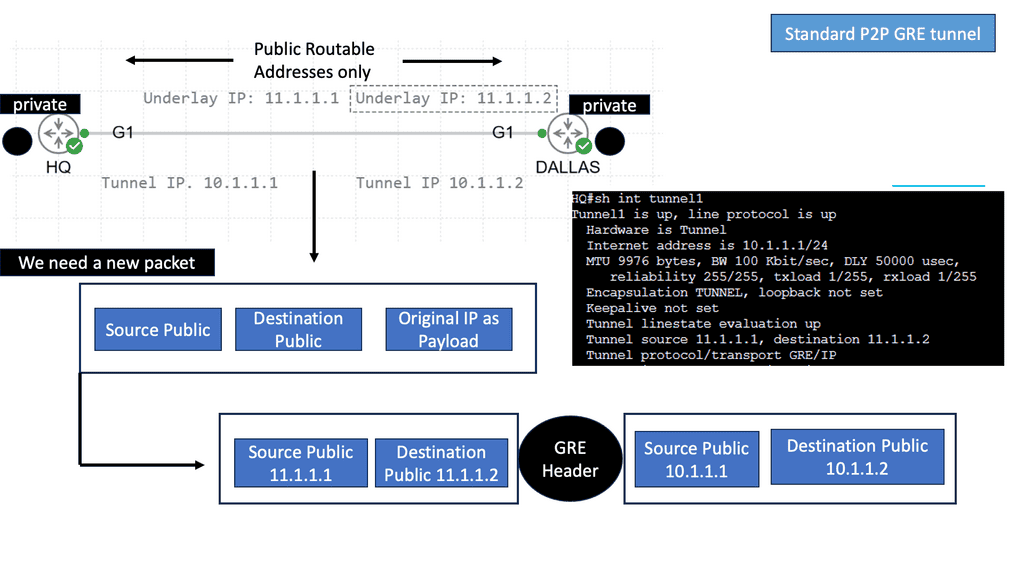
Data & Control Plane
Forwarding and control planes are separated in overlay networks, resulting in a flexible, programmable, and scalable network. To simplify the underlay, the control plane and data plane are separated. As the control plane becomes the network’s brain, it allows faster forwarding and optimizes packets and network reliability. As an underlay for the centralized controller, Cisco SD-Access supports building a fabric using an existing network.
Underlay networks can be automated with Cisco DNA Center. As a result, it is helpful for new implementations or infrastructure growth since it eliminates the hassle of setting up the underlay. For differentiation, segmentation, and mobility, overlay networks often use alternate forwarding attributes in an additional header.
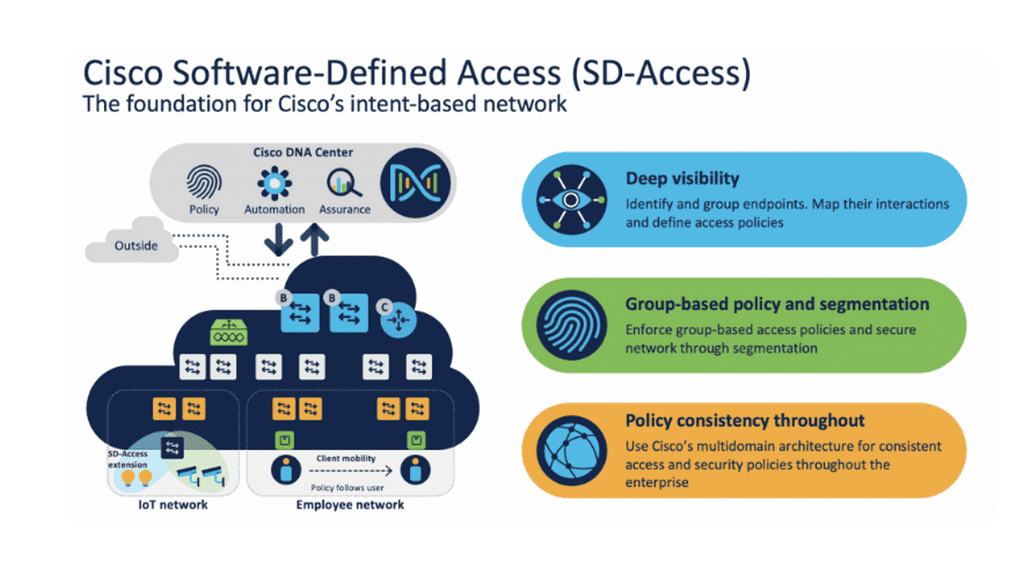
Networking Complexity
Networks continue to get more complex as traffic demands increase. While software-defined networking (SDN) can abstract the underlying complexities, we must consider how we orchestrate the policy and intent across multi-vendor, multi-domain elements.
To overcome complexity, you have to abstract. We have been doing this with tunneling for decades. However, different abstractions are used at the business and infrastructure resource levels.
At a business level, you need to be flexible, as rules will change and must be approached differently from how the operating system models resources. We must make new architecture decisions for this, as it’s not just about configuration management and orchestrations. None of these can look at the network state, which we need to do.
For this, we need network intelligence. Networks are built and managed today using a manual approach without algorithmic validation. The manual process of networking will not be viable in the future. Let’s face it: humans make mistakes.
There are many reasons for network outages, ranging from software bugs and hardware/power failure to security breaches. All of these come from a lack of implementation of network security. However, human error is still the number one cause. Manual configuration inhibits us. Intent-based networking eliminates this inhibition.
The traditional approach to networking
In the traditional network model, there is a gap between the architect’s intent and what’s achieved. Not just for device configuration but also for achieved runtime behavior. Until now, there has not been a way to validate the original intent or to have a continuous verification mechanism.
Once you have achieved this level of assurance, you can focus on business needs and not be constrained by managing a legacy network. For example, Netflix moved its control plane to the cloud and now focuses all its time on its customer base.
We have gone halfway and spent billions of dollars on computing storage and applications, but the network still lags. The architecture and protocols have become more complex, but the management tools have not kept pace. Fortunately, now, this is beginning to change.
Software-defined networking; Slow Deployments
SDN shows great promise that could release networking, but deployments have been slow. Primarily down to large cloud-scale organizations with ample resources and dollars. But what can the rest of the industry do if we do not have that level of business maturity? Intent-based networking is a natural successor to SDN, as many intent-based vendors have borrowed the same principles and common architectures.
The systems are built on the divide between the application and the network infrastructure. However, SDN operates at the network architecture level, where the control plane instructs the data plane forwarding node. Intent-based systems work higher at the application level to offer true brownfield network automation.
SDN and SD-WAN have made considerable leaps in network programmability, but intent-based networking is a further leap to zero-touch self-healing networks. For additional information on SD-WAN, including the challenges with existing WANs, such as lack of agility with BGP ( what is BGP protocol in networking ) and the core features of SD-WAN, check out this SDWAN tutorial.
Intent-Based Networking Use Case
The wide-area network (WAN) edge consists of several network infrastructure devices, including Layer 3 routers, SD-WAN appliances such as Viptela SD-WAN, and WAN optimization controllers. These devices could send diagnostic information for the intent-based system to ingest. The system can ingest from multiple sources, including a monitoring system and network telemetry.
As a result, the system can track application performance over various links. Suppose there is a performance-related problem, the policies are unmet, and application performance degrades.
In that case, the system can take action, such as rerouting the traffic over a less congested link or notifying a network team member. The intent-based system does not have to take corrective action, similar to how IDS/IPS is deployed. These devices can take disciplinary action if necessary, but many use IDS/IPS to alert.
Looking deeper into intent-based networking systems
The intent-based architecture combines machine learning (ML), cognitive computing, and deep analytics, providing enhanced levels of automation and programmability through an easy-to-use GUI. Combining these technologies allows you to move from a reactive to a proactive system.
ML, a sub-application of artificial intelligence (AI), allows intent-based systems to analyze and learn from data automatically without explicit programming. Therefore, it enables systems to understand and predict the data for autonomous behavior. Intent-based networking represents a radical new approach to network architecture and takes networking to the next level in intelligence.
It is not a technology that will be accepted overnight. Its adoption will be slow as, to some, a fully automated network can sound daunting, placing faith in your business, which for many organizations is the network.
However, deploying intent-based networking systems offers a new way to build and operate networks, which increases agility, availability, and security compared to traditional networking.
Intent-based networking (IBN) is transforming the way networks are managed. By shifting the focus from device-centric configurations to intent-driven outcomes, IBN simplifies network management, enhances agility and scalability, improves security, and optimizes network performance. As organizations strive to meet the demands of the digital age, embracing this innovative approach can pave the way for a more efficient and intelligent network infrastructure.

Continuous Assurance & Drift Investigation
Intent is only useful if the network continues to behave as intended. Introduce a controlled configuration change, inspect the evidence, and decide whether the platform should alert, recommend remediation, or apply an authorised corrective action.
Desired vs actual state
Assurance compares observed network behaviour with the intended state.
Investigation evidence
Select the evidence you believe explains the observed drift.
Simulate drift, inspect the actual state, then select the evidence that explains the mismatch.