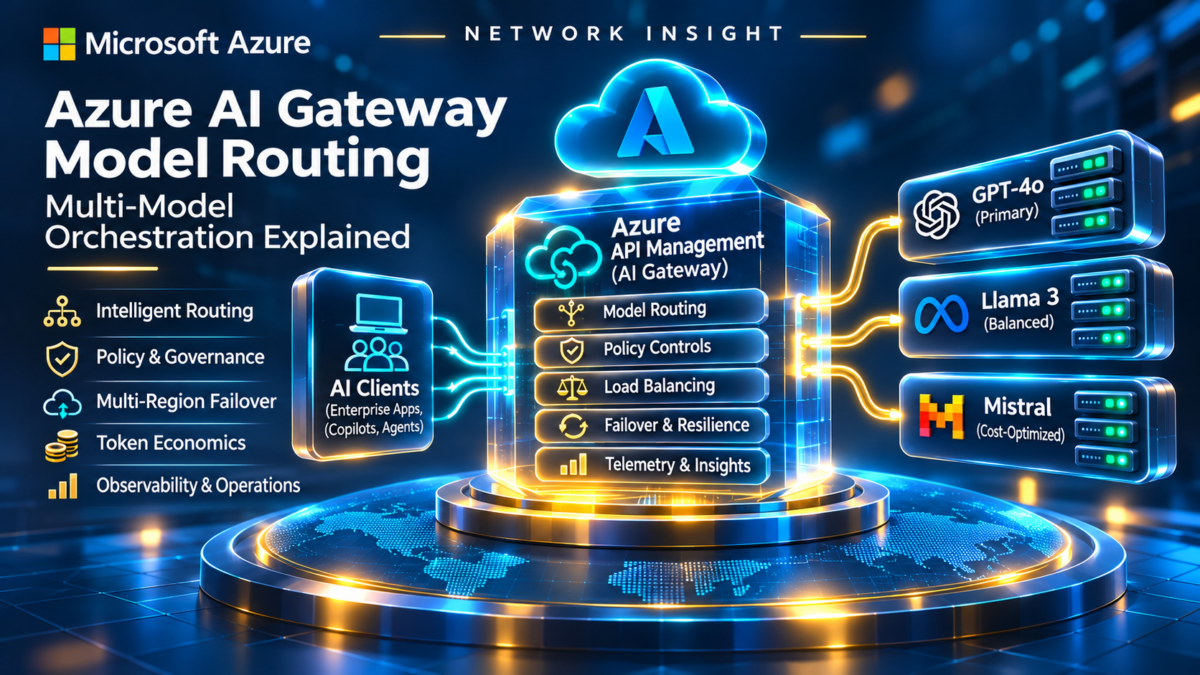
Azure AI Gateway Model Routing & Multi-Model Orchestration Explained
Enterprise AI platforms increasingly need to support multiple models, deployments, regions and workload types. Rather than directing every request to a single inference endpoint, an intelligent AI gateway can apply routing policies to select an appropriate backend for each request.
This introduces a new engineering discipline: multi-model AI gateway architecture. Engineers must consider model capabilities, latency, throughput, cost, quotas, regional availability, security boundaries and recovery behavior when deciding where inference requests should execute.
From a Single AI Endpoint to an Intelligent Routing Architecture
A basic AI integration connects an application to one model endpoint. This can be sufficient for small workloads, but it creates limitations as an enterprise AI platform expands.
Different workloads have different requirements. Some need low latency, others require advanced reasoning, long context windows, specialized capabilities or strict cost controls.
A multi-model gateway introduces a centralized routing boundary that can apply consistent identity, security, governance and traffic policies while distributing requests across eligible model deployments.
Route workloads according to supported capabilities, context requirements and task complexity.
Consider measured latency, capacity availability, quota pressure and deployment health.
Compare eligible models using token pricing, workload quality and total execution cost.
Inside an Enterprise Multi-Model AI Gateway
The architecture below separates the API gateway, routing decision logic and model-serving backends.
Azure API Management provides gateway policies, API exposure and supported backend routing capabilities. More advanced semantic classification or dynamic cost-aware decisions may require application-level orchestration or an external decision service.
Agents · APIs
Request Governance
Health · Capacity
Gateway Routing Versus Model Orchestration
One of the most important architectural distinctions is the difference between a gateway routing decision and an orchestration decision.
A gateway primarily manages API traffic and enforces infrastructure-level policies. An orchestrator may understand the task itself, select tools, invoke multiple models and combine intermediate results.
| Capability | Gateway Responsibility | Orchestration Responsibility |
|---|---|---|
| Authentication | Validate and enforce API access policies | Propagate appropriate workload identity and authorization context |
| Backend selection | Apply configured routing and backend policies | Select models based on task semantics or workflow requirements |
| Traffic distribution | Use supported backend pools and balancing rules | Coordinate workload execution across services |
| Cost management | Enforce budgets and collect supported usage telemetry | Choose an economically appropriate execution strategy |
| Failure recovery | Apply configured retry, breaker and failover behavior | Handle workflow-aware recovery and side effects |
| Multi-step reasoning | Forward and govern API requests | Manage prompts, tools, agents and intermediate model calls |
Avoid placing every model-selection responsibility inside gateway policies. Keep infrastructure routing close to the gateway, while using a dedicated orchestration layer when decisions depend on complex application semantics.
What a Production Multi-Model Gateway Must Achieve
A successful multi-model architecture must optimize more than raw request distribution. It needs to maintain predictable behavior under changing demand, backend failures and model capability constraints.
Ensure the selected backend supports the requested operation, context size, modality and API contract.
Use compatible alternatives without violating request semantics or deadline budgets.
Record routing policy, selected backend, outcome, latency and relevant cost signals.
Production routing decisions should be auditable. Engineers need to understand why a request used a particular model, which alternatives were eligible and whether the decision met its performance and cost objectives.
What You Will Engineer in This Guide
This guide follows the complete lifecycle of a multi-model AI request, from architecture and policy selection through capacity management, failover and production optimization.
| Section | Engineering Focus |
|---|---|
| 01 | Multi-Model AI Gateway Architecture & Request Lifecycle |
| 02 | Azure API Management Backend Pools & Model Deployments |
| 03 | Policy-Based Model Selection & Request Classification |
| 04 | Intelligent Routing by Latency, Cost & Model Capability |
| 05 | Weighted Load Balancing & Capacity-Aware Routing |
| 06 | Multi-Region Failover & Model Availability |
| 07 | Token Budgets, Model Economics & Cost-Aware Routing |
| 08 | Routing Telemetry, Decision Tracing & Troubleshooting |
| 09 | Production Architecture, Governance & Optimization |
By the end of the guide, readers should understand how to design a governed multi-model routing architecture that balances capability, performance, availability and cost while preserving operational visibility.
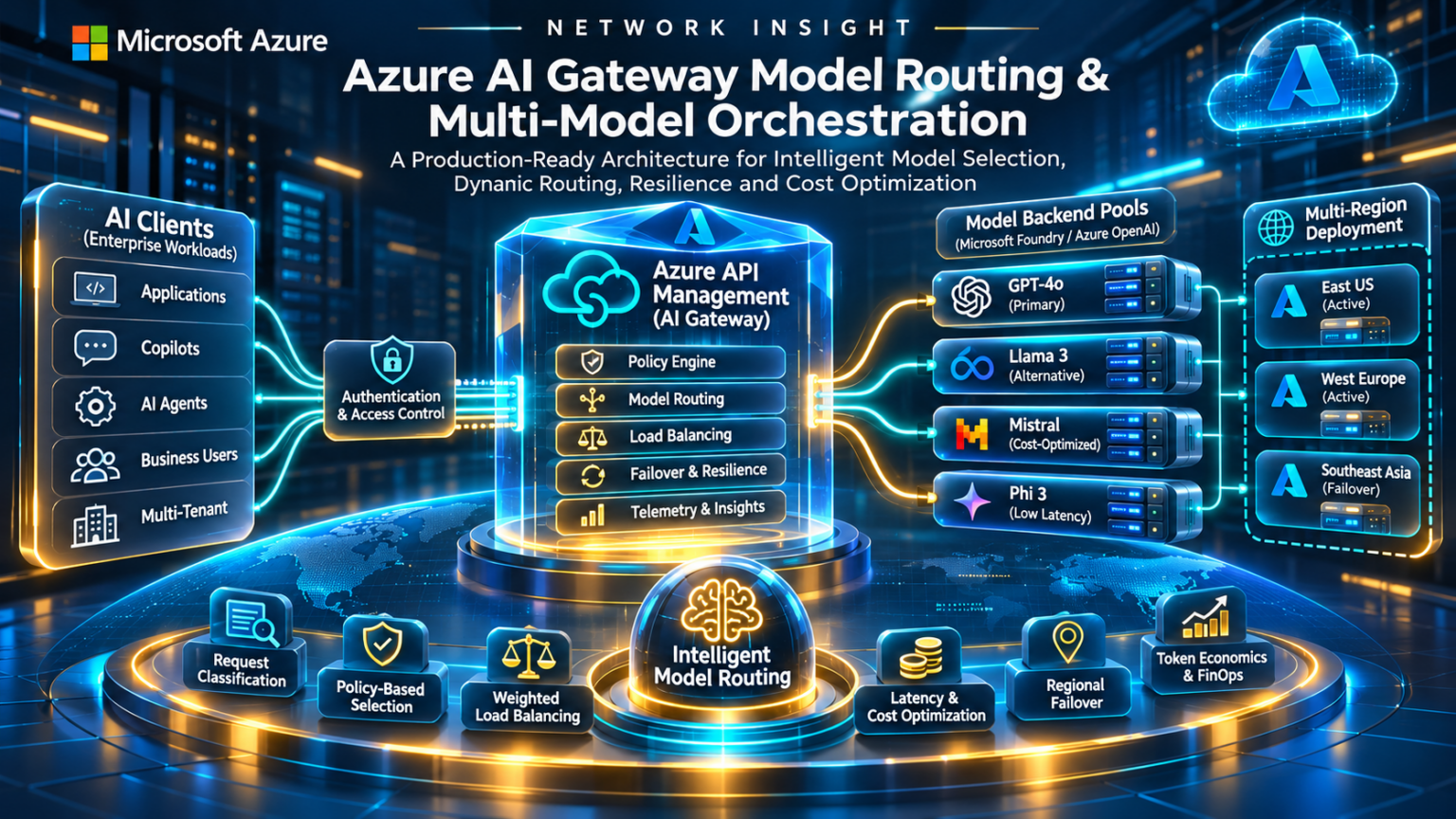
Azure AI Gateway Model Routing & Multi-Model Orchestration
Explore the engineering architecture behind intelligent multi-model routing, policy-driven selection, backend capacity, regional failover, token economics and production AI gateway operations.
Multi-Model AI Gateway Architecture & Request Lifecycle
Follow an enterprise inference request from client authentication through policy evaluation, model selection, backend execution and response delivery.
Multi-Model AI Gateway Architecture & Request Lifecycle
A multi-model AI gateway creates a controlled execution boundary between enterprise applications and multiple model-serving deployments.
Its purpose is to enforce consistent access and routing policies while allowing requests to reach an appropriate model backend.
The architecture separates API governance, routing decisions, backend execution and operational telemetry, enabling each concern to evolve without requiring every application to manage the complete model estate.
Why Multi-Model AI Gateways Exist
Enterprise AI applications increasingly rely on different model families, deployments and execution environments.
A single model may not provide the best balance of capability, latency, availability and cost for every workload.
Select from eligible models according to task requirements, context limits, supported modalities and API contracts.
Reduce dependence on a single model deployment by maintaining compatible alternatives.
Evaluate model selection against token consumption, execution cost and required output quality.
Multi-model routing is not simply round-robin traffic distribution. Model eligibility and request compatibility must be established before load balancing or cost optimization.
Separating Control-Plane Decisions from Request Execution
The control plane defines how the gateway should behave.
It includes configuration such as API definitions, authentication policies, backend registration, routing rules, deployment eligibility and governance controls.
Register approved inference endpoints, deployment identities and relevant configuration metadata.
Define eligible backends, access restrictions, traffic policies and failure behavior.
Version, test, deploy and audit routing changes through controlled engineering processes.
Control-plane configuration influences runtime behavior but should not be confused with the per-request execution path.
How the Gateway Processes Live AI Requests
The data plane handles the actual flow of requests and responses.
A typical request enters Azure API Management, passes configured policy checks and is forwarded to a selected backend.
| Execution Stage | Responsibility | Engineering Consideration |
|---|---|---|
| Ingress | Receive the client request | Authentication, request size and API contract |
| Policy evaluation | Apply configured gateway rules | Authorization, quotas and policy order |
| Routing decision | Select an eligible backend | Capability, deployment health and policy |
| Backend execution | Invoke the model-serving endpoint | Latency, token limits and throttling |
| Response handling | Return the backend result | Streaming, failures and client compatibility |
Not every routing decision must execute inside APIM itself. An external routing service or application orchestrator may supply decisions that gateway policies enforce.
Following an AI Request from Client to Model Backend
The following visualization illustrates a conceptual five-stage request lifecycle.
Request Metadata
Policy Enforcement
Backend Selection
Token Generation
Telemetry
Evaluating Model Compatibility Before Routing
Model eligibility determines whether a backend can satisfy the requirements of a request.
This is a prerequisite for weighted routing, latency optimization and cost-based model selection.
| Eligibility Dimension | Example Requirement | Routing Consequence |
|---|---|---|
| API operation | Chat or embeddings endpoint | Exclude incompatible operations |
| Context capacity | Prompt and output fit model limits | Exclude insufficient context capacity |
| Modality | Text, image or audio support | Require supported input/output types |
| Regional policy | Approved execution geography | Restrict eligible deployment regions |
| Security | Approved endpoint and identity | Exclude unauthorized backends |
| Availability | Backend operationally eligible | Avoid known unavailable deployments |
A lower-cost model must never be selected solely because it is cheaper if it cannot satisfy the request's functional or governance requirements.
Connecting Azure APIM to Microsoft Foundry and Azure OpenAI Deployments
Microsoft Foundry provides capabilities for working with AI models and applications, while Azure OpenAI deployments expose model inference endpoints.
Azure API Management can serve as a governed API boundary in front of supported model-serving endpoints.
Endpoint contracts, authentication requirements and supported capabilities must be verified for each model provider and deployment type.
API exposure, policy enforcement, backend routing and supported usage controls.
Model discovery, deployment and AI application engineering capabilities.
Execute supported inference operations under deployment capacity and quota constraints.
Securing Multi-Model Routing Decisions
Centralized routing creates a valuable governance boundary, but it also introduces security requirements.
The gateway should enforce appropriate client authorization and use controlled identities or credentials when accessing model backends.
Ensure requests originate from authorized applications and principals.
Prefer controlled identity-based access when supported by the target service.
Prevent requests from reaching unauthorized models, regions or data-processing environments.
A routing engine must not allow untrusted client metadata to override authorization, residency or backend eligibility policies.
Streaming, Failure Recovery and Response Compatibility
Model routing continues to matter after backend selection.
The gateway must preserve the expected API contract and manage responses appropriately.
| Response Concern | Engineering Requirement |
|---|---|
| Streaming | Preserve supported streaming behavior and avoid unintended buffering |
| API compatibility | Normalize differences only where a safe and supported contract exists |
| Timeouts | Respect client deadlines and backend execution constraints |
| Retries | Avoid unsafe replay after visible output or non-idempotent side effects |
| Telemetry | Record selected backend, response outcome and relevant timing signals |
A fallback model may differ in output format, tool support, tokenization or behavior. Compatibility must be validated rather than assumed.
Designing a Governed Multi-Model Request Lifecycle
A production multi-model AI gateway combines policy enforcement, model eligibility, routing decisions, backend execution and operational visibility.
Separating control-plane configuration from runtime request execution makes the architecture easier to manage and evolve.
Model compatibility must be established before optimization, while security and governance rules remain mandatory throughout the request lifecycle.
Multi-model routing is a governed decision process, not simply a mechanism for distributing HTTP requests. Successful designs combine eligibility, policy, performance, resilience and traceability across the entire AI request lifecycle.
Multi-Model Request Journey Explorer
Follow an enterprise AI request through the gateway, inspect each architectural decision, and discover how a request reaches the selected AI model deployment.
Configure an Enterprise AI Request
AI Request Execution Path
Current Request Stage
Ready to inspect
Configure a request and select Trace Request to begin the architectural walkthrough.
Model Selection Explanation
Gateway-to-Model Execution Timeline
Request Lifecycle Log
| Stage | Component | Event | Duration |
|---|---|---|---|
| No request events recorded. | |||
What the Request Journey Teaches
Azure API Management handles gateway policies and backend forwarding. Rich semantic classification and dynamic model selection may require an external application or orchestration service.
Fallback requires compatible API operations, supported input modalities, token limits, deployment configuration and application expectations.
Correlate client, gateway, routing-service and inference spans to explain where latency and failures originate.
Record model selection, routing rationale, deployment identity and outcome without unnecessarily exposing sensitive prompt content.
Azure API Management Backend Pools & Model Deployments
Azure API Management can provide a governed routing layer in front of multiple model-serving deployments. Backend entities and backend pools help separate API-facing contracts from the underlying inference endpoints.
This architecture allows engineers to manage backend configuration, traffic distribution, resilience and access controls without embedding every endpoint directly into client applications.
However, backend pools are not a complete semantic model-selection engine. The gateway still needs appropriate eligibility rules and compatible deployments before traffic distribution.
Understanding Azure APIM Backend Resources
An APIM backend entity represents a configured backend service that gateway policies can reference.
Backend configuration can include a service URL and supported authentication, TLS and resilience settings.
Identify the model-serving endpoint to which APIM forwards compatible requests.
Use supported credentials or managed identity arrangements to authenticate backend calls.
Apply supported circuit-breaker and backend configuration features where available.
Applications should depend on a stable API contract rather than individual model deployment URLs wherever a gateway abstraction is appropriate.
Grouping Multiple Model Deployments
A backend pool groups backend entities for supported load-balancing and failover scenarios.
Pool members should be compatible with the requests they may receive.
A pool containing endpoints with different API contracts or model capabilities requires additional routing safeguards.
| Pool Component | Purpose | Engineering Consideration |
|---|---|---|
| Backend member | Reference a configured inference endpoint | Verify API and model compatibility |
| Priority | Organize preferred and fallback backend groups | Understand failover behavior and health signals |
| Weight | Influence distribution among eligible pool members | Weights are not capacity measurements |
| Circuit breaker | Temporarily reject routing to a backend under configured conditions | Feature support and behavior depend on gateway tier and configuration |
Visualizing APIM Traffic Distribution
The architecture below illustrates three compatible model deployments within a conceptual backend pool.
Use the controls to explore weighted routing and priority-based fallback behavior.
Shared API Contract
Routing Policies
Understanding Weights and Traffic Allocation
Weighted load balancing influences how requests are distributed among eligible backends within a priority group.
A backend with a larger weight may receive a greater share of selected requests over time.
Illustrative same-priority pool:

Deployment A weight = 5
Deployment B weight = 3
Deployment C weight = 2

Total weight = 10

Expected long-run proportions:

A = 5 / 10 = 50%
B = 3 / 10 = 30%
C = 2 / 10 = 20%

Actual request distribution
can vary over short intervals.
A static weight does not automatically reflect remaining tokens per minute, current concurrency, backend queue depth or real-time model performance.
Designing Preferred and Fallback Deployment Groups
Priority configuration allows engineers to express preferred backend groups and alternatives.
A typical design may use primary deployments at one priority and fallback deployments at another.
| Priority Group | Deployment | Purpose |
|---|---|---|
| Priority 1 | Deployment A | Preferred inference capacity |
| Priority 1 | Deployment B | Additional preferred capacity |
| Priority 2 | Deployment C | Fallback when the preferred group is unavailable according to configured behavior |
Priority failover is not the same as sending every request to the lowest-latency or lowest-cost backend.
Engineers must validate the actual failure detection and retry behavior of their APIM configuration.
Connecting Backend Pools to Model Deployments
Azure OpenAI and supported Microsoft Foundry model endpoints can participate in enterprise AI gateway architectures.
Deployment endpoints may differ in API version, authentication, operation support and request schema.
Ensure each member supports the required inference operation and request format.
Validate context limits, modality, tool support and required output behavior.
Account for approved regions, deployment quotas and permitted data-processing boundaries.
Do not combine arbitrary model endpoints into one interchangeable pool without validating their API contracts and workload compatibility.
Securing Access to Model Backends
Backend authentication should be separated from client authentication.
Azure APIM can authenticate callers and, where supported, use managed identity to access Azure model-serving resources.
| Security Layer | Engineering Control |
|---|---|
| Client to gateway | Validate client identity and authorization |
| Gateway to backend | Use supported backend credentials or managed identity |
| Network access | Apply appropriate private connectivity and endpoint restrictions |
| Secret management | Protect credentials and avoid embedding secrets in client applications |
| Auditability | Record relevant routing and authorization outcomes without logging sensitive prompt content unnecessarily |
Managing Backend Failure and Recovery
Backend pools become more useful when combined with appropriate resilience configuration.
Supported APIM circuit-breaker behavior can temporarily prevent traffic from being forwarded to a backend after configured failure conditions.
Engineers should distinguish between transient throttling, persistent backend failures, application errors and incompatible requests.
| Signal | Possible Meaning | Engineering Response |
|---|---|---|
| HTTP 429 | Rate or token capacity constraint | Inspect quotas, retry guidance and alternative eligible capacity |
| HTTP 5xx | Backend or intermediary failure | Investigate dependency health and failure scope |
| High latency | Queueing or inference slowdown | Inspect backend latency and capacity telemetry |
| Connection failure | Connectivity, TLS or endpoint issue | Validate networking and backend configuration |
Circuit-breaker support and specific backend pool behavior depend on the APIM gateway tier, feature availability and configuration. Validate these capabilities before relying on them for production failover.
Building a Production-Ready Backend Pool Architecture
Azure APIM backend entities and backend pools provide useful building blocks for managing multiple inference deployments.
Weighted distribution and priority groups can support traffic allocation and failover when configured appropriately.
However, backend pools must be designed around model compatibility, security requirements and realistic operational failure scenarios.
Backend pools distribute traffic among eligible deployments; they do not independently guarantee intelligent model selection. Production designs combine backend configuration, eligibility rules, secure access, resilience and observability.
Backend Pool Architecture Builder
Design a multi-region AI backend pool behind Azure API Management. Configure model deployments, assign routing weights, test endpoint availability and validate the resulting gateway architecture.
Configure Model Deployments
Multi-Region Backend Pool
Architecture Readiness Assessment
Pool Selection Inspector
Configured Backend Weight Distribution
Backend Pool Operations
| Event | Component | Result |
|---|---|---|
| No engineering events recorded. | ||
Engineering Reliable AI Backend Pools
Two endpoints may expose different model families, versions or API contracts. A routing pool must respect workload compatibility.
Multi-region deployments can reduce dependency on a single Azure region, provided that the application and gateway routing design support cross-region failover.
Weighted selection controls relative routing preference. It does not automatically account for live token capacity, inference queue depth or backend saturation.
Test authentication, endpoint contracts, deployment availability, quotas, fallback compatibility and observability before exposing the pool to enterprise workloads.
Policy-Based Model Selection & Request Classification
Intelligent multi-model routing begins with a controlled decision process. Before an AI request can be assigned to a model deployment, the platform must determine what the request requires, which policies apply and which backends are eligible.
Azure API Management can enforce configured gateway policies, while application-level services may provide additional workload classification or semantic model-selection logic.
The objective is to produce a routing decision that is authorized, explainable, compatible and operationally safe.
Why Model Selection Requires a Policy Framework
A model router must consider more than endpoint availability. Different AI workloads require different capabilities, security controls and performance objectives.
Policy-based routing defines the constraints that must be satisfied before a backend can be selected.
Enforce tenant authorization, approved regions, data restrictions and model access policies.
Require the selected deployment to support the request operation, context size and capabilities.
Choose among eligible deployments using cost, latency, capacity or organizational preferences.
Optimization should occur only after authorization, governance and model compatibility checks have succeeded.
Using Trusted Metadata to Guide Routing
Routing decisions often depend on information associated with the incoming request.
Examples include authenticated tenant identity, API operation, requested capabilities, latency class and workload priority.
| Metadata Field | Example | Engineering Use |
|---|---|---|
| Tenant identity | Authenticated tenant A | Apply tenant-specific authorization and quotas |
| Operation | Chat completion | Filter incompatible backend APIs |
| Workload class | Interactive chat | Apply a latency-oriented routing preference |
| Capability requirement | Tool calling | Require eligible model support |
| Data residency | Approved EU processing | Restrict deployment geography |
| Cost preference | Economy | Optimize among already eligible backends |
Client-provided routing headers are not automatically trustworthy. Security-sensitive metadata should be derived from validated identity, trusted configuration or authorized claims.
Classifying AI Requests Before Model Selection
Workload classification assigns a request to an engineering category that can influence model selection.
Classification may use trusted application metadata, explicit API routes, validated request attributes or a dedicated semantic classification service.
Favor eligible deployments that meet strict response-time requirements.
Require models with the capabilities needed for advanced reasoning tasks.
Favor economical execution when workload deadlines and quality requirements permit.
Classification is not equivalent to authorization. A request classified as high priority must still satisfy the tenant's access and governance policies.
Building a Deterministic Routing Decision Pipeline
A reliable routing decision pipeline applies checks in a deliberate order.
The following example uses four stages: identity and governance, workload classification, model eligibility and backend selection.
Implementing Gateway-Level Routing Rules
Azure API Management provides a policy execution framework that can inspect supported request context and apply configured conditions.
Policies can be used to enforce access controls, select backends and apply request-processing behavior.
Conceptual policy decision:

1. Validate caller identity
2. Determine authorized workload class
3. Evaluate required model capabilities
4. Select an approved backend group
5. Apply backend routing configuration
6. Emit routing telemetry

Example decision:

IF tenant is unauthorized:
    DENY

ELSE IF operation requires reasoning:
    SELECT approved reasoning pool

ELSE IF workload is latency-sensitive:
    SELECT approved low-latency pool

ELSE:
    SELECT approved default pool
This pseudocode describes the intended policy logic rather than a directly deployable APIM policy document.
Complex semantic classification may require a dedicated service or application orchestrator. APIM policy expressions should not be assumed to provide built-in semantic understanding of arbitrary prompts.
Filtering Deployments Before Optimization
Once a request has been classified, the routing engine must identify eligible deployments.
Eligibility combines functional requirements, authorization, geography and operational constraints.
| Filter | Condition | Outcome |
|---|---|---|
| Operation | Backend supports requested API | Include or exclude |
| Capabilities | Required tools, modality or context supported | Include or exclude |
| Authorization | Tenant approved for model deployment | Include or exclude |
| Residency | Deployment meets processing restrictions | Include or exclude |
| Availability | Backend eligible under configured health policy | Include or exclude |
Only after this filtering stage should the router evaluate latency, cost or distribution preferences.
When Routing Requires Understanding the Task
Some workloads cannot be classified reliably from request metadata alone.
A semantic classifier may examine an appropriately authorized and minimized representation of the request to estimate task type or complexity.
Identify categories such as summarization, extraction, coding or complex reasoning.
Use conservative fallback policies when classification confidence is insufficient.
Avoid exposing sensitive prompt content to unnecessary classification services.
A classifier's output is an inference, not an authorization decision. It must never override mandatory tenant, security or residency restrictions.
Recording Why a Model Was Selected
Production routing decisions should be observable and explainable.
Engineers need to reconstruct the policy path followed by a request without unnecessarily storing sensitive prompt content.
{
  "request_id": "example-req-1042",
  "tenant": "tenant-a",
  "workload_class": "interactive",
  "policy_version": "routing-v3",
  "required_capabilities": ["chat"],
  "eligible_backend_count": 2,
  "selected_backend": "low-latency-pool",
  "decision_reason": "latency_preference",
  "decision_outcome": "allowed"
}
Useful telemetry includes the policy version, workload classification, eligible backend count, selected deployment and final routing outcome.
Building a Safe Policy-Based Model Router
Policy-based model selection introduces structure into multi-model AI gateway decisions.
A production router should evaluate trusted identity and governance constraints before classifying workloads and selecting eligible deployments.
Semantic classification can improve routing decisions but should remain subordinate to mandatory policy enforcement.
Authorization and eligibility determine what the router may select; optimization determines which eligible backend it should prefer. This separation is essential for secure, explainable enterprise AI routing.
AI Routing Policy Designer
Engineer policy-driven model selection for an enterprise AI gateway. Build ordered rules, classify request metadata, evaluate routing decisions and investigate why a particular AI deployment was selected.
Build an Ordered Policy
Configure a Test Request
Request Classification & Rule Evaluation
Why Was This Model Selected?
Rule Evaluation Timeline
Policy Conflict & Coverage Analysis
Gateway Policies vs Intelligent Classification
Workload type, tenant tier and region can be supplied by a trusted application or derived from validated identity and policy context.
A broad rule placed above a specific rule may capture traffic before the intended specialist route can execute.
Routing to a model that lacks the required modality or operation is not a valid fallback strategy.
Azure API Management can evaluate policies and forward requests, while complex semantic classification may require a separate routing service.
Intelligent Routing by Latency, Cost & Model Capability
Intelligent AI routing selects a suitable model deployment from a set of eligible alternatives using workload requirements and operational objectives.
Unlike simple load balancing, intelligent routing considers multiple decision dimensions, including model capabilities, latency expectations, inference economics and backend availability.
The central engineering challenge is to distinguish mandatory eligibility constraints from optimization preferences.
Why a Single Routing Metric Is Insufficient
The fastest model may not support the required reasoning capability. The least expensive deployment may violate a workload's latency objective.
Multi-objective routing evaluates several competing engineering goals while preserving mandatory constraints.
Prefer deployments capable of meeting interactive response-time requirements.
Evaluate estimated token consumption and model pricing.
Require model support for the requested task, modality and API contract.
A scoring engine must never compensate for a mandatory capability or authorization failure by assigning a high performance or cost score.
Routing Against Latency Objectives
AI inference latency includes more than network transit time. It can include gateway processing, backend queueing, prefill execution and token generation.
Routing decisions should use relevant measurements for the workload, such as time to first token, end-to-end response time or percentile latency.
| Latency Signal | Meaning | Routing Use |
|---|---|---|
| TTFT | Time to first token | Interactive responsiveness |
| TPOT | Time per output token | Streaming generation performance |
| End-to-end latency | Complete request duration | Overall user experience |
| P95 latency | 95th-percentile observed duration | Tail-latency objectives |
| Queue delay | Time awaiting backend execution | Capacity pressure detection |
Historical latency measurements should be interpreted carefully because prompt length, output length, concurrency and model behavior influence observed performance.
Understanding the Cost of a Routing Decision
Inference cost often depends on model pricing and the number of input and output tokens.
Some deployment types use different billing models, so cost calculations must match the actual service and commercial arrangement.
Illustrative token-priced inference:

Estimated cost =
  (input_tokens / 1,000,000)
    × input_price_per_million
  +
  (output_tokens / 1,000,000)
    × output_price_per_million

Example:

Input tokens:  8,000
Output tokens: 2,000

Input price:  $2 / million
Output price: $8 / million

Estimated cost =
  0.008 × $2
  +
  0.002 × $8

Estimated cost = $0.032
The figures above are hypothetical. Actual costs can depend on deployment type, model version, cached tokens, regional pricing and commercial terms.
Enforcing Capability Requirements Before Scoring
Model capability is a hard eligibility dimension when the workload depends on specific features.
Examples include tool calling, structured output, vision support, long context windows and specialized reasoning behavior.
Ensure the backend supports the requested API operation and payload contract.
Filter deployments lacking mandatory modality, tool or output features.
Use validated evaluations to determine whether a model meets required task quality.
A model's nominal feature support does not automatically guarantee adequate output quality. Production routing should incorporate workload-specific evaluation results.
Comparing Eligible Models with Weighted Preferences
The following educational engine demonstrates a simplified routing decision using capability filtering followed by normalized latency and cost scores.
Adjust the workload requirement and preference weighting to observe how the selected deployment changes.
Turning Different Metrics into Comparable Scores
Latency and cost have different units and scales. A routing engine therefore needs a normalization method before combining them into a weighted score.
For each eligible model:

Latency score =
  1 - (latency - minimum_latency)
      / (maximum_latency - minimum_latency)

Cost score =
  1 - (cost - minimum_cost)
      / (maximum_cost - minimum_cost)

Combined score =
  latency_weight × latency_score
  +
  cost_weight × cost_score

Where:

latency_weight + cost_weight = 1

Higher combined score is preferred.

If all candidate values are equal,
assign the same normalized score
for that metric.
This is one possible scoring strategy rather than a universal routing algorithm.
Production systems may instead use constrained optimization, Pareto-front analysis, learned policies or workload-specific decision rules.
Preventing Optimization from Violating Policy
Hard constraints determine whether a deployment may be selected.
Soft preferences determine which eligible deployment is more desirable.
| Decision Factor | Constraint Type | Example |
|---|---|---|
| Tenant authorization | Hard | Model access must be permitted |
| Required modality | Hard | Vision request needs vision-capable model |
| Approved processing region | Hard | Deployment must satisfy residency policy |
| Latency preference | Soft unless expressed as a strict SLO constraint | Prefer lower expected response time |
| Cost preference | Soft unless constrained by a hard budget | Prefer lower estimated execution cost |
| Model quality | Hard minimum plus optional preference | Require acceptable evaluation performance |
Handling Uncertainty in Real-World Model Performance
Model latency and cost are not perfectly predictable before a request executes.
Prompt length, expected output, backend queueing, cache behavior and model characteristics can all affect the result.
Prefer representative latency and capacity signals over outdated averages.
Use workload-specific estimates and account for prediction uncertainty.
Validate that routing changes preserve required model performance and task outcomes.
Avoid routing oscillation caused by noisy telemetry. Use appropriate smoothing, hysteresis, policy stability and controlled rollout procedures.
Designing an Explainable Multi-Objective Model Router
Intelligent model routing combines functional eligibility with performance and economic preferences.
Latency and cost should be compared using an explicit decision method, while mandatory constraints remain non-negotiable.
A production router should record the candidate set, applied constraints, selected deployment and decision rationale.
Filter first, optimize second, validate continuously. The best routing decision is not necessarily the fastest or cheapest deployment; it is the most appropriate eligible deployment for the workload and its operational objectives.
Model Selection Decision Engine
Engineer intelligent AI routing decisions by evaluating model capabilities, estimated latency, token economics and workload quality. Adjust routing objectives and observe how the selected inference deployment changes.
Configure the AI Request
Routing Preference Weights
Intelligent Model Selection Pipeline
Latency, Cost, Quality & Eligibility
| Model | Capability | Latency | Cost | Quality | Score | Status |
|---|---|---|---|---|---|---|
| Run the decision engine. | ||||||
Latency vs Request Cost
Model Selection Decision Trace
Production Routing Considerations
A cheaper or faster model is not a valid choice if it cannot support the required modality, context length or application operation.
Time to first token, output generation rate, prompt size and deployment load all influence actual inference latency.
Model quality should be measured against representative enterprise tasks using evaluation datasets and acceptance criteria.
Record selected model, decision rationale, estimated cost, actual latency and inference outcomes to improve routing policies over time.
Weighted Load Balancing & Capacity-Aware Routing
Multi-model AI gateways must distribute inference traffic across deployments with different capacity limits, operational conditions and performance characteristics.
Static weighted routing can influence request distribution, but it does not automatically account for changing tokens-per-minute quotas, requests-per-minute limits, backend saturation or inference queueing.
Capacity-aware routing introduces additional decision logic that considers available serving capacity, workload demand and backend eligibility before assigning traffic.
Understanding Static Traffic Distribution
Weighted load balancing assigns relative distribution preferences to eligible backend deployments.
When backends share a compatible API contract and priority group, weights can influence their expected request share.
Illustrative backend weights:

Deployment A = 50
Deployment B = 30
Deployment C = 20

Total = 100

Expected request share:

A = 50%
B = 30%
C = 20%

Important:

Request share is not
the same as token share.

A deployment receiving 30%
of requests may consume
more than 30% of tokens.
Static weights are useful for planned traffic distribution, but they do not represent real-time available inference capacity.
Understanding Token and Request Capacity Constraints
Model deployments may be constrained by token and request quotas, including tokens per minute (TPM) and requests per minute (RPM).
Both constraints matter because a workload can exhaust request capacity before token capacity, or vice versa.
| Constraint | Meaning | Failure Scenario |
|---|---|---|
| TPM | Allowed or provisioned token throughput under the applicable quota model | Large prompts or high token demand trigger throttling |
| RPM | Request rate limit for the applicable deployment or service | Many small requests exhaust request capacity |
| Concurrency | Simultaneous requests or serving activity | Queueing and latency increase under load |
| Regional quota | Capacity allocated under regional or deployment-specific constraints | Failover region lacks sufficient spare capacity |
Actual quota enforcement can vary by model, deployment type, API and service configuration.
Why Equal Request Counts Produce Unequal Load
AI requests have variable token demand.
A short chat completion and a long-context reasoning request can consume very different amounts of backend capacity.
Small prompts and limited output can produce relatively low token demand.
Large input contexts may consume substantial token budget per request.
Long responses increase generation work and can extend backend occupancy.
Illustrative workload:

100 requests/minute
2,000 estimated tokens/request

Estimated token demand:

100 × 2,000
= 200,000 tokens/minute

If a deployment supports
150,000 TPM under the
applicable quota model:

Estimated demand exceeds
the nominal token budget.
Token estimates are imperfect. Actual service quota accounting may use reservation or estimation mechanisms that differ from final billed token usage.
Using Available Capacity to Guide Backend Selection
Capacity-aware routing attempts to distribute requests according to the ability of eligible deployments to serve additional demand.
Unlike static weighting, it can use signals such as quota headroom, recent throttling, queue pressure and backend health.
Conceptual capacity calculation:

Available TPM =
  configured TPM budget
  -
  estimated current TPM demand

Candidate is eligible only if:

- Model capability matches
- Governance policies permit it
- Backend is operationally eligible
- Required capacity is available

Then:

Select a backend using
a configured capacity-aware
routing policy.
APIM backend pools support configured traffic distribution and resilience features. Real-time capacity-aware selection may require additional telemetry, custom policy logic or an external routing service.
Comparing Weighted and Capacity-Aware Routing
This educational simulator compares static weighted request distribution against a simplified capacity-aware allocation model.
Adjust request demand, token size and backend availability to examine capacity saturation.
Recognizing Capacity Exhaustion
Backend saturation occurs when offered demand approaches or exceeds the deployment's effective serving capacity.
Depending on the service and configuration, saturation can produce increased latency, queueing, throttling or rejected requests.
| Signal | Interpretation | Possible Action |
|---|---|---|
| HTTP 429 | Quota or rate constraint | Respect retry guidance and evaluate eligible alternatives |
| Increasing P95 latency | Queueing or inference slowdown | Inspect capacity and workload characteristics |
| High TPM utilization | Token budget pressure | Reduce demand or add approved capacity |
| Uneven backend load | Traffic skew or unsuitable weights | Review distribution and request token profiles |
Preventing Retries from Increasing Backend Pressure
Retry behavior can unintentionally amplify demand during an outage or throttling event.
If multiple clients retry aggressively, the gateway and backend may receive substantially more traffic than the original workload.
Illustrative retry amplification:

Original demand:
100 requests

Every failed request retries twice:

Maximum attempted requests:
100 + 100 + 100 = 300

Amplification factor:
300 / 100 = 3×

Production controls:

- Bounded retries
- Exponential backoff
- Jitter
- Retry budgets
- Deadline enforcement
- Circuit breakers
- Idempotency safeguards
Avoid automatically replaying requests after partial streamed output has been delivered or when the operation may have non-idempotent side effects.
Observing Backend Headroom and Routing Effectiveness
Capacity-aware routing requires reliable operational signals.
Engineers should measure traffic distribution, backend utilization, throttling, latency and routing outcomes.
Estimate remaining eligible token and request capacity.
Observe tail latency and changes under different workload levels.
Track rejected requests, fallback events and retry outcomes.
Telemetry should be correlated with model, deployment, region, policy version and workload classification.
Designing Stable Capacity-Aware AI Routing
Weighted routing provides a simple method for distributing requests among compatible deployments.
Capacity-aware routing extends this model by considering available quota, workload demand and backend operational conditions.
Production implementations must also control retries, prevent routing oscillation and preserve model eligibility and governance constraints.
Request distribution is not equivalent to capacity distribution. Effective AI gateway routing must account for variable token demand, deployment limits and operational headroom.
AI Traffic Distribution Simulator
Engineer how an enterprise AI gateway distributes inference traffic across multiple model deployments. Compare weighted routing with capacity-aware selection, investigate token saturation and discover why request-balanced pools may still experience uneven infrastructure pressure.
Configure the Inference Workload
AI Gateway Traffic Fabric
Token Capacity & Traffic Distribution
Weighted vs Capacity-Aware Routing
| Strategy | Accepted | Rejected | Pool Util. |
|---|---|---|---|
| Run Compare Strategies. | |||
Capacity & Saturation Investigator
Inference Traffic Decisions
| Event | Backend | Outcome |
|---|---|---|
| No simulation events. | ||
Designing Capacity-Aware AI Gateways
A 500-token request and a 10,000-token request can impose very different inference capacity demands.
Weighted routing distributes selection preference, but does not inherently react to current token headroom.
Real-time routing requires reliable capacity estimates, health information and feedback controls.
Use admission control, retries with backoff, load shedding and compatible fallback deployments.
Multi-Region Failover & Model Availability
Enterprise AI platforms must remain resilient when a model deployment, regional service or supporting dependency becomes unavailable.
Multi-region AI gateway architecture distributes approved inference capacity across geographically separated deployments and establishes controlled recovery paths.
The engineering objective is not simply to redirect traffic after an error. It is to maintain model compatibility, governance, request safety and predictable recovery throughout a failure.
Designing Regional Diversity for AI Inference
A multi-region design deploys compatible model capacity across more than one approved region.
This can reduce dependence on a single regional deployment, but resilience depends on the independence of the supporting infrastructure and services.
Handles normal inference traffic under the configured routing policy.
Provides compatible capacity when the preferred deployment is unavailable.
Returns traffic to preferred capacity after health and stability are confirmed.
Multiple model deployments in one region do not provide the same failure isolation as appropriately independent regional deployments.
Recognizing Backend and Regional Failures
Failover depends on detecting when a backend should no longer receive requests.
Possible signals include connection failures, repeated server errors, throttling and unacceptable response latency.
| Failure Signal | Possible Cause | Routing Consideration |
|---|---|---|
| Connection timeout | Network or backend reachability problem | Consider compatible alternative after bounded failure handling |
| HTTP 5xx | Service or intermediary failure | Evaluate configured retry and circuit-breaker conditions |
| HTTP 429 | Quota or rate constraint | Respect retry guidance and evaluate eligible spare capacity |
| High latency | Queueing or inference slowdown | Avoid reacting to transient measurement noise |
| Regional service incident | Regional dependency disruption | Validate alternative region availability and policy compliance |
Using APIM Backend Priority for Failover Design
Azure API Management backend pools support priority and weight configuration for supported load-balancing scenarios.
Engineers can organize preferred deployments and fallback deployments into different priority groups.
Conceptual regional design:

Priority 1
  Region A / Deployment 1
  Region A / Deployment 2

Priority 2
  Region B / Deployment 1

Priority 3
  Region C / Deployment 1

Routing objective:

Use preferred eligible capacity.

If the preferred group
becomes unavailable under
configured failure handling:

Consider the next eligible
priority group.

Never bypass residency
or capability constraints.
Verify supported APIM gateway tiers, backend pool features, circuit-breaker behavior and retry configuration before relying on automatic failover.
Preventing Repeated Requests to Unhealthy Backends
Circuit breakers can temporarily prevent traffic from reaching a backend when configured failure conditions are met.
This reduces repeated attempts against a failing dependency and can support routing toward alternative eligible capacity.
Requests may flow to the backend according to routing policy.
Configured failure conditions prevent new attempts for a defined period.
Traffic eligibility is restored according to supported recovery behavior.
Circuit-breaker semantics vary by implementation. Do not assume every gateway exposes identical half-open or active-probing behavior.
Investigating Regional Routing Decisions
This educational investigation demonstrates how a conceptual multi-region router reacts to regional failures and governance restrictions.
Approved Workload
Priority & Policy
Ensuring Fallback Models Can Serve the Request
A fallback deployment must support the required API contract and workload capabilities.
Model versions may differ in context limits, tool support, output behavior and performance.
| Compatibility Dimension | Required Validation |
|---|---|
| API operation | Fallback endpoint supports the same required operation |
| Context window | Prompt and expected output fit supported limits |
| Tool support | Required tool-calling behavior is available |
| Structured output | Required schema or output constraints are supported |
| Quality | Fallback model meets minimum workload evaluation standards |
Preventing Failover from Violating Governance Policies
Cross-region failover can change where inference processing occurs.
Organizations may have contractual, regulatory or internal requirements restricting approved processing locations.
A healthy fallback region must not receive a request if it violates the workload's data-processing or governance restrictions.
When no compliant deployment remains, the correct outcome may be controlled rejection rather than unsafe failover.
Engineering Reliable Failover Without Request Amplification
Failover introduces retry and recovery complexity.
Engineers must consider whether a request can be replayed safely, whether partial output has already been delivered and whether a backend operation produced side effects.
Use retry limits, deadlines, backoff and jitter to avoid traffic amplification.
Avoid transparent replay after a response stream has already reached the client.
Test deployment outages, throttling, regional restrictions and recovery behavior.
Illustrative recovery test:

1. Confirm primary region healthy
2. Send representative inference traffic
3. Inject a controlled backend failure
4. Observe failure detection
5. Verify eligible fallback selection
6. Measure failed and recovered requests
7. Check latency and retry amplification
8. Confirm governance compliance
9. Restore primary capacity
10. Validate stable failback behavior
Designing Governed Multi-Region AI Resilience
Multi-region model routing can improve inference availability by providing alternative deployment capacity.
Successful failover requires reliable failure detection, compatible models, sufficient spare capacity and strict governance enforcement.
Recovery procedures should be tested regularly using realistic workload and failure scenarios.
Failover must preserve correctness and governance, not merely restore connectivity. A resilient AI gateway routes only to approved, compatible and operationally eligible deployments.
Multi-Region Failover Investigator
Investigate how an enterprise AI gateway maintains inference availability when Azure regions, model deployments or individual backend endpoints become unavailable. Configure failover controls, inject faults and examine routing decisions during failure and recovery.
Configure Regional Resilience
Enterprise AI Failover Topology
Request-Level Routing Investigation
| Request | Region | Outcome | Decision |
|---|---|---|---|
| No requests simulated. | |||
Failure Detection & Recovery Analysis
Multi-Region AI Gateway Design Principles
Fallback deployments must support the required operation, modality, context size and application contract.
Regional outages, endpoint errors, throttling and capacity exhaustion may require different responses.
Use recovery verification, hysteresis and controlled reintroduction of traffic.
Cross-region failover must satisfy data-handling, compliance and organizational routing constraints.
Token Budgets, Model Economics & Cost-Aware Routing
Enterprise AI routing must balance model capabilities and operational performance against the economics of inference consumption.
Different models can have substantially different input-token prices, output-token prices, caching characteristics and deployment billing arrangements.
Cost-aware routing introduces financial decision criteria into model selection, while ensuring that quality, authorization and operational constraints remain mandatory.
Understanding the Cost Structure of AI Inference
Token-based inference pricing commonly separates input-token and output-token consumption.
For supported configurations, cached input tokens may have different pricing from uncached input tokens.
Tokens submitted to the model, including applicable instructions, context and conversation history.
Tokens produced during model execution, subject to model-specific accounting rules.
Eligible repeated prompt content that may receive discounted accounting under supported offerings.
Illustrative token-priced model:

Request cost =
  uncached_input_tokens × input_rate
  +
  cached_input_tokens × cached_rate
  +
  output_tokens × output_rate

All rates must use
the same token unit.

For per-million pricing:

Cost =
  tokens / 1,000,000 × rate
Comparing Model Economics Across Deployments
Model selection can significantly affect total inference cost.
A high-capability model may cost more per request, while an economy model may be sufficient for routine workloads.
| Illustrative Model | Input / 1M | Output / 1M | Cached Input / 1M |
|---|---|---|---|
| Model A · Economy | $0.50 | $1.50 | $0.20 |
| Model B · Balanced | $2.00 | $8.00 | $0.80 |
| Model C · Advanced | $5.00 | $20.00 | $2.00 |
These figures are hypothetical educational values, not current Azure or Microsoft Foundry service prices. Production cost calculations should use the applicable model, region, deployment and billing terms.
Understanding Prompt Caching and Effective Input Cost
Some model offerings support prompt caching, which can reduce the effective cost of eligible repeated input content.
Cache eligibility depends on model and service-specific requirements.
Stable prompt prefixes may be eligible for caching under supported model behavior.
Use actual usage metadata where available rather than assuming every repeated token is cached.
Keep reusable context stable when doing so is compatible with application requirements.
Cache hit rates should be measured rather than assumed, particularly when routing across multiple deployments.
Enforcing Financial Guardrails Across AI Workloads
Multi-tenant AI platforms may allocate spending budgets to applications, departments or customers.
Financial controls can prevent uncontrolled inference demand and support predictable cost allocation.
| Control | Purpose | Engineering Consideration |
|---|---|---|
| Monthly budget | Define permitted spending | Use reliable accounting and period boundaries |
| Per-request ceiling | Limit unusually expensive requests | Estimate maximum output and token usage |
| Tenant quota | Control shared service consumption | Coordinate distributed counters and concurrency |
| Alert threshold | Notify operators before exhaustion | Allow for telemetry and billing delays |
| Hard enforcement | Reject or constrain excess usage | Requires authoritative budget reservation or equivalent control |
Azure Cost Management budgets and alerts are not equivalent to synchronous per-request spending enforcement. Hard controls require an appropriate admission and accounting mechanism.
Simulating Monthly Inference Economics
This interactive model estimates inference costs for three hypothetical deployments.
Adjust request volume, token consumption, cache hit rate and spending budget to compare outcomes.
Choosing Economical Models Without Sacrificing Requirements
Cost-aware routing selects an economical deployment from the set of models that satisfy mandatory requirements.
A production routing engine may consider task complexity, expected token consumption, model evaluation results and available budget.
Conceptual decision order:

1. Authenticate tenant
2. Enforce residency and policy
3. Identify required capabilities
4. Filter incompatible models
5. Enforce minimum task quality
6. Estimate request cost
7. Check budget admission
8. Select preferred eligible model
9. Record actual usage and outcome

Never select an unsuitable model
solely because it is cheaper.
Why the Cheapest Request May Not Be the Cheapest Outcome
A lower-cost model can produce greater overall expense if its task success rate is insufficient.
Repeated attempts, human correction and downstream errors can change the effective economics.
Illustrative comparison:

Model A:
  Cost per attempt = $0.01
  Success rate     = 50%

Model B:
  Cost per attempt = $0.03
  Success rate     = 95%

Under independent repeated
attempts until success:

Expected cost per success =
  cost per attempt / success rate

Model A = $0.020
Model B = $0.0316

But task quality, retries,
latency and operational risk
must also be considered.
This simplified formula assumes independent attempts with a stable success probability. Real-world tasks often require more detailed evaluation.
Measuring Cost Across Tenants, Models and Workloads
AI FinOps requires cost visibility across deployment, tenant, application and workload dimensions.
Operational telemetry should connect token usage and estimated cost with the routing decision and task outcome.
Record input, output and cached-token accounting where available.
Associate usage with authenticated tenants and authorized applications.
Compare spending with task quality, latency and successful outcomes.
Gateway-level estimated cost should be reconciled against actual billing data because token accounting, caching and deployment pricing may differ from preliminary estimates.
Building Economically Efficient AI Routing
Cost-aware AI routing extends model selection beyond latency and availability to include inference economics.
Token pricing, caching, workload demand and tenant budgets influence financial outcomes.
Production optimization must preserve model capability, task quality, governance and operational resilience.
Optimize cost per acceptable outcome, not merely cost per inference request. Reliable AI FinOps connects routing decisions with quality, usage and financial accountability.
Multi-Model Cost Optimization Lab
Engineer the economics of enterprise AI inference. Compare model tiers, configure token consumption, allocate workloads and investigate how routing strategies influence estimated monthly AI spending.
Configure Enterprise AI Demand
Enterprise AI Economics Pipeline
Model Routing & Cost Distribution
| Workload | Traffic | Selected Model | Monthly Requests | Monthly Cost |
|---|---|---|---|---|
| Run the cost model. | ||||
Baseline vs Optimized Spending
Budget Pressure & Cost Controls
Illustrative Token Pricing
| Model Tier | Input / 1M Tokens | Output / 1M Tokens | Primary Use |
|---|
Designing Cost-Efficient AI Gateways
Not every request requires an expensive reasoning model. Workload classification enables appropriate model selection.
Input and generated tokens can have different prices. Output-heavy workloads may substantially increase spending.
Use tenant quotas, cost alerts and application-level admission policies to control consumption.
Lower-cost routing must still meet accuracy, safety and task-quality requirements.
Routing Telemetry, Decision Tracing & Troubleshooting
Production AI gateways require visibility into how inference requests are classified, authorized, routed and executed across model deployments.
Routing observability connects gateway policy decisions with backend performance, model availability, token usage and operational failures.
Without this visibility, engineers may see only a failed inference request, without understanding which routing decision caused the failure or which backend dependency was responsible.
Understanding the AI Gateway Telemetry Pipeline
A multi-model routing platform produces telemetry at several architectural layers.
These layers may include client applications, Azure API Management, routing services, model endpoints and downstream application dependencies.
Capture request outcomes, gateway latency, backend status and policy diagnostics.
Record candidate eligibility, policy versions and selected deployment identifiers.
Observe model latency, token consumption, throttling and execution outcomes.
A complete routing investigation requires correlation across the gateway, routing logic and model-serving dependencies.
Following an Inference Request Across Services
Distributed tracing associates related operations with a shared trace context.
A trace may include spans representing gateway processing, policy evaluation, backend selection and inference execution.
Illustrative request trace:

TRACE: 7fa2-example

Span 1: Client Request
  Duration: 20 ms

Span 2: APIM Policy Processing
  Duration: 12 ms

Span 3: Routing Decision
  Duration: 8 ms

Span 4: Backend Connection
  Duration: 35 ms

Span 5: Model Inference
  Duration: 1,250 ms

Total illustrative duration:
1,325 ms
Span boundaries depend on instrumentation. Not every internal APIM policy step is automatically exposed as a separate OpenTelemetry span.
Recording Why a Backend Was Selected
Routing decision logs explain the policy outcome for each request or sampled request group.
Useful fields include tenant, workload class, policy version, eligible backend count and selected model.
{
  "trace_id": "example-trace-1042",
  "tenant": "tenant-a",
  "workload_class": "interactive",
  "policy_version": "routing-v4",
  "eligible_backends": 3,
  "selected_backend": "model-a-region-1",
  "decision_reason": "latency_preference",
  "fallback_used": false,
  "outcome": "success"
}
Avoid logging raw prompts, credentials, access tokens or sensitive response content unless there is a specifically authorized and protected operational need.
Integrating Gateway and Application Diagnostics
Azure Monitor, Application Insights and supported APIM diagnostic integrations can provide useful operational visibility.
Application-level instrumentation may be required to expose custom model selection and semantic routing decisions.
| Telemetry Source | Typical Information | Engineering Use |
|---|---|---|
| APIM diagnostics | Gateway requests, response codes and configured diagnostic details | Investigate gateway and backend failures |
| Application Insights | Application requests, dependencies and custom telemetry | Correlate routing with application behavior |
| Azure Monitor metrics | Supported service-level performance and availability signals | Observe operational trends |
| Custom router logs | Eligibility, policy decisions and selected backend | Explain routing outcomes |
| Model usage data | Available token and inference accounting | Analyze consumption and cost |
Investigating Multi-Model Gateway Failures
This educational incident console demonstrates how engineers can interpret request traces, backend errors and routing decisions.
Select an incident scenario and inspect the diagnostic evidence and recommended investigation path.
Awaiting incident investigation.
Select a scenario to examine the troubleshooting path.
Separating Gateway Delay from Model Execution Time
End-to-end inference latency combines several processing stages.
Engineers should distinguish gateway overhead, network transit, backend queueing and model execution time.
| Latency Component | Diagnostic Question |
|---|---|
| Gateway processing | Are policy execution or external dependencies delaying the request? |
| Backend connection | Are DNS, TLS or network conditions contributing delay? |
| Inference queueing | Is the backend experiencing capacity pressure? |
| Model generation | Are output length or model characteristics increasing execution time? |
| Streaming delivery | Are client or intermediary conditions affecting token delivery? |
Identifying the Scope of an AI Routing Incident
A routing incident may affect one tenant, model, deployment, region or the entire gateway platform.
Correlating failures across these dimensions helps identify the likely failure domain.
Determine whether failures are isolated to specific identities or policies.
Compare errors and latency across model deployments.
Identify regional concentration and common dependency failures.
Building a Repeatable AI Gateway Investigation Procedure
Production troubleshooting should follow a consistent sequence that separates policy, routing and backend execution failures.
AI Gateway Incident Workflow

1. Identify affected requests
2. Correlate trace and request IDs
3. Confirm caller authorization
4. Inspect applied policy version
5. Review model eligibility decision
6. Identify selected backend
7. Inspect backend response status
8. Compare latency and quota signals
9. Evaluate failover and retry behavior
10. Confirm remediation with new traces
Diagnostic logging should be sufficiently detailed for troubleshooting while minimizing sensitive data collection and controlling access to telemetry.
Making Multi-Model Routing Observable and Explainable
Routing telemetry connects policy decisions with backend performance and inference outcomes.
Distributed tracing, decision logs and model usage metrics provide complementary views of request execution.
Effective troubleshooting requires correlation across gateway, routing and model-serving layers.
Every production routing decision should be explainable through observable evidence. Engineers need to understand why a backend was selected, how the request executed and where failures occurred.
AI Routing Incident Console
Investigate enterprise AI gateway routing decisions across classification, policy evaluation, backend selection and model inference. Inject production-style incidents, inspect correlated traces and identify the likely root cause before recommending remediation.
Inject an AI Routing Incident
AI Gateway Routing Topology
Routing Decision Trace Explorer
| Request ID | Classification | Selected Model | HTTP | Latency | Routing Decision |
|---|---|---|---|---|---|
| Generate telemetry to inspect requests. | |||||
Latency & Error Investigation
Incident Diagnosis & Remediation
Production Routing Troubleshooting Checklist
Production Architecture, Governance & Optimization
Production multi-model AI gateways combine model routing, API security, workload governance, capacity management, observability and financial controls into a single operational architecture.
Azure API Management can provide the enterprise API gateway layer, while Microsoft Foundry and supported model deployments provide inference capabilities.
Additional routing services, policy logic and telemetry may be required to implement advanced decisions based on workload semantics, model quality, real-time capacity or cost.
The production objective is governed, observable, resilient and economically sustainable inference orchestration.
Assembling the Enterprise Multi-Model AI Gateway
A production architecture separates client access, policy enforcement, model routing and inference execution.
Each layer should have a clearly defined operational responsibility.
The diagram represents logical responsibilities, not a literal sequence of network hops. Governance and telemetry controls span multiple layers.
Protecting Model Access and Inference Traffic
Enterprise AI gateways must enforce identity, authorization and network security consistently across models.
Azure API Management can support inbound authentication, authorization policy integration and backend authentication.
Authenticate callers and authorize access to approved API capabilities.
Use supported managed identity authentication instead of embedded secrets.
Evaluate private endpoints, DNS, network isolation and approved egress paths.
Backend credentials and routing decisions should not be controlled by untrusted client-supplied headers.
Enforcing Model Eligibility and Organizational Policy
Governance determines which models and regions a workload is permitted to use.
Model eligibility should be evaluated before optimization by latency, cost or capacity.
Conceptual production decision order:

1. Authenticate caller
2. Resolve tenant and workload policy
3. Validate model permissions
4. Enforce data residency
5. Check required model capabilities
6. Check backend availability
7. Evaluate capacity and latency
8. Apply financial constraints
9. Select eligible deployment
10. Record decision and outcome
Performance and cost optimization must never override mandatory authorization, residency or compliance restrictions.
Managing Gateway Configuration as Versioned Infrastructure
Production routing policies should be reviewed, tested and deployed through controlled delivery pipelines.
Infrastructure as Code can help standardize APIM configuration, identity, diagnostics and supporting resources.
| Engineering Practice | Production Objective |
|---|---|
| Version-controlled policies | Trace routing behavior to an approved configuration |
| Infrastructure as Code | Reduce configuration drift across environments |
| Preproduction testing | Validate security, model compatibility and failover |
| Canary rollout | Limit exposure when introducing routing changes |
| Rollback procedure | Restore a known-good configuration after regression |
Evaluate Your Enterprise AI Gateway Architecture
This engineering assessment evaluates twelve essential production controls across security, routing, reliability and operations.
Select controls that are implemented and verified, then review the readiness score and outstanding remediation priorities.
Select verified engineering controls to calculate the readiness score and identify remaining gaps.
Defining SLOs and Operational Resilience
Production AI gateways should define measurable service-level objectives for inference reliability and performance.
Useful indicators include successful request rate, end-to-end latency, throttling frequency and recovery effectiveness.
Measure the proportion of valid requests completed successfully.
Monitor P95/P99 latency and streaming response characteristics.
Measure failover outcomes, recovery time and rejected requests.
Balancing Quality, Performance and Inference Economics
Model routing optimization should evaluate cost alongside workload requirements and successful task outcomes.
Lower-cost deployments may serve routine workloads, while more capable models remain available for tasks requiring advanced reasoning or specialized capabilities.
Conceptual optimization objective:

Minimize:
  Expected inference cost

Subject to:
  Required model capabilities
  Minimum task quality
  Authorization and residency
  Latency objectives
  Backend availability
  Capacity constraints
  Tenant financial controls

Measure:
  Cost per successful task
  Not only cost per request
Operating the AI Gateway as a Managed Platform
Production AI routing requires ongoing evaluation because model availability, capabilities, pricing and workload behavior change.
Platform engineering teams should establish regular operational reviews and controlled optimization cycles.
| Operational Activity | Recommended Focus |
|---|---|
| Daily | Availability, throttling, latency, error rates and budget anomalies |
| Weekly | Routing distribution, model quality, capacity trends and incident review |
| Monthly | Cost optimization, policy review, model lifecycle and resilience testing |
| Before major changes | Regression evaluation, security review, canary deployment and rollback validation |
Engineering an Enterprise-Ready Multi-Model AI Gateway
Enterprise multi-model routing is a combination of API management, policy enforcement, model selection, reliability engineering and operational governance.
Azure API Management provides gateway capabilities, while supported Azure AI model services provide inference endpoints.
Advanced orchestration may require additional routing intelligence and telemetry beyond basic gateway load balancing.
A production AI gateway is not simply a model proxy. It is a governed decision and control layer that determines which approved model can serve a request, under what operational conditions and at what acceptable cost.
Continue exploring enterprise AI gateway architecture, model security, observability and intelligent orchestration through the Network Insight engineering guides.
Explore Azure AI Gateway ArchitectureEnterprise AI Routing Architecture Lab
Design a production-oriented enterprise AI gateway. Combine multi-model routing, security governance, regional resilience, cost controls and observability. Validate your architecture against engineering readiness criteria and identify remaining design gaps.
Enterprise Deployment Designer
Enterprise Multi-Model Routing Fabric
Production Architecture Scorecard
Architecture Risks & Remediation
Enterprise AI Gateway Deployment Assessment
Enterprise AI Gateway Design Considerations
Use API Management for gateway policies and request mediation. Introduce an orchestration service where advanced semantic routing is required.
Model compatibility, capacity, regional availability and application contracts must be verified before traffic is redirected.
Identity, network restrictions, data residency, content safety and cost controls should influence the permitted routing paths.
Correlate request identifiers, routing policies, backend responses and inference telemetry to investigate production behavior.

- Azure AI Gateway Semantic Caching & Intelligent Response Reuse - November 23, 2026
- Azure AI Gateway Model Routing Orchestration Explained - November 23, 2026
- Azure AI Gateway Observability Performance Explained - November 23, 2026