
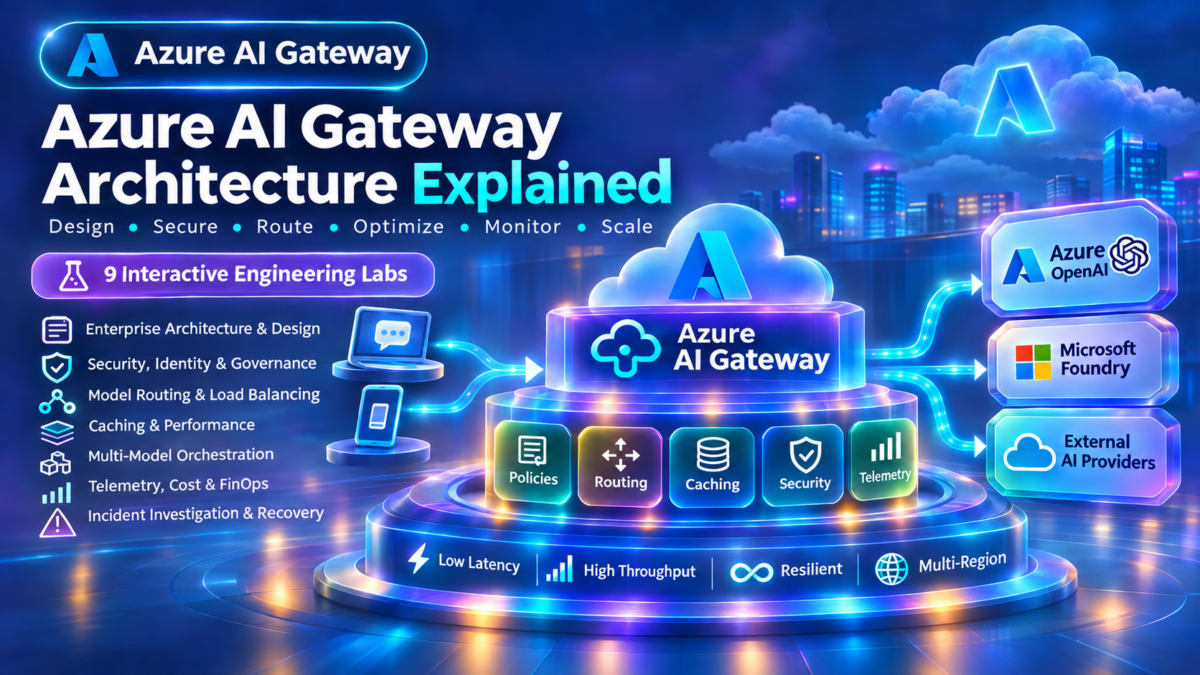
Inside the Azure AI Gateway
Modern enterprise AI platforms require a secure and observable control point between applications and AI model endpoints. An AI gateway provides this control through authentication, authorization, policy enforcement, traffic routing, rate limiting, token governance, caching, and operational telemetry.
In Microsoft Azure, Azure API Management can act as a centralized AI gateway, connecting client applications, AI agents and enterprise services to Azure OpenAI, Microsoft Foundry model deployments and other supported AI backends.
Rather than allowing every application to manage its own model credentials, traffic policies, routing rules and operational controls, organizations can introduce a shared gateway layer that applies consistent governance across AI workloads.
The Azure AI Gateway Architecture
An AI request begins at an application, service or AI agent. The request reaches the gateway, where configured security and traffic policies determine whether it should be accepted, rejected, transformed, cached or forwarded to an appropriate model backend.
When a request is forwarded, the gateway communicates with the selected model deployment, receives the response and applies any configured response processing before returning data to the caller.
Enterprise Services
AI Agents
Internal APIs HTTPS Request
AI Gateway Policies
The AI gateway is a policy and traffic-management layer. It does not replace the model endpoint, the identity provider or the application. Its purpose is to coordinate and enforce configured controls across the inference request path.
Why Enterprises Introduce an AI Gateway
As organizations adopt multiple AI applications, model deployments and AI agents, managing each connection independently becomes operationally difficult.
Without a centralized gateway, individual applications may implement inconsistent authentication, retry behavior, token consumption controls, logging and backend selection strategies.
Centralized Policy Enforcement
Apply consistent request validation, authentication, authorization and traffic controls across AI APIs.
Model Backend Abstraction
Reduce direct coupling between client applications and individual model deployments.
Traffic Governance
Enforce configured rate limits, token budgets, quotas and routing policies.
Operational Resilience
Support carefully designed retry, fallback and backend selection strategies.
Security Boundaries
Protect backend credentials, validate callers and integrate private connectivity where supported.
Observability and Cost
Monitor requests, latency, errors, token usage and attributed consumption.
An AI gateway does not automatically guarantee model availability, secure prompt handling, reduced inference cost or successful failover. These outcomes depend on correctly designed policies, backend capabilities, network connectivity and operational controls.
How an AI Request Traverses the Gateway
The following conceptual request lifecycle illustrates how gateway policies can influence an inference request.
Gateway policy execution order matters. For example, a request may be rejected by authentication or throttling policies before any model backend is contacted.
A valid cache hit may allow a configured response to be returned without forwarding a new inference request to the model.
API Management can enforce gateway-level request or token policies, while model deployments may have their own capacity and quota restrictions. A request permitted by the gateway can still be throttled by the selected backend.
Separating Gateway Configuration from Runtime Traffic
AI gateway architecture can be understood through two complementary operational concerns: configuration management and runtime request processing.
Configuration and Management
Administrators define APIs, policies, backend configurations, credentials, monitoring integration and deployment settings.
Runtime Request Processing
The gateway receives traffic, evaluates applicable policies, communicates with backends and returns responses.
Operations and Telemetry
Engineers observe performance, errors, consumption, backend health and policy outcomes to support production operations.
This separation becomes important when designing secure deployments, managing configuration changes and diagnosing whether a problem originates in policy configuration, gateway execution or a downstream AI model endpoint.
An Azure AI gateway provides a centralized architectural layer for managing inference traffic between applications and model backends. Azure API Management can enforce identity, policy, routing, capacity and observability controls while allowing organizations to evolve their AI model infrastructure independently of client applications.
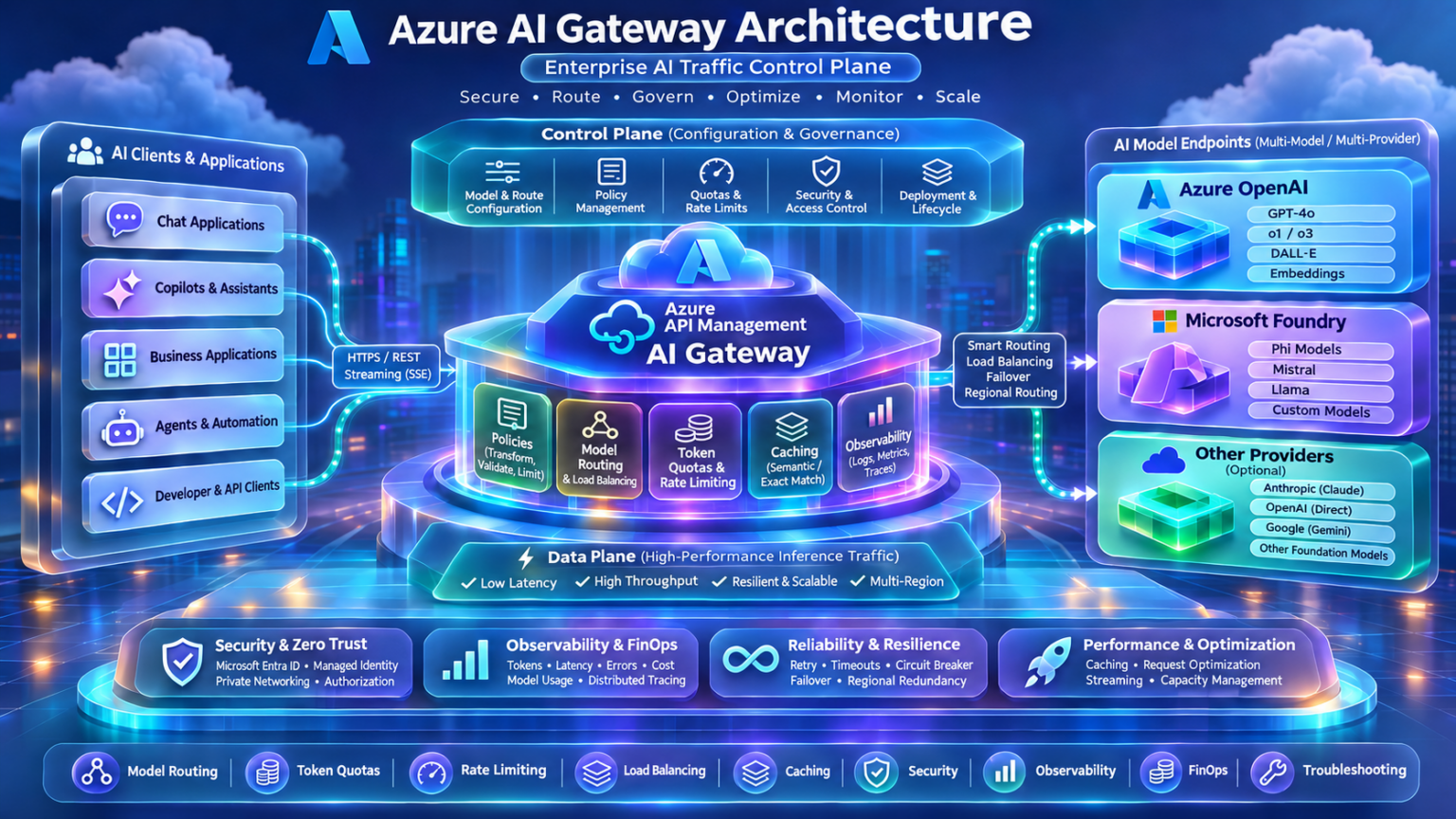
Explore the Azure AI Gateway Architecture
Navigate the nine engineering layers of a production Azure AI gateway, from API Management and intelligent model routing to token governance, security, observability and incident recovery. Select any architecture node to open its section.
Azure AI Gateway Architecture Fundamentals
An AI gateway provides a centralized traffic-management and policy-enforcement layer between AI applications and model inference endpoints.
In Microsoft Azure, Azure API Management can implement AI gateway capabilities through authentication, authorization, rate limiting, token governance, backend routing, caching and observability policies.
Understanding this architecture requires examining the relationship between client applications, gateway infrastructure, configured policies, model backends and operational telemetry.
What Is an Azure AI Gateway?
An AI gateway is an architectural layer that mediates requests between clients and AI model endpoints.
It extends traditional API gateway principles with controls relevant to AI workloads, such as token consumption, model deployment selection and inference traffic monitoring.
Centralized Access
Applications communicate through a managed gateway endpoint rather than independently integrating with every model.
Policy Enforcement
The gateway evaluates configured security, traffic-management and request processing rules.
Backend Abstraction
Model deployments can be represented through backend configurations, reducing direct client coupling.
Operational Visibility
Engineers can monitor traffic, latency, failures and available AI usage measurements.
An AI gateway is not necessarily a separate Azure product. Azure API Management can provide AI gateway functionality through supported policies, backend configurations and integrations.
Understanding the Layers of an AI Gateway
AI gateway architecture can be decomposed into several logical layers. Each layer performs a distinct responsibility in the request processing path.
These layers represent architectural responsibilities. They do not imply that every deployment requires a separate component or network hop for each layer.
The Main Components of an Azure AI Gateway Deployment
A typical deployment combines API Management configuration, gateway runtime processing, backend model services and supporting security and monitoring integrations.
| Component | Responsibility | Engineering Consideration |
|---|---|---|
| Client Applications | Generate AI inference requests | Authentication, retries and API contracts |
| Azure API Management | Expose APIs and process gateway policies | Deployment tier, networking and availability |
| API Policies | Enforce configured request and response controls | Policy order, scope and error handling |
| Backend Configuration | Define model endpoint connectivity | Endpoint selection and authentication |
| Model Endpoints | Execute AI inference workloads | Capacity, quota, latency and availability |
| Identity Services | Support authentication and access control | Managed identities and least privilege |
| Monitoring Services | Collect available diagnostics and telemetry | Tracing, privacy and operational correlation |
How the Gateway Processes an Inference Request
Gateway request processing follows the configured API Management policy pipeline.
Policies may validate a caller, inspect request metadata, enforce traffic limits, select a backend, modify requests or process backend responses.
Azure API Management policies are executed according to their configured scope and order within the inbound, backend, outbound and on-error sections. An early policy rejection can prevent the request from reaching the model backend.
Separating Configuration Management from Runtime Traffic
An important architectural distinction is the separation between configuration management and request execution.
Control and Management Plane
Engineers define APIs, policies, backend configurations, identities, monitoring settings and deployment parameters.
Data Plane
The gateway runtime receives client requests, evaluates policies, communicates with backends and returns responses.
This distinction helps engineers understand why configuration changes, policy propagation, gateway availability and backend health must be investigated separately.
Common Azure AI Gateway Deployment Architectures
AI gateways can be deployed using different patterns depending on network requirements, operational scale and organizational boundaries.
Centralized Gateway
Multiple applications share a centrally managed AI gateway and common policy framework.
Private Enterprise Gateway
Gateway and backend connectivity are designed around private network access and controlled exposure.
Multi-Region Gateway Design
Regional gateways and model backends can support distributed traffic management and resilience objectives.
Network isolation, virtual network integration, gateway deployment options and multi-region capabilities vary across API Management tiers and deployment models. Validate the selected tier against current Azure feature support.
API Gateway vs AI Gateway vs Model Router
These terms describe related but different architectural responsibilities.
| Component | Primary Role | Typical Capabilities |
|---|---|---|
| API Gateway | Manage API traffic | Authentication, policies, routing, throttling |
| AI Gateway | Manage AI inference traffic | API gateway functions plus AI-specific token, model and telemetry controls |
| Model Router | Select a model or deployment | Backend selection, routing strategies and fallback |
| Inference Endpoint | Execute model inference | Model execution, generation and response delivery |
An AI gateway may include model routing, and an API gateway may implement AI-specific policies. The distinction is primarily architectural, not necessarily a separation into independent products.
Designing a Production-Ready AI Gateway
Production gateway architecture should address security, capacity, performance, observability, reliability and maintainability together.
Least-Privilege Access
Grant callers and gateway identities only the permissions required for their workloads.
Capacity Awareness
Align gateway rate limits and token policies with model backend capacity constraints.
Observable Operations
Monitor latency, errors, traffic volume and supported AI usage metrics.
Controlled Failure Handling
Design retries, fallback and timeout behavior to avoid amplifying backend failures.
Understanding the AI Gateway as an Architectural Control Point
Azure AI gateway architecture provides a centralized approach to managing traffic between AI applications and inference backends.
Azure API Management can implement these capabilities through its gateway runtime, policy pipeline, backend configuration, identity integration and monitoring capabilities.
Understanding the distinction between gateway policies, model routing, backend inference and infrastructure management is essential for building reliable production AI platforms.
An Azure AI gateway is a policy-driven architectural control point. It centralizes security, traffic governance, backend selection and operational visibility while allowing AI applications to interact with model deployments through a consistent API layer.
Azure AI Gateway Architecture Explorer
Trace an AI request from the client application through Azure API Management, security policies, backend routing, model inference and telemetry. Switch architecture views and inject realistic request failures.
Architecture Configuration
The data plane processes application traffic. The control plane defines API configurations, policies, backend settings and operational controls. This is a conceptual enterprise architecture; actual Azure deployment options vary.
Request Telemetry
AI Gateway Data Plane
Architecture Assessment
Build the architecture to start a request trace.
Gateway Engineering Console
Azure API Management for AI Workloads
Azure API Management provides an API gateway and management platform that can enforce security, traffic, routing and observability policies for AI inference workloads.
In an AI gateway deployment, API Management sits between applications and supported model endpoints, applying configured policies before and after backend communication.
Understanding the API Management policy pipeline, API definitions, backend configuration, identity integration and policy inheritance is essential for designing maintainable enterprise AI gateways.
Understanding Azure API Management Components
Azure API Management provides capabilities for defining, publishing, securing and monitoring APIs.
Its gateway runtime processes incoming API traffic according to configured policies, while management capabilities allow engineers to define APIs, backends, products, subscriptions and operational settings.
Gateway Runtime
Receives API requests, evaluates policies, communicates with backends and returns responses.
API Definitions
Describe exposed operations, paths, methods and API contracts used by clients.
Backend Resources
Represent backend services and related connection configuration used for request forwarding.
Management Capabilities
Support API configuration, policy management, monitoring and lifecycle operations.
Azure API Management provides API lifecycle and policy management capabilities in addition to request forwarding. AI gateway functionality is implemented through supported APIM features and configuration.
How APIM Executes AI Gateway Policies
Azure API Management organizes policy processing into four sections: inbound, backend, outbound and on-error.
These sections determine where request validation, backend communication, response processing and error handling occur.
The on-error section is entered when supported policy processing errors occur. Ordinary backend HTTP error responses are not necessarily equivalent to APIM policy execution failures.
Understanding APIM Policy Structure
APIM policies use XML-based configuration. Policies are organized by execution section and can be applied at supported configuration scopes.
The base element determines where inherited policies from broader scopes are executed within the current policy section.
APIM supports policy configuration at multiple scopes, including global, product, API and operation levels. Effective policy behavior depends on scope, inheritance and placement of the base element.
How AI APIs Are Published and Organized
AI model access can be exposed through API definitions that provide clients with managed operations and consistent request paths.
APIM products can group APIs for publication and access management. Subscription requirements depend on the configured API and product settings.
API
Represents the exposed interface for client access to AI operations.
Product
Groups APIs for managed publication and subscription workflows.
Subscription
Provides subscription-based access controls where enabled.
APIM subscription keys can control access to configured APIs or products, but they should not automatically be treated as equivalent to strong user or workload authentication. Use appropriate identity validation and authorization controls for sensitive AI workloads.
Connecting APIM to AI Model Endpoints
Backend configuration determines where gateway requests are forwarded.
For AI workloads, backends may represent supported Azure OpenAI deployments, Microsoft Foundry model endpoints or other compatible services.
| Backend Element | Purpose | Engineering Consideration |
|---|---|---|
| Backend URL | Identifies destination service | Endpoint correctness and connectivity |
| Authentication | Allows gateway access to backend | Managed identity or supported credential method |
| Backend Selection | Determines request destination | Routing logic and deployment compatibility |
| Timeout Behavior | Controls request waiting behavior | Inference duration and streaming requirements |
| Retry Policy | Handles configured retry scenarios | Retry amplification and request semantics |
Using Managed Identities for Backend Authentication
Managed identities allow supported Azure resources to obtain Microsoft Entra tokens without embedding long-lived application secrets in configuration.
When correctly configured, an APIM managed identity can authenticate to a supported Azure AI backend using an access token for the appropriate resource audience.
Enabling a managed identity does not automatically grant access to an AI backend. Appropriate role assignments and backend authorization must also be configured.
Extending APIM for AI Gateway Workloads
AI workloads introduce operational concerns that differ from conventional API traffic.
Token consumption, model deployment selection, inference latency and response characteristics can require AI-aware policies and telemetry.
Token Limits
Enforce supported token-based consumption controls.
Model Routing
Select among configured model backends using appropriate policy logic.
AI Telemetry
Observe supported token metrics, requests, failures and latency.
Caching
Apply supported response caching policies where correctness, privacy and workload behavior permit.
AI-specific policies may have requirements involving API type, APIM tier, gateway version, backend compatibility or policy configuration. Validate the relevant feature documentation before production deployment.
Managing APIM Policies in Production
Production AI gateways should use controlled configuration management, testing and observability practices.
Gateway policy changes can affect every client sharing an API, so engineers should validate security, routing, throttling and response behavior before rollout.
Policy Version Control
Track policy definitions and configuration changes through controlled deployment processes.
Preproduction Validation
Test expected and rejected requests, authentication, routing and failure behavior.
Operational Telemetry
Collect request-level diagnostics, latency, error rates and available AI usage measurements.
Controlled Rollback
Maintain validated recovery procedures for faulty gateway policy deployments.
Prompts, model responses, tokens and authentication headers can contain sensitive information. Diagnostic configuration should follow data minimization, access control and retention requirements.
Understanding APIM as the AI Gateway Execution Layer
Azure API Management provides the gateway runtime and management capabilities required to implement many enterprise AI gateway patterns.
Its policy pipeline controls request and response processing, while API definitions, backend resources, managed identities and monitoring integrations support broader operational requirements.
Production implementations must consider policy scope, inheritance, backend authorization, traffic limits, monitoring and safe deployment procedures.
Azure API Management can provide a policy-driven execution layer for enterprise AI gateways. Understanding inbound, backend, outbound and on-error processing is fundamental to designing secure, observable and maintainable inference traffic architectures.
API Management Policy Pipeline Simulator
Execute Azure API Management policies in sequence. Validate client credentials, apply inbound transformations, forward requests to AI backends and inspect outbound processing and error handling.
API Management Policy Configuration
APIM policies execute within inbound, backend, outbound and on-error sections. The exact policy order depends on the configured XML policy document and inherited policy scopes.
Policy Execution Metrics
Azure API Management Policy Architecture
Policy Execution Timeline
Policy Execution Assessment
Build the pipeline to begin policy execution.
APIM Policy Engineering Console
AI Model Routing and Load Balancing
AI model routing determines which inference backend receives a request, while load balancing distributes traffic across available model deployments according to configured selection rules.
In Azure AI gateway architectures, Azure API Management can route traffic among configured Azure OpenAI deployments, Microsoft Foundry model endpoints and other compatible backends.
Effective routing requires more than distributing HTTP requests. Engineers must consider model compatibility, deployment capacity, regional availability, inference latency, quota behavior, health signals and failure recovery.
Why AI Workloads Require Intelligent Backend Routing
Traditional API load balancing often distributes requests among servers providing equivalent application functionality.
AI inference introduces additional complexity because model deployments may differ in capacity, model version, supported features, regional placement, response latency and consumption cost.
Capacity Distribution
Spread compatible requests across deployments to reduce concentration on one backend.
Regional Placement
Select deployments based on supported regional architecture, latency and residency constraints.
Model Compatibility
Ensure requests reach endpoints supporting the required model, API contract and features.
Failure Handling
Redirect eligible requests when a backend becomes unavailable or constrained.
Inside an AI Model Routing Architecture
A gateway can maintain configurations for multiple AI model backends.
Routing logic selects an eligible backend based on configured policies, supported load balancing capabilities and the operational state available to the gateway.
Agents
Enterprise APIs
Backend Routing Logic
The gateway selects and forwards requests. The selected backend performs inference using its own model infrastructure, capacity allocation and service controls.
Common AI Backend Selection Strategies
Different workloads require different routing objectives. A single routing strategy may not suit every application.
| Strategy | How It Works | Engineering Consideration |
|---|---|---|
| Round Robin | Cycles through eligible backends | Assumes reasonably comparable backend suitability |
| Weighted Routing | Assigns different selection proportions | Weights should reflect intended allocation, not guaranteed throughput |
| Priority-Based Routing | Prefers a primary backend before alternatives | Requires explicit failover conditions |
| Capacity-Aware Routing | Uses available capacity or throttling signals | Signals may be delayed or incomplete |
| Regional Routing | Selects a deployment based on region-related rules | Data residency and model availability must be considered |
| Model-Based Routing | Matches requests to compatible model deployments | API, model and feature compatibility are essential |
These are architectural strategies. Their implementation may require supported APIM backend pools, policy expressions, external routing logic or additional services. Feature availability depends on the deployed APIM configuration.
Using Backend Pools to Organize Model Deployments
A backend pool represents a group of configured backend destinations that can participate in supported routing and load balancing behavior.
Pool members should be selected carefully because successful request distribution requires compatible endpoints and appropriate authentication.
Backend Membership
Define which deployments are eligible for a particular routing policy.
Backend Weights
Assign configured distribution preferences among eligible members.
Backend Priority
Prefer selected backends when priority-based routing is configured.
Two deployments should not be considered interchangeable solely because they expose HTTP endpoints. Validate model capabilities, API versions, request schemas, authentication and response semantics before placing them in the same routing strategy.
Why AI Load Balancing Must Consider Token Capacity
AI inference requests can consume very different amounts of backend capacity.
A short request and a long context request may both count as one HTTP request while placing substantially different demands on model resources.
Capacity-aware designs can incorporate supported throttling signals, quota information and operational telemetry to improve backend selection.
Tokens-per-minute allocations and request limits describe service constraints, not guaranteed response latency or throughput. Actual inference performance also depends on workload characteristics, model behavior and service conditions.
Routing Across Azure Regions
Multi-region AI gateway architectures can support geographic distribution, operational resilience and placement requirements.
However, region selection must account for model availability, backend deployment type, data residency, network connectivity and application latency.
Regional Availability
Verify that the required model and deployment capabilities are supported in the destination region.
Latency Considerations
Evaluate network distance, backend processing time and streaming behavior.
Residency Constraints
Ensure routing behavior respects contractual, organizational and regulatory data-processing requirements.
Regional Failure
Define when alternate regions may receive traffic and how applications recover.
Multi-region model deployments do not guarantee application continuity. Gateway availability, client connectivity, authentication, backend compatibility and recovery procedures must also be considered.
Backend Health, Throttling and Failover
AI gateway routing must distinguish between backend unavailability, capacity exhaustion, transient errors and application-level failures.
Depending on the configured policies and backend capabilities, a gateway may retry, select another eligible backend or return an error to the caller.
Once a streaming response has begun, transparently replaying a request against another model can create inconsistent output. Retry logic should account for response commitment, duplicate execution, latency budgets and request semantics.
Balancing Performance, Reliability and Governance
Routing architecture is a tradeoff between competing objectives.
For example, selecting the lowest-latency backend may increase cost or violate residency requirements. Selecting the cheapest compatible model may change response quality or supported capabilities.
| Objective | Potential Benefit | Tradeoff |
|---|---|---|
| Lowest Latency | Faster response delivery | May concentrate traffic on constrained backends |
| Maximum Availability | More recovery options | Requires compatible and reachable alternatives |
| Cost Optimization | Lower model consumption expense | Potential differences in quality and capabilities |
| Regional Control | Stronger placement governance | May reduce eligible backend choices |
| Capacity Distribution | Reduced load concentration | Requires meaningful capacity signals |
Understanding Model Routing as a Policy-Driven Decision
AI model routing is a critical function of enterprise AI gateway architecture.
Azure API Management can support routing across configured model backends, with behavior determined by backend resources, supported load balancing capabilities and gateway policies.
Effective designs must consider capacity, compatibility, regional placement, operational health, failure handling and request semantics.
AI load balancing is not simply equal distribution of HTTP requests. A production gateway must select compatible model backends while accounting for capacity, availability, regional constraints and safe recovery behavior.
AI Model Routing and Load Balancing Lab
Configure an enterprise AI gateway with multiple Azure model deployments. Compare routing algorithms, adjust backend weights, inject regional failures and observe how requests are distributed across healthy endpoints.
Gateway Routing Configuration
Round robin rotates between healthy backends. Weighted routing biases selection. Least-served routing balances cumulative request counts in this simplified model. Priority routing prefers Backend A until it becomes unavailable.
Gateway Routing Metrics
Live AI Gateway Routing Topology
Backend Request Distribution
Routing Assessment
Build the backend pool to begin routing requests.
AI Gateway Routing Console
Token Quotas, Rate Limiting and Capacity Management
AI gateway capacity management controls how inference requests consume shared model resources and how traffic is constrained when demand exceeds configured limits.
In Azure AI gateway architectures, Azure API Management can apply request-based and supported token-based policies before forwarding traffic to AI model deployments.
Understanding requests per minute, tokens per minute, quota allocation, throttling behavior and backend capacity is essential for building reliable production AI systems.
Why AI Capacity Is Different from Traditional API Capacity
Conventional API capacity planning often begins with request rate, response latency and concurrent connections.
AI inference workloads introduce token consumption as an additional resource dimension. Two requests can consume dramatically different amounts of model capacity even when they generate the same number of HTTP transactions.
Request Rate
Measures the number of requests received during a defined time interval.
Token Consumption
Represents input and generated output token usage, subject to model-specific accounting.
Concurrency
Describes how many inference requests are active at the same time.
Inference Latency
Measures the time required to process and return inference results.
HTTP request volume alone is insufficient for AI capacity planning. Token demand, model processing characteristics, concurrency and backend limits must also be considered.
Inside an AI Gateway Token Capacity Architecture
Gateway-level capacity controls and backend model quotas operate at different points in the request path.
A request may satisfy the gateway's configured limits but still encounter throttling or capacity restrictions at the selected model deployment.
AI Agents
Batch Inference
Enterprise APIs
Capacity Governance
API Management policy limits do not increase the available quota of an Azure OpenAI or Microsoft Foundry model deployment. Backend throttling remains possible even when the gateway accepts a request.
Understanding Requests per Minute and Tokens per Minute
Requests per minute (RPM) measures how many inference requests are permitted or processed during a specified interval.
Tokens per minute (TPM) measures token demand or consumption according to the applicable service or gateway accounting rules.
| Metric | What It Measures | Engineering Significance |
|---|---|---|
| RPM | Requests within a defined interval | Controls request frequency and burst pressure |
| TPM | Tokens within a defined interval | Controls token-based demand |
| Concurrency | Simultaneously active requests | Influences queueing and response latency |
| Input Tokens | Tokens supplied to the model | Influences context processing demand |
| Output Tokens | Tokens generated by the model | Influences generation time and consumption |
This calculation provides a useful starting point for workload planning, but actual service quota enforcement can use estimates or accounting rules that differ from final billed token usage.
Some model services estimate token demand when a request is admitted, while final usage may be determined after inference completes. Gateway token policies and backend quotas should not be assumed to use identical accounting methods.
Enforcing Traffic Limits at Azure API Management
Azure API Management supports policies that can limit request rates and enforce configured consumption controls.
For AI workloads, supported token-based policies can provide additional controls related to model token consumption.
Request Rate Limits
Restrict the number of requests accepted during a configured interval.
Token Rate Limits
Apply supported token-based rate controls to compatible AI APIs.
Consumption Quotas
Restrict permitted usage over longer configured accounting periods.
Rate-limit enforcement depends on policy configuration, counter keys, gateway deployment topology and supported synchronization behavior. Do not assume all gateway instances share perfectly synchronized counters.
Allocating AI Capacity Across Applications and Teams
Shared AI platforms often serve multiple applications, teams and business units.
Without appropriate consumption controls, a high-volume workload can exhaust shared capacity and affect other applications.
Gateway policies can use suitable counter keys and access controls to apply different limits to applications or consumers.
Application token budgets should reflect workload priority, expected demand, service-level objectives and available backend capacity. A configured budget does not reserve model processing resources unless supported capacity arrangements explicitly provide that guarantee.
Understanding HTTP 429 and Capacity Rejection
HTTP 429 indicates that a request has been rejected due to rate limiting or throttling.
In AI gateway architectures, throttling can originate from the gateway's configured policies or from the downstream model service.
| Failure Source | Typical Cause | Investigation |
|---|---|---|
| Gateway Rate Limit | Configured request threshold exceeded | Inspect APIM policies and counters |
| Gateway Token Limit | Supported token threshold exceeded | Inspect token policy and consumer key |
| Backend Throttling | Model deployment capacity restriction | Inspect backend response and quota telemetry |
| Transient Capacity Pressure | Temporary service demand or resource pressure | Review time-correlated errors and retry guidance |
Engineers should correlate gateway diagnostics, policy execution information and backend responses to determine where throttling originated. HTTP status alone is insufficient for precise fault isolation.
Managing Burst Traffic Without Creating Retry Storms
AI traffic is often bursty. Multiple users, agents or automated workflows may submit requests simultaneously.
When requests are throttled, uncontrolled retries can increase demand on already constrained backends.
Exponential Backoff
Increase the waiting interval between eligible retry attempts.
Randomized Jitter
Reduce synchronized retry behavior across multiple clients.
Retry Budgets
Limit the number and duration of retry attempts.
Admission Control
Reject or defer demand when capacity is insufficient instead of amplifying overload.
Designing Capacity for Real AI Workloads
Capacity planning should combine observed request rates, token distributions, concurrency, latency objectives and backend quota information.
Average token usage alone may hide important peak demand and burst behavior.
| Planning Input | Why It Matters | Recommended Analysis |
|---|---|---|
| Peak RPM | Identifies request bursts | Measure short-window peaks |
| Token Distribution | Captures variable request sizes | Inspect averages and percentiles |
| Concurrent Requests | Reveals simultaneous demand | Correlate with latency and errors |
| Backend Quota | Defines service admission constraints | Validate per deployment and region |
| Latency Objectives | Defines user-facing performance targets | Measure time to first token and completion time |
| Failure Rate | Reveals capacity pressure | Correlate 429, timeout and retry events |
Capacity estimates should be validated with representative workload testing. Model behavior, prompt length, output length, streaming, concurrency and deployment configuration can materially affect observed performance.
Understanding Capacity as a Shared Gateway and Backend Responsibility
AI gateway capacity management requires coordination between gateway traffic policies and downstream model service constraints.
Azure API Management can enforce supported request and token-based controls, but it does not replace backend model quota enforcement or guarantee inference throughput.
Production designs should combine consumption governance, burst handling, capacity-aware routing, observability and safe retry behavior.
Requests per minute and tokens per minute describe different aspects of AI demand. A production Azure AI gateway must manage both while accounting for backend quota, workload variability, throttling and controlled recovery from overload.
Token Budget and Throttling Simulator
Configure token-per-minute and request-per-minute limits. Generate enterprise AI traffic, inspect per-client consumption, trigger HTTP 429 responses and investigate retry behavior.
AI Gateway Capacity Configuration
This educational model uses a rolling 60-second request window and reserves estimated tokens when a request is admitted. Real Azure OpenAI quotas and APIM policies can use different enforcement and token-accounting behavior.
Capacity Metrics
Live Gateway Token Budget
Per-Tenant Token Consumption
Gateway Capacity Assessment
Send requests to investigate capacity enforcement.
Token Quota Engineering Console
AI Gateway Security and Zero Trust
Securing an enterprise AI gateway requires more than protecting a public API endpoint. Engineers must establish trusted identities, enforce authorization, secure backend credentials, control network access and protect sensitive inference data.
In Azure, these requirements can be addressed through Azure API Management, Microsoft Entra ID, managed identities, Azure RBAC, private networking, encryption and operational security controls.
A Zero Trust approach assumes that requests must be explicitly validated and authorized, regardless of their network origin.
Why AI Gateways Require Multiple Security Boundaries
AI gateways often provide access to valuable model services and sensitive enterprise data.
A compromised caller, exposed backend credential or incorrectly configured routing policy can create risks involving unauthorized inference, data exposure, service abuse and unexpected consumption costs.
Caller Authentication
Establish the identity of users, applications and workloads accessing AI APIs.
Authorization
Determine which AI APIs and operations an authenticated caller may access.
Network Isolation
Restrict gateway and model endpoint connectivity according to network security requirements.
Data Protection
Protect prompts, model responses, credentials and operational telemetry.
Inside a Secure Azure AI Gateway Architecture
A secure AI gateway design separates caller identity, gateway policy enforcement, backend authentication and network access into distinct trust decisions.
Each request should be evaluated using appropriate identity, authorization and policy controls before being forwarded to a protected model endpoint.
Workload Identity
Access Token
Authorization Policies
Secure Backend Access
Microsoft Foundry
Backend Authorization
Private connectivity can reduce network exposure, but it does not replace authentication, authorization, least privilege or application-level security controls.
Authenticating AI Gateway Callers
Microsoft Entra ID can provide identity and token services for applications, users and workloads accessing protected AI APIs.
Azure API Management can validate supported JWT access tokens using configured token validation policies.
A valid access token proves that a token satisfies configured validation requirements. It does not automatically mean the caller is authorized to use every AI model or API operation.
Securing Gateway-to-Model Authentication
Managed identities allow supported Azure services to authenticate to other Azure resources without embedding long-lived secrets in application configuration.
In a supported Azure AI gateway design, API Management can use its managed identity to acquire an access token for a protected AI backend.
Enable Identity
Configure the appropriate managed identity on the APIM instance.
Grant Permissions
Assign the required backend access permissions using the supported authorization mechanism.
Acquire Token
Configure the gateway to request the correct token audience for the backend service.
Managed identity eliminates the need to store certain long-lived backend credentials, but engineers must still configure appropriate role assignments, endpoint access and network connectivity.
Controlling Which Callers Can Use AI Models
Authorization determines what an authenticated caller may do.
Enterprise AI gateways can enforce application access rules using validated identity claims, API-level policies and supported subscription controls.
| Control | Purpose | Engineering Consideration |
|---|---|---|
| JWT Validation | Verify configured token properties | Issuer, audience, expiry and claims |
| API Authorization | Restrict operations to permitted callers | Roles, scopes and policy expressions |
| APIM Subscriptions | Control subscription-based API access | Keys are not a substitute for workload identity |
| Azure RBAC | Grant supported Azure resource permissions | Least-privilege role assignments |
| Backend Authorization | Control gateway access to model services | Managed identity and required backend roles |
When APIM accesses a model using a shared managed identity, the backend may see the gateway identity rather than the original client. Per-caller authorization must therefore be enforced at the appropriate layer.
Protecting AI Gateway and Backend Connectivity
Private networking can reduce the exposure of AI services to public network paths.
Azure AI gateway deployments may use supported APIM virtual network capabilities, private endpoints, private DNS and network security controls to protect connectivity.
A private endpoint requires appropriate DNS resolution so that supported service names resolve to the intended private IP addresses. Incorrect DNS configuration can cause connection failures or unexpected routing.
Inbound private access, outbound VNet connectivity, network injection and gateway deployment options vary across Azure API Management tiers. Confirm the required capabilities before choosing a deployment model.
Protecting Secrets, Prompts and Model Responses
AI gateway security includes protecting both infrastructure credentials and inference data.
Prompts and model responses may contain confidential business information, personal data or other sensitive content.
Credential Protection
Prefer supported managed identities and secure secret storage over hardcoded credentials.
Transport Encryption
Use appropriate TLS configuration to protect data in transit.
Diagnostic Protection
Avoid unnecessary logging of prompts, responses, access tokens and secrets.
Data Governance
Apply suitable retention, access control and data handling policies to AI traffic.
Request and response bodies may contain sensitive information. Enable payload diagnostics only when necessary, with appropriate redaction, access restrictions and retention controls.
Common AI Gateway Security Failure Scenarios
Security architecture should account for both conventional API threats and AI-specific risks.
| Threat Scenario | Potential Impact | Relevant Control |
|---|---|---|
| Stolen API Credential | Unauthorized inference consumption | Identity controls, credential rotation, usage limits |
| Overprivileged Gateway Identity | Excessive backend access | Least-privilege RBAC and scope review |
| Exposed Model Endpoint | Bypass of intended gateway controls | Network restrictions and backend authentication |
| Incorrect JWT Validation | Acceptance of unintended callers | Strict issuer, audience and claim validation |
| Sensitive Payload Logging | Data exposure through diagnostics | Redaction, access control and retention policies |
| Prompt Injection | Manipulated model or agent behavior | Application-level safeguards and tool authorization |
API Management can enforce important network, identity and traffic controls, but application-level AI risks such as prompt injection, unsafe tool execution and model output handling require additional safeguards.
Building a Zero Trust AI Gateway Architecture
A secure Azure AI gateway combines caller identity, authorization, backend authentication, network isolation, credential protection and data governance.
Microsoft Entra ID and managed identities can provide strong identity foundations, while Azure API Management policies enforce configured access and traffic controls.
Private networking and secure diagnostics provide additional protection, but they do not replace application-level security or least-privilege authorization.
Zero Trust AI gateway architecture requires every relevant trust boundary to be protected. Authentication, authorization, backend identity, private connectivity and data protection must work together to secure enterprise inference traffic.
AI Gateway Security Decision Lab
Evaluate enterprise AI gateway security across identity, authorization, managed identities, private connectivity and credential protection. Trace the trust chain from client applications to protected AI model deployments.
Zero Trust Security Configuration
Zero Trust requires more than authentication. A secure gateway must verify identity, enforce authorization, protect backend credentials and restrict unnecessary network exposure.
Security Assessment Metrics
Enterprise AI Gateway Trust Architecture
Security Control Findings
Security Decision Assessment
Configure the trust chain and evaluate security.
Zero Trust Engineering Console
AI Gateway Performance and Caching
AI gateway performance depends on more than network latency. Inference response times are influenced by model processing, token generation, backend capacity, request size, streaming behavior and gateway policy execution.
Caching can reduce unnecessary inference requests when previously generated responses remain suitable for reuse. However, AI caching introduces additional challenges involving semantic similarity, correctness, privacy, freshness and response context.
Azure API Management can support selected caching patterns through its supported policies and integrations, but the architecture must be designed around the characteristics of the AI workload.
Understanding the AI Inference Latency Budget
End-to-end inference latency includes multiple processing stages.
These may include client network transit, gateway policy evaluation, backend network transit, model admission and queueing, prompt processing and output generation.
Gateway Processing
Time spent evaluating configured policies, transformations and routing decisions.
Network Transit
Time required to transfer requests and responses between clients, gateways and model endpoints.
Model Processing
Backend admission, prompt processing and inference execution.
Output Generation
Time required for the model to generate and deliver output tokens.
A slow AI response does not automatically indicate a gateway problem. Engineers should separate gateway processing, network latency and backend inference time when diagnosing performance.
Inside an AI Gateway Caching Architecture
A caching layer can return a previously generated response when the incoming request satisfies configured cache eligibility rules.
Depending on the caching design, eligibility may require an exact request match or an acceptable semantic similarity between prompts.
Model Parameters
User Context
Request Matching
Backend Routing
A cached response may be unsuitable if the caller, model version, system instructions, authorization context, tool results or underlying data have changed. Cache eligibility must account for these dependencies.
Reusing Responses for Identical Requests
Exact-match caching returns a stored response when an incoming request matches a previously cached request according to a defined cache key.
This can be effective for repeatable AI tasks where the relevant input, model configuration and response context remain stable.
Request Normalization
Define which request fields must match before a cached response can be reused.
Cache Key Design
Include relevant model, parameters, tenant and authorization context.
Expiration
Apply appropriate time-to-live and invalidation controls.
Identical prompts can require different answers when time-sensitive information, external data, conversation state or authorization context changes.
Reusing Responses for Semantically Similar Prompts
Semantic caching uses representations of prompt meaning to identify potentially reusable responses even when request text is not identical.
A typical semantic cache architecture uses embeddings, similarity comparison and a configured acceptance threshold.
Two prompts may be semantically similar but require different answers. Semantic caching must be tested against domain accuracy, privacy and response correctness requirements.
Understanding Streaming and Perceived Latency
Time to first token (TTFT) measures how long a client waits before receiving the first generated output token.
For streaming AI applications, TTFT can be an important user-experience metric because users begin seeing output before the full response is complete.
| Metric | Meaning | Engineering Use |
|---|---|---|
| TTFT | Time until first generated token is received | Measures initial streaming responsiveness |
| Total Response Time | Time until response completion | Measures full request duration |
| Output Token Rate | Generated output tokens per second | Measures generation throughput |
| Gateway Processing Time | Time spent processing gateway policies | Supports gateway bottleneck investigation |
| Backend Latency | Time associated with backend request processing | Supports model-side performance diagnosis |
Streaming can improve perceived responsiveness by delivering partial output earlier, but it does not automatically reduce model computation time or total token generation duration.
Cache Expiration, Invalidation and Context Isolation
AI caching requires governance because cached responses can become stale or inappropriate for a different caller.
Cache expiration, invalidation, tenant isolation and authorization context are essential design considerations.
Time-to-Live
Define how long cached responses remain eligible for reuse.
Invalidation
Remove or invalidate entries when underlying information changes.
Tenant Isolation
Prevent responses from being reused across unauthorized tenant boundaries.
Model Versioning
Account for model changes that may affect response compatibility.
Prompts and responses may contain sensitive data. Cache storage, encryption, access control, retention and deletion policies must be evaluated as part of the overall security architecture.
Measuring Cache Hit Rate and Inference Savings
Cache hit rate measures the proportion of eligible requests served from cache rather than requiring a new model inference request.
A higher hit rate may reduce backend demand, but the value of caching depends on correctness, cache lookup overhead and the cost of maintaining cache infrastructure.
An aggressive similarity threshold may increase cache hits while reducing response accuracy. Cache quality should be evaluated alongside latency and cost.
Designing a High-Performance AI Gateway
Gateway performance optimization should target measured bottlenecks rather than applying caching or routing changes without workload evidence.
| Optimization | Potential Benefit | Tradeoff |
|---|---|---|
| Exact-Match Caching | Avoids repeat inference for eligible requests | Requires correct cache keys and freshness |
| Semantic Caching | Reuses suitable responses across similar prompts | Similarity errors and embedding overhead |
| Streaming | Improves perceived responsiveness | Requires streaming-compatible policies and clients |
| Backend Routing | Distributes demand across compatible deployments | Routing complexity and capacity awareness |
| Prompt Optimization | Can reduce token demand and processing overhead | May change model behavior or answer quality |
| Telemetry Analysis | Identifies actual performance bottlenecks | Requires careful diagnostic configuration |
Streaming responses may require different cache handling from ordinary buffered responses. Do not assume a standard response cache can transparently cache every streaming inference operation.
Understanding AI Gateway Performance as an End-to-End Problem
AI gateway performance depends on gateway policy execution, network transit, backend model behavior, token generation and application delivery.
Caching can reduce repeated inference demand when responses are safe and appropriate to reuse. Streaming can improve perceived responsiveness without necessarily reducing total inference duration.
Production optimization requires careful measurement of latency, cache quality, token consumption, correctness and backend behavior.
A high-performance Azure AI gateway must optimize the complete inference request path. Exact-match caching, semantic caching, streaming and routing can improve efficiency, but only when implemented with appropriate correctness, privacy, compatibility and observability controls.
AI Gateway Cache and Latency Explorer
Compare exact-match and conceptual semantic caching. Generate AI requests, inspect cache hits and misses, analyze inference latency and evaluate the impact of response streaming on perceived performance.
AI Gateway Performance Configuration
Exact caching requires the same cache key. Semantic caching can reuse responses for sufficiently similar prompts, subject to similarity thresholds and safety constraints. This simulator uses predefined prompt families rather than real embeddings.
Performance Metrics
Live AI Gateway Cache Architecture
Request Latency Breakdown
Gateway Cache Memory
Performance Assessment
Send a request to investigate caching behavior.
AI Gateway Performance Console
Multi-Model and Multi-Provider AI Gateways
Enterprise AI platforms increasingly require access to multiple model families, deployments, regions and providers. A multi-model AI gateway provides a common control layer through which applications can access approved AI services.
In Azure, API Management can act as a gateway for supported Azure OpenAI, Microsoft Foundry and compatible external AI endpoints.
This architecture can simplify application integration, centralize governance and support configurable backend routing. However, differences between model APIs and capabilities must still be handled explicitly.
Why Enterprise AI Platforms Need Multiple Models
Different AI models are optimized for different workloads, including reasoning, code generation, summarization, classification, embeddings and multimodal processing.
A single model deployment may not satisfy every application's latency, cost, capability, availability or governance requirements.
Model Specialization
Select models according to workload requirements and supported capabilities.
Cost Optimization
Route eligible workloads to models with suitable cost and performance characteristics.
Availability
Use alternative compatible deployments when a preferred backend becomes unavailable.
Governance
Apply consistent access, monitoring and consumption policies across approved AI endpoints.
Inside a Multi-Model Azure AI Gateway
A multi-model gateway separates application-facing API access from backend model selection.
Applications communicate with the gateway, while routing and transformation policies determine which compatible backend receives each request.
AI Agents
Enterprise APIs
Automation Workflows
Backend Selection
Policy Enforcement
Different models may support different request schemas, context windows, tool-calling behavior, streaming formats, modalities and output semantics. A gateway cannot assume every model is a drop-in replacement.
Separating Applications from Backend Model Implementations
Model abstraction allows applications to communicate through a stable API contract while backend model selection changes behind the gateway.
This can reduce application coupling to specific deployment URLs and credentials.
A common API should specify supported request fields, model capabilities, response formats, errors and streaming behavior. Unsupported features must be rejected or handled explicitly.
Selecting the Right Model for Each Request
Multi-model routing can use static policies, application requirements, model capabilities, observed health or other configured criteria.
Capability-Based Routing
Select a backend that supports the required workload or API feature.
Cost-Aware Routing
Prefer eligible models according to configured cost policies and quality requirements.
Health-Aware Routing
Avoid unhealthy or unavailable endpoints when compatible alternatives exist.
| Routing Criterion | Purpose | Important Constraint |
|---|---|---|
| Capability | Match workload requirements to model features | Features must be verified per model |
| Latency | Prefer lower-latency eligible backends | Latency varies with workload and load |
| Cost | Control inference expenditure | Pricing and token accounting differ |
| Availability | Avoid unavailable endpoints | Requires reliable health signals |
| Region | Meet deployment and data location requirements | Availability and residency must be verified |
Managing Different Backend Security Requirements
Backend providers may use different authentication methods, authorization models and credential formats.
Azure model endpoints may support Microsoft Entra authentication and managed identities, while external providers may require API keys or other supported credentials.
Azure Identity
Use supported managed identity and role-based access for compatible Azure backends.
External Credentials
Protect provider-specific credentials using suitable secret management and rotation controls.
Backend authentication should be configured separately from caller authentication. Tokens or secrets intended for one service must not be forwarded to an unrelated provider.
Recovering from Model Endpoint Failures
Fallback allows a request to be redirected to an alternative compatible backend when the preferred endpoint cannot complete the operation.
However, fallback must account for request compatibility, retry safety, partial responses, deadlines and data governance.
Load balancing distributes requests across eligible backends during normal operation. Fallback changes the selected backend in response to an eligible failure or unavailable service.
Handling Differences Between Model APIs
Model providers differ in their API interfaces, request parameters, streaming formats, error responses, usage reporting and supported capabilities.
A multi-provider gateway should define a clear compatibility contract and identify where provider-specific adapters are required.
| Compatibility Area | Potential Difference | Gateway Responsibility |
|---|---|---|
| Request Schema | Different JSON fields and endpoints | Transform supported requests |
| Authentication | Different identity and credential mechanisms | Apply backend-specific authentication |
| Streaming | Different event and chunk formats | Preserve or adapt supported streams |
| Tool Calling | Different tool definitions and semantics | Validate compatibility before routing |
| Usage Reporting | Different token and billing metrics | Normalize only comparable measurements |
| Error Handling | Different status and error structures | Map errors without hiding useful detail |
Converting provider-specific responses into a common format may omit features or metadata. Applications should know which capabilities are guaranteed by the gateway contract and which remain provider-specific.
Operating a Multi-Provider AI Gateway in Production
A multi-provider architecture introduces additional operational complexity.
Teams must monitor backend health, provider-specific limits, response quality, latency, cost and access controls across all configured destinations.
Model Inventory
Maintain a controlled inventory of approved deployments, capabilities and owners.
Provider Health
Monitor endpoint availability, latency, throttling and failure patterns.
Cost Governance
Attribute consumption and expenditure across models, applications and providers.
Compliance
Validate provider usage against data handling, residency, retention and security requirements.
Adding alternative models can improve flexibility, but each provider introduces its own operational, contractual, security and data handling considerations.
Designing a Unified Enterprise AI Access Layer
Multi-model AI gateways allow applications to access approved AI services through a common control layer.
Azure API Management can provide API governance, authentication, traffic policies and configurable routing to compatible AI endpoints.
However, model abstraction, provider compatibility, fallback, credential management and operational monitoring require deliberate architecture decisions.
A successful multi-model AI gateway does not simply connect applications to multiple models. It provides a controlled architecture for selecting, securing, monitoring and governing compatible AI services while preserving the differences that matter between providers.
Multi-Model Gateway Orchestration Lab
Route AI workloads through a unified gateway to Azure OpenAI, Microsoft Foundry and an external model provider. Compare capability matching, task-aware selection, provider failures and fallback decisions.
AI Gateway Orchestration Configuration
Multi-model orchestration requires capability matching, provider-specific authentication, request/response adapters and error handling. This lab models those decisions without making external API calls.
Orchestration Metrics
Multi-Provider AI Gateway Architecture
Model Capability Matrix
Orchestration Decision
Select an AI workload and orchestrate a request.
Multi-Model Engineering Console
AI Gateway Observability and FinOps
Operating enterprise AI gateways requires visibility into application traffic, gateway policies, model endpoint performance, token consumption, failures and inference costs.
Traditional API monitoring focuses on request volume, latency, status codes and availability. AI workloads introduce additional dimensions, including prompt tokens, generated tokens, model selection, time to first token, provider consumption and cost attribution.
Azure Monitor, Application Insights, Log Analytics and supported API Management diagnostics can provide important operational signals. Additional application or backend instrumentation may be required to capture complete AI-specific telemetry.
Understanding the AI Gateway Telemetry Model
AI gateway observability should correlate traffic across the application, gateway and model backend rather than treating each component as an isolated system.
Useful telemetry includes request identity, routing decisions, latency, response status, backend selection and token usage when available.
Request Telemetry
Track request volume, response status, route selection and end-to-end latency.
Model Telemetry
Capture available token usage, model identifiers and inference performance.
Reliability Telemetry
Monitor failures, throttling, retries and backend availability.
Financial Telemetry
Attribute consumption and estimated expenditure to applications, models and business units.
Inside an Azure AI Gateway Telemetry Pipeline
An enterprise observability architecture collects signals from multiple layers of the inference request path.
Gateway diagnostics can provide API traffic visibility, while application and backend telemetry may contribute token consumption, model-specific timing and business context.
Agent Workflows
Correlation IDs
Business Context
Request Diagnostics
Backend Routing
Usage Signals
Gateway diagnostics may not expose every model timing, token usage or provider billing field. A complete observability solution may need to combine gateway, application and model service telemetry.
Defining an AI Gateway Operational Dashboard
A production dashboard should combine conventional API metrics with AI-specific consumption and performance indicators.
| Metric | Purpose | Operational Value |
|---|---|---|
| Request Rate | Measure incoming demand | Capacity planning and traffic analysis |
| P50 / P95 / P99 Latency | Measure response-time distribution | Detect slow-tail performance |
| HTTP 429 Rate | Measure throttling responses | Investigate quotas and capacity |
| HTTP 5xx Rate | Measure server-side failures | Investigate gateway and backend errors |
| Token Usage | Measure reported input and output consumption | Capacity and cost analysis |
| Backend Distribution | Measure requests by deployment | Validate routing behavior |
Tracing an Inference Request Across Multiple Services
Distributed tracing helps engineers follow a request through application components, gateway policies and backend service calls.
Correlation identifiers and supported tracing instrumentation make it easier to identify where failures or latency are introduced.
A request identifier alone does not guarantee a complete distributed trace. Applications, gateway components and supported downstream services must propagate and record appropriate correlation context.
Measuring Input and Output Token Consumption
AI consumption is often influenced by the number and type of tokens processed by the model.
Input and output token usage should be recorded using available provider usage fields or other supported telemetry.
Token counts vary by model, tokenizer and API behavior. Where available, use the model provider's reported usage fields for consumption analysis.
Attributing AI Inference Costs to Applications and Teams
FinOps connects technical consumption metrics to financial accountability.
For AI gateways, this can involve attributing model usage to applications, departments, projects, tenants or other business dimensions.
Usage Attribution
Associate model requests and consumption with approved application identifiers.
Cost Estimation
Apply appropriate pricing or allocation rules to measured usage.
Budget Governance
Monitor consumption against business budgets and operational thresholds.
Actual charges depend on the applicable model pricing, deployment model, billing units, discounts, infrastructure and provider terms. Reconcile estimates with authoritative billing data.
Detecting AI Gateway Performance and Consumption Problems
Operational alerting should identify conditions that require engineering investigation.
Useful alert categories include rising error rates, sustained throttling, abnormal latency, backend unavailability and unexpected consumption.
| Alert Category | Example Signal | Possible Investigation |
|---|---|---|
| Throttling | Sustained HTTP 429 increase | Quota, policy and backend capacity |
| Latency | P95 response time exceeds baseline | Gateway, network and model performance |
| Availability | Backend connection failures | Endpoint health and connectivity |
| Consumption | Unexpected token usage increase | Application behavior and workload demand |
| Financial | Estimated spend exceeds threshold | Cost attribution and usage patterns |
Alert thresholds should reflect workload behavior, service objectives and expected demand patterns. Static thresholds without context can generate excessive operational noise.
Protecting Sensitive AI Observability Data
AI observability can create security and privacy risks if prompts, responses, tokens or credentials are logged without appropriate controls.
Diagnostic design should minimize sensitive data collection and enforce suitable access, retention, redaction and audit requirements.
Data Minimization
Collect only the telemetry required for operational and business purposes.
Access Control
Restrict access to logs, traces and cost data according to business roles.
Retention
Define retention periods based on operational, legal and governance requirements.
Redaction
Prevent unnecessary exposure of credentials, personal data and sensitive prompt content.
Full prompt and response logging can expose confidential information. Prefer metadata-based monitoring where possible and apply appropriate safeguards when payload inspection is necessary.
Operating an Observable and Cost-Aware AI Gateway
AI gateway observability requires correlated visibility into applications, gateway policies, model backends, token consumption and financial usage.
Azure monitoring services can provide a foundation for metrics, logs, traces and alerting, while additional instrumentation may be required for complete AI workload telemetry.
FinOps extends this visibility by connecting consumption to business ownership, budgets and cost optimization.
A production Azure AI gateway should make inference traffic measurable, diagnosable and financially accountable. Request telemetry, distributed tracing, token usage, latency analysis and cost attribution provide the foundation for reliable and efficient enterprise AI operations.
AI Gateway Telemetry and Cost Analyzer
Generate AI inference telemetry, compare model costs, inspect token consumption, investigate request latency, analyze errors and explore distributed request traces.
AI Gateway Telemetry Configuration
Traffic and pricing are synthetic. Cost estimates use illustrative per-token rates rather than live Azure or external-provider pricing. Filters affect the displayed telemetry and cost analysis.
Observability Metrics
AI Gateway Request Latency Timeline
Model Cost Allocation
Distributed Request Trace
FinOps Assessment
Generate inference requests to populate the dashboard.
AI Gateway Observability Console
AI Gateway Production Troubleshooting and Reliability
Production AI gateways must remain reliable when model endpoints experience throttling, increased latency, network failures, service errors, or regional disruptions. Engineers need to identify the failing component, understand the request path, and apply recovery mechanisms without creating additional instability.
Azure API Management can provide a policy-based control layer for backend selection, request handling, retries, and traffic governance. However, production reliability also depends on the model service, networking, application behavior, observability, and available backend capacity.
Effective troubleshooting combines request tracing, gateway diagnostics, backend telemetry, error classification, and carefully designed recovery procedures.
Understanding the AI Gateway Failure Domain
An inference request crosses several components before the application receives a response. A failure in any component can affect the overall transaction.
Engineers should distinguish failures originating in the client, gateway, network path, backend model deployment, and supporting dependencies such as identity or DNS.
Gateway Failures
Policy errors, authentication failures, incorrect backend configuration, and gateway capacity constraints.
Backend Failures
Model service errors, unavailable deployments, capacity pressure, and provider-specific incidents.
Connectivity Failures
DNS resolution problems, private endpoint configuration, TLS failures, and network reachability issues.
Application Failures
Excessive concurrency, incorrect timeouts, unsafe retries, and incompatible request payloads.
A backend HTTP 429 response requires a different investigation from an APIM policy error or a private DNS failure. Treating every failure as a generic model outage can lead to unnecessary retries and ineffective recovery actions.
Inside an AI Gateway Incident Recovery Architecture
A resilient gateway design can use health signals, bounded retries, circuit-breaker behavior, and compatible alternative deployments to handle eligible failures.
Recovery must be constrained by request deadlines, model compatibility, data governance, and available capacity. Not every failed request can safely be replayed.
Request Deadline
Correlation ID
Error Classification
Recovery Policies
Configuring another endpoint does not guarantee failover capacity. A secondary deployment must have sufficient available quota, compatible capabilities, valid credentials, network reachability, and an acceptable data location.
Diagnosing HTTP 429, 5xx, and Timeout Failures
HTTP response codes provide useful starting points for investigation, but they do not always identify the originating component. Gateway policies can generate or transform responses, and backend services may return their own error codes.
| Symptom | Possible Cause | Engineering Investigation |
|---|---|---|
| HTTP 401 | Missing, invalid, or expired credentials | Check token validation and backend authentication |
| HTTP 403 | Authorization or access restriction | Inspect RBAC, policy decisions, and network restrictions |
| HTTP 429 | Gateway throttling or backend capacity limits | Identify response origin, quota, rate limits, and retry guidance |
| HTTP 500 | Gateway policy failure or backend internal error | Correlate gateway logs and backend diagnostics |
| HTTP 502 / 503 | Backend connectivity or service availability problems | Check endpoint health, DNS, TLS, and service status |
| HTTP 504 | Gateway timeout while waiting for a response | Review request duration, timeout configuration, and backend latency |
A 429 response generated by an APIM rate-limit policy is not necessarily evidence of Azure OpenAI backend throttling. Use correlated diagnostics to determine which layer produced the response.
Investigating Token and Request Capacity Exhaustion
AI model services may enforce limits based on requests, tokens, deployment capacity, or other provider-specific constraints. An application that exceeds these limits can experience throttling even when the gateway itself remains healthy.
A systematic investigation should compare request arrival rates, input token demand, concurrent workloads, configured limits, and backend response headers where available.
When many clients retry simultaneously, additional requests can intensify capacity pressure. Use bounded retries, backoff with jitter, and concurrency controls where appropriate.
Preventing Retry Storms and Excessive Backend Load
Retries can recover from transient failures, but they can also increase backend load, latency, and consumption. A robust retry policy classifies failures and respects a finite request deadline.
Bounded Attempts
Limit the number of retries so requests cannot loop indefinitely.
Backoff and Jitter
Spread retry traffic to reduce synchronized demand spikes.
Retry Eligibility
Retry only when the operation is safe and the failure is potentially transient.
A timed-out request may still have been processed by the backend. Replaying it can cause duplicate consumption or repeated side effects in agent workflows. Idempotency and request state should be considered before retrying.
Isolating Unhealthy AI Model Deployments
A circuit breaker prevents repeated requests from being sent to a backend that is experiencing persistent failures. The mechanism uses a defined failure policy to transition between operational states.
| State | Behavior | Operational Meaning |
|---|---|---|
| Closed | Requests are allowed through | Backend is considered available |
| Open | Requests are rejected or directed elsewhere | Backend is temporarily isolated |
| Half-Open | Limited probe requests are allowed | Backend recovery is being evaluated |
In a distributed gateway deployment, circuit-breaker decisions may need to be coordinated across gateway instances. Local-only failure counters can produce inconsistent backend routing.
Designing AI Model Failover Across Azure Regions
Regional resilience can reduce dependence on a single model deployment or geographic location. A secondary region may provide alternative inference capacity when the primary region experiences an eligible failure.
Engineers must validate regional model availability, quota, API compatibility, network paths, identity permissions, and data residency requirements.
Primary Deployment
Handles normal inference traffic with monitored capacity and health.
Secondary Deployment
Provides eligible alternative capacity when failover conditions are satisfied.
Routing Control
Directs traffic according to availability, compatibility, and policy constraints.
Recovery Validation
Tests failover and failback without assuming configuration alone guarantees resilience.
Sending prompts or responses to a different region or provider can change where data is processed. Failover policies must respect applicable residency, security, and compliance requirements.
A Structured AI Gateway Troubleshooting Workflow
Production incident response should establish the scope of the failure, identify the affected layer, preserve diagnostic evidence, apply safe mitigation, and verify recovery.
| Investigation Stage | Engineering Question | Evidence |
|---|---|---|
| Detection | What changed? | Alerts, metrics, incident timeline |
| Scoping | Which callers and backends are affected? | Application, region, deployment, correlation IDs |
| Isolation | Which component is failing? | Gateway logs, backend telemetry, connectivity tests |
| Mitigation | What can safely restore service? | Capacity, retry policy, fallback eligibility |
| Validation | Has service actually recovered? | Latency, errors, throughput, cost and user impact |
A useful incident record includes configuration changes, traffic shifts, alert times, affected deployments, mitigation actions, and recovery evidence. This supports root-cause analysis and future reliability improvements.
Building a Resilient Production AI Gateway
AI gateway reliability depends on the complete inference path, including clients, API policies, network connectivity, model deployments, capacity, and operational monitoring.
HTTP error classification, bounded retries, circuit breakers, health-aware routing, and compatible fallback deployments can help reduce the impact of transient and persistent failures.
These mechanisms must be designed carefully to avoid retry amplification, duplicate processing, unexpected cost increases, and violations of data governance requirements.
A production-ready Azure AI gateway is not simply an API endpoint connected to an AI model. It is a controlled reliability architecture that detects failures, identifies their origin, protects backend capacity, supports safe recovery, and provides the operational evidence required to maintain dependable enterprise inference services.
AI Gateway Incident Investigation Lab
Diagnose production AI gateway incidents. Investigate HTTP 429 throttling, model backend failures, timeouts, retry amplification and circuit-breaker behavior. Apply remediation and compare operational state before and after recovery.
Production Incident Configuration
Select an incident and start the simulation. Run diagnostics to inspect the failure, then choose an appropriate remediation strategy. Incorrect remediation choices will not automatically resolve the incident.
Incident Response Metrics
Live AI Gateway Incident Architecture
Diagnostic Investigation
Incident Event Timeline
Incident Assessment
Select an incident scenario to begin.
Production Troubleshooting Console

- Azure AI Gateway Architecture - November 16, 2026
- Azure AI High-Performance Networking Explained - November 16, 2026
- Azure OpenAI Architecture Explained - November 16, 2026