
Azure AI Gateway Semantic Caching & Intelligent Response Reuse Explained
Engineering high-performance enterprise AI gateways with semantic similarity, vector-based cache retrieval, intelligent response reuse, governed invalidation and cost-efficient model inference.
Enterprise AI applications frequently submit requests that are identical or semantically similar to requests processed previously. Without an effective caching strategy, each request may trigger another model inference operation, consuming tokens, deployment capacity and processing time.
Semantic caching changes the request lifecycle. Instead of immediately invoking a model, the gateway can determine whether an approved, sufficiently similar and sufficiently fresh response already exists.
Why Semantic Caching Matters for Enterprise AI
Traditional API caching works effectively when requests can be identified through stable cache keys. Generative AI workloads introduce an additional challenge: two differently worded prompts may request essentially the same information.
Semantic caching addresses this challenge by comparing the meaning of eligible requests using embeddings and vector similarity.
Valid cached responses can avoid the model-generation stage, potentially reducing end-to-end response time.
Reusing approved responses can reduce repeated inference calls and preserve capacity for requests requiring generation.
Cache hits may avoid model input and output token charges, although cache lookup and infrastructure costs remain.
Exact-Match Caching vs Semantic Caching
Exact-match caching and semantic caching solve related but different problems. A production design may combine both.
The gateway derives a cache key from a canonical representation of the request and relevant policy context.
A matching key can return a cached response, provided freshness and authorization requirements remain satisfied.
The system creates an embedding for the eligible request and searches a vector index for semantically similar requests.
A candidate response is reused only after similarity, eligibility, freshness and safety validation.
Azure API Management supports caching capabilities, but a complete semantic cache involving embedding generation, vector similarity and response validation generally requires additional application logic and supported storage or retrieval services.
The Semantic Cache Request Lifecycle
A production cache architecture should evaluate both technical similarity and policy eligibility before reusing generated content.
Identify tenant, workload, model requirements and cache eligibility.
Perform exact lookup and, where permitted, embedding similarity retrieval.
Check tenant isolation, policy version, response freshness and suitability.
Return a valid cached response or invoke an approved model deployment.
Why Semantic Similarity Alone Is Not Enough
A high similarity score does not guarantee that two prompts can safely share the same response.
Requests may differ in user permissions, time sensitivity, model instructions, geographic requirements or confidential context.
Cached content must not cross authorization boundaries unless explicitly designed and approved for sharing.
Cached answers must be revalidated or invalidated when their underlying information changes.
Similar prompts can require different answers due to constraints, context or user-specific details.
Semantic similarity is a retrieval signal, not an authorization decision or proof of answer correctness. Cache reuse must remain subject to explicit governance and response validation controls.
What This Engineering Guide Will Cover
The following nine sections build the architecture from first principles through production implementation and troubleshooting.
Request lifecycle, exact caching, embeddings and vector similarity search.
Cache storage design, retrieval confidence, TTL and invalidation.
Tenant isolation, cache economics, observability and incident investigation.
The objective is not simply to cache more AI responses. It is to reuse the right response, for the right request, under the right security and freshness conditions— without unnecessarily invoking another model.
Explore the Semantic Caching Architecture
Navigate nine engineering sections covering Azure AI Gateway semantic caching, embedding similarity, vector storage, response validation, invalidation, security, performance and production troubleshooting.
Semantic Caching Architecture & AI Request Lifecycle
A production semantic caching architecture determines whether an enterprise AI request can safely reuse an existing response or must invoke a model deployment to generate a new result.
This decision requires more than a similarity search. The platform must enforce authentication, tenant isolation, cache eligibility, model compatibility, response freshness and operational governance.
The central engineering objective is to avoid unnecessary inference without compromising response correctness, security or application behavior.
The Enterprise Semantic Cache Architecture
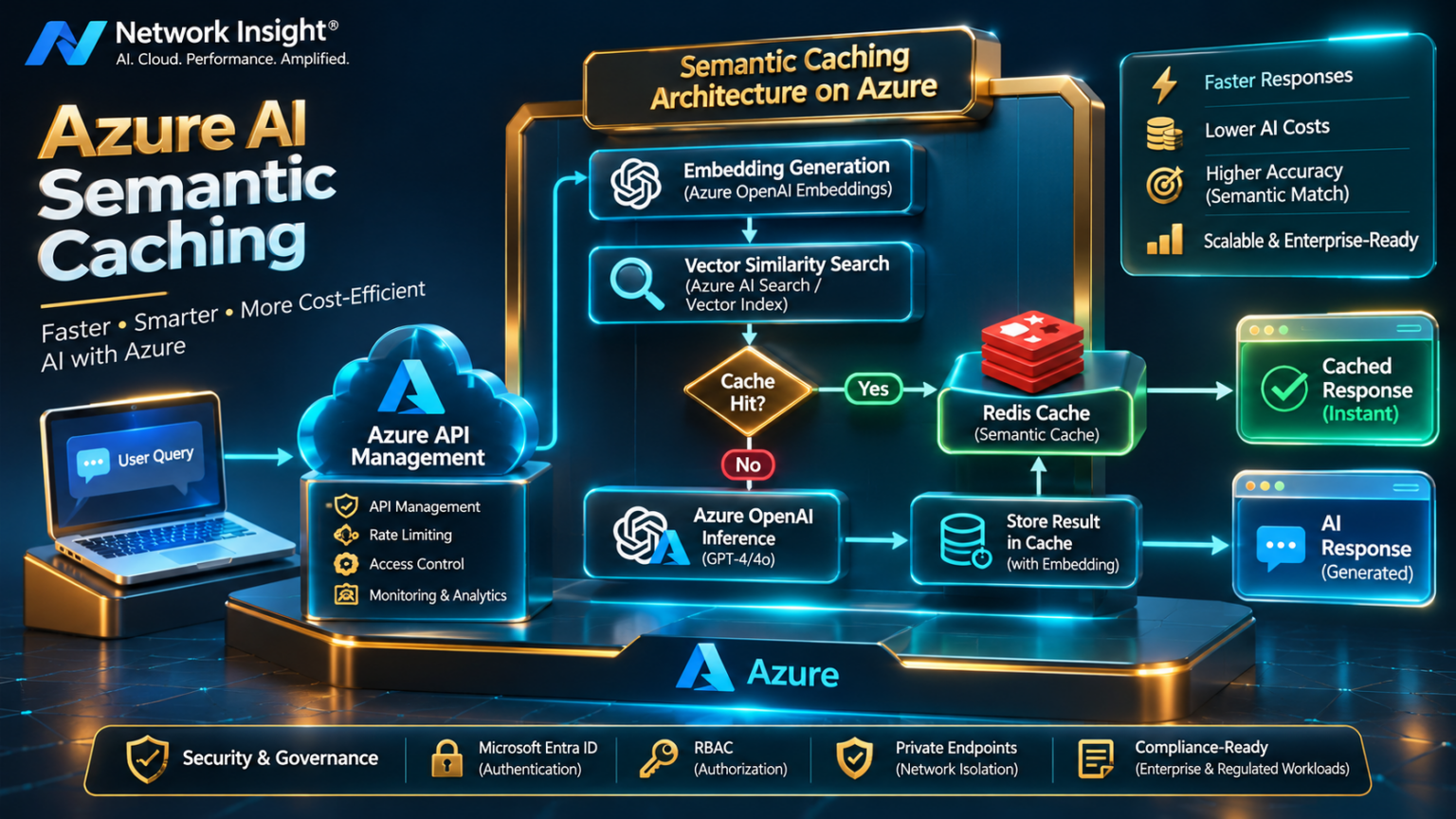
An enterprise semantic cache sits logically between the AI gateway's request-governance layer and the model inference service.
Azure API Management may handle API exposure, authentication policies, rate limits and supported gateway caching functions.
A separate semantic cache service can implement request normalization, embedding generation, vector retrieval, validation and cache admission.
Authenticate callers, resolve tenant context and enforce cache eligibility.
Find eligible cached responses through exact keys and vector similarity.
Generate a new response when no valid reusable result exists.
API Management caching and semantic response caching are related but distinct capabilities. Embedding-based retrieval and validation generally require custom orchestration and suitable storage.
Authentication, Classification & Cache Eligibility
The gateway must establish the request's security and workload context before attempting response reuse.
This context may include the authenticated tenant, user permissions, requested model capability, application version and data-handling restrictions.
Conceptual request admission:

1. Authenticate client
2. Resolve tenant and user scope
3. Apply authorization policy
4. Identify workload category
5. Check cache eligibility
6. Determine permitted cache partition
7. Continue to cache lookup or inference
Requests involving live transactions, personalized confidential information or actions with side effects may require bypassing semantic response caching.
Using Canonical Request Keys Before Vector Search
Exact-match caching can provide an efficient first lookup stage.
A canonical cache key should reflect the inputs that materially determine response validity, rather than relying only on the visible prompt text.
Illustrative cache key inputs:

Tenant / Authorization Scope
Application Version
Model & Deployment Contract
System Prompt Version
Retrieval Corpus Version
Generation Parameters
Normalized User Request

Canonical representation
          |
          v
Cryptographic Hash
          |
          v
Exact Cache Lookup
Omitting important context from a cache key can cause unsafe response reuse. Including unnecessary volatile fields can reduce cache hit rates.
Representing Request Meaning as a Vector
When exact lookup misses and semantic caching is permitted, the system can generate an embedding representing the request.
The embedding model maps text into a numerical vector space where related requests may have nearby representations.
Request A:
"Explain Azure private endpoints"

Request B:
"How do private endpoints work in Azure?"

        Embedding Model
               |
               v
      Numerical Vectors
               |
               v
       Similarity Search
Embedding compatibility is important. A change in embedding model or vector representation may require index versioning or re-embedding.
Searching for Semantically Similar Cached Requests
A vector store retrieves candidate cache entries based on similarity between the incoming embedding and stored request embeddings.
Candidate retrieval should operate within an authorized partition or enforce equivalent security filters before results are exposed.
| Retrieval Property | Engineering Purpose |
|---|---|
| Tenant partition | Restrict retrieval to an authorized data boundary |
| Embedding version | Prevent incompatible vector comparisons |
| Similarity score | Rank candidate requests by semantic proximity |
| Response metadata | Support freshness, policy and compatibility checks |
| Candidate limit | Bound retrieval work and downstream validation cost |
Investigating Semantic Cache Request Outcomes
Explore four distinct request outcomes: an exact cache hit, a validated semantic hit, a cache miss requiring inference and a request rejected by cache governance.
Select a scenario to inspect the request path.
The selected scenario will explain why a cached response can or cannot be reused.
Deciding Whether a Cached Answer Is Safe to Reuse
A retrieved candidate must pass validation before the gateway can return its stored response.
Similarity thresholds alone are insufficient because semantically related requests may differ in important details.
Confirm the candidate is accessible to the authenticated request scope.
Validate instructions, model contract and response-relevant context.
Reject expired or invalidated entries and responses tied to outdated data.
A high vector similarity score does not prove that two requests require interchangeable answers. Explicit validation remains necessary.
Generating and Conditionally Caching a New Response
When no valid cache entry exists, the system invokes an approved model deployment.
The response can be returned to the client and evaluated for future cache admission.
Cache Miss
    |
    v
Select Approved Model
    |
    v
Invoke Inference
    |
    v
Validate Model Response
    |
    +----> Return Response to Client
    |
    v
Evaluate Cache Admission
    |
    +----> Reject Storage
    |
    +----> Store Eligible Response
             |
             v
        Attach Metadata:
        - Tenant / policy scope
        - Model and prompt version
        - Embedding version
        - Creation time / expiry
        - Source data version
Cache population may occur asynchronously when the application architecture permits it, but write failures should not silently compromise response correctness.
Building a Governed Semantic Cache Request Pipeline
The semantic caching lifecycle begins with authenticated request admission and continues through exact lookup, embedding retrieval, candidate validation and inference fallback.
Each stage contributes to either performance optimization or response safety.
Production architectures should make cache decisions observable, versioned and governed by explicit eligibility policies.
Semantic caching is a governed response-reuse pipeline, not simply a vector similarity lookup. Reliable systems combine retrieval, authorization, freshness validation and model inference fallback.
Semantic Cache Request Journey Explorer
Follow an enterprise AI request from the application through authentication, cache eligibility, exact-match lookup, semantic similarity retrieval and model inference. Discover when a cached response can be safely reused — and when the gateway must call the model.
Configure an Enterprise AI Request
AI Gateway Semantic Cache Pipeline
Semantic Cache Decision Timeline
Stored Response Entries
| Tenant | Request | Version | Status |
|---|---|---|---|
| Cache is empty. | |||
Latest Response Decision
What Happens Inside a Semantic Cache?
The gateway must establish identity and authorization before considering cached content for reuse.
Exact lookup can avoid embedding and vector search overhead when the canonical request already exists.
A high vector similarity score does not guarantee that a cached answer is factually or contextually valid.
Tenant boundaries, freshness, model versions and sensitivity policies must constrain cache eligibility.
Exact-Match Caching vs Semantic Similarity
Exact-match caching identifies previously processed requests through deterministic keys, while semantic caching retrieves candidate responses using vector representations of request meaning.
Both approaches can reduce unnecessary model inference, but they introduce different engineering requirements for correctness, performance, security and cache lifecycle management.
A production architecture often combines them into a hybrid response-reuse pipeline: exact lookup first, followed by governed semantic retrieval when appropriate.
Two Different Methods of Identifying Reusable Responses
Exact-match caching evaluates whether a request's canonical representation produces the same cache key as an existing entry.
Semantic caching instead compares a request embedding with stored embeddings to retrieve similar previously processed requests.
Same relevant request inputs produce the same canonical cache key.
Different wording may retrieve a related cached request.
Use exact lookup before semantic retrieval and validate all candidate responses.
Engineering Reliable Exact-Match Cache Identification
Exact-match caching depends on the design of the canonical request representation.
The key must include all context that materially affects response validity.
Conceptual canonical cache key:

cache_key = HASH(
  tenant_scope,
  authorization_scope,
  application_version,
  system_prompt_version,
  model_contract,
  generation_parameters,
  retrieval_corpus_version,
  normalized_user_request
)
Normalization may remove irrelevant whitespace or standardize known formatting differences, but it must not discard meaningful distinctions.
Over-normalization can collapse requests that require different answers. Under-normalization can reduce cache reuse by creating unnecessarily distinct keys.
Comparing Meaning Instead of Identical Text
Semantic caching uses an embedding model to represent eligible requests as numerical vectors.
Vector similarity functions, such as cosine similarity, can rank candidate requests by proximity in embedding space.
Request A:
"How does Azure Private Link work?"

Request B:
"Explain private connectivity with Azure Private Link."

Request C:
"How do I delete a private endpoint?"

Semantic Retrieval:

A ↔ B : Potentially related explanations
A ↔ C : Related technology, different task

Important:
Similarity does not prove response equivalence.
Even a high similarity score can be misleading when requests contain different entities, timeframes, negation or operational intent.
Latency and Compute Differences Between Cache Strategies
Exact lookup is typically inexpensive when implemented with an efficient key-value store.
Semantic retrieval introduces additional work, including embedding generation, vector search, candidate filtering and validation.
| Engineering Dimension | Exact-Match Cache | Semantic Cache |
|---|---|---|
| Lookup method | Canonical key | Embedding similarity |
| Additional inference | No embedding required for lookup | Embedding generation may be required |
| Retrieval complexity | Key-value lookup | Vector search and validation |
| Reuse opportunity | Equivalent canonical requests | Potentially equivalent paraphrases |
| Correctness risk | Incomplete key context or stale entry | False semantic matches plus exact-cache risks |
| Operational overhead | Key lifecycle and invalidation | Embedding models, indexes, thresholds and validation |
Why Semantically Similar Requests May Require Different Answers
Semantic caching creates the possibility of a false-positive cache hit: a retrieved response appears relevant but is not suitable for the new request.
This is especially important when requests contain numbers, names, operational commands, time-sensitive data or security context.
Two prompts may discuss similar Azure services but refer to different subscriptions or resources.
Requests to explain a configuration and change it are not interchangeable.
Answers about current incidents or live capacity may become invalid quickly.
Embedding proximity is not proof of answer equivalence. Similarity must be combined with policy checks and response validation.
Exact vs Semantic Cache Decision Explorer
Select a request scenario to examine how exact-match caching and semantic retrieval produce different results.
Explain Azure Private Link architecture.
Explain Azure Private Link architecture.
Combining Exact Lookup and Semantic Retrieval
A hybrid cache architecture can reduce unnecessary semantic retrieval by performing exact lookup first.
If exact lookup misses, the system may perform semantic retrieval, provided the workload is eligible.
Incoming AI Request
        |
        v
Authentication & Cache Policy
        |
        v
Canonical Exact Lookup
        |
        +---- HIT ----> Validate & Reuse
        |
        v
Semantic Cache Eligible?
        |
        +---- NO -----> Model Inference
        |
        v
Embedding Generation
        |
        v
Vector Candidate Retrieval
        |
        v
Policy & Response Validation
        |
        +---- PASS ---> Reuse Response
        |
        +---- FAIL ---> Model Inference
This design allows simple repeat requests to avoid embedding generation while retaining semantic reuse for eligible paraphrased requests.
Measuring Reuse Quality, Not Just Cache Hit Rate
A high cache hit rate is not automatically a sign of a successful semantic cache.
Engineers should measure whether reused responses remain accurate, authorized, current and useful.
| Metric | Meaning | Engineering Objective |
|---|---|---|
| Exact hit rate | Requests served by deterministic key matches | Measure repeated-request reuse |
| Semantic hit rate | Requests served by validated semantic matches | Measure paraphrase reuse |
| False-positive rate | Incorrect responses accepted as reusable | Minimize unsafe or unsuitable reuse |
| Cache lookup latency | Time spent retrieving and validating candidates | Ensure cache overhead is justified |
| Cost per successful task | Total operating cost divided by successful outcomes | Optimize economics without sacrificing quality |
Choosing the Right Cache Strategy for AI Workloads
Exact-match caching provides efficient deterministic lookup when relevant request context can be represented reliably.
Semantic caching extends reuse to differently worded requests but introduces additional retrieval and validation complexity.
Hybrid caching combines both approaches while maintaining explicit governance boundaries.
Use exact matching for deterministic reuse and semantic retrieval for carefully validated equivalence. Optimize cache quality and successful task outcomes, not hit rate alone.
Exact-Match vs Semantic Cache Comparator
Explore how canonical cache keys differ from semantic similarity. Compare request normalization, embedding retrieval and cache acceptance decisions using realistic enterprise AI questions.
Build a Comparison Experiment
Prompt & Cache Key Inspector
—
—
Cache Strategy Decision Comparison
Semantic Similarity & Threshold
Response Reuse Assessment
Choosing the Correct Cache Mechanism
A deterministic cache key can produce a reliable hit when all relevant request dimensions match.
Vector similarity can identify paraphrases but cannot independently guarantee answer equivalence.
Questions with similar vocabulary may request opposite operations or incompatible outcomes.
Tenant, permissions, language, model configuration, data version and application context can affect whether a response is reusable.
Embedding Generation & Vector Similarity Search
Semantic caching relies on embedding models and vector retrieval to identify previously processed requests that may be meaningfully related to a new AI request.
Instead of comparing prompt strings directly, the architecture converts eligible text into numerical vectors and searches for nearby representations within an authorized cache index.
The engineering challenge is to combine reliable vector retrieval with explicit response equivalence, security and freshness validation.
How Embedding Models Represent Request Meaning
An embedding model transforms text into a numerical vector containing multiple dimensions.
The model is trained to represent useful relationships between text inputs in its embedding space.
Incoming request:

"Explain Azure private endpoints"

          |
          v

Embedding Model

          |
          v

Illustrative vector:

[0.18, -0.42, 0.73, 0.11, ...]

          |
          v

Vector Similarity Search
Real embedding models typically produce substantially more dimensions than the simplified example shown here.
Understanding Embedding Dimensionality
Vector dimensionality defines the number of numerical components in an embedding.
The embedding model and its configured output dimensions determine the expected vector shape.
Stored vectors must match the dimensionality expected by the selected index and retrieval process.
Higher-dimensional vectors generally require more raw storage and may increase index costs.
Dimensionality alone does not determine retrieval quality; models and workloads must be evaluated.
Cosine Similarity and Vector Comparison
Cosine similarity compares the angle between two nonzero vectors.
It is commonly used for embedding retrieval because it measures directional similarity rather than relying solely on vector magnitude.
Cosine Similarity:

cos(A,B) = (A · B) / (||A|| × ||B||)

Where:

A · B   = Dot product
||A||   = Magnitude of vector A
||B||   = Magnitude of vector B

For nonzero vectors:

-1 = Opposite direction
 0 = Orthogonal vectors
+1 = Same direction
Cosine similarity is a mathematical relationship between vectors. A value near 1 does not automatically mean that cached responses are interchangeable or safe to reuse.
Nearest-Neighbor Retrieval and Candidate Ranking
Vector search identifies stored embeddings that are closest to an incoming query vector under a configured similarity or distance metric.
Approximate nearest-neighbor indexing can improve retrieval efficiency for large collections, while introducing a recall and performance trade-off.
| Search Method | Engineering Characteristics | Typical Consideration |
|---|---|---|
| Exact nearest neighbor | Evaluates the candidate space without approximation | Computational cost as collections grow |
| Approximate nearest neighbor | Uses indexing to accelerate candidate retrieval | Recall, latency and index tuning |
| Metadata-filtered search | Restricts eligible candidate records | Tenant isolation and policy enforcement |
| Hybrid retrieval | Combines lexical and vector retrieval signals | Exact entities, keywords and semantic meaning |
Where Semantic Cache Embeddings Can Be Stored
Azure architectures can use supported vector-search capabilities in services such as Azure AI Search or vector-enabled data stores.
A Redis-based architecture may also be appropriate when its selected service and deployment support the required vector indexing and retrieval features.
Vector retrieval, filtering and search-oriented indexing for supported workloads.
Low-latency cache access with vector capabilities where supported by the chosen offering.
Coordinates embeddings, retrieval, response validation and cache admission.
Vector search features, limits, supported index types and deployment options vary by Azure service, tier and API version. Validate the selected architecture against current service documentation.
Explore Cosine Similarity and Candidate Ranking
Drag the cyan query vector endpoint to change its direction. The laboratory calculates cosine similarity against three fixed candidate vectors and ranks them according to the result.
Adjust the similarity threshold to see which candidates qualify for further validation.
Retrieval Configuration
Restricting Vector Retrieval to Authorized Candidates
Semantic cache retrieval must respect tenant, user, workload and policy boundaries.
Metadata filtering can narrow the search to candidate entries that satisfy the request's authorization and compatibility requirements.
Conceptual candidate filter:

tenant_id        = authenticated_tenant
policy_version   = current_policy_version
embedding_model  = compatible_embedding_model
cache_status     = valid
expires_at       > current_time

Then:

Retrieve top-k similar vectors
Validate candidate response
Reuse only if all checks pass
Filtering must be enforced by trusted backend logic and storage access controls. Client-supplied tenant identifiers must not be trusted as authorization evidence.
Managing Model Changes and Vector Index Compatibility
Embedding models can change over time, and different model versions may produce incompatible vector spaces.
A production semantic cache should record the embedding model identifier and version associated with each entry.
Record the model, deployment and vector schema used for each cache entry.
Plan re-embedding or separate indexes when migrating to incompatible models.
Evaluate retrieval quality and similarity distributions after model changes.
Designing Reliable Embedding-Based Cache Retrieval
Embedding generation enables semantic comparison between differently worded AI requests.
Vector search retrieves potentially reusable responses, while metadata filters and validation rules determine whether those candidates are actually eligible.
Engineers should evaluate retrieval quality, vector compatibility, latency, storage cost and false-positive response reuse.
Vector similarity identifies candidates, not guaranteed answers. A reliable semantic cache combines embedding retrieval with authorization, compatibility, freshness and response validation.
Embedding Similarity Laboratory
Explore how an AI gateway converts eligible requests into embedding vectors, compares their direction using cosine similarity and retrieves nearby cached candidates. Manipulate a query vector and inspect the mathematical decisions behind semantic retrieval.
Configure the Vector Search
Interactive Embedding Map
Nearest-Neighbor Search Ranking
| Rank | Cached Request | Vector | Cosine Similarity | Threshold | Retrieval |
|---|---|---|---|---|---|
| Run vector search to inspect candidates. | |||||
Cosine Similarity Calculator
Semantic Candidate Assessment
Embedding Retrieval Engineering Principles
Query and cached vectors must use compatible embedding representations, dimensionality and model versions.
Cosine similarity measures vector direction rather than raw magnitude, helping compare normalized semantic representations.
Vector search retrieves candidate neighbors. A separate validation layer decides whether any response is eligible for reuse.
Vector proximity does not establish tenant authorization, response correctness, freshness or contextual compatibility.
Azure Managed Redis, Vector Stores & Cache Architecture
A production semantic cache requires a storage architecture capable of maintaining reusable AI responses, embedding vectors, cache metadata, authorization boundaries and lifecycle controls.
Azure architectures may use Azure Managed Redis, Azure AI Search or other supported vector-enabled storage services, depending on workload requirements and the capabilities of the selected service tier.
The engineering objective is to balance retrieval latency, memory efficiency, security, scalability, operational resilience and cache correctness.
Understanding the Semantic Cache Storage Layer
Semantic caching differs from simple response caching because the storage layer must support both response retrieval and semantic candidate discovery.
A cache entry may include a request embedding, a response payload, canonical request metadata, model version information and freshness controls.
Stores the generated response and the metadata needed to determine reuse eligibility.
Supports nearest-neighbor retrieval of potentially similar requests.
Records tenant scope, model compatibility, expiry and invalidation state.
Using Redis-Based Infrastructure for Low-Latency Cache Access
Azure Managed Redis provides managed Redis-compatible infrastructure for supported caching and data workloads.
A Redis-based semantic cache can combine low-latency key-value access with vector retrieval when the selected service, modules and configuration support the required functionality.
Conceptual Redis-Based Cache Architecture

Azure API Management
        |
        v
Semantic Cache Service
        |
        +---- Exact Key Lookup
        |
        +---- Vector Candidate Search
        |
        v
Cache Metadata Validation
        |
        +---- Valid Hit --> Reuse Response
        |
        +---- Miss ------> Model Inference
Confirm current Azure Managed Redis capabilities, supported vector indexing, availability features and service limits before selecting a production tier.
Using Search-Oriented Vector Indexes for Semantic Retrieval
Azure AI Search supports vector-search workloads with indexing and filtering capabilities suitable for retrieval applications.
A semantic cache architecture can use a search index to retrieve candidate request records while storing response payloads in a separate cache or data service.
Search for nearby request embeddings using a supported vector-search configuration.
Restrict candidates using trusted tenant, policy and compatibility metadata.
Use a search index for candidate discovery and a separate store for response payload retrieval.
Separating vector indexing from response storage can provide architectural flexibility, but introduces consistency, latency and operational coordination requirements.
Designing a Governed Semantic Cache Record
Cache entry schemas should include sufficient information to validate response reuse and support operational troubleshooting.
{
  "cache_id": "illustrative-entry-001",
  "tenant_scope": "tenant-a",
  "authorization_scope": "approved-scope",
  "canonical_request_hash": "...",
  "embedding_model_version": "embedding-v1",
  "embedding_dimensions": 1536,
  "request_embedding": [0.12, -0.31, "..."],
  "response_reference": "response-001",
  "model_contract": "approved-model-v1",
  "system_prompt_version": "prompt-v3",
  "retrieval_corpus_version": "docs-v7",
  "created_at": "timestamp",
  "expires_at": "timestamp",
  "cache_status": "valid"
}
The schema is illustrative rather than a specific Azure API contract. Production implementations should minimize sensitive stored content, enforce encryption and apply retention policies.
Estimating Vector Storage and Response Capacity
Raw vector memory can be estimated from the number of entries, vector dimensions and numerical precision.
Raw Vector Bytes =

Entry Count
× Dimensions per Vector
× Bytes per Dimension

Example:

100,000 entries
× 1,536 dimensions
× 4 bytes (float32)

= 614,400,000 bytes
≈ 586 MiB of raw vectors
Real storage requirements also include response payloads, metadata, index structures, allocator overhead, fragmentation and replication.
Semantic Cache Storage Architecture Designer
Configure the number of cache entries, embedding dimensions, average response size and logical copy count.
The designer estimates raw vector and response storage, applies an illustrative index overhead factor and compares the resulting estimate with a selected planning capacity.
Storage Configuration
Estimated Storage Requirements
Managing Cache Expiration and Storage Pressure
Cache entries should have explicit freshness and retention policies.
Time-to-live controls help prevent indefinite response reuse, while eviction policies manage storage pressure when capacity becomes limited.
| Mechanism | Purpose | Engineering Risk |
|---|---|---|
| TTL expiration | Remove or invalidate entries after a defined interval | TTL alone may not detect earlier source changes |
| Explicit invalidation | Revoke entries when source data or policies change | Missed invalidation events |
| Capacity eviction | Reclaim storage under pressure | Reduced hit rate and increased inference load |
| Version-based rejection | Reject incompatible cache entries | Cache churn after deployment changes |
Private Connectivity, Replication and Failure Handling
Production cache services should use supported private networking, authentication and encryption capabilities appropriate to the chosen Azure deployment.
Replication and high availability can improve resilience, but application logic must still handle cache unavailability, stale data and partial failures.
Restrict access to trusted application paths using supported private network integration.
Apply least privilege and supported identity-based or credential-based authentication.
Allow authorized inference to continue when the cache is unavailable, subject to capacity controls.
A semantic cache is an optimization layer. Its failure should not cause unauthorized response reuse. Where feasible, the system should degrade safely to governed model inference or reject requests when required controls cannot be enforced.
Designing a Scalable Semantic Cache Storage Platform
Semantic cache storage combines response payloads, embeddings, metadata and retrieval indexes.
Engineers must evaluate capacity, latency, storage architecture, security boundaries, freshness controls and failure recovery.
Azure Managed Redis, Azure AI Search and other supported storage services provide different capabilities and operational trade-offs.
Design the cache as a governed data platform, not merely a collection of stored AI responses. Capacity planning, index compatibility, tenant isolation and lifecycle controls are essential to reliable production reuse.
Cache Storage Architecture Designer
Design the storage layer behind an enterprise semantic caching gateway. Configure response storage, vector indexing, embedding dimensions, metadata boundaries and cache capacity. Examine the resulting architecture and identify important production design risks.
Configure the Semantic Cache
Semantic Cache Infrastructure
Storage Footprint Breakdown
Enterprise Cache Record Schema
Storage Design Review
Semantic Cache Architecture Principles
The vector index identifies candidate responses. A separate governance layer decides whether those responses may be reused.
Embedding model changes can invalidate assumptions about vector compatibility, ranking and index dimensionality.
Vector payloads are only one part of storage consumption. Index structures, replication and operational overhead require capacity planning.
Tenant ownership, expiry, response version, authorization context and sensitivity must constrain retrieval and response reuse.
Similarity Thresholds, Retrieval Confidence & Response Validation
Semantic cache retrieval must determine whether a candidate response is sufficiently similar to the incoming request to justify further validation and potential reuse.
Similarity thresholds influence how many candidates are retrieved, but the correct threshold depends on the embedding model, workload, query distribution and acceptable response-reuse risk.
Production engineering requires calibrated similarity thresholds, precision and recall evaluation, response equivalence checks and explicit governance controls.
Understanding Semantic Similarity Thresholds
A similarity threshold defines the minimum score a retrieved candidate must achieve before it is considered for response reuse.
Higher thresholds generally reduce the number of accepted candidates, while lower thresholds generally increase retrieval coverage.
Illustrative decision:

Similarity Score = 0.89
Configured Threshold = 0.85

0.89 >= 0.85

Result:
Candidate passes similarity screening.

Important:
Further validation is still required.
A cosine similarity score is not automatically a calibrated probability that a cached response is correct or interchangeable.
Balancing Cache Reuse Against Incorrect Matches
Precision measures the proportion of accepted candidates that are genuinely suitable for reuse.
Recall measures the proportion of genuinely reusable candidates that the retrieval policy accepts.
Precision = TP / (TP + FP)

Recall = TP / (TP + FN)

TP = Suitable candidate accepted
FP = Unsuitable candidate accepted
FN = Suitable candidate rejected
TN = Unsuitable candidate rejected
For sensitive enterprise workloads, minimizing false-positive reuse may be more important than maximizing cache hit rate.
When High Similarity Produces the Wrong Answer
Two requests can share similar terminology while requiring different responses.
Common failure cases include resource identifiers, numbers, dates, negation, security scope and operational intent.
Similar Azure configuration questions may refer to different subscriptions or tenants.
Explaining a service and deleting that service are not equivalent requests.
Historical answers may be unsuitable for current operational conditions.
Evaluating Similarity Scores Against Ground Truth
Threshold calibration requires a representative evaluation dataset containing labeled reusable and non-reusable request pairs.
Engineers can evaluate candidate scores across multiple thresholds and measure precision, recall, false-positive rates and inference avoidance.
| Calibration Input | Purpose |
|---|---|
| Positive request pairs | Identify responses that are genuinely reusable |
| Negative request pairs | Identify semantically related but incompatible requests |
| Similarity distributions | Understand overlap between suitable and unsuitable candidates |
| Threshold sweep | Compare retrieval quality across candidate thresholds |
| Production shadow evaluation | Measure candidate decisions without serving cached answers |
Validating Candidate Responses Beyond Similarity
Similarity screening should be followed by independent checks that establish whether a cached response is suitable for the current request.
Ensure the cached response is accessible to the authenticated tenant and user context.
Validate model requirements, instructions, parameters and source-data versions.
Reject expired, revoked or otherwise outdated cache entries.
A candidate passing the similarity threshold is only eligible for further evaluation. It must not automatically be returned to the requesting client.
Semantic Cache Threshold Calibration Laboratory
Adjust the similarity threshold and observe how candidate acceptance changes.
The laboratory uses a small, labeled evaluation dataset to calculate precision, recall, false-positive acceptance and the percentage of requests passing similarity screening.
Why One Global Similarity Threshold May Be Insufficient
Different workloads have different requirements for response correctness and acceptable reuse risk.
A threshold suitable for general educational questions may be inappropriate for operational instructions, regulated data or security-sensitive workflows.
| Workload | Suggested Engineering Approach |
|---|---|
| General documentation Q&A | Evaluate semantic reuse with source-version and freshness validation |
| Technical troubleshooting | Validate environment, resource identity and operational context |
| Financial or regulated responses | Apply strict policy and correctness controls; bypass caching when unsuitable |
| Agent actions or tool execution | Do not treat cached text as authorization to repeat side effects |
Deploying Similarity Thresholds Safely
Threshold changes should be evaluated before they affect live response reuse.
Shadow-mode evaluation can compare cache candidates against newly generated responses without returning the cached candidate to users.
Production Threshold Evaluation

1. Build labeled evaluation dataset
2. Measure baseline similarity scores
3. Sweep candidate thresholds
4. Calculate precision and recall
5. Review false-positive examples
6. Run shadow-mode retrieval
7. Validate tenant and policy boundaries
8. Canary the approved threshold
9. Monitor quality and rollback signals
Treat threshold configuration as a versioned production policy. Record changes, evaluation results and rollback criteria.
Calibrating Semantic Retrieval for Safe Response Reuse
Similarity thresholds determine which candidates proceed to validation.
Precision, recall and false-positive analysis help engineers understand the trade-off between retrieval coverage and response-reuse risk.
Production systems should combine calibrated retrieval with authorization, freshness, compatibility and correctness validation.
Optimize semantic cache precision and response correctness before maximizing hit rate. A high similarity score is a candidate-selection signal, not proof that a response can safely be reused.
Semantic Threshold Tuning Simulator
Calibrate semantic cache acceptance using a labeled evaluation dataset. Adjust similarity thresholds, apply response validation policies and investigate precision, recall, false-positive reuse and missed cache opportunities.
Calibrate Cache Acceptance
Similarity Score Distribution
Cache Acceptance Confusion Matrix
Individual Cache Acceptance Decisions
| Candidate | Similarity | Ground Truth | Decision | Classification |
|---|
Cost-Weighted Quality Assessment
Response Reuse Quality Report
Threshold & Validation Design Principles
Thresholds should be tested against representative, labeled production-style queries rather than chosen from arbitrary similarity values.
Reusing the wrong response can be more harmful than calling the model again, especially for security-sensitive or regulated workloads.
Intent, context, authorization, response version and freshness checks reduce unsafe reuse that vector similarity cannot detect.
New embedding models, prompt patterns and application changes can alter retrieval behavior and require recalibration.
Cache Invalidation, Freshness, TTL & Version Control
A semantic cache can only deliver reliable response reuse when stored answers remain current, compatible with the application and valid under the latest governance policies.
Cached AI responses can become stale when source documents change, model instructions are updated, authorization policies evolve or a cache entry exceeds its permitted lifetime.
Production systems therefore require explicit freshness controls, time-to-live policies, event-driven invalidation, version tracking and safe cache-miss behavior.
Why Semantic Cache Responses Become Stale
A cached response represents the output of a model under a particular set of inputs, instructions and data conditions.
When those conditions change, the response may no longer be suitable for reuse.
Documentation, configuration or retrieved source data changes after the response was generated.
Authorization, retention or response-sharing requirements are modified.
Prompt instructions, model behavior or retrieval contracts change.
Using TTL to Bound Response Reuse
Time-to-live defines how long a cache entry may remain eligible for reuse after its creation or most recent approved refresh.
A TTL policy can reduce indefinite response reuse, but it cannot detect all source-data changes.
Cache Entry:

created_at = 10:00
TTL        = 30 minutes
expires_at = 10:30

At 10:20:
TTL check passes.

At 10:30:
Entry is expired.

Important:
A source update at 10:10 may require
invalidation before TTL expiration.
TTL provides an upper bound on reuse duration, not a guarantee that the response remains correct until expiry.
Invalidating Cached Responses When Source Data Changes
Event-driven invalidation can revoke cached responses when relevant source data or application state changes.
An application may publish an invalidation event after updating a document corpus, policy configuration or other response-relevant data.
Source Data Updated
        |
        v
Change Event Published
        |
        v
Cache Invalidation Processor
        |
        v
Identify Affected Cache Entries
        |
        v
Mark Entries Invalid
        |
        v
Future Requests Trigger New Inference
Event delivery must be designed for retries, idempotency and partial failure recovery.
Tracking Model, Prompt and Retrieval Versions
A cached response may depend on multiple versioned components.
Changes to those components can invalidate otherwise fresh cache entries.
| Version Field | Why It Matters |
|---|---|
| Model contract | Identifies the expected model behavior and response format |
| System prompt version | Tracks changes to instructions and output constraints |
| Embedding model version | Ensures compatibility with the vector index |
| Retrieval corpus version | Detects changes to supporting knowledge sources |
| Authorization policy version | Prevents reuse under outdated access rules |
When a Cached Answer Becomes Operationally Dangerous
Stale AI responses can be more damaging than ordinary cache misses because they may appear authoritative while describing outdated system conditions.
A cached troubleshooting answer refers to a network topology that has since changed.
A response generated under an earlier authorization policy is no longer permitted.
A cached status summary is reused after the incident state has changed.
Cache Freshness & Invalidation Investigator
Advance the simulated clock, modify source-data versions and trigger explicit invalidation to investigate whether a cached response remains reusable.
Change the TTL to observe how expiration interacts with source freshness and version compatibility.
The cached response is currently eligible for reuse.
Preventing Excessive Inference After Cache Expiration
A cache stampede occurs when many requests encounter an expired or missing cache entry at approximately the same time.
Without coordination, multiple requests may invoke expensive model inference for the same underlying workload.
Cache Entry Expires
        |
        v
100 Concurrent Requests
        |
        v
Without Coordination:
100 Model Inference Calls

With Single-Flight Coordination:
1 Authorized Refresh Operation
        |
        v
Other Requests Wait, Bypass
or Follow Defined Fallback Policy
Single-flight request coordination, bounded concurrency and backpressure can reduce duplicate inference. Never serve stale responses unless an explicit policy permits it.
Monitoring Invalidation and Freshness Failures
Cache freshness controls should be observable through metrics, logs and operational alerts.
| Signal | Engineering Interpretation |
|---|---|
| Expired entry rate | Frequency of TTL-driven cache rejection |
| Invalidation lag | Delay between source change and cache invalidation |
| Version mismatch rate | Frequency of cache rejection due to incompatible versions |
| Refresh concurrency | Number of simultaneous cache regeneration operations |
| Stale response incidents | Confirmed cases of incorrect reuse caused by outdated data |
Designing Reliable Cache Freshness and Invalidation
TTL policies provide bounded cache lifetimes, while event-driven invalidation can revoke entries when relevant data changes.
Version tracking prevents reuse across incompatible model, prompt, embedding and policy configurations.
Production systems must also handle cache stampedes, invalidation failures and safe inference fallback.
A cached response is reusable only while its freshness, source compatibility and governance conditions remain valid. TTL is one control within a broader invalidation strategy.
Cache Freshness & Invalidation Investigator
Investigate what happens when a cached AI response outlives its source data, model configuration or validity period. Advance time, modify authoritative content and apply cache invalidation controls to prevent stale enterprise AI responses.
Control the Cache Lifecycle
AI Response Freshness Architecture
Cache Lifetime Timeline
Cached vs Authoritative State
| Component | Cached | Current | State |
|---|
Latest Cache Lookup Outcome
Cache Lifecycle Event Timeline
Freshness & Invalidation Engineering
A cache entry can remain within its TTL even after authoritative source information changes.
Track source documents, prompts, models, embeddings and policy versions when they influence response validity.
Source updates and policy changes may require targeted invalidation rather than waiting for natural expiration.
Event-driven invalidation should be supported by version checks, reconciliation and TTL controls where appropriate.
Tenant Isolation, Security & Data Governance
Enterprise semantic caching introduces security challenges because previously generated AI responses may contain confidential, tenant-specific or authorization-dependent information.
A semantic cache must prevent unauthorized response reuse across tenants, users, applications and security contexts.
Production systems therefore require authorization-aware retrieval, trusted identity enforcement, response classification, private connectivity, retention controls and comprehensive auditing.
Preventing Cross-Tenant Semantic Cache Leakage
Multi-tenant AI platforms may serve multiple organizations through shared gateway and model infrastructure.
Even when requests are semantically similar, responses belonging to different tenants must not be shared unless an explicit, authorized sharing policy permits it.
Tenant A Request
       |
       v
Authenticated Tenant Scope
       |
       v
Tenant A Cache Partition
       |
       +---- Authorized Candidates
       |
       v
Response Validation


Tenant B Request
       |
       v
Authenticated Tenant Scope
       |
       v
Tenant B Cache Partition

No implicit cross-tenant reuse.
Similarity scores must never override tenant authorization boundaries. Enforce isolation before candidate retrieval wherever the storage system supports it.
Binding Cache Entries to Security Context
Cache keys and retrieval filters should incorporate trusted authorization context.
Relevant fields may include tenant identity, application identity, access scope, policy version and data classification.
Conceptual Secure Cache Scope

cache_scope = HASH(
  authenticated_tenant,
  authorized_resource_scope,
  application_identity,
  policy_version,
  data_classification,
  model_contract
)

Exact Lookup:
Use scope + canonical request key.

Semantic Retrieval:
Enforce scope before candidate acceptance.
Scope values must be derived from trusted authentication and authorization services, not from unverified client-supplied fields.
Classifying AI Responses Before Cache Admission
Not every AI response should be stored.
Responses containing secrets, personal information, regulated data or sensitive operational details may require restricted caching or complete exclusion.
Potentially reusable across approved contexts when policy and correctness checks pass.
Requires tenant-scoped storage and authorized retrieval.
May require strict isolation, minimal retention or cache bypass.
Classify responses before writing them to the cache. Do not assume encryption alone makes every response suitable for reuse.
Defending Against Malicious Cached Responses
Semantic caches can become targets for cache poisoning if untrusted content influences stored responses or metadata.
Prompt injection embedded in retrieved documents, user messages or external content may cause a model to produce an unsafe response that is subsequently cached and reused.
Retrieved documents and user-supplied text may contain malicious instructions.
Unsafe or misleading output may be admitted into the cache.
Multiple requests may receive the same compromised response.
Mitigations include source trust boundaries, output validation, cache admission policies, provenance metadata and rapid invalidation mechanisms.
Protecting the Semantic Cache Data Plane
Azure deployments should use supported identity, network isolation and encryption controls appropriate to the selected services.
Managed identities, Microsoft Entra ID, private endpoints and service-specific access controls can contribute to a defense-in-depth architecture where supported.
Conceptual Azure Security Architecture

Authenticated Client
        |
        v
Azure API Management
        |
        v
Trusted Cache Orchestration Service
        |
        +---- Authorization Check
        |
        +---- Private Vector Store Access
        |
        +---- Private Response Store Access
        |
        v
Validated Cache Response

Security Controls:
Identity · Network · Encryption · Audit
Identity integration and private connectivity support vary by Azure service, deployment tier and configuration. Validate the selected architecture against current documentation.
Secure Semantic Cache Policy Laboratory
Select the requesting tenant, authorization scope, response classification, cache freshness and policy compatibility.
The laboratory evaluates the request against a simplified security policy and explains why reuse is permitted or denied.
Request & Cache Context
Security Evaluation
Security checks pass.
Controlling Cached Response Retention and Deletion
Semantic caches may store user prompts, embeddings, generated responses and operational metadata.
These records can create privacy and data-governance obligations depending on the information they contain and the applicable policies.
| Governance Control | Engineering Purpose |
|---|---|
| Data minimization | Store only information required for approved cache operation |
| Retention limits | Bound how long prompts, responses and embeddings are retained |
| Deletion workflows | Remove affected cache entries and associated indexes |
| Encryption | Protect data in transit and at rest using supported controls |
| Access logging | Support investigations and governance reviews |
Embeddings should not automatically be treated as anonymous data. Their handling should reflect the sensitivity of the source content and applicable policies.
Investigating Unauthorized or Incorrect Cache Reuse
Security incidents involving cached responses require sufficient telemetry to identify affected requests, cache entries and policy decisions.
Audit records should support investigation without unnecessarily exposing sensitive prompt or response content.
Conceptual Cache Audit Event

timestamp
request_correlation_id
authenticated_tenant
cache_entry_id
cache_policy_version
authorization_decision
similarity_screen_result
response_validation_result
final_cache_decision
invalidation_reference
Incident response procedures should support immediate cache invalidation, access revocation, affected-entry discovery and controlled restoration.
Designing a Secure Enterprise Semantic Cache
Semantic cache security depends on trusted identity, authorization-aware retrieval, data classification and controlled response reuse.
Tenant isolation must be enforced independently of embedding similarity.
Sensitive content, prompt injection, cache poisoning, retention and auditing must all be addressed in the production design.
Semantic similarity must never override security boundaries. Every cache hit must satisfy the requesting identity's authorization, data governance and response-validity requirements.
Secure Semantic Cache Policy Lab
Investigate the security controls that govern cached AI response reuse. Simulate tenant isolation, identity-based authorization, data classification, confidential response handling and malicious cache population attempts.
Configure the Access Attempt
AI Gateway Trust Boundaries
Authorization & Governance Results
Protected Response Metadata
Response Reuse Assessment
Gateway Policy Decision Log
Semantic Cache Governance Principles
Restrict candidate search to authorized tenant and resource scopes before evaluating semantic similarity.
A cached answer must never bypass the current user's access permissions or application authorization policy.
Confidential data may require restricted caching, encryption, shortened retention or complete cache exclusion.
Trusted population workflows, integrity checks and audit trails reduce the risk of malicious cache manipulation.
Cache Hit Rates, Token Savings & Performance Optimization
Semantic caching can reduce repeated model inference by reusing previously validated responses for eligible AI requests.
The financial and performance benefits depend on validated cache hit rates, model token costs, embedding overhead, vector retrieval latency, storage expenses and the quality of the cache admission policy.
Production optimization requires measuring real inference avoidance, calculating net cost savings, controlling cache overhead and protecting response correctness.
Measuring Validated Semantic Cache Hits
A semantic cache hit occurs when an eligible request receives a previously generated response after all required validation checks pass.
A similarity threshold match alone is not a validated cache hit.
Validated Cache Hit Rate =

Validated Cache Reuses
----------------------
Total Eligible Requests

Example:

3,500 validated reuses
10,000 eligible requests

Hit Rate = 35%
Report the eligible request population and separately track bypassed requests, rejected candidates and cache failures. An eligible hit rate is not necessarily the same as the percentage of all gateway requests avoiding inference.
Understanding Avoided Model Inference Tokens
Each validated cache reuse can avoid a model generation call that would otherwise consume input and output tokens.
However, semantic caching may introduce embedding generation and retrieval costs that must be included in the economic calculation.
Baseline Inference Cost =

(Input Tokens / 1,000,000 × Input Price)
+
(Output Tokens / 1,000,000 × Output Price)

Net Savings =

Avoided Inference Cost
-
Embedding Cost
-
Retrieval Cost
-
Cache Infrastructure Cost
-
Other Operational Overhead
Pricing varies by model, provider, region, deployment and commercial agreement.
Comparing Cache Retrieval Against Model Inference
Semantic cache retrieval may be faster than a complete model inference request, particularly for long responses.
The cache path still introduces work, including embedding generation, vector search, metadata filtering and response validation.
Converts the incoming request into an embedding when semantic retrieval is required.
Finds eligible candidate entries within the authorized cache scope.
Applies security, compatibility and freshness checks before returning a cached response.
Cache latency should be measured at the request level, including the additional lookup cost incurred on cache misses.
Reducing Model Serving Pressure
Validated cache reuse can reduce the number of requests reaching model inference infrastructure.
This may free capacity for requests that genuinely require model execution.
Illustrative Workload:

Incoming Requests = 10,000

Validated Cache Reuses = 3,500

Inference Requests = 6,500

Inference Avoidance = 35%

Actual GPU capacity impact depends on:
Token lengths
Batching behavior
Model architecture
Serving efficiency
Traffic concurrency
A 35% reduction in inference request count does not necessarily translate into a 35% reduction in GPU utilization or infrastructure cost. Workload characteristics and serving efficiency matter.
Determining When Semantic Caching Is Economically Beneficial
Semantic caching becomes economically beneficial when the cost of avoided inference exceeds the additional cost of the cache system.
The break-even point depends on inference price, workload repetition, cache lookup overhead and infrastructure costs.
| Factor | Effect on Cache Economics |
|---|---|
| Higher model inference cost | Increases potential savings from validated reuse |
| Higher validated hit rate | Increases avoided inference volume |
| Higher embedding cost | Reduces net savings |
| Higher cache infrastructure cost | Raises the break-even hit rate |
| More non-cacheable requests | Reduces the proportion of traffic that can benefit |
AI Cache Economics Simulator
Configure request volume, validated cache hit rate, token usage, model pricing and semantic cache overhead.
The simulator estimates avoided inference cost, cache operating cost, net savings and the break-even hit rate.
Workload Configuration
Estimated Monthly Economics
Inference Request Distribution
Reducing Embedding, Retrieval and Validation Overhead
Semantic caching should be optimized across the complete request lifecycle.
Check authorized exact matches before generating embeddings where appropriate.
Tune indexing, metadata filters and candidate limits for the selected workload.
Cache only responses that are suitable for governed reuse.
Measuring the Real Impact of Semantic Caching
Cache performance should be measured using both economic and quality metrics.
| Metric | Engineering Purpose |
|---|---|
| Validated cache hit rate | Measure approved response reuse |
| Cache lookup latency | Measure embedding, retrieval and validation overhead |
| Avoided inference tokens | Estimate model workload reduction |
| Net savings | Compare avoided inference cost against total cache cost |
| Incorrect reuse rate | Monitor response quality and false-positive failures |
| Cache bypass rate | Track traffic excluded by policy or workload characteristics |
Optimizing Semantic Cache Economics and Performance
Semantic caching can reduce model inference costs and improve response latency when validated reuse is sufficiently frequent.
Engineers must include embedding, retrieval, storage and operational overhead when calculating net savings.
Production optimization should prioritize response correctness while improving hit rates, throughput and cost efficiency.
Measure net avoided inference cost, not simply the number of similarity matches. A successful semantic cache improves economics and latency without compromising response correctness or governance.
AI Cache Economics Simulator
Model the financial and performance impact of semantic caching in an enterprise Azure AI gateway. Configure inference traffic, token consumption, cache effectiveness and infrastructure costs to discover when intelligent response reuse becomes economically beneficial.
Configure AI Gateway Workload
Monthly Request Distribution
Inference Cost vs Semantic Cache Cost
Every request invokes the model.
Cache misses invoke the model; all requests incur lookup overhead.
Response Time Optimization
Minimum Cache Effectiveness
Cache Hit Rate vs Monthly Net Savings
Semantic Cache Optimization Principles
Count only eligible, validated response reuse. Raw vector matches do not necessarily represent successful cache hits.
Embeddings, cache infrastructure, validation and operational costs reduce gross inference savings.
Increasing cache hit rate by accepting incorrect responses can create greater operational costs than the model inference saved.
Average latency is useful for modeling, but production engineering also requires p95, p99, concurrency and cache miss analysis.
Production Architecture, Observability & Troubleshooting
A production semantic cache must integrate gateway routing, embedding generation, vector retrieval, response validation, model inference and operational monitoring into one governed request lifecycle.
Enterprise deployments must also handle cache outages, stale responses, incorrect semantic matches, latency regressions, tenant isolation and unexpected inference cost increases.
The engineering objective is to build a semantic caching platform that is observable, resilient, secure, cost-efficient and operationally predictable.
Production Azure AI Gateway Semantic Cache Architecture
Azure API Management can provide gateway policies, authentication, routing and integration with backend services.
A custom semantic cache orchestration layer can implement embedding generation, vector candidate retrieval, authorization checks, response validation and cache admission.
Azure API Management does not, by itself, implement a complete embedding-based semantic response cache. The orchestration, vector retrieval and validation capabilities must be provided by an appropriate application architecture.
Engineering the End-to-End Cache Request Flow
The request flow should enforce security and eligibility controls before performing semantic retrieval.
1. Receive authenticated request

2. Resolve tenant and authorization scope

3. Determine cache eligibility

4. Check authorized exact-match cache

5. Generate query embedding if required

6. Search authorized vector candidates

7. Apply similarity screening

8. Validate freshness and response contract

9. Valid hit:
   Return cached response

10. Miss:
    Execute approved model inference

11. Validate generated response

12. Admit eligible response to cache

13. Record telemetry and cost signals
Cache operations should be bounded by timeouts and failure policies so that retrieval overhead does not unnecessarily delay every request.
Tracing the Semantic Cache Request Lifecycle
Distributed tracing helps engineers identify latency and failures across gateway, cache, embedding, vector search and model inference components.
Azure Monitor, Application Insights and OpenTelemetry-compatible instrumentation can support observability in appropriately configured Azure applications.
Connect gateway requests to cache lookup, validation and inference spans.
Measure embedding generation, vector search, response retrieval and model execution.
Record validated hits, misses, bypasses, invalidations and rejection reasons.
Illustrative Trace

gateway.request
  |
  +-- identity.authorization
  |
  +-- cache.eligibility
  |
  +-- cache.exact_lookup
  |
  +-- embedding.generate
  |
  +-- vector.search
  |
  +-- cache.validate
  |
  +-- model.inference (on miss)
  |
  +-- cache.admission
  |
  +-- gateway.response
Avoid logging raw prompts, response content, credentials or sensitive embeddings unless explicitly authorized and governed. Prefer correlation identifiers and controlled diagnostic metadata.
Defining Production Service-Level Objectives
Semantic caching should improve the user experience without introducing unacceptable reliability or correctness risks.
Service-level objectives should distinguish the cache path from the complete AI request path.
| SLI / Metric | Engineering Purpose |
|---|---|
| Gateway request latency | Measure complete end-user request performance |
| Cache lookup p95 / p99 | Detect slow embedding or vector retrieval |
| Validated cache hit rate | Measure approved inference avoidance |
| Incorrect reuse rate | Monitor response correctness and semantic false positives |
| Cache availability | Measure cache-path operational health |
| Inference fallback success | Measure continuity during cache failures |
| Net inference savings | Track economic impact after cache overhead |
Understanding Production Semantic Cache Incidents
Semantic cache incidents may arise from infrastructure, application policy, vector retrieval quality or invalidation failures.
Index pressure, backend saturation or network issues increase cache lookup time.
A semantically similar candidate is returned despite incompatible request intent.
Invalidation events fail or version changes are not enforced.
Incorrect retrieval filtering exposes an unauthorized candidate.
Storage or memory pressure causes eviction, timeouts or degraded throughput.
Reduced validated reuse or increased cache bypass raises model costs.
Semantic Cache Incident Investigation Console
Select a production incident to investigate its telemetry, likely root cause and recommended remediation.
Each scenario represents a different failure mode across retrieval, validation, freshness, security, capacity or economics.
Incident Selection
Diagnostic Telemetry
Incident Analysis
Select Investigate Incident to view analysis.
Remediation guidance will appear here.
Validation guidance will appear here.
Distributed Trace
Designing Safe Cache Bypass and Inference Fallback
A semantic cache is an optimization layer and should not become an unnecessary single point of failure for the AI application.
When cache retrieval fails, the gateway may route eligible requests to approved model inference if authorization and capacity controls remain enforceable.
Cache Lookup Failure
        |
        v
Classify Failure
        |
        +---- Transient Cache Error
        |        |
        |        v
        |   Bounded Retry / Bypass
        |
        +---- Security Validation Failure
        |        |
        |        v
        |   Reject Cache Reuse
        |
        +---- Cache Unavailable
                 |
                 v
          Governed Inference
          or Controlled Rejection
Never bypass authorization, policy enforcement or required security validation merely to preserve cache hit rate or availability.
Deploying Semantic Caching Through Controlled Engineering Stages
Production deployment should proceed through controlled evaluation, shadow testing, limited rollout and monitored expansion.
| Stage | Engineering Objective |
|---|---|
| Architecture validation | Verify security boundaries, cache eligibility and data flows |
| Offline evaluation | Calibrate semantic thresholds and validate response equivalence |
| Shadow mode | Observe cache candidates without serving them |
| Canary deployment | Enable limited governed reuse with rollback controls |
| Production monitoring | Measure correctness, latency, availability and net savings |
| Continuous optimization | Tune cache admission, thresholds, storage and invalidation |
Building a Production-Ready Azure Semantic Cache
Enterprise semantic caching combines multiple engineering disciplines: AI inference, vector retrieval, distributed systems, security, storage, observability and cost optimization.
The most important design principle is that semantic similarity identifies potential reuse candidates, while independent validation determines whether reuse is permitted.
Production architectures should remain observable, resilient and governed throughout the request lifecycle.
A successful semantic cache is not simply a faster way to retrieve an old AI answer. It is a governed response-reuse system that reduces inference cost and latency while preserving correctness, freshness, security and operational reliability.
Semantic Cache Incident Investigation Console
Investigate production failures across an Azure AI semantic caching architecture. Examine gateway telemetry, Redis performance, embedding compatibility, authorization boundaries and cache invalidation events. Diagnose the incident, apply remediation and validate service recovery.
Select a Production Failure
A sudden drop in cache effectiveness has increased model inference volume.
Azure AI Gateway Architecture
Semantic Cache Operational Metrics
AI Request Execution Path
Select the Most Likely Failure
Investigation & Remediation Events
Recovery Validation & Engineering Assessment

- Azure AI Gateway Semantic Caching & Intelligent Response Reuse - November 23, 2026
- Azure AI Gateway Model Routing Orchestration Explained - November 23, 2026
- Azure AI Gateway Observability Performance Explained - November 23, 2026