
AWS AI Networking Architecture Explained: How AWS Connects, Secures, and Scales Enterprise AI Workloads
Enterprise artificial intelligence depends on more than models and compute capacity. It requires a carefully designed network connecting applications, AI services, enterprise data, security controls, and users. Amazon Web Services provides networking capabilities that support private AI connectivity, workload segmentation, hybrid integration, and scalable application delivery.
Why Networking Matters for Enterprise AI
Modern enterprise AI applications frequently operate across multiple services and network boundaries.
An application may run inside an Amazon VPC, invoke a model through Amazon Bedrock, retrieve documents from Amazon S3, access enterprise databases, and communicate with on-premises systems.
Each interaction introduces requirements for routing, name resolution, identity, security policy, latency, and operational visibility.
The network therefore becomes an essential part of the AI application architecture rather than simply the transport between components.
A Simplified AWS AI Networking Architecture
AI Application
Application code running on supported AWS compute services, such as EC2, ECS, EKS, or Lambda.
Network Connectivity
VPC networking, routing, DNS, VPC endpoints, and appropriate security controls.
AI and Data Services
Amazon Bedrock, supported model endpoints, S3, retrieval services, and enterprise data.
Conceptual relationship between application, networking, and managed services. Actual traffic paths vary according to the application platform, endpoint configuration, service access method, and routing design. Managed AI services do not necessarily reside inside the customer's VPC.
Four Foundations of AWS AI Networking
Network Isolation
Amazon VPC, subnets, route tables, security groups, and network ACLs establish workload boundaries.
Private Service Access
Supported VPC endpoints and AWS PrivateLink provide private access paths to selected services.
Enterprise Integration
Transit Gateway, Site-to-Site VPN, and Direct Connect connect cloud networks with enterprise systems.
Security and Visibility
IAM, AWS Network Firewall, CloudWatch, VPC Flow Logs, and other controls support governance and troubleshooting.
What This Engineering Guide Covers
This guide develops AWS AI networking from foundational VPC architecture through to a complete production-ready enterprise design.
Each section explores a specific engineering challenge, including service connectivity, routing decisions, private access, security enforcement, and failure investigation.
Understanding AWS AI Networking Architecture
Amazon VPC and AI Workload Segmentation
AWS PrivateLink, VPC Endpoints, and DNS
Amazon Bedrock and AI Service Connectivity
AWS Network Firewall and Egress Security
Hybrid AI Networking and Transit Gateway
Application Delivery and AI Scalability
AWS AI Network Monitoring and Troubleshooting
Designing a Production-Ready AWS AI Network
From AI Connectivity to Enterprise Architecture
Understanding AWS AI networking means understanding how applications, model services, enterprise data, and security boundaries interact. Throughout this guide, the focus is on engineering decisions, traffic paths, network behavior, security controls, and operational reliability, providing the foundation for designing and troubleshooting real-world AWS AI environments.
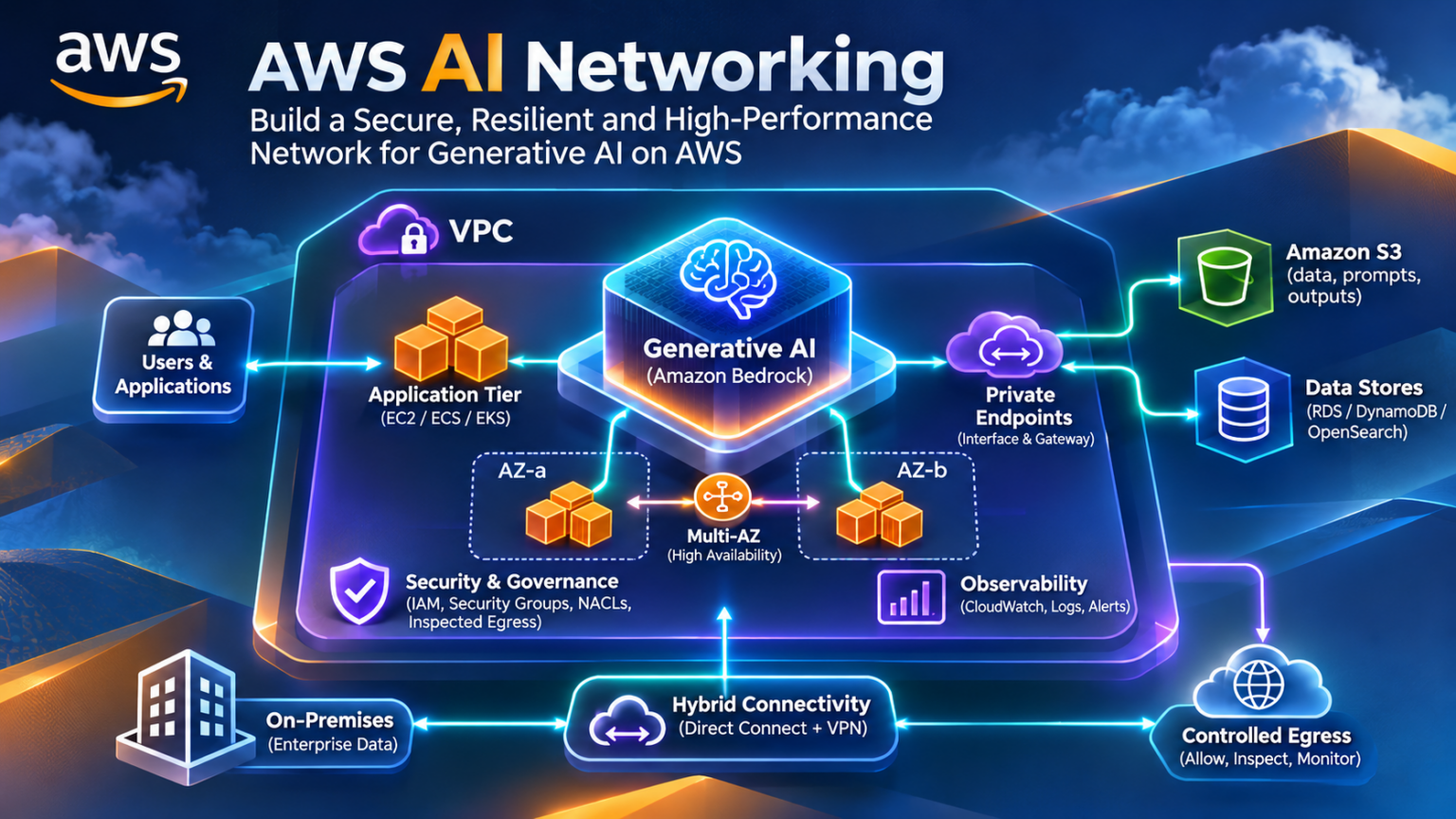
Understanding AWS AI Networking Architecture
AWS AI networking connects application workloads, managed model services, enterprise data, and users through a combination of Amazon VPC networking, private service access, DNS, routing, identity, and security controls. Understanding these architectural boundaries is the foundation for designing reliable enterprise AI environments.
An enterprise AI application is rarely a single self-contained system. It may include a web interface, an application API, an orchestration service, a managed foundation model, a retrieval layer, and several enterprise data sources.
AWS provides services that support each of these components. However, the services may operate across different networking and administrative boundaries.
The network architecture determines how application requests reach their dependencies, how private access is established, and where security policies can be enforced.
1.1 The Five Layers of AWS AI Networking
A useful way to understand AWS AI networking is to separate the architecture into five logical layers. Each layer has different responsibilities and potential failure modes.
Client and Application Access Layer
Enterprise users, browsers, API clients, application ingress, authentication, and approved external access.
Application Compute Layer
Application logic running on EC2, ECS, EKS, Lambda, or another supported AWS hosting environment.
VPC Connectivity and Security Layer
Subnets, route tables, security groups, network ACLs, DNS resolution, and supported VPC endpoints.
Managed AI Service Layer
Amazon Bedrock, supported foundation model endpoints, and related managed AI service capabilities.
Enterprise Data and Integration Layer
Amazon S3, databases, retrieval systems, approved APIs, and on-premises enterprise data sources.
Logical architecture, not a mandatory packet forwarding sequence. Applications may access data before or after invoking a model, and AWS-managed AI services do not necessarily operate inside the customer's VPC.
1.2 Understanding the Amazon VPC Boundary
Amazon Virtual Private Cloud provides a logically isolated networking environment in which customers can deploy supported AWS resources and configure network addressing, subnets, routing, and security.
An application hosted on EC2 or an appropriately configured container platform may communicate through VPC networking. Lambda functions can also be configured for VPC connectivity when required.
However, AWS-managed services such as Amazon Bedrock are not automatically deployed inside the customer's VPC.
Instead, applications access supported service endpoints through available connectivity mechanisms, including public regional endpoints or supported interface VPC endpoints.
Customer Network
The customer controls supported VPC addressing, subnet placement, routing, security groups, and connectivity to other networks.
Service Access Boundary
VPC endpoints can provide private access to supported AWS services without requiring an internet gateway or NAT gateway for that path.
AWS-Managed Service
AWS operates the underlying managed service infrastructure, while the customer remains responsible for appropriate access and application configuration.
1.3 Following an Enterprise AI Request
Consider an enterprise AI assistant that accepts a user question, retrieves supporting documents, invokes a foundation model, and returns a response.
The request may cross several application and networking boundaries before the final answer reaches the user.
User Request
An authenticated user submits a question to the enterprise AI application.
Application Processing
The application validates the request and determines the required operations.
Data Retrieval
The application retrieves approved context from a configured enterprise data source.
Model Invocation
The application invokes an authorized model through a supported Amazon Bedrock endpoint.
Response Delivery
The application processes the model response and returns the result to the user.
Each stage can fail independently. Data retrieval may be blocked by an access policy, the application may fail to resolve a service hostname, or a model invocation may be rejected because of insufficient permissions.
This is why end-to-end AI troubleshooting requires both network diagnostics and application-level telemetry.
1.4 AWS Networking Components and Their Roles
| AWS Component | Primary Role | AI Networking Relevance |
|---|---|---|
| Amazon VPC | Logical network isolation | Hosts supported application resources and network endpoints |
| VPC Subnets | Address and availability-zone placement | Separate application components and endpoint interfaces |
| Route Tables | Destination-based forwarding | Control paths toward gateways, connected networks, and endpoints |
| Security Groups | Stateful traffic filtering | Restrict permitted application and endpoint connections |
| Network ACLs | Stateless subnet-level filtering | Provide additional inbound and outbound subnet controls |
| Interface VPC Endpoints | Private access to supported services | Enable private connectivity to supported Amazon Bedrock APIs |
| Amazon Route 53 Resolver | DNS resolution and forwarding | Resolve service names and support hybrid DNS designs |
| AWS Transit Gateway | Centralized network interconnection | Connect multiple VPCs and hybrid network attachments |
| AWS Direct Connect | Dedicated connectivity to AWS | Support enterprise hybrid access and predictable network design |
1.5 Public and Private AI Service Connectivity
An application may access supported AWS service APIs through public regional endpoints or through configured private connectivity.
Public endpoint access does not necessarily mean that the application itself must be publicly reachable. For example, a private subnet workload may use a NAT gateway for permitted outbound connections.
With AWS PrivateLink, supported interface VPC endpoints allow workloads to connect privately to selected AWS service APIs.
Private DNS configuration can allow applications to continue using standard service hostnames while resolving to private endpoint addresses.
Endpoint policies, IAM permissions, security groups, and service-specific controls remain important even when private networking is enabled.
1.6 AWS Shared Responsibility in AI Networking
AWS operates and secures the underlying infrastructure of its cloud services, while customers retain responsibilities that depend on the services they select.
For customer-managed VPC workloads, these responsibilities commonly include network configuration, security group policies, IAM permissions, application security, and data protection.
Managed AI services reduce the customer's responsibility for operating underlying service infrastructure.
However, customers must still manage appropriate model access, application identities, data permissions, and the connectivity mechanisms used by their workloads.
1.7 Engineering Failure Scenario
An AI Application Cannot Invoke Amazon Bedrock from a Private Subnet
An enterprise application runs on an EC2 instance in a private subnet. The application has permission to invoke a model, but model requests time out.
The application has no general outbound internet route and the required private service endpoint has not been configured.
1. Inspect Connectivity
Confirm the intended access method, VPC routing, DNS resolution, and whether a suitable service endpoint exists.
2. Validate Private Access
Configure the required supported interface endpoint, private DNS, and endpoint security group rules.
3. Verify Application Access
Retest network connectivity, IAM authorization, model access, and application response handling.
This incident demonstrates the difference between authorization and connectivity.
A workload can possess valid IAM permissions but still lack a functioning network path to the service it needs.
1.8 Architecture Engineering Checklist
Key Engineering Takeaway
AWS AI networking connects customer-managed application infrastructure with managed AI services and enterprise data platforms. Understanding VPC boundaries, service endpoints, routing, DNS, identity, and security responsibilities provides the foundation for designing reliable and secure AI applications.
AWS AI Traffic Journey Explorer
Follow AI application traffic through AWS networking. Compare private inference, public inference and retrieval-augmented generation connectivity.
01 / Choose an AI traffic scenario
02 / AWS AI network path
Private service connectivity03 / Packet and service inspector
Examine how each stage contributes to application connectivity.
trace:~$

Select a scenario and start the journey.
04 / Engineering checks
Private and public service connectivity have different routing and security dependencies.
AWS AI connectivity depends on more than the application endpoint. DNS, VPC routing, security groups, endpoint configuration, IAM permissions and service availability all influence whether an inference request succeeds.
Amazon VPC, Subnets, and AI Workload Segmentation
Amazon Virtual Private Cloud provides the networking foundation for many AWS AI applications. Through subnet design, route tables, security groups, network ACLs, and Availability Zone placement, engineers can create isolated, resilient, and controlled environments for enterprise AI workloads.
Enterprise AI applications commonly include multiple components with different network access requirements.
Application ingress, backend APIs, orchestration services, private endpoints, and data processing workloads should not automatically share identical network permissions.
Amazon VPC provides the foundation for separating these components into appropriately controlled network environments.
2.1 Understanding Amazon VPC Architecture
An Amazon VPC is a logically isolated virtual network within an AWS Region.
A VPC contains one or more IP address ranges, subnet configurations, route tables, and network security controls.
Subnets belong to a single Availability Zone, while a VPC can contain subnets across multiple Availability Zones in the same Region.
This makes it possible to distribute application resources across failure domains while maintaining a consistent VPC architecture.
2.2 Example: Dual-Availability-Zone AI VPC
Illustrative address plan only. Each subnet is confined to one Availability Zone. NAT gateways require appropriate internet gateway connectivity, while interface endpoints provide private service access through endpoint network interfaces. Vertical connectors represent logical relationships, not guaranteed forwarding paths.
2.3 Public and Private Subnets
A public subnet is generally associated with a route table that includes a route to an internet gateway.
A private subnet does not provide direct internet gateway routing for its resources.
Private application subnets may use NAT gateways for approved outbound internet connectivity or VPC endpoints for supported AWS service access.
Public Subnet
Commonly used for internet-facing load balancers, public-facing network resources, and NAT gateways. A route to an internet gateway does not by itself make every resource publicly reachable.
Private Application Subnet
Suitable for backend application compute and orchestration components that should not receive direct inbound internet connections.
Endpoint Subnet
Can host interface VPC endpoint network interfaces for private connectivity to supported AWS services. Dedicated endpoint subnets are an architectural choice, not a universal requirement.
2.4 Security Groups and Network ACLs
AWS provides two important VPC traffic filtering mechanisms: security groups and network access control lists.
Security groups are stateful controls associated with supported resources and network interfaces.
Network ACLs are stateless controls applied at the subnet boundary.
| Feature | Security Group | Network ACL |
|---|---|---|
| Filtering Model | Stateful | Stateless |
| Association | Supported resource network interfaces | Subnet |
| Rules | Allow rules | Allow and deny rules |
| Rule Evaluation | All applicable rules evaluated together | Ordered rule numbers, first matching rule |
| Return Traffic | Tracked connection responses generally permitted automatically | Explicitly permitted by applicable rules |
| AI Networking Example | Allow application traffic to a Bedrock interface endpoint on TCP 443 | Apply additional subnet-level filtering where required |
2.5 VPC Route Tables and Traffic Forwarding
Each subnet is associated with a VPC route table, either explicitly or through the main route table.
Route tables contain destination prefixes and corresponding targets.
AWS selects routes according to its documented route priority and longest-prefix matching rules.
Common route targets include internet gateways, NAT gateways, transit gateways, and other supported networking resources.
Interface VPC endpoints generally use private IP addresses within the VPC, so traffic to an endpoint in the same VPC follows the appropriate local network path.
This differs from gateway endpoints, such as supported S3 gateway endpoints, which use route table entries associated with endpoint prefix lists.
2.6 Availability Zones and AI Application Resilience
AWS Availability Zones provide separate infrastructure locations within an AWS Region.
Deploying application components across multiple Availability Zones can reduce the impact of certain infrastructure failures.
Production AI applications may distribute compute instances, load balancing targets, and interface endpoint network interfaces across selected Availability Zones.
However, resilience also depends on application design, state management, service availability, and the ability to recover from downstream AI service failures.
2.7 AI Workload Segmentation Strategy
An enterprise AI environment can benefit from separating different workload functions according to their trust levels and communication requirements.
For example, the application frontend may need access to backend APIs, while the backend may require access to Amazon Bedrock and selected enterprise data services.
These communication paths should be explicitly documented and controlled.
| Workload Zone | Typical Components | Security Objective |
|---|---|---|
| Ingress Zone | Load balancers and application entry points | Restrict permitted inbound access |
| Application Zone | APIs, containers, orchestration services | Permit only required application communication |
| Private Service Access Zone | Interface VPC endpoints | Control access to supported managed services |
| Data Zone | Databases and selected data-processing components | Protect sensitive enterprise information |
| Operations Zone | Approved management and monitoring infrastructure | Separate administrative access and observability |
2.8 Engineering Case Study: AI Application Segmentation
Preventing Unnecessary Communication Between AI Application Components
An enterprise AI assistant is deployed across private application subnets.
The application backend requires access to Amazon Bedrock and a database, but the frontend should not communicate directly with the database.
1. Define Trust Boundaries
Identify frontend, backend, data, and endpoint communication requirements.
2. Apply Security Policies
Configure security groups so only approved application components can reach sensitive resources.
3. Validate Traffic
Test allowed and denied connections and inspect relevant network telemetry to verify the intended segmentation.
This approach reduces unnecessary lateral communication and makes application dependencies easier to understand and troubleshoot.
2.9 Production VPC Engineering Checklist
Key Engineering Takeaway
Amazon VPC provides the foundation for organizing AWS AI workloads into controlled network environments. Effective architecture combines subnet segmentation, security groups, network ACLs, route tables, Availability Zone distribution, and private service access to support secure, resilient, and operationally manageable enterprise AI applications.
AWS VPC Segmentation Designer
Explore workload isolation inside an Amazon VPC. Configure simplified security policies, inspect subnet routes and test connectivity between AI application, inference, data and management tiers.
01 / Security group policy designer
Toggle the allowed ingress relationships. All other tested ingress flows are denied.
02 / Route-table inspection
The route-failure setting represents an educational forwarding fault, not a removable AWS VPC local route.
03 / Connectivity test generator
flow-test:~$

Awaiting connectivity test.
Subnets establish address and route-table boundaries, while security groups enforce stateful network access rules on associated resources. Subnets alone do not isolate workloads from other subnets in the same VPC. Network ACLs and other controls can impose additional restrictions.
AWS PrivateLink, VPC Endpoints, and DNS
Private connectivity is a central design consideration for enterprise AI applications. AWS PrivateLink and VPC endpoints allow supported AWS services to be accessed through private networking paths, while DNS determines how applications discover and connect to those endpoints. Together, these capabilities help engineers design controlled AI service access.
Enterprise AI applications frequently need to invoke managed services without exposing their application infrastructure directly to the internet.
For example, an application deployed in private VPC subnets may need to invoke Amazon Bedrock, retrieve objects from Amazon S3, or access supporting AWS APIs.
VPC endpoints provide connectivity options that can eliminate the need for general internet egress for supported service paths. DNS, security groups, IAM permissions, and endpoint policies must still be configured correctly.
3.1 Understanding AWS PrivateLink
AWS PrivateLink is a connectivity technology that enables private access to supported services through interface endpoints. These endpoints use elastic network interfaces with private IP addresses in selected VPC subnets.
Applications can communicate with supported service endpoints using private connectivity without requiring an internet gateway or NAT gateway for those specific connections.
AWS PrivateLink also supports private connectivity to compatible endpoint services published by other AWS accounts or service providers.
Importantly, an interface endpoint does not place the managed service itself inside the customer's VPC. It provides a private network entry point to that service.
3.2 Example: Private Connectivity to Amazon Bedrock
Private AI Application
An application running in a private VPC subnet sends an authorized model invocation request.
Interface VPC Endpoint
A private endpoint network interface receives HTTPS traffic using a private VPC address.
Amazon Bedrock Runtime
The AWS-managed service processes a permitted model invocation through its supported API.
Illustrative path for a supported Bedrock Runtime interface endpoint. The endpoint resides in the customer's VPC, while the managed Bedrock service remains AWS-operated. Service endpoint availability and configuration vary by Region and API.
3.3 Interface Endpoints vs Gateway Endpoints
AWS supports different VPC endpoint types, and the distinction matters when designing AI application connectivity.
Interface endpoints use private IP addresses and are powered by AWS PrivateLink. Gateway endpoints use route table entries to provide access to supported Amazon S3 and DynamoDB services.
| Characteristic | Interface Endpoint | Gateway Endpoint |
|---|---|---|
| Connectivity Technology | AWS PrivateLink | VPC gateway endpoint routing |
| Network Placement | Endpoint network interfaces in selected subnets | Route table associations; no endpoint ENI |
| Addressing | Private IP addresses | AWS-managed service prefix lists |
| Common Services | Amazon Bedrock and many supported AWS APIs | Amazon S3 and DynamoDB |
| Security Groups | Applicable to endpoint network interfaces | Not attached to the gateway endpoint |
| Pricing | Generally hourly and data processing charges | No additional endpoint hourly or data processing charge |
| AI Networking Example | Private Bedrock model invocation | Private access to S3 training or retrieval data |
3.4 Private DNS and Service Name Resolution
Network connectivity depends on DNS. Applications generally use service hostnames rather than hardcoded endpoint IP addresses.
For supported interface endpoints, enabling private DNS allows the standard regional service hostname to resolve to the private addresses associated with the endpoint from appropriately configured VPC resolvers.
For example, a supported Bedrock Runtime
endpoint in a given Region can allow
applications to use the normal
bedrock-runtime.REGION.amazonaws.com
hostname while resolving privately.
Application Query
The application requests the service hostname through its configured DNS resolver.
VPC DNS Resolution
The VPC resolver evaluates applicable private DNS configuration and resolution rules.
Private Address
The supported service hostname resolves to an interface endpoint private IP address.
HTTPS Connection
The application connects to the endpoint on TCP 443, subject to security controls.
DNS resolution should be validated from the actual application environment. Different resolver settings, forwarding rules, and hybrid DNS configurations can produce different answers.
3.5 Endpoint Security Groups, Policies, and IAM
Private endpoints require several complementary security controls. The endpoint network interface security group must permit required traffic from approved sources.
For HTTPS-based service access, this commonly means permitting TCP 443 from the relevant application security group or source network.
Where supported, endpoint policies can restrict the principals, actions, and resources allowed through the endpoint.
IAM permissions and service-specific authorization remain necessary. Endpoint access does not bypass identity-based access control.
Network Reachability
DNS, VPC routing, security groups, and network ACLs determine whether a connection can reach the endpoint.
Endpoint Policy
Supported endpoint policies provide an additional authorization boundary for requests passing through the configured endpoint.
Service Authorization
IAM permissions, model access, and service-specific controls determine whether the requested AI operation is permitted.
3.6 Amazon Bedrock Endpoint Design
Amazon Bedrock provides different API endpoint families for different capabilities. Private connectivity must be planned around the specific APIs used by the application.
For example, model invocation through Bedrock Runtime is distinct from management operations performed through the Bedrock control-plane API.
Applications using additional Bedrock capabilities may require other supported endpoint configurations or network paths.
Engineers should inventory every API dependency, verify endpoint support in the target Region, and test each required operation from the deployed application environment.
3.7 Hybrid DNS and On-Premises AI Applications
Some enterprise AI applications operate partly on-premises and partly inside AWS.
An on-premises application may connect to AWS through Site-to-Site VPN or Direct Connect and need to resolve private endpoint hostnames.
Amazon Route 53 Resolver inbound endpoints can support DNS queries from connected enterprise networks, while outbound endpoints and forwarding rules support selected queries from AWS toward external DNS infrastructure.
Hybrid DNS design must account for connectivity, routing, resolver access rules, conditional forwarding, and the required DNS domains.
Private endpoint DNS behavior should be tested from both AWS workloads and connected enterprise networks rather than assuming identical resolution paths.
3.8 Troubleshooting Private Endpoint Connectivity
Amazon Bedrock Invocation Fails After Private Endpoint Deployment
An enterprise AI application previously invoked Amazon Bedrock through an approved outbound path. The network team creates a Bedrock Runtime interface endpoint and removes general internet egress.
Following the change, model invocation requests time out. The application IAM permissions have not changed.
1. Validate DNS
Confirm the application resolves the intended Bedrock Runtime hostname to the expected private endpoint addresses.
2. Inspect Network Controls
Verify endpoint security groups, source egress rules, network ACLs, and reachability to TCP 443.
3. Verify API Access
Confirm the correct endpoint service, endpoint policy, IAM permissions, and supported model invocation API.
A timeout typically directs the investigation toward DNS or network connectivity first, while an explicit access-denied response suggests examining authorization controls.
However, engineers should validate the actual error and application logs rather than relying on symptoms alone.
3.9 Private Connectivity Engineering Checklist
Key Engineering Takeaway
AWS PrivateLink and VPC endpoints provide essential private connectivity options for enterprise AI architectures. Reliable implementation depends on endpoint selection, DNS resolution, security group policy, IAM authorization, and hybrid network integration. Understanding these boundaries allows engineers to reduce unnecessary internet dependencies while preserving controlled access to AWS-managed AI services.
AWS Private Endpoint Resolution Lab
Compare AWS PrivateLink interface endpoints and Amazon S3 gateway endpoints. Investigate DNS, security policies and routing dependencies.
01 / Private AWS service connectivity
Interface VPC Endpoint02 / Endpoint configuration
Modify endpoint settings to investigate connectivity failures.
Interface endpoints create private network interfaces in selected subnets. With private DNS enabled, supported standard service hostnames can resolve to those private IPs.
03 / DNS and connectivity diagnostics
aws-network:~$

Select DNS lookup or connectivity test.
04 / Engineering interpretation
DNS resolution and private network reachability are separate checks. A successful DNS lookup does not prove that the application is authorised or that TCP connectivity is permitted.
Interface endpoints use private endpoint ENIs and can provide private DNS integration. Gateway endpoints for Amazon S3 and DynamoDB use route-table entries associated with the endpoint. They do not create endpoint ENIs or use interface endpoint security groups.
Amazon Bedrock and AI Service Connectivity
Amazon Bedrock provides managed access to supported foundation models and generative AI capabilities through AWS service APIs. Enterprise applications must integrate these capabilities with appropriate networking, IAM authorization, data retrieval, application orchestration, and operational controls.
Amazon Bedrock allows applications to work with supported foundation models without requiring customers to deploy and operate the underlying model-serving infrastructure themselves.
However, integrating Bedrock into an enterprise environment still requires engineering decisions about service endpoints, identity, application architecture, data access, and request processing.
The networking design determines how application workloads reach the required Bedrock APIs and supporting services. The application and authorization design determines what operations those workloads are allowed to perform.
4.1 Understanding Amazon Bedrock Architecture
A typical Bedrock-based application consists of three major architectural components: application compute, Bedrock service connectivity, and the selected model capability.
Application compute can run on Amazon EC2, Amazon ECS, Amazon EKS, AWS Lambda, or another supported hosting platform.
The application uses AWS APIs to request model inference or other supported Bedrock operations.
Bedrock manages the underlying infrastructure associated with its managed model-serving capabilities, while the application remains responsible for request construction, authorization, data handling, and response processing.
Enterprise AI Application
Application compute handles user requests, prompt construction, retrieval logic, and model invocation through the AWS SDK.
Amazon Bedrock Runtime
A supported Bedrock Runtime API receives an authenticated request through the configured service connectivity path.
Foundation Model
The selected supported model processes the inference request through AWS-managed service infrastructure.
Conceptual service interaction. The middle component represents a managed API boundary, not a router. Network access may use supported public regional endpoints or interface VPC endpoints.
4.2 Bedrock Control Plane vs Runtime APIs
AWS separates many management operations from runtime inference operations. This distinction is important when designing endpoint connectivity, IAM permissions, and monitoring.
The Bedrock control-plane APIs support supported administrative and resource-management operations.
Bedrock Runtime APIs support model inference operations such as invoking supported models and processing conversational requests.
| Capability | Control Plane | Runtime |
|---|---|---|
| Primary Purpose | Service and model-related management operations | Model inference requests |
| Typical API Family | Amazon Bedrock | Amazon Bedrock Runtime |
| Example Operation | List supported foundation models | Invoke a supported model |
| Connectivity | Supported regional service endpoint | Supported runtime service endpoint |
| Private Access | Corresponding supported interface endpoint | Corresponding supported interface endpoint |
| Security | IAM and applicable service controls | IAM, model permissions, and applicable service controls |
Applications that use additional Bedrock capabilities, such as managed agents or knowledge bases, may depend on other API families and supporting AWS services.
Engineers should therefore document the actual APIs used rather than assuming that all Bedrock operations share one endpoint.
4.3 Identity and Model Authorization
Network connectivity is only one requirement for successful model invocation.
The calling application must also possess appropriate AWS credentials and permission to perform the requested operation.
Applications running on supported AWS compute platforms can use associated IAM roles to obtain temporary credentials without embedding long-lived access keys in application code.
IAM policies can restrict access to supported model resources and specific actions.
Additional model availability, account configuration, and service-specific requirements may apply depending on the model and Region.
Application Identity
Assign appropriately scoped IAM roles to supported application compute resources and avoid unnecessary static credentials.
Model Invocation Permission
Grant only the required Bedrock actions and supported model resource permissions for the application workload.
Service Connectivity
Ensure DNS resolution, endpoint configuration, and network security rules permit the intended HTTPS service connections.
4.4 Retrieval-Augmented Generation on AWS
Retrieval-augmented generation, commonly called RAG, combines a foundation model with relevant external information retrieved at request time.
This allows an application to provide selected enterprise context to a model without relying exclusively on information contained in the model's original training process.
AWS RAG architectures may use Amazon S3, supported vector search systems, databases, application-managed retrieval, or managed Bedrock Knowledge Bases capabilities.
The precise networking and security requirements depend on which components are managed by AWS and which are operated by the application.
User Question
An authenticated user submits a request to the AI application.
Retrieval Query
Application logic identifies relevant search terms or vector retrieval inputs.
Enterprise Context
Approved documents or records are retrieved from a configured data source.
Model Invocation
The application sends the constructed prompt and selected context to Bedrock Runtime.
Response Processing
The application validates and processes the model response before delivery.
4.5 Supporting AWS Service Dependencies
An AI application often requires additional AWS services beyond Amazon Bedrock.
Amazon S3 may store source documents, application artifacts, or selected datasets.
AWS Secrets Manager may provide application secrets, while AWS KMS supports key management for supported encryption workflows.
Amazon CloudWatch can support application monitoring and operational telemetry.
These dependencies must be considered when implementing restricted outbound connectivity. Blocking general internet egress without providing appropriate service access can disrupt application functionality.
| Service | Example AI Role | Connectivity Consideration |
|---|---|---|
| Amazon Bedrock | Managed foundation model capabilities | Correct API endpoint and authorization |
| Amazon S3 | Documents, datasets, and application artifacts | Supported gateway or interface endpoint design |
| AWS Secrets Manager | Application secret retrieval | Approved service access and IAM permissions |
| AWS KMS | Supported key management operations | Service access, key policies, and IAM |
| Amazon CloudWatch | Monitoring and operational telemetry | Required monitoring API and log delivery paths |
| Retrieval Data Store | Context search and retrieval | Service-specific networking and data access controls |
4.6 Performance and Model Invocation Latency
AI application performance is influenced by more than the network path to the model API.
Total response time can include application processing, data retrieval, prompt preparation, network communication, model inference, and response handling.
Model selection, input and output token volumes, request concurrency, service quotas, and available inference capacity can significantly affect application latency.
Network engineers should distinguish connection establishment problems from service processing delays and application bottlenecks.
Where supported, streaming responses can improve perceived responsiveness by allowing the application to deliver output incrementally.
4.7 Engineering Case Study: Bedrock Invocation Failure
Application Can Reach Bedrock but Model Invocation Is Rejected
An enterprise AI application runs in private VPC subnets and connects to a configured Bedrock Runtime interface endpoint.
DNS resolution succeeds and HTTPS connectivity is available. However, model invocation returns an authorization error.
1. Confirm Network Reachability
Verify the application uses the intended endpoint and that the request reaches the Bedrock API.
2. Inspect IAM Authorization
Review the calling role, required Bedrock actions, resource restrictions, and applicable endpoint policies.
3. Validate Model Requirements
Confirm the selected model is supported in the Region and that relevant account, model-access, and invocation requirements are satisfied.
This incident illustrates an important troubleshooting principle: successful network connectivity does not imply successful application authorization.
Engineers should use the actual API error response, application logs, and relevant AWS telemetry to identify the failed layer.
4.8 Bedrock Connectivity Engineering Checklist
Key Engineering Takeaway
Amazon Bedrock provides managed foundation model capabilities, but enterprise integration requires careful coordination between application compute, service endpoints, IAM authorization, model access, retrieval systems, and supporting AWS services. Understanding these dependencies allows engineers to build AI applications that are secure, observable, and operationally reliable.
Amazon Bedrock Connectivity Explorer
Investigate model inference, streaming, knowledge-base retrieval and RAG workflows. Examine API endpoints, permissions and service dependencies.
01 / Select an AI application workflow
02 / AWS AI service architecture
bedrock-runtime03 / Service connectivity controls
04 / AI API request inspector
bedrock:~$

Select a workflow and execute a request.
05 / Engineering interpretation
Different Bedrock API operations have different permissions and dependencies. Network connectivity alone does not guarantee successful model inference.
Amazon Bedrock exposes different service interfaces for model invocation and knowledge-base operations. Successful application requests require the appropriate regional endpoint, IAM authorisation, available models or knowledge bases and functioning downstream dependencies.
AWS Network Firewall, Egress Control, and AI Security
Enterprise AI applications require controlled connectivity to model APIs, enterprise data, and supporting services. AWS Network Firewall, VPC routing, private endpoints, security groups, IAM, and service-level policies can be combined to reduce unnecessary exposure, enforce approved traffic paths, and support defense-in-depth security architectures.
AI applications introduce security challenges because they may process sensitive enterprise information, invoke managed model services, retrieve external content, and communicate with multiple internal and external systems.
A secure AWS AI architecture must control which destinations workloads can reach, which services can access sensitive data, and how network and application activity is monitored.
Network security is one part of this design. Identity, authorization, data classification, encryption, and application safeguards remain equally important.
5.1 Understanding AWS Network Firewall
AWS Network Firewall is a managed network security service that supports stateful and stateless traffic inspection for Amazon VPC environments.
Firewall policies can evaluate traffic using supported network and application attributes, including protocol, IP addresses, ports, and selected higher-layer indicators.
AWS Network Firewall uses firewall endpoints deployed into selected Availability Zones. Route tables must steer the intended traffic through those endpoints.
Deploying a firewall does not automatically place all VPC traffic under inspection. The architecture must account for traffic direction, route selection, and return-path symmetry.
5.2 Example: Centralized AI Egress Inspection
Private AI Application
An application running in private subnets initiates an approved outbound connection.
AWS Network Firewall
Route-table steering directs selected traffic through a firewall endpoint for policy evaluation and inspection.
Approved Destination
Permitted traffic continues toward an appropriate gateway and approved external service.
Simplified logical inspection path. Actual internet egress commonly also requires NAT gateway and internet gateway routing. Firewall and return traffic paths must be designed correctly in each relevant Availability Zone.
5.3 Route-Table Steering and Inspection Symmetry
AWS Network Firewall depends on routing decisions to receive traffic. Firewall endpoints are not automatically inserted into every VPC forwarding path.
Engineers may use subnet route tables to direct selected traffic toward firewall endpoints before forwarding through NAT gateways, transit gateways, or other appropriate network targets.
Stateful inspection requires careful handling of forward and return paths. Asymmetric routing can prevent a firewall from observing both directions of a connection and may cause unexpected traffic drops.
Multi-Availability-Zone deployments should account for firewall endpoint placement, failure domains, and the intended same-zone traffic paths.
5.4 Firewall Inspection and Policy Evaluation
Traffic Initiation
The application initiates a connection to a selected destination.
Route Selection
VPC route tables direct the selected traffic through a firewall endpoint.
Policy Evaluation
Applicable stateless and stateful rules determine how the traffic is handled.
Forward or Drop
Allowed traffic continues along its configured route; denied traffic is blocked.
AWS Network Firewall supports multiple rule types and policy evaluation behaviors. Stateful policies can use supported Suricata-compatible rules and domain-oriented filtering mechanisms.
TLS-encrypted traffic presents an important visibility limitation. Without an appropriately configured and supported TLS inspection design, the firewall cannot simply inspect the full encrypted application payload.
5.5 Private Endpoints and Egress Security
Private VPC endpoints can reduce the need for general outbound internet connectivity when an application accesses supported AWS-managed services.
For example, a private AI application may invoke supported Amazon Bedrock APIs through interface VPC endpoints and retrieve S3 data through an appropriately configured endpoint.
These service connections may remain on private AWS connectivity paths without traversing a centralized internet egress firewall.
Consequently, security controls must also be applied at the endpoint, IAM, resource-policy, and application layers.
Network Inspection
Apply firewall policy to traffic deliberately routed through inspection endpoints.
Private Endpoint Controls
Restrict supported endpoint access using security groups, endpoint policies, and appropriate DNS configuration.
Identity and Data Protection
Use least-privilege IAM, resource policies, encryption, and application-level safeguards to protect sensitive information.
5.6 Egress Control Strategies for AI Applications
| Control | Security Objective | Engineering Consideration |
|---|---|---|
| Private Subnets | Remove direct inbound internet routing | Does not automatically block all outbound access |
| Security Groups | Restrict permitted network connections | Design least-privilege ingress and egress rules |
| AWS Network Firewall | Inspect and filter routed traffic | Requires correct traffic steering and policy configuration |
| Interface VPC Endpoints | Provide private service connectivity | Validate endpoint availability, DNS, and security groups |
| Endpoint Policies | Restrict supported operations through endpoints | Capabilities vary by service and endpoint type |
| IAM and Resource Policies | Enforce service and data authorization | Apply least privilege and explicit organizational boundaries |
| Application Data Controls | Reduce inappropriate disclosure of sensitive information | Validate data access, prompt content, and output handling |
5.7 AI Data Exfiltration and Network Security
Data exfiltration is a significant concern when AI applications can access sensitive enterprise data and communicate with external services or destinations.
An overly permissive application may retrieve confidential information and transmit it to an unintended external API or service.
Network controls can reduce available communication paths, while IAM, resource policies, and application safeguards restrict the data that workloads can access and disclose.
Prompt injection and application logic vulnerabilities require particular attention because network inspection alone cannot determine whether every authorized AI request is appropriate.
5.8 Engineering Case Study: Unapproved AI Egress
AI Application Attempts to Reach an Unapproved External Service
An enterprise AI application has approved private access to Amazon Bedrock and selected enterprise data sources.
A newly introduced application component attempts to send data to an external AI API that is not part of the approved architecture.
1. Identify the Destination
Review application telemetry, DNS activity, and relevant network flow records to establish the attempted communication path.
2. Enforce Egress Policy
Validate security groups, routing, and firewall rules so unapproved destinations are blocked where applicable.
3. Review Data Permissions
Examine the application's IAM permissions, data access, and processing logic to identify the underlying exposure risk.
The investigation should establish whether the attempted connection was blocked, what data the application could access, and whether any sensitive information was actually transmitted.
Network telemetry can identify traffic patterns, but application logs and data-access evidence are often required to understand the complete incident.
5.9 Production AI Network Security Checklist
Key Engineering Takeaway
AWS AI network security requires a defense-in-depth architecture that combines controlled routing, AWS Network Firewall, private service endpoints, security groups, IAM, and data protection policies. The goal is not simply to block internet access, but to establish explicitly approved communication paths and verify that AI workloads can access only the services and information they require.
AWS Egress Policy Simulator
Design outbound security rules for AI workloads. Inspect traffic through a conceptual AWS Network Firewall path and evaluate approved and restricted destinations.
01 / AI workload outbound traffic
Inspected egress architecture02 / Outbound policy rules
Enable the destination categories that your AI environment is permitted to access.
03 / Routing and inspection
04 / Traffic generator
firewall:~$

Awaiting outbound traffic.
An AWS Network Firewall policy is effective only when traffic is routed through its endpoints. Domain and protocol inspection, stateful rules, route symmetry, NAT design, DNS and application-level controls all contribute to secure AI egress.
Hybrid AI Networking: Direct Connect, VPN, and Transit Gateway
Enterprise AI systems frequently span on-premises infrastructure and AWS. AWS Direct Connect, Site-to-Site VPN, Transit Gateway, and BGP routing provide connectivity mechanisms that support hybrid application integration, private data access, and resilient enterprise networking.
Many organizations cannot move every application and data source into AWS. Enterprise databases, legacy systems, regulated workloads, and operational infrastructure may remain on-premises.
AI applications hosted in AWS may therefore require private connectivity to corporate data centres, while on-premises applications may need access to AWS-hosted services.
Hybrid networking combines physical connectivity, encrypted tunnels where required, routing protocols, DNS, and network security controls.
6.1 Understanding Hybrid AWS AI Connectivity
A typical hybrid architecture includes an enterprise network, an AWS connectivity boundary, and one or more VPCs hosting application resources.
Direct Connect provides dedicated network connectivity to AWS through supported connectivity arrangements. Site-to-Site VPN provides encrypted IPsec connectivity over supported network paths.
Transit Gateway can interconnect multiple VPCs and supported hybrid network attachments using centralized routing constructs.
6.2 Example: Hybrid AI Network Architecture
Enterprise Data Centre
Corporate applications, databases, internal DNS, and enterprise routing infrastructure.
AWS Connectivity Hub
Direct Connect gateway and/or VPN connectivity integrated with Transit Gateway routing.
AWS AI Application VPC
Private application compute, supported VPC endpoints, and controlled enterprise data connectivity.
Conceptual architecture. Direct Connect and VPN use different attachment and gateway arrangements. The actual path depends on the selected Direct Connect virtual interface, gateway associations, VPN configuration, and Transit Gateway route tables.
6.3 Direct Connect vs Site-to-Site VPN
| Characteristic | AWS Direct Connect | AWS Site-to-Site VPN |
|---|---|---|
| Transport | Dedicated connectivity through supported provider or AWS locations | IPsec tunnels over supported IP connectivity |
| Encryption | Not inherently encrypted end-to-end | IPsec encryption |
| Routing | BGP on supported virtual interfaces | Static or BGP routing depending on configuration |
| Typical Use | Predictable hybrid connectivity and substantial enterprise traffic | Encrypted hybrid access, rapid deployment, or resilience |
| Resilience | Multiple connections and locations can improve resilience | Multiple tunnels and customer gateway designs |
| AI Networking Example | Connecting enterprise data systems to AWS AI application VPCs | Secure hybrid connectivity for AI applications and backup paths |
Direct Connect can provide more consistent network characteristics than internet-based connectivity, but it does not guarantee application latency or service performance.
VPN can provide encrypted connectivity and may be used independently or alongside Direct Connect, depending on the architecture.
6.4 BGP Routing in Hybrid AI Networks
Border Gateway Protocol is central to many AWS hybrid network designs. It allows supported AWS connectivity components and enterprise routers to exchange network reachability information.
For Direct Connect, BGP is used with supported virtual interfaces. Dynamic Site-to-Site VPN configurations can also exchange routes using BGP.
BGP route advertisement must align with the intended enterprise address plan and network segmentation policy.
Overlapping prefixes, incorrect route advertisement, missing return routes, or inappropriate route preference can disrupt AI application connectivity.
6.5 Transit Gateway Route Propagation
AWS Transit Gateway provides centralized routing between supported network attachments.
Transit Gateway route tables determine how traffic is forwarded between attached VPCs, VPN connections, and supported Direct Connect gateway associations.
Attachments can be associated with Transit Gateway route tables, while route propagation can introduce eligible routes into selected tables.
Route propagation does not automatically establish unrestricted connectivity between all attachments. Association, propagation, static routes, and VPC subnet route tables must be considered together.
Enterprise Prefix
The enterprise network advertises an approved on-premises prefix.
Hybrid Attachment
Supported Direct Connect or VPN routing exchanges network reachability.
Transit Gateway
Applicable Transit Gateway route tables select the intended network attachment.
Application VPC
VPC subnet routes and security controls permit the intended application path.
6.6 Hybrid DNS and Private AI Service Access
Hybrid AI applications often depend on DNS resolution across AWS and enterprise network boundaries.
On-premises systems may need to resolve private application hostnames in AWS, while AWS workloads may need to resolve internal corporate domains.
Amazon Route 53 Resolver inbound and outbound endpoints can support controlled DNS forwarding between connected networks.
Private DNS for interface VPC endpoints introduces additional considerations. Applications must resolve the intended service hostname to reachable endpoint addresses.
DNS forwarding and network routing must be designed together, particularly when on-premises applications access AWS private endpoints.
6.7 Hybrid AI Network Resilience
Physical Connectivity
Use appropriately diverse connections and supported AWS connectivity locations to reduce single points of failure.
Routing Resilience
Design BGP route preference, failover behavior, and Transit Gateway propagation with predictable recovery.
Application Resilience
Implement retries, timeouts, monitoring, and appropriate application-level recovery for downstream dependencies.
Resilience testing should include failure of individual VPN tunnels, connectivity links, routing adjacencies, DNS components, and selected application services.
A redundant physical path is not sufficient if routing policy prevents the backup path from becoming usable.
6.8 Engineering Case Study: Missing Hybrid Route
AWS AI Application Cannot Reach an On-Premises Enterprise Database
An AI application runs inside an AWS VPC and retrieves approved enterprise data from an on-premises database.
The Direct Connect BGP session is established, but database connections time out after a network routing change.
1. Verify BGP Routes
Confirm the required enterprise prefix is advertised and accepted through the intended hybrid connectivity path.
2. Inspect AWS Routing
Check Transit Gateway route table association, propagation, and application subnet routes.
3. Validate Return Path
Verify enterprise return routes, firewall rules, DNS resolution, and database listener reachability.
The established BGP session demonstrates that the routing peers can communicate, but it does not prove that the application prefix is installed along the intended forwarding path.
A complete investigation must follow both traffic directions and validate network security and application behavior.
6.9 Hybrid AI Engineering Checklist
Key Engineering Takeaway
Hybrid AWS AI networking requires coordination between Direct Connect, Site-to-Site VPN, BGP routing, Transit Gateway, VPC subnet routes, DNS, and network security controls. A reliable design must support predictable forward and return traffic paths while preserving enterprise segmentation and application resilience.
AWS Hybrid Routing Path Explorer
Investigate hybrid AI connectivity through Direct Connect, Site-to-Site VPN and Transit Gateway. Change path preference, inject failures and inspect route selection.
01 / Hybrid AI connectivity topology
Direct Connect preferred02 / Hybrid routing controls
03 / Route and event inspector
hybrid:~$

Inspect the active route or send traffic.
04 / Network event timeline
AWS hybrid routing decisions depend on the actual Direct Connect, VPN, BGP and Transit Gateway configuration. A preferred connection can fail over to another available path when routing converges and the required routes remain valid. Direct Connect does not inherently encrypt traffic; Site-to-Site VPN provides IPsec encryption.
Application Load Balancing and AI Scalability
Production AI applications must handle changing request volumes, maintain reliable service access, and control response latency. AWS Elastic Load Balancing, CloudFront, Auto Scaling, and multi-Availability-Zone deployment patterns help distribute application traffic and support resilient AI application architectures.
AI application workloads can be highly variable. Request volumes may change rapidly, while individual model requests can have significantly different processing times.
Enterprise AI systems therefore require careful separation between application traffic distribution and the scaling behavior of downstream AI inference services.
Load balancing can distribute requests across application instances, but it does not automatically increase the capacity of a managed foundation model service.
7.1 Understanding AWS Elastic Load Balancing
AWS Elastic Load Balancing distributes incoming traffic across registered targets according to the selected load balancer type and configuration.
Application Load Balancer operates primarily at Layer 7 and supports HTTP and HTTPS routing.
Network Load Balancer operates at Layer 4 and supports transport-level traffic distribution.
The appropriate choice depends on protocol requirements, traffic behavior, security architecture, and operational constraints.
7.2 Example: AI Application Request Distribution
Enterprise AI Clients
Users and applications submit requests through an approved HTTPS application endpoint.
Application Load Balancer
HTTP requests are routed to healthy application targets according to listener and target rules.
Scalable AI Application Tier
Application instances process requests and invoke supported downstream AI services.
The load balancer distributes application traffic. Downstream Amazon Bedrock inference capacity and quotas remain separate from the application's target scaling.
7.3 Application Load Balancer vs Network Load Balancer
| Characteristic | Application Load Balancer | Network Load Balancer |
|---|---|---|
| Primary Layer | Layer 7 | Layer 4 |
| Protocols | HTTP, HTTPS, and supported application protocols | TCP, UDP, TLS, and supported transport protocols |
| Routing Features | Host, path, and other supported HTTP routing conditions | Transport-level target distribution |
| Health Checks | Application-oriented HTTP/HTTPS checks | Supported TCP, HTTP, and HTTPS checks |
| Typical AI Use | Web applications, AI APIs, and inference-facing application services | Transport-level services and specialized connectivity requirements |
| Design Consideration | HTTP behavior, timeouts, and request routing | Connection handling, protocol requirements, and target design |
7.4 AI Request Processing and Scaling Layers
Client Request
The user submits an authenticated request to the AI application.
Traffic Distribution
A load balancer selects an eligible healthy application target.
Application Processing
Application logic performs validation, retrieval, and model request preparation.
Model Inference
The application invokes a supported model service and processes the response.
7.5 Auto Scaling for AI Application Compute
AWS Auto Scaling capabilities can adjust supported compute capacity in response to selected demand signals.
EC2 Auto Scaling groups can increase or decrease instance capacity, while Amazon ECS and other supported compute services provide their own scaling mechanisms.
Scaling policies should use metrics appropriate to the workload. CPU utilization alone may not accurately represent an AI application's bottleneck.
Request concurrency, queue depth, processing latency, and downstream service throttling may provide important additional signals.
Compute Capacity
Scale application instances based on supported compute and application metrics.
Request Demand
Monitor request rate, active concurrency, queue depth, and processing time.
Inference Constraints
Account for model service quotas, throughput capacity, throttling, and inference latency.
7.6 Amazon CloudFront and Global AI Application Access
Amazon CloudFront can provide a global content delivery layer for supported web applications and APIs.
CloudFront can cache eligible content closer to users, terminate supported HTTPS connections, and integrate with additional AWS security services.
However, dynamic AI inference requests are not automatically suitable for caching. User-specific prompts and model responses require careful cache-policy design.
Engineers should distinguish static application assets, cacheable API responses, and personalized inference requests.
7.7 Latency Engineering for AI Applications
Total AI response latency is the result of multiple processing stages.
These can include client network delay, load balancer processing, application execution, enterprise data retrieval, model inference, and response delivery.
Engineers should instrument each stage separately to identify the actual performance bottleneck.
Streaming model responses, where supported, may improve perceived latency by delivering partial output before the full response is complete.
| Latency Component | Potential Cause | Engineering Focus |
|---|---|---|
| Client Network | Distance, connectivity, or congestion | Regional placement and delivery architecture |
| Load Balancer | Target health, connection handling, or configuration | Health checks, target metrics, and timeout settings |
| Application Compute | Resource saturation or inefficient processing | Scaling metrics and application profiling |
| Retrieval Layer | Slow queries or external data dependencies | Database performance and retrieval architecture |
| Model Inference | Model processing, quotas, or throttling | Model selection, service metrics, and capacity planning |
7.8 Multi-Availability-Zone Resilience
Production application architectures commonly distribute compute across multiple Availability Zones within a Region.
Supported load balancers can route traffic to healthy targets according to their configuration.
Application resilience also depends on downstream databases, retrieval services, networking components, and model service availability.
Engineers should test failure scenarios rather than assuming that a multi-AZ application tier guarantees end-to-end service availability.
7.9 Engineering Case Study: AI Application Latency Spike
Application Response Times Increase During a Surge in AI Requests
An enterprise AI application runs behind an Application Load Balancer with multiple application targets.
During a demand spike, user response times increase significantly even though the load balancer continues to report healthy targets.
1. Inspect Load Balancer Metrics
Review request counts, target response time, HTTP errors, and target health.
2. Examine Application Capacity
Check CPU, memory, concurrency, queue depth, and scaling activity across targets.
3. Investigate Model Latency
Review downstream inference duration, throttling, service quotas, and application retry behavior.
Healthy load balancer targets do not guarantee that the complete AI request journey is performing within acceptable limits.
The investigation must correlate application telemetry with downstream inference and retrieval performance.
7.10 AI Scalability Engineering Checklist
Key Engineering Takeaway
AWS AI application scalability requires coordinated design across load balancing, application compute, Auto Scaling, content delivery, retrieval systems, and model inference capacity. Effective engineering separates network traffic distribution from downstream AI processing constraints and uses end-to-end observability to identify performance bottlenecks.
AWS AI Request Distribution Lab
Simulate application load balancing for AI inference gateways. Adjust request demand, scale backend targets and investigate performance under changing traffic loads.
01 / AWS AI application distribution
Application Load Balancer02 / Workload and capacity controls
03 / Application performance dashboard
alb:~$

Awaiting traffic simulation.
An Application Load Balancer distributes HTTP and HTTPS requests across registered healthy application targets. Backend capacity, target health, application concurrency and downstream AI service limits determine whether the system can handle demand. Scaling application targets does not automatically increase the quotas of a managed foundation model.
AWS AI Network Monitoring and Troubleshooting
Reliable enterprise AI applications require visibility across network connectivity, routing, DNS, security policies, application behavior, and managed AI service dependencies. AWS provides multiple diagnostic and monitoring capabilities that help engineers identify failures and distinguish network problems from application and authorization issues.
AI applications depend on several interconnected infrastructure layers. A failed model invocation may be caused by DNS resolution, VPC routing, endpoint security, IAM permissions, service throttling, or application logic.
Troubleshooting therefore requires evidence from multiple AWS services rather than relying on one diagnostic tool or a single application error.
A structured investigation should identify the failed layer, establish the intended traffic path, and correlate network evidence with application and service telemetry.
8.1 Understanding AWS AI Network Observability
AWS observability capabilities provide different views of application and infrastructure behavior.
VPC Flow Logs record selected metadata about IP traffic associated with supported VPC networking resources.
CloudWatch provides metrics, logs, alarms, and other operational monitoring capabilities.
CloudTrail records supported AWS account and API activity, while Reachability Analyzer evaluates modeled network reachability between supported resources.
No single service provides complete visibility into every AI request.
8.2 Example: AI Network Observability Architecture
AI Application Workload
Private application compute generates network traffic, application logs, and model invocation requests.
AWS Monitoring Services
Flow Logs, CloudWatch, CloudTrail, and network analysis tools provide complementary evidence.
Engineering Investigation
Engineers correlate telemetry, configuration, and application errors to identify the failed dependency.
Conceptual telemetry flow, not an application packet-forwarding path. Different AWS monitoring services collect different categories of information and have distinct configuration requirements.
8.3 Amazon VPC Flow Logs
VPC Flow Logs provide records describing selected IP traffic flowing to and from supported network interfaces, subnets, or VPCs.
Flow log records can include source and destination addresses, ports, protocol, packet and byte counts, timestamps, and acceptance or rejection information, depending on the configured format.
These records help engineers investigate whether expected network traffic is observed and whether applicable network controls reject it.
However, Flow Logs do not capture complete application payloads and cannot independently prove that a model invocation was authorized or successful.
8.4 VPC Reachability Analyzer
VPC Reachability Analyzer evaluates modeled network connectivity between supported source and destination resources.
It analyzes relevant AWS networking configuration, including supported routes and security controls, to determine whether a path is reachable.
The tool is particularly useful for investigating configuration-related connectivity failures.
Reachability Analyzer performs static configuration analysis rather than sending actual application packets or verifying external service behavior.
8.5 CloudWatch and CloudTrail
Amazon CloudWatch
Monitor application metrics, infrastructure performance, logs, alarms, and supported AWS service telemetry.
AWS CloudTrail
Investigate supported AWS API and account activity, including relevant configuration changes and enabled event types.
Reachability Analyzer
Analyze modeled network paths and identify configuration elements that prevent supported resource connectivity.
CloudTrail event coverage depends on the service, API operation, and event configuration.
Some service operations require explicit data-event configuration or additional logging capabilities.
Engineers should verify the relevant logging support before assuming that every AI inference request will appear in CloudTrail.
8.6 AWS AI Diagnostic Tool Comparison
| Tool | Primary Evidence | Typical Investigation |
|---|---|---|
| VPC Flow Logs | IP flow metadata and selected accept/reject information | Unexpected network drops or missing traffic |
| Reachability Analyzer | Modeled AWS network configuration paths | Routing and security configuration errors |
| CloudWatch | Metrics, application logs, alarms, and service telemetry | Latency, errors, saturation, and service degradation |
| CloudTrail | Supported API and account activity | Configuration changes and authorized API activity |
| Route 53 Resolver Query Logging | Supported DNS query records | Unexpected DNS resolution behavior |
| Transit Gateway Flow Logs | Transit Gateway traffic metadata | Hybrid and inter-VPC traffic analysis |
| Application Tracing | Request-level execution and dependency timing | Identifying slow or failed AI processing stages |
8.7 Structured AI Network Troubleshooting Workflow
Identify the Symptom
Determine whether the failure is DNS, timeout, authorization, or performance related.
Trace the Network
Validate endpoint resolution, routing, security groups, and relevant traffic records.
Inspect Service Access
Review IAM, endpoint policies, service availability, and actual API error responses.
Correlate Evidence
Compare network findings with application logs, service metrics, and configuration changes.
8.8 DNS and Hybrid Network Investigations
DNS resolution is a frequent source of application connectivity failures, especially when interface VPC endpoints and hybrid DNS forwarding are involved.
Engineers should verify the hostname used by the application, the configured DNS resolver, and the addresses returned by resolution.
Hybrid networks require additional validation of Route 53 Resolver endpoints, forwarding rules, enterprise DNS configuration, and network routing.
Transit Gateway route tables and VPC subnet routes must also be checked when traffic crosses multiple VPCs or enterprise network boundaries.
8.9 Engineering Case Study: Bedrock Connectivity Incident
Bedrock Runtime Requests Fail Following a Network Security Change
An enterprise AI application runs in private subnets and invokes Amazon Bedrock through a configured interface VPC endpoint.
Following a security group update, model invocation requests begin timing out.
1. Check DNS Resolution
Confirm the application resolves the expected Bedrock Runtime hostname to the intended private endpoint addresses.
2. Analyze Connectivity
Review endpoint security groups, VPC Flow Logs, and supported network reachability analysis.
3. Correlate the Change
Inspect relevant CloudTrail configuration activity and compare security group rules before and after the change.
In this example, the investigation may identify that the endpoint security group no longer permits the application source to connect on TCP 443.
Restoring the intended authorized rule can resolve the connectivity failure, provided no additional configuration issues exist.
The engineer should then repeat the model invocation test and confirm both network connectivity and successful API behavior.
8.10 Production AI Observability Checklist
Key Engineering Takeaway
AWS AI troubleshooting requires a layered observability strategy that combines VPC Flow Logs, Reachability Analyzer, CloudWatch, CloudTrail, DNS diagnostics, Transit Gateway telemetry, and application tracing. Effective investigations correlate these sources to distinguish network connectivity failures from identity, service, and application-level problems.
AWS Network Incident Investigator
Investigate AI application failures using simulated AWS operational evidence. Identify the root cause, select remediation and verify service recovery.
01 / AI service dependency map
02 / Operational evidence
Examine multiple evidence sources before selecting a diagnosis.
Investigation timeline
03 / Root-cause diagnosis
Compare network evidence with application telemetry. A network failure and an authorisation failure require different remediation actions.
AWS AI troubleshooting requires correlation across multiple layers. VPC Flow Logs can reveal network-level accepts and rejects, while CloudWatch, application logs, DNS diagnostics, route tables and service permissions provide complementary evidence. A single log source rarely explains every application failure.
Designing a Production-Ready AWS AI Network
A production AWS AI network must combine secure application connectivity, private access to supported AI services, controlled enterprise data flows, resilient hybrid routing, scalable application infrastructure, and end-to-end operational visibility. The objective is to build an architecture that is secure, observable, maintainable, and aligned with enterprise requirements.
The previous sections examined individual AWS networking components. Production engineering requires these components to operate together as a coherent system.
A successful architecture must answer several questions: Where should applications run? How will they access AI services? Which networks and data sources can they reach? How will failures be detected and how will the environment recover?
These decisions should be established before workloads are deployed into production.
9.1 Production AWS AI Reference Architecture
A reference architecture should separate user-facing application delivery, private application compute, service connectivity, enterprise data access, and monitoring responsibilities.
This layered model makes traffic paths easier to document, secure, and troubleshoot.
Layer 1 — Client Access and Application Delivery
Enterprise users, approved application endpoints, optional CloudFront, AWS WAF, and suitable load balancing provide controlled access to the AI application.
Layer 2 — Private AI Application Infrastructure
Regional VPC architecture with multi-Availability-Zone private application subnets, security groups, route tables, and appropriately scaled compute resources.
Layer 3 — Private Service Connectivity
Supported interface and gateway VPC endpoints, private DNS, IAM authorization, and endpoint security controls provide access to required AWS services.
Layer 4 — AI Services and Enterprise Data
Amazon Bedrock and other supported managed AI services operate outside the customer-managed VPC boundary, while authorized application workflows access enterprise data and retrieval systems.
Layer 5 — Security, Hybrid Connectivity, and Operations
Direct Connect, VPN, Transit Gateway, firewall inspection, CloudWatch, Flow Logs, CloudTrail, and application telemetry provide cross-cutting connectivity, security, and operational functions.
Logical architecture only. These layers represent responsibilities rather than a mandatory sequential packet path. Hybrid connectivity, security inspection, and monitoring operate across relevant layers. Managed AI services are not depicted as resources hosted inside the customer VPC.
9.2 Network Segmentation and Private Connectivity
The VPC should be designed around application trust boundaries rather than placing every component into a single shared subnet.
Application compute, data systems, network inspection components, and endpoint interfaces should use appropriate subnet and security group arrangements.
Multi-Availability-Zone design improves resilience when supported components are distributed and configured correctly.
Private endpoints can reduce dependence on general internet egress for supported AWS service connections.
Network Boundaries
Define VPC CIDRs, subnet placement, routing domains, and security group relationships.
Private Service Access
Use supported VPC endpoints with correct DNS, endpoint security, and IAM authorization.
Defense in Depth
Combine least-privilege access, controlled egress, network inspection, encryption, and data protection.
9.3 Production Architecture Design Decisions
AWS provides several connectivity patterns, but not every workload requires every service.
For example, a single application VPC may not require Transit Gateway. A fully private application may not require an internet-facing load balancer.
Architecture complexity should be justified by actual requirements.
| Design Area | Production Decision | Validation Requirement |
|---|---|---|
| VPC Architecture | Choose regional address plan, subnet layout, and AZ placement | Routing, segmentation, and resilience tests |
| AI Service Access | Select supported private endpoint or other approved connectivity patterns | DNS, TLS, IAM, endpoint policy, and API tests |
| Application Delivery | Select internal or external access and appropriate load balancing | Authentication, health checks, and traffic tests |
| Hybrid Networking | Choose Direct Connect, VPN, Transit Gateway, or simpler alternatives | BGP routes, return paths, DNS, and failover |
| Egress Security | Define approved destinations and inspection requirements | Allowed and denied traffic scenarios |
| Scalability | Set compute scaling and downstream inference capacity strategy | Load, concurrency, quota, and latency testing |
| Observability | Configure metrics, logs, tracing, and audit evidence | Incident detection and diagnostic exercises |
| Governance | Establish infrastructure ownership, IAM, tagging, and change controls | Policy review and deployment verification |
9.4 Production Deployment Roadmap
A phased deployment approach reduces risk by validating fundamental networking before introducing complex application dependencies.
Architecture and Addressing
Document application requirements, AWS Regions, VPC CIDRs, subnet boundaries, trust zones, and connectivity dependencies.
Core Network Foundation
Deploy VPCs, route tables, subnets, security groups, and appropriate multi-AZ infrastructure.
Private AI Connectivity
Configure supported VPC endpoints, DNS, IAM policies, and authorized access to AI services.
Hybrid and Security Controls
Integrate enterprise connectivity, required firewall inspection, approved egress, and data access controls.
Scaling and Resilience
Configure load balancing, compute scaling, downstream capacity planning, and failure recovery.
Observability and Validation
Enable monitoring, perform security and performance testing, validate failure scenarios, and document operations.
9.5 Security and Governance Requirements
Production AI environments require governance beyond traditional network access controls.
Organizations should define which users, workloads, models, and applications are permitted to access particular datasets.
IAM and resource policies should follow least-privilege principles, with encryption, logging, and appropriate organizational controls.
AI-specific risks such as prompt injection, sensitive information disclosure, inappropriate tool access, and unauthorized data retrieval must be addressed at the application and data layers.
9.6 Production Resilience and Failure Testing
Production readiness requires evidence that the architecture behaves predictably under failure.
Engineers should test application target failures, Availability Zone disruptions, hybrid connectivity loss, DNS failures, endpoint misconfiguration, and downstream service degradation.
Recovery expectations should be documented using appropriate availability and recovery objectives.
Where required, multi-Region strategies introduce additional considerations involving data replication, model availability, application state, and routing failover.
9.7 Architecture Review: Enterprise AI Deployment
Deploying a Secure Enterprise AI Assistant on AWS
An organization wants to deploy an internal AI assistant that retrieves authorized corporate information and invokes supported Amazon Bedrock models.
The application must remain privately accessible to enterprise users, support multiple Availability Zones, and provide auditable service access.
1. Connectivity Architecture
Deploy private application infrastructure, supported service endpoints, and approved enterprise connectivity with correct DNS and routing.
2. Security Architecture
Apply least-privilege IAM, security groups, controlled egress, data access restrictions, and appropriate encryption controls.
3. Operational Architecture
Configure metrics, application tracing, audit logging, scaling policies, incident procedures, and recovery testing.
The design should be accepted for production only after the team verifies the complete user-to-application, application-to-data, and application-to-model request journeys.
Both successful and deliberately denied access paths should be tested.
9.8 Final AWS AI Network Readiness Checklist
Building Secure, Scalable, and Observable AWS AI Networks
Enterprise AI infrastructure is not simply a model API connected to an application. It is a distributed system whose reliability depends on network architecture, identity, data access, service connectivity, and operational engineering.
AWS provides the building blocks for this architecture: Amazon VPC, PrivateLink, VPC endpoints, Amazon Bedrock, AWS Network Firewall, Direct Connect, Site-to-Site VPN, Transit Gateway, Elastic Load Balancing, CloudWatch, and network diagnostic services.
The engineering objective is to combine only the components required by the workload, establish clearly defined trust boundaries, and validate every critical communication path before production.
A production-ready AWS AI network should be private where appropriate, explicitly authorized, resilient by design, measurable in operation, and straightforward to troubleshoot.
AWS AI Architecture Builder
Design a production-oriented AI network. Select connectivity, resilience, security, data access and observability controls, then evaluate the architecture.
01 / Architecture configuration
02 / Live architecture preview
03 / Architecture assessment findings
The engineering assessment will identify strengths and weaknesses across eight architectural controls.
Production AI networking is not defined by one AWS service. It combines secure VPC placement, appropriate service endpoints, availability, application scaling, controlled egress, identity and access management, operational monitoring and tested recovery procedures.

- Azure AI Architecture Explained - November 13, 2026
- GPU Cluster Network Design Explained - November 13, 2026
- Understanding AI Networking Architecture - November 13, 2026