
Agentic AI Architecture Explained: How Intelligent Agents Plan, Communicate, and Execute Tasks
Artificial intelligence is evolving from systems that simply generate answers into applications capable of coordinating multi-step workflows, selecting tools, retrieving information, and taking actions within defined operational boundaries.
This architectural shift changes how AI applications are designed, deployed, secured, and operated. Instead of relying on a single model invocation, agentic systems combine language models with orchestration software, external services, memory, APIs, and execution environments.
For network and infrastructure engineers, agentic AI introduces familiar distributed systems challenges: service communication, authentication, authorization, latency, retries, timeouts, state management, observability, and failure recovery.
From Generating Responses to Executing Workflows
Traditional language-model applications generally follow a straightforward interaction: a user submits a prompt, the model processes the available context, and the application returns a generated response.
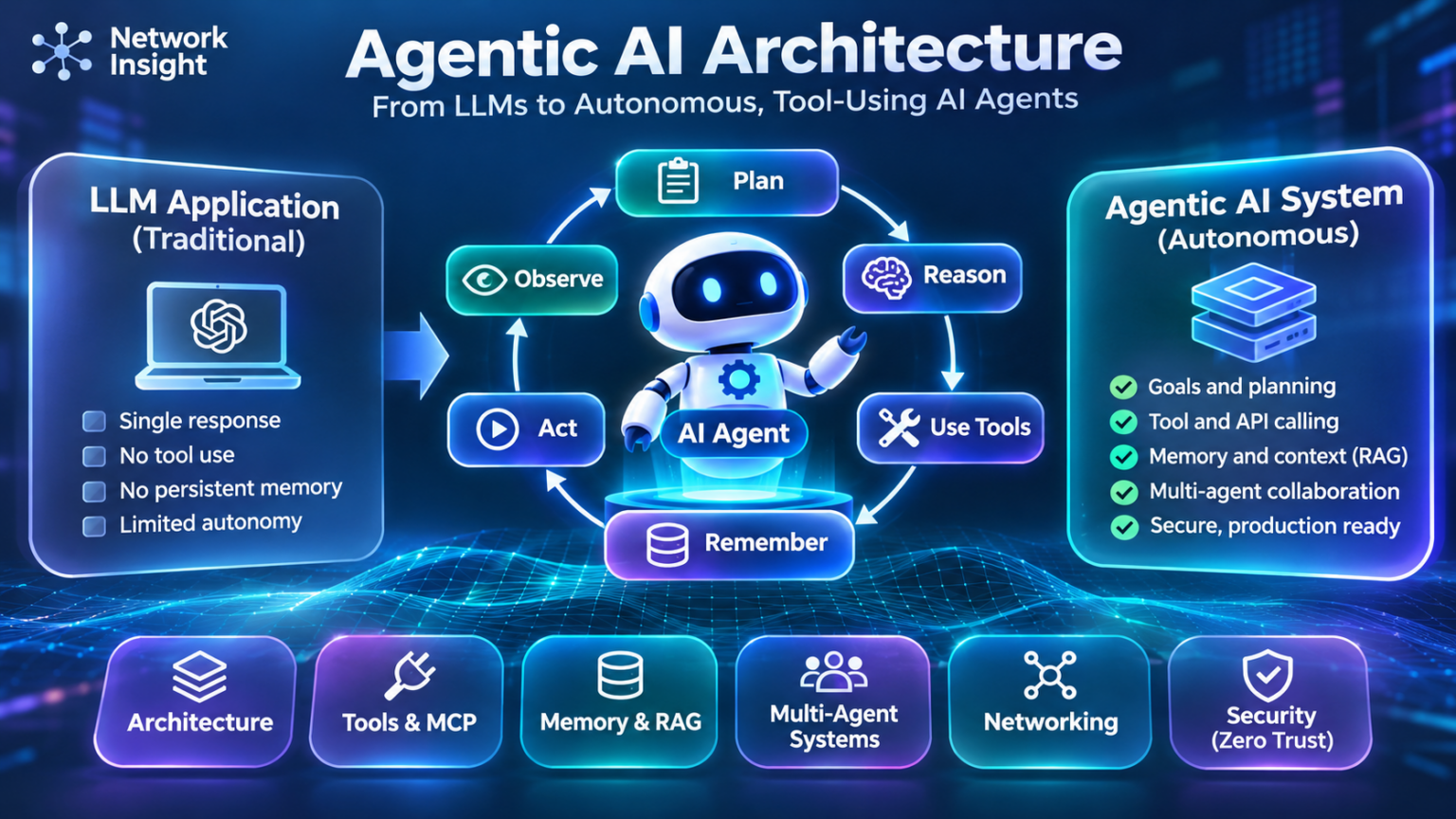
Agentic AI extends this interaction by introducing a control loop in which the system can determine intermediate actions, interact with authorized external tools, observe results, and decide what to do next.
The language model may help select an action, but the surrounding agent runtime is responsible for executing tool calls, managing application state, enforcing permissions, and determining when the workflow should stop.
Prompt → Response
The application provides instructions and context to a language model. The model produces an output, typically without independently executing external actions.
Goal → Actions → Outcome
The application coordinates planning, tool selection, execution, observation, and potentially repeated decisions until a stopping condition is reached.
Agentic AI is therefore not simply a more powerful language model. It is an application architecture in which models interact with software systems to accomplish defined tasks.
Inside an AI Agent Execution Cycle
Consider an AI agent assigned to investigate an application performance incident.
The agent may inspect monitoring metrics, query logs, retrieve documentation, compare infrastructure changes, and produce a diagnosis.
Each interaction may require a network request, authentication, authorization, execution time, and error handling.
The agent may repeat this cycle several times before completing its objective. However, not every agentic implementation uses the same execution model.
Some systems follow predefined workflows, while others dynamically select tools and determine subsequent actions based on intermediate results.
Engineering Principle
Agentic AI combines model inference, application orchestration, state management, external integrations, and policy enforcement. The model proposes or generates actions; the application controls their execution.
Six Core Building Blocks of Agentic AI
Production agentic applications typically depend on several cooperating components. Understanding their responsibilities is essential for designing secure and reliable AI workflows.
Language Model
Interprets context, generates responses, and may propose actions or tool calls.
Agent Runtime
Coordinates execution, manages state, validates actions, and enforces stopping conditions.
Tools and MCP
Connects agents to external APIs, services, databases, and other capabilities.
Memory and Retrieval
Provides relevant documents, persistent information, and retrieved knowledge.
Multi-Agent Systems
Coordinates specialized agents, task delegation, shared state, and workflow dependencies.
Security and Observability
Enforces permissions, monitors execution, records traces, and supports incident investigation.
Why Agentic AI Matters to Network Engineers
An agentic application may appear to users as a single intelligent assistant, but its internal execution can involve many distributed components.
A single request may generate multiple model invocations, API calls, database queries, retrieval operations, and external service interactions.
These interactions introduce network latency, service dependencies, authentication requirements, partial failures, retries, timeouts, and consistency challenges.
Engineers must understand not only whether an agent reaches its intended result, but also how the workflow behaves when a tool fails, a service becomes unavailable, or an action is rejected by security policy.
Network Insight Engineering Focus
This learning journey approaches Agentic AI as a distributed application architecture. We will explore communication paths, orchestration decisions, tool protocols, security boundaries, execution traces, and realistic troubleshooting scenarios.
What This Agentic AI Learning Journey Covers
Across nine sections, we will progressively examine how AI agents are constructed, how they communicate, how they maintain context, and how multiple agents coordinate complex tasks.
We will also investigate the security and operational challenges introduced by tool execution, delegated actions, external services, and autonomous workflows.
Each editorial section will be accompanied by an interactive engineering widget, allowing readers to explore agent architecture, execution behavior, and failure investigation.
The objective is to move beyond introductory AI concepts and develop a practical understanding of how agentic systems are designed, secured, observed, and troubleshot in production environments.
Agentic AI Fundamentals: What Makes an AI System an Agent?
An AI agent is a software system that can pursue a defined objective by interpreting information, selecting actions, interacting with its environment, and evaluating the results. Understanding this execution model is the foundation of agentic AI architecture.
What Is an AI Agent?
An AI agent is an application that uses artificial intelligence to make decisions or select actions in pursuit of a defined objective. In modern language-model-based systems, the model often interprets context and proposes the next step, while an application runtime manages execution.
Unlike a conventional prompt-response interaction, an agent can participate in a multi-step process. It may retrieve information, invoke an API, inspect a result, update its working context, and select another action.
The key characteristic is not unrestricted autonomy. It is the ability to select or coordinate actions within a defined environment and set of operating constraints.
Engineering Definition
An agentic system combines a decision-making component, execution logic, environmental inputs, and controlled actions. Its level of autonomy depends on the permissions, workflow design, and policy boundaries established by the application.
Six Capabilities That Enable Agentic Behavior
Agentic systems are constructed from cooperating capabilities. Not every implementation requires every capability, but these six provide a useful architectural model.
Goal Interpretation
Understand the requested outcome, operating context, and constraints that define successful completion.
Planning and Reasoning
Determine a next action or sequence of steps using the information currently available.
Tool Interaction
Use authorized functions, APIs, databases, or services to retrieve information or perform actions.
State and Memory
Maintain working context, execution history, and relevant information across workflow steps.
Observation
Interpret tool responses, environmental changes, errors, and intermediate execution outcomes.
Bounded Autonomy
Operate within explicit permissions, resource limits, approval rules, and stopping conditions.
These capabilities work together. A system that can reason about a task but cannot execute external actions has a different operational model from one that can modify infrastructure, create records, or invoke production APIs.
The Agent Loop: Reason, Act, Observe, Evaluate
Many agentic applications use an iterative execution loop. Rather than producing one final answer immediately, the agent determines an action, executes it through the application runtime, and evaluates the resulting information.
The runtime may invoke the model multiple times during this process. Each model invocation can receive an updated context containing previous actions, tool results, and execution state.
A successful workflow requires clear stopping conditions. These may include task completion, an iteration limit, a timeout, an unrecoverable error, or a requirement for human approval.
Important Design Constraint
An agent loop must not assume that every tool call succeeds or that repeating an action is always safe. Retrying a read-only query is different from repeating a payment, deletion, or configuration change.
Automation vs LLM Applications vs Agentic AI
Agentic AI is often described as the next stage of automation, but the distinction is more precise when viewed through the control model.
| Capability | Traditional Automation | LLM Application | Agentic AI |
|---|---|---|---|
| Primary control | Predefined program logic | Application prompt flow | Runtime plus model-driven decisions |
| Task execution | Specified sequence | Usually generates an output | Can coordinate multiple actions |
| Tool selection | Hardcoded or rule-based | Application-dependent | May be selected dynamically |
| Feedback handling | Explicit branches and rules | Often a single response | May adapt after observations |
| State management | Application-defined | Prompt and session context | Execution state, context, and memory |
| Operational risk | Known programmed actions | Primarily output-related | Outputs plus external action effects |
These categories are not mutually exclusive. An agentic application may use deterministic workflows for sensitive operations while allowing model-driven decisions for investigation, information retrieval, or task planning.
Autonomy Does Not Mean Unlimited Authority
An important architectural principle is the separation between an agent's ability to propose an action and its authority to execute it.
For example, an agent may identify that restarting a service could resolve an incident. However, the application may require approval before allowing that restart.
The runtime can enforce restrictions through tool allowlists, scoped credentials, policy checks, execution budgets, approval workflows, and audit logging.
Read-Only Access
The agent may query logs, metrics, and configuration without modifying production systems.
Approved Actions
Sensitive operations require explicit authorization or human confirmation before execution.
Execution Limits
Timeouts, token budgets, tool quotas, and iteration limits prevent uncontrolled execution.
Security Principle
A model-generated tool request should be treated as an untrusted proposal until the application validates its parameters, permissions, and execution context.
Why Agent State Matters
Multi-step agent execution requires the system to retain information about previous actions and observations. Without this state, the application may repeat work, lose context, or make inconsistent decisions.
Working state may contain the current objective, completed steps, tool results, pending actions, errors, and execution metadata.
Longer-lived memory is a separate concern. It may include user preferences, retrieved documents, prior workflow outcomes, or information stored in external databases.
Engineers should distinguish transient execution state from persistent application memory. They have different retention, consistency, security, and recovery requirements.
Example: An AI Agent Investigates a Network Incident
Consider a network operations agent receiving the following objective:
Incident Objective
Investigate why application traffic between two services is experiencing increased latency. Identify the likely cause without modifying production network configuration.
A controlled agent might follow this execution sequence:
Query monitoring APIs for latency, interface utilization, packet drops, and error counters.
Retrieve topology information and compare the expected path with observed forwarding behavior.
Examine configuration changes, interface events, and relevant service logs.
Compare possible causes such as congestion, packet loss, routing changes, or service overload.
Return an evidence-based diagnosis, identify uncertainty, and recommend appropriate next steps.
In this example, the agent is permitted to investigate but not to make configuration changes. Any proposed remediation would be presented for review.
The investigation may involve several independent services. A failed monitoring API call should not automatically be interpreted as a network fault. The agent must distinguish missing evidence from evidence of failure.
Engineering Challenges in Agentic Systems
Agentic AI introduces operational complexity because execution paths may vary depending on model decisions, external responses, and changing application state.
Engineers must consider how to observe the complete execution journey, enforce consistent policies, recover from partial failures, and control costs.
Tool Failures
Handle unavailable services, invalid responses, timeouts, and safe retries.
Permission Boundaries
Prevent unauthorized actions and enforce least-privilege access to tools.
Execution Tracing
Record model invocations, tool requests, decisions, errors, and latency.
Latency and Cost
Monitor execution time, model usage, tool overhead, and resource budgets.
Result Validation
Verify important outputs against authoritative evidence and application rules.
State Consistency
Preserve workflow progress and avoid unintended duplicate side effects.
Understanding the Agentic Execution Model
An AI agent is best understood as a controlled software system capable of selecting or coordinating actions toward a defined objective.
The language model may provide reasoning and tool selection, but the application runtime remains responsible for execution, authorization, state management, and operational control.
This distinction becomes increasingly important as agents interact with distributed services, production APIs, shared memory, and other agents.
Key Engineering Takeaway
Agentic AI is an execution architecture, not simply a conversational interface. Its reliability depends on how decisions, tool calls, permissions, state, and failures are managed across the complete workflow.
Inside an Agentic AI System
Traditional AI generates a response. An AI agent can plan, select tools, take permitted actions, inspect results and adapt its next step.
Agent reasoning and action cycle
What a conventional assistant might do
What the agent is doing
Agentic AI is not simply a longer chatbot response. Its defining architectural capability is a controlled feedback loop between decisions, tool calls, observations and subsequent actions.
AI Agent Architecture: Models, Runtimes, Tools, and Execution Environments
An AI agent is not a single software component. It is a coordinated application architecture that combines model inference, execution control, tool integrations, context management, and security boundaries.
The Internal Architecture of an AI Agent
A production AI agent typically consists of several cooperating components. The language model interprets context and may propose actions, while an agent runtime coordinates the execution lifecycle.
External tools provide access to APIs, databases, search services, files, and other capabilities. Supporting systems manage state, memory, policy, and observability.
The runtime is the central control component. It determines which information is supplied to the model, how model-generated tool requests are validated, and how execution continues after a tool responds.
Architectural Principle
The language model does not automatically possess access to infrastructure or APIs. Tool capabilities are exposed by the application, and execution must be controlled by the runtime.
The Model as a Decision-Making Component
The language model processes the context supplied by the application and generates an output. Depending on the system, this output may be a final response, a structured action, or a request to invoke a tool.
Model context can include system instructions, the user's objective, previous messages, retrieved documents, tool descriptions, and earlier execution results.
The model may identify that additional information is required and propose an appropriate tool call. However, the runtime must determine whether the proposed action is valid and authorized.
Context Interpretation
Understand instructions, task requirements, and available environmental information.
Action Selection
Propose a tool or intermediate operation based on current context.
Response Generation
Produce structured outputs, summaries, explanations, or final task results.
Model outputs should not be treated as inherently correct or authoritative. Applications may require schema validation, policy checks, and independent verification before taking consequential actions.
The Runtime as the Execution Control Plane
The agent runtime manages the operational lifecycle of the agent. It receives objectives, assembles model context, processes model responses, dispatches authorized tool calls, and determines whether execution should continue.
This component is analogous to a control plane because it coordinates decisions and execution policy. However, the term is conceptual rather than a standardized networking architecture.
Workflow Coordination
Maintains task progress and determines the next execution step.
Tool Dispatch
Validates and invokes permitted functions and external services.
State Management
Records intermediate results, errors, execution metadata, and pending operations.
Failure Handling
Applies timeout, retry, fallback, and escalation policies.
Execution Budgets
Enforces limits on model calls, tool operations, time, and cost.
Human Approval
Pauses sensitive operations until an authorized user approves them.
Connecting Agents to External Capabilities
Tools allow an agentic application to interact with systems outside the language model. Examples include monitoring APIs, database queries, document retrieval, ticketing platforms, and infrastructure management interfaces.
A tool typically exposes a defined operation with structured inputs and outputs. The runtime validates arguments, applies authorization checks, and invokes the underlying implementation.
Tools may be implemented as local functions, remote APIs, or capabilities exposed through protocols such as the Model Context Protocol (MCP).
Tool Execution Boundary
Tool descriptions tell the model what capabilities are available. They do not replace server-side authentication, parameter validation, authorization, or audit logging.
How Context Reaches the Language Model
A language model processes the context supplied during an invocation. It does not automatically possess the complete execution history or all information stored by the application.
The runtime must decide which information is relevant and assemble it into the model request.
Context may include the current objective, task instructions, recent conversation history, tool outputs, retrieved documents, and selected persistent memory.
Context windows impose practical limits on the amount of information that can be supplied. Applications may use summarization, retrieval, and selective history management to preserve relevant information.
Context Engineering Risk
Retrieved documents and tool responses may contain inaccurate or malicious instructions. Applications should distinguish trusted control instructions from untrusted external content.
Following a Tool Call Through the Architecture
Consider an agent investigating elevated interface utilization on a network switch.
The runtime provides the model with the investigation objective and available read-only monitoring tools.
The model proposes a telemetry query. The runtime validates the request, executes the tool, records the result, and supplies relevant information to the next model invocation.
This trace illustrates an important architectural distinction: model inference, tool execution, and policy enforcement are separate operations.
A production trace should also record correlation identifiers, execution durations, tool status, and relevant error information, while avoiding unnecessary exposure of sensitive data.
Where Agent Components Run
Agentic applications may be deployed as a single service or distributed across multiple infrastructure components.
The runtime may operate in a containerized application, while model inference runs on a remote AI platform or a self-hosted GPU cluster.
Tools may connect to internal APIs, databases, SaaS services, or isolated execution environments.
| Component | Typical Deployment | Engineering Consideration |
|---|---|---|
| Agent Runtime | Application service or container | State, scaling, execution control |
| Language Model | Hosted API or GPU inference service | Latency, capacity, data handling |
| Tool Services | Local functions or remote APIs | Authentication, timeouts, reliability |
| Memory Store | Database or retrieval platform | Consistency, retention, access control |
| Execution Sandbox | Restricted process or isolated environment | Resource limits, isolation, permissions |
| Observability | Logging, tracing, and monitoring systems | Correlation, auditability, sensitive data |
Deployment decisions influence latency, operational complexity, failure domains, and security exposure. An agent with access to sensitive infrastructure should not automatically inherit unrestricted network connectivity or privileged credentials.
Engineering a Production-Ready Agent Runtime
A production runtime must account for failures that occur outside the language model itself.
A tool may time out, a remote API may return an invalid response, a credential may expire, or a workflow may be interrupted after completing only part of its intended work.
Timeouts and Retries
Bound tool execution time and retry only when operations can be repeated safely.
Least Privilege
Scope credentials and tool permissions to the minimum required capabilities.
Durable Execution
Preserve critical workflow progress and support controlled recovery.
Distributed Tracing
Correlate model calls, tool requests, service responses, and policy decisions.
Approval Gates
Require explicit authorization before sensitive or irreversible actions.
Structured Outputs
Validate schemas, parameters, and critical results before downstream use.
Production Engineering Principle
The agent runtime is a security and reliability boundary. It must not assume that model outputs, tool responses, or external content are inherently trustworthy.
Understanding the Agent Architecture
An AI agent combines multiple software components into a coordinated execution environment.
The language model interprets context and may propose actions. The runtime manages execution, dispatches tools, enforces policy, and maintains workflow state.
Supporting components provide memory, retrieval, security, and observability. Together, they form a distributed application architecture with familiar networking and operational challenges.
Key Engineering Takeaway
Designing an agentic application requires separating model decisions from execution authority. Reliable systems validate actions, control tool access, preserve state, and observe the complete execution lifecycle.
AI Agent Architecture Builder
Explore the components of an intelligent agent. Configure its capabilities, inspect its architecture, and simulate how the agent processes an engineering objective.
Configure Agent Capabilities
Enable or disable components to see how the architecture changes.
Click Memory, Tools or Guardrails to inspect its responsibilities and how it contributes to agent execution.
Architecture Assessment
Agent Execution
An LLM alone is not a complete operational agent. Agent architecture combines a reasoning model with context management, tool interfaces, execution controls and feedback from the environment.
Planning and Reasoning Loops: How AI Agents Decide What to Do Next
Agentic AI systems can coordinate multi-step tasks by selecting actions, observing results, and adapting subsequent execution. Understanding how planning and reasoning loops operate is essential for building reliable, controlled, and observable AI agents.
What Does Planning Mean in Agentic AI?
Planning is the process of determining how an objective can be achieved through one or more actions. In agentic systems, a language model may propose a sequence of steps or select the next operation based on the current context.
Planning does not necessarily require the model to generate a complete workflow before execution. Some agents operate incrementally, deciding one step at a time as new information becomes available.
Other architectures construct an explicit plan, execute individual tasks, and revise the plan when observations reveal unexpected conditions.
Engineering Definition
Agent planning is the coordination of actions toward a defined objective. The plan may be predefined, model-generated, dynamically revised, or a combination of these approaches.
The Reason–Act–Observe–Evaluate Loop
Many agentic systems use an iterative control loop. The application supplies the model with relevant context, the model proposes an action, and the runtime executes the action through an authorized tool.
The tool result becomes an observation that informs the next decision. The runtime evaluates whether the objective has been achieved or additional execution is required.
This architecture allows an agent to adapt to changing information. However, each additional model invocation and tool call introduces latency, cost, and potential failure conditions.
Reasoning and Acting as an Execution Pattern
ReAct is a well-known approach that interleaves reasoning-oriented decisions with actions and observations.
Rather than generating a complete answer from the initial context, the agent can request information from external tools and incorporate the returned evidence into subsequent decisions.
For example, an agent investigating a failed application deployment might first query service health, then inspect recent deployment events, and finally examine relevant logs.
Each observation changes the available evidence and may influence the next selected action.
Implementation Detail
ReAct is an execution pattern, not a requirement to expose private model reasoning. Production systems can record structured decisions, tool calls, observations, and outcomes without storing hidden reasoning traces.
Comparing Common Agent Planning Approaches
Different tasks benefit from different planning strategies. The appropriate approach depends on task complexity, predictability, latency requirements, and operational risk.
| Strategy | Execution Model | Best Suited For | Tradeoff |
|---|---|---|---|
| Single-Step | Select and execute one operation | Simple tool requests | Limited adaptability |
| Iterative ReAct | Decide after each observation | Investigations and exploration | Repeated model latency |
| Plan-and-Execute | Generate plan, then execute tasks | Structured multi-step workflows | Plan may become outdated |
| Task Graph | Execute dependency-aware tasks | Complex workflows with parallel stages | Coordination complexity |
| Hierarchical | Delegate subtasks to specialized components | Large or specialized tasks | Additional orchestration overhead |
Many production systems combine these strategies. A deterministic workflow may coordinate high-level execution while model-driven agents handle selected investigative subtasks.
Breaking Complex Objectives into Smaller Tasks
Complex objectives often contain multiple independent or dependent operations. Task decomposition divides the objective into manageable steps.
Consider an agent assigned to investigate increased application latency in a data centre.
The investigation may require network telemetry, application metrics, and infrastructure change records. These activities can potentially execute in parallel if their dependencies and access policies permit it.
Decomposition improves clarity and can enable parallel execution. However, the runtime must understand dependencies, coordinate results, and prevent conflicting actions.
How Agents Evaluate Intermediate Results
An agent should not assume that every action moves the workflow closer to its objective. Tool responses may be incomplete, inaccurate, stale, or unrelated to the problem.
Evaluation involves determining whether the available evidence supports the current conclusion and whether additional investigation is necessary.
Evidence Quality
Check whether observations are relevant, current, and sufficiently trustworthy.
Goal Progress
Determine which task requirements have been completed and what remains.
Plan Revision
Update the execution plan when observations invalidate earlier assumptions.
Evaluation may be performed by application rules, model-based assessment, external validators, or a combination of these methods.
For consequential operations, independent validation is preferable to relying solely on the same model that generated the proposed result.
Example: An Agent Investigates a Network Performance Incident
The following illustrative trace demonstrates how an agent may adapt its investigation after receiving new evidence.
The agent initially collected broad telemetry. After observing high utilization and discards, it narrowed the investigation toward queue behavior and congestion.
The observations support a congestion hypothesis, but further correlation is required before establishing the root cause of application latency.
When Should an Agent Stop or Replan?
An agentic workflow requires explicit termination conditions. Without them, the system may repeatedly invoke tools, consume resources, or continue attempting an impossible task.
Goal Completed
Required outputs have been produced and validated against completion criteria.
Execution Budget
Time, model calls, token usage, or tool limits have been reached.
Approval Required
A sensitive operation requires authorization before execution can continue.
Tool Failure
Apply bounded retries, fallback operations, or error escalation.
Invalid Assumption
Revise the plan when observations contradict previous evidence.
Partial Completion
Preserve execution state and resume safely without duplicating side effects.
Production Safety Constraint
Replanning must not bypass authorization boundaries. A failed or denied action should not cause the agent to search for an alternative unauthorized execution path.
Engineering Reliable Agent Planning Loops
Agent planning coordinates actions toward a defined objective. Some systems generate complete plans, while others select actions incrementally as new observations become available.
ReAct-style execution demonstrates how decisions, tool calls, and observations can form an iterative workflow.
More complex applications may use task graphs, hierarchical planning, parallel execution, and explicit evaluation stages.
Key Engineering Takeaway
A reliable agent planning architecture must coordinate decisions with execution policy, evidence validation, state management, failure recovery, and clear stopping conditions.
Agent Planning & Dynamic Replanning Lab
Watch an AI agent decompose an objective into dependent tasks, execute a plan, detect unexpected results and generate a recovery strategy.
Agent Task Execution Plan
SEQUENTIAL PLANPlanner Decision Panel
Agent planning is more than producing a checklist. A capable planner must respect dependencies, incorporate observations and revise its execution strategy when assumptions fail.
Tool Calling and Model Context Protocol: How AI Agents Communicate with External Systems
Tool calling transforms a language model from a component that generates responses into part of an application capable of interacting with external systems. Model Context Protocol (MCP) provides a standardized approach for connecting AI applications to tools, resources, and prompts.
What Is Tool Calling in Agentic AI?
Tool calling allows a language-model application to request an operation from an external capability. The model may identify an appropriate tool and generate structured arguments for that operation.
The application runtime receives the proposed tool call, validates its parameters, applies authorization checks, and invokes the underlying implementation.
The tool result can then be returned to the model as additional context, allowing the agent to continue its workflow.
Fundamental Distinction
A model-generated tool call is a request, not proof that an action has executed. The application determines whether execution is permitted and whether the operation succeeds.
How a Tool Request Moves Through an Agent
A typical tool execution involves several distinct components. The model proposes an operation, the runtime validates it, and a tool adapter invokes the target service.
This separation enables the application to enforce controls independently of the language model. It also creates clear observability points for tracing requests and diagnosing failures.
Describing Capabilities with Structured Schemas
A tool definition describes an operation that the application makes available to the model. It commonly includes a name, description, and structured input schema.
Schemas help constrain the shape of model-generated arguments, but they do not eliminate the need for runtime validation.
{
  "name": "get_interface_metrics",
  "description": "Read network interface telemetry",
  "inputSchema": {
    "type": "object",
    "properties": {
      "device": {
        "type": "string"
      },
      "interface": {
        "type": "string"
      }
    },
    "required": ["device", "interface"]
  }
}
The model may propose a request using this tool, but the runtime must verify that the requested device and interface are within the caller's authorized scope.
The implementation must also validate input types, enforce limits, handle errors, and protect downstream systems from unsafe requests.
What Is MCP and Why Does It Matter?
Model Context Protocol is an open protocol designed to standardize how AI applications connect to external tools and contextual information.
Instead of implementing a completely different integration mechanism for every application, an MCP-compatible client can communicate with MCP servers through a common protocol model.
MCP supports capabilities such as tools, resources, and prompts. These capabilities serve different purposes and should not be treated as interchangeable.
Tools
Expose executable operations that an AI application may invoke through the MCP protocol.
Resources
Expose contextual data that clients can discover and read through defined resource interfaces.
Prompts
Provide reusable prompt templates and structured interaction patterns exposed by servers.
Protocol Perspective
MCP standardizes integration interfaces, not the complete behavior of an autonomous agent. Planning, policy enforcement, state management, and workflow control remain responsibilities of the host application and its runtime.
Hosts, Clients, and Servers
MCP uses a host-client-server architecture. The host is the AI application that coordinates the user experience and integration environment.
An MCP client is a protocol component created by the host to communicate with a particular MCP server.
The MCP server exposes capabilities such as tools, resources, or prompts. A host can maintain connections to multiple MCP servers.
| Component | Responsibility | Engineering Concern |
|---|---|---|
| MCP Host | Coordinates AI application and integration access | Trust boundaries, user approval, policy |
| MCP Client | Maintains protocol communication with a server | Session lifecycle, capabilities, transport |
| MCP Server | Exposes tools, resources, and prompts | Authentication, validation, backend access |
| Backend Service | Performs underlying business or infrastructure operations | Permissions, availability, side effects |
An MCP server may run as a local process or as a remote service. Its placement affects authentication, network exposure, operational reliability, and deployment requirements.
JSON-RPC, stdio, and Streamable HTTP
MCP uses JSON-RPC 2.0 as its message format. JSON-RPC defines structured requests, responses, and notifications.
Common MCP transports include standard input/output (stdio) for communication with local processes and Streamable HTTP for HTTP-based communication.
Transport selection affects the operational architecture. A local stdio server typically communicates through process streams, while a remote HTTP server introduces network connectivity, TLS, authentication, and service availability concerns.
{
  "jsonrpc": "2.0",
  "id": 42,
  "method": "tools/call",
  "params": {
    "name": "get_interface_metrics",
    "arguments": {
      "device": "leaf-01",
      "interface": "Ethernet1"
    }
  }
}
This message represents a protocol request, not an HTTP request by itself. The transport determines how the JSON-RPC message is carried between client and server.
Protocol Version Consideration
MCP evolves through protocol revisions. Clients and servers should negotiate compatible protocol versions and supported capabilities. Implementations should follow the specification appropriate to their deployed versions rather than assuming all features are universally supported.
Example: An Agent Queries Network Telemetry Through MCP
Consider an AI operations agent investigating packet drops on a data centre switch.
The agent's runtime may use an MCP client to invoke a telemetry tool exposed by an MCP server.
The model proposes a tool call for interface metrics on a specified network device.
The host checks the tool name, argument schema, caller permissions, and execution policy.
The client sends a JSON-RPC tools/call request through its configured transport.
The server validates access and invokes the underlying telemetry service.
The response is processed, logged as appropriate, and supplied as context for subsequent agent execution.
The model does not directly establish the MCP connection or execute the remote telemetry operation. These responsibilities belong to the application and integration components.
Securing Tool Execution and MCP Integrations
Tool integrations introduce security boundaries between the AI application and external systems.
A model may generate a syntactically valid request that is inappropriate, unauthorized, or unsafe to execute.
The runtime and tool server must independently enforce the relevant security controls.
Authentication
Establish the identity of callers and services using appropriate credentials.
Authorization
Enforce access to permitted tools, resources, and backend operations.
Input Validation
Validate schemas, resource identifiers, arguments, and execution limits.
Network Isolation
Restrict server connectivity and prevent unnecessary access to internal services.
Human Approval
Require authorization before sensitive or irreversible tool operations.
Audit and Tracing
Record tool execution events, policy decisions, failures, and correlation identifiers.
Prompt Injection and Tool Trust
External tool results and retrieved resources may contain untrusted instructions. An agent should not treat external content as authority to bypass policies or invoke additional privileged tools.
Tool Calling as a Distributed Communication Architecture
Tool calling allows AI applications to extend beyond text generation by invoking controlled external capabilities.
MCP provides standardized protocol interfaces through which AI applications can discover and interact with tools, resources, and prompts.
From a network engineering perspective, these integrations introduce communication paths, trust boundaries, service dependencies, transport considerations, and failure conditions.
Key Engineering Takeaway
MCP standardizes how capabilities are exposed and accessed, but it does not eliminate the need for application-level security, authorization, validation, observability, and reliable execution control.
Agent Tool Execution & API Lab
Explore how an AI agent selects a tool, constructs a structured request, executes an API call, interprets the response and decides what to do next.
{
  "agent": "network-insight-agent",
  "status": "ready",
  "message": "Awaiting tool invocation"
}
Tool Permission Controls
Configure which operations the agent is allowed to request.
Tool Execution Result
Agent Decision
Tool use connects an AI agent's reasoning to external systems. Structured schemas, permission checks, response validation and failure handling are essential for reliable execution.
Agent Memory and Retrieval-Augmented Generation: How AI Agents Store, Retrieve, and Use Context
Agentic AI systems need more than model inference and tool execution. Multi-step workflows require working context, persistent state, and access to relevant information. Memory systems and retrieval-augmented generation provide mechanisms for supplying that information when it is needed.
What Does Memory Mean in Agentic AI?
In an agentic application, memory refers to information retained or retrieved to support future execution steps. This information may include conversation history, workflow state, previous tool results, retrieved documents, or stored knowledge.
A language model does not automatically maintain an unlimited persistent memory across independent invocations. The application must manage what information is retained and what context is supplied to the model.
Memory architecture therefore becomes an application design concern involving storage, retrieval, consistency, security, and lifecycle management.
Engineering Definition
Agent memory is an application-managed mechanism for retaining or retrieving information that influences subsequent agent execution. It may be transient, persistent, structured, or retrieval-based.
Working Memory, Persistent Memory, and External Knowledge
Agentic applications commonly separate information into multiple storage and retrieval layers.
Working memory contains information needed for the current task. Persistent memory stores selected information across sessions or workflows. External knowledge systems provide access to documents, records, and other data sources.
These categories describe different responsibilities, not necessarily separate physical databases. A single storage platform may support multiple memory functions.
Comparing Agent Memory Strategies
Different memory mechanisms solve different problems. Choosing the appropriate mechanism depends on persistence requirements, retrieval patterns, information structure, and security constraints.
| Memory Type | Typical Content | Storage Pattern | Primary Concern |
|---|---|---|---|
| Working Context | Recent messages and tool results | Prompt context or session state | Context window limits |
| Execution State | Task progress and pending actions | Structured state store | Consistency and recovery |
| Persistent Memory | Selected facts and prior outcomes | Database or memory service | Retention and correctness |
| Semantic Memory | Meaning-based searchable information | Vector or hybrid search index | Retrieval relevance |
| External Knowledge | Documents and operational records | Search index, database, API | Freshness and authorization |
A common engineering mistake is to treat all stored information as equally authoritative. A retrieved document, remembered preference, and current system state have different trust and freshness characteristics.
How RAG Supplies External Knowledge to an Agent
Retrieval-Augmented Generation, or RAG, is an architecture that retrieves relevant information from external sources and supplies that information as context for model generation.
Instead of relying only on information represented in model parameters, the application can search documents, databases, or knowledge repositories for relevant evidence.
Retrieval does not guarantee correctness. The application must evaluate source relevance, permissions, freshness, and the quality of generated responses.
RAG can be used in a simple question-answering application or as part of a larger agentic workflow.
In an agentic system, the agent may decide when retrieval is required, which knowledge source to query, and whether the returned evidence is sufficient.
How Semantic Retrieval Works
Semantic retrieval commonly uses embeddings to represent text or other content as numerical vectors. These vectors encode useful relationships in the embedding model's representation space.
During ingestion, documents may be divided into chunks, converted into embeddings, and stored in a searchable vector index.
At query time, the application creates an embedding for the search query and retrieves candidate records using a similarity measure.
Document Chunking
Divide source material into retrievable units while preserving relevant context.
Embedding Generation
Convert content into numerical representations using an embedding model.
Similarity Search
Retrieve candidates using vector similarity and optional metadata constraints.
Hybrid Retrieval
Combine semantic similarity with keyword search and structured filtering.
Reranking
Reorder retrieved candidates using additional relevance scoring methods.
Source Metadata
Preserve document identity, timestamps, access permissions, and provenance.
Retrieval Accuracy
High vector similarity does not prove factual correctness. Semantic retrieval should be combined with source validation, access control, and appropriate evaluation methods.
Managing the Model Context Window
A model invocation has a finite context capacity. Agentic applications must decide which information should be included in each request.
Supplying every historical message and tool result is often inefficient. It can increase cost, latency, and the risk of distracting the model with irrelevant information.
Context engineering involves selecting, organizing, summarizing, and validating information before it reaches the model.
Relevance
Include information that supports the current objective and decision.
Summarization
Compress older execution history while preserving important facts and constraints.
Provenance
Preserve the source and timestamp of retrieved information where possible.
Context engineering is especially important in long-running workflows where the agent performs many tool calls and accumulates substantial execution history.
Example: An Agent Uses RAG to Investigate a BGP Incident
Consider an AI operations agent investigating a BGP route advertisement failure.
The agent has access to current router telemetry and an internal knowledge repository containing network design documents, operational runbooks, and previous incident reports.
Query BGP neighbor status, routing tables, and advertised prefixes using read-only tools.
Search the knowledge repository for the expected BGP topology, route policies, and relevant configuration standards.
Compare live routing state with documented expectations and identify discrepancies.
Retrieve similar historical incidents and evaluate whether their causes are relevant to the current failure.
Present the likely cause, supporting evidence, remaining uncertainty, and recommended verification steps.
This example illustrates the difference between live operational state and retrieved knowledge. A historical runbook may describe the intended configuration, but it cannot prove the current state of the network.
Network Engineering Principle
Retrieved knowledge provides context. Live telemetry provides observations about the current environment. A reliable diagnosis should distinguish between these evidence sources and reconcile conflicting information.
Engineering Reliable Agent Memory Systems
Memory and retrieval systems introduce operational challenges involving data freshness, access control, consistency, and retrieval quality.
A persistent memory record may become outdated. A vector index may contain stale documents. A retrieval pipeline may return irrelevant or unauthorized information.
Data Freshness
Track source updates and refresh indexes when underlying information changes.
Access Control
Enforce user and tenant permissions during retrieval and memory access.
State Integrity
Prevent conflicting updates and preserve important workflow state.
Retrieval Evaluation
Measure relevance, recall, answer grounding, and failure patterns.
Retention Policies
Control what information is stored, how long it remains, and when it is deleted.
Retrieval Tracing
Record search operations, selected sources, latency, and retrieval failures.
Memory Poisoning and Prompt Injection
Persistent memory and retrieved documents can contain malicious or misleading content. Applications should validate memory updates, enforce source trust boundaries, and avoid treating retrieved text as privileged instructions.
Memory and Retrieval as Core Agent Infrastructure
Agentic AI applications require mechanisms for preserving execution state and accessing relevant information across workflow steps.
Working memory supports immediate execution. Persistent memory retains selected information. Retrieval systems provide access to external knowledge sources.
RAG allows an application to retrieve relevant evidence and supply it to a language model as additional context.
Key Engineering Takeaway
Reliable agent memory architecture depends on relevance, freshness, provenance, access control, and consistent state management. Retrieval improves access to information, but does not automatically guarantee accurate or trustworthy conclusions.
AI Agent Memory & Context Explorer
Investigate how an agent stores observations, manages limited working context, retrieves relevant knowledge and maintains continuity across tasks.
Short-Term Working Memory
ACTIVE CONTEXTPersistent Agent Memory
RETRIEVABLE STOREConsolidated records remain available for retrieval after they leave the active context.
Semantic Memory Retrieval
Enter a concept or engineering term to search the agent's stored observations.
An agent's context window is finite. Reliable memory architecture requires selective retention, summarisation, retrieval and careful handling of stale information.
Multi-Agent Systems: Agent Collaboration, Delegation, and Orchestration
Multi-agent systems extend agentic AI beyond a single execution loop. Multiple specialized agents can collaborate on a shared objective, exchange information, delegate tasks, and coordinate execution through an orchestration layer.
What Is a Multi-Agent System?
A multi-agent system consists of multiple agents or agent-like components that cooperate to complete tasks.
Each agent may have a specialized role, a distinct set of tools, access to specific information, or an independent execution context.
Rather than requiring one agent to perform every operation, a multi-agent architecture distributes work across components that can operate sequentially or concurrently.
Coordination may be centralized through a supervisor or distributed through direct agent communication.
Engineering Definition
A multi-agent system coordinates multiple decision-making or task-executing components toward one or more objectives. Its effectiveness depends on clear roles, communication contracts, shared-state policies, and execution control.
Supervisor and Worker Agent Architecture
A common design uses a supervisor agent or orchestration service to coordinate specialized workers.
The supervisor receives the overall objective, decomposes it into subtasks, assigns responsibilities, and aggregates the results.
Worker agents execute their assigned tasks using their own context, tools, and permissions.
This architecture provides clear coordination points, but the supervisor can become a bottleneck or failure dependency if the system is not designed for resilience.
Why Separate Agents into Specialized Roles?
Specialization allows different agents to operate with focused instructions, tool access, and domain knowledge.
A network investigation agent may be permitted to query routing tables and interface metrics, while a security agent may inspect policy logs and authentication events.
Separating these responsibilities can simplify context management and reduce unnecessary access to unrelated tools.
Focused Context
Each agent receives information relevant to its assigned task and domain.
Scoped Tools
Limit each agent to the capabilities required for its role.
Independent Evaluation
Assess individual agent outputs and failure patterns separately.
Architectural Tradeoff
More agents do not automatically produce better results. Additional components introduce communication overhead, coordination complexity, latency, and potential failure points.
Centralized, Decentralized, and Hierarchical Coordination
Multi-agent architectures can use several coordination models. The appropriate model depends on task dependencies, scale, security boundaries, and operational requirements.
| Model | Coordination | Advantage | Challenge |
|---|---|---|---|
| Supervisor / Worker | Central orchestrator assigns tasks | Clear control and aggregation | Supervisor bottleneck |
| Peer-to-Peer | Agents communicate directly | Flexible collaboration | Complex coordination |
| Hierarchical | Multiple levels of delegation | Supports large task structures | Delegation overhead |
| Pipeline | Output of one agent feeds another | Predictable execution order | Sequential latency |
| Event-Driven | Events trigger specialized agents | Loose coupling and responsiveness | Event ordering and duplication |
Hybrid systems are common. A supervisor may coordinate high-level tasks, while workers communicate through queues, APIs, or shared workflow state.
How Agents Exchange Tasks and Results
Agent communication requires structured contracts describing requests, responses, status, and failure conditions.
Agents may communicate through direct API calls, message queues, shared state stores, or dedicated agent communication protocols.
A task message should identify the requested operation, relevant context, correlation identifiers, and any execution constraints.
Task Identity
Identify the workflow, task, requesting component, and correlation context.
Input Contract
Define expected arguments, data types, and task constraints.
Result Contract
Return structured outputs, execution status, and relevant evidence.
Error Contract
Distinguish timeouts, authorization failures, invalid requests, and unavailable dependencies.
Security Context
Enforce caller identity and delegated permissions at each service boundary.
Observability
Correlate task delegation, agent execution, and downstream tool requests.
Distributed Systems Principle
Agent-to-agent communication should be treated as service-to-service communication. Messages require validation, authorization, error handling, correlation, and clear ownership of execution state.
Coordinating Concurrent Agent Tasks
Independent tasks may be executed concurrently to reduce overall workflow latency.
For example, a network investigation agent and an application monitoring agent may collect evidence at the same time.
However, parallel execution introduces synchronization and consistency challenges. Agents may observe different versions of shared state or produce conflicting recommendations.
Dependency Management
Start tasks only when their required inputs are available.
Result Aggregation
Merge evidence while preserving source identity and uncertainty.
Concurrency Limits
Bound simultaneous model calls, API requests, and resource consumption.
Multi-Agent Investigation of a Network Incident
Consider an application experiencing intermittent latency across a data centre environment.
A supervisor delegates investigation tasks to three specialized agents.
The supervisor combines results from different evidence sources. It must distinguish confirmed observations from hypotheses and avoid treating a missing security event as definitive proof that security controls played no role.
Handling Partial Failures in Multi-Agent Workflows
Multi-agent architectures introduce additional failure domains. One agent may time out, another may return incomplete information, and a shared dependency may become unavailable.
The orchestration layer must determine whether to retry, continue with partial evidence, reassign the task, or stop the workflow.
Worker Timeout
Apply deadlines, cancellation, and bounded retry policies.
Partial Results
Preserve available evidence and explicitly report missing inputs.
Conflicting Outputs
Validate competing conclusions against authoritative data sources.
Duplicate Execution
Use idempotency controls for operations that may be retried.
Shared-State Conflict
Coordinate updates and prevent concurrent agents from overwriting critical state.
Supervisor Failure
Preserve durable workflow state and support controlled recovery.
Security Boundary
Delegating a task does not automatically delegate unrestricted authority. Each receiving agent and downstream service must enforce its own authorization rules and approved execution scope.
Designing Reliable Multi-Agent Systems
Multi-agent architectures distribute work across specialized components that can collaborate on complex objectives.
Supervisor-worker, peer-to-peer, hierarchical, pipeline, and event-driven models provide different coordination patterns.
These systems introduce familiar distributed computing challenges involving communication, concurrency, shared state, security, and partial failures.
Key Engineering Takeaway
Multi-agent systems should be designed as distributed applications with explicit communication contracts, scoped permissions, durable state, bounded execution, and end-to-end observability.
Multi-Agent Collaboration Command Centre
Coordinate specialist agents, delegate tasks, exchange findings and observe how an orchestrator combines independent investigations into one result.
Shared Agent Task Board
Agent Availability
Disable specialists to explore how the orchestrator handles unavailable capabilities.
Inter-Agent Communication
Orchestrator Synthesis
Multi-agent architectures divide work among specialists. Effective collaboration requires explicit task ownership, structured communication, shared state and failure handling.
Agentic AI Networking: Communication Paths, APIs, Latency, and Distributed Tracing
Agentic AI is fundamentally a distributed application architecture. Model inference, tool execution, memory retrieval, and multi-agent coordination frequently depend on network communication between services. Understanding these communication paths is essential for engineering reliable AI systems.
Why Networking Matters in Agentic AI
Agentic AI applications often depend on multiple networked services. A single user request may trigger model inference, retrieval operations, tool calls, and communication between specialized agents.
Each interaction may introduce network latency, authentication overhead, service dependencies, and failure conditions.
Unlike a simple application request, an agentic workflow may involve multiple sequential communication steps. Latency can accumulate as the workflow progresses.
Network Engineering Perspective
An agentic application should be analyzed as a distributed service graph. Each model invocation, tool request, retrieval operation, and agent-to-agent exchange creates an observable communication dependency.
Mapping the Agent Communication Path
A typical agentic workflow begins at an application interface. The request reaches the agent runtime, which may communicate with a model service and several external tools.
Some operations occur locally, while others cross network boundaries into remote services, cloud platforms, or enterprise infrastructure.
The communication topology should identify each service endpoint, protocol, authentication mechanism, network boundary, and expected latency.
This information provides the foundation for troubleshooting, capacity planning, and security policy design.
DNS, TCP, TLS, HTTP, and Service Discovery
Agentic applications rely on conventional network protocols to connect their distributed components.
DNS resolves service names to reachable endpoints. TCP or other supported transports provide connectivity. TLS protects communication where configured and properly validated.
HTTP-based APIs commonly carry model inference requests, tool calls, and service responses.
DNS Resolution
Resolve model, tool, and application service endpoints.
Transport Connectivity
Establish reliable connections using supported transport protocols.
TLS Security
Protect traffic and validate remote service identities.
HTTP APIs
Exchange structured requests and responses between application services.
Service Discovery
Locate healthy service instances in dynamic environments.
Load Balancing
Distribute requests across available backend service instances.
A failure at any of these layers can interrupt an agent workflow even when the model and application logic are functioning correctly.
Understanding End-to-End Agent Latency
Agentic workflows can be latency-sensitive because they often perform multiple sequential model calls and tool operations.
End-to-end latency includes more than network round-trip time. It may include queueing, model inference, database processing, tool execution, and application orchestration.
The following example illustrates how several stages contribute to a single workflow.
If operations are sequential, their durations contribute to the total workflow time. Independent operations may execute concurrently, reducing elapsed time when dependencies allow.
Performance analysis should identify the critical path rather than simply summing every operation in a distributed workflow.
Timeouts, Retries, Circuit Breakers, and Backpressure
Distributed agentic systems must tolerate partial failures and variable service performance.
A tool endpoint may respond slowly, a model service may be rate-limited, or a backend dependency may become temporarily unavailable.
| Pattern | Purpose | Engineering Consideration |
|---|---|---|
| Timeout | Bound waiting time for an operation | Set deadlines according to task requirements |
| Retry | Recover from transient failures | Use backoff, jitter, and idempotency |
| Circuit Breaker | Reduce calls to failing dependencies | Define recovery and probing behavior |
| Rate Limiting | Control request volume | Protect service capacity and quotas |
| Backpressure | Prevent overloaded consumers | Bound queues and concurrent work |
| Bulkhead Isolation | Limit failure propagation | Separate resource pools and dependencies |
Retry Safety
Retrying an operation can create duplicate side effects. Agents should not automatically retry configuration changes, financial operations, or other consequential actions without appropriate idempotency and authorization controls.
Message Queues and Event-Driven Agent Architectures
Not every agent task requires a synchronous request-response interaction. Long-running workflows may benefit from asynchronous communication.
Message queues and event brokers can decouple task producers from execution workers. This allows workloads to be buffered, distributed, and processed independently.
However, asynchronous execution introduces additional concerns involving delivery guarantees, duplicate messages, ordering, task ownership, and durable state.
Task Queues
Buffer work and distribute tasks across available execution workers.
Event Streams
Publish state changes and operational events to interested components.
Durable Workflows
Preserve task progress and support recovery after interruptions.
Observing an Agent Workflow Across Services
Distributed tracing allows engineers to follow a request as it moves through multiple services.
A trace can contain spans representing model calls, tool execution, retrieval operations, and downstream service requests.
Correlation identifiers and propagated trace context help connect these operations into a single execution journey.
This trace makes it possible to distinguish a model inference delay from a network timeout or downstream service failure.
Tracing should record relevant execution metadata while protecting credentials, sensitive prompts, and confidential tool responses.
Investigating Agent Communication Failures
When an agent workflow fails, the underlying cause may be located in the network, service infrastructure, application runtime, or downstream dependency.
Effective troubleshooting begins by identifying the failed communication boundary and validating the relevant protocol layer.
DNS Failure
Verify service name resolution, DNS responses, and endpoint configuration.
Connection Failure
Check routing, firewall policy, listening ports, and transport connectivity.
TLS Failure
Inspect certificate validity, trust chains, hostname verification, and protocol compatibility.
API Timeout
Correlate network RTT, server processing time, queueing, and configured deadlines.
Rate Limiting
Inspect service quotas, request concurrency, and response status codes.
Trace Discontinuity
Verify trace context propagation and instrumentation across service boundaries.
Operational Principle
Troubleshoot agentic AI systems using the same layered approach applied to distributed applications: connectivity, transport security, application protocols, service dependencies, and execution state.
Agentic AI as a Networked Distributed System
Agentic AI applications depend on communication between runtimes, model services, tools, databases, and other agents.
Network protocols, service discovery, latency, timeouts, retries, and message delivery all influence workflow reliability.
Distributed tracing provides visibility into the execution path and helps engineers isolate failures across service boundaries.
Key Engineering Takeaway
Agentic AI networking should be engineered with explicit service boundaries, secure communication, bounded latency, resilient dependencies, and end-to-end observability.
AI Agent Security & Guardrails Lab
Test agent security controls against simulated threats. Configure trust boundaries, inspect policy decisions, and observe how an agent's permitted actions change.
Threat Payload Inspector
Security Policy Assessment
Security Control Centre
Enable or disable defensive controls.
Policy Enforcement Decision
Security Outcome
Agent security depends on more than filtering prompts. Strong systems enforce tool permissions, separate trusted instructions from untrusted data, validate outputs and maintain auditable execution boundaries.
Agentic AI Security: Zero Trust, Identity, Prompt Injection, and Tool Authorization
Agentic AI introduces security challenges because language models can influence actions performed against external systems. Secure architectures must enforce identity, authorization, execution boundaries, and independent policy controls rather than relying on model instructions alone.
Why Agentic AI Requires a Different Security Model
Traditional language model applications primarily generate responses. Agentic applications may also request tool execution, retrieve sensitive information, and coordinate operations across external services.
This creates additional attack surfaces involving tool arguments, retrieved content, persistent memory, delegated permissions, and communication between agents.
A model may propose an operation, but the application must determine whether the operation is authorized, appropriate, and safe to execute.
Security Principle
Model output should be treated as untrusted execution input. Authorization must be enforced by deterministic application controls and downstream services, not by model instructions alone.
Applying Zero Trust to Agentic Systems
Zero Trust assumes that access should not be granted solely because a request originates from a trusted network location or application component.
Instead, access decisions should consider identity, requested operation, resource sensitivity, and applicable policy.
In agentic systems, this means every consequential tool invocation should pass through appropriate authorization and execution controls.
Zero Trust controls should also apply to service-to-service communication, memory access, MCP integrations, and agent delegation.
Who Is the Agent Acting For?
An agentic workflow may involve several identities: the human user, the application, the agent runtime, and the downstream service.
These identities should not be treated as interchangeable. An agent may execute within a service identity while acting on behalf of a particular user.
Authorization must determine what operations are permitted for the specific execution context.
User Identity
Establish the authenticated user and applicable permissions.
Workload Identity
Identify the runtime or service executing the operation.
Delegated Authority
Restrict operations to explicitly approved scopes and resources.
Confused Deputy Risk
A privileged agent runtime can become a confused deputy if it uses its own broad permissions to perform operations that the requesting user is not authorized to perform.
Protecting Agents from Untrusted Instructions
Prompt injection occurs when attacker-controlled content attempts to influence model behavior in ways that conflict with the application's intended instructions or security boundaries.
The malicious content may appear in retrieved documents, web pages, tool responses, repository files, or other external data.
For example, an agent retrieving a network operations runbook might encounter text instructing it to ignore its approved workflow and execute an unrelated privileged command.
The runbook content should be treated as task data, not as a new source of execution authority.
Trust Separation
Distinguish application instructions from untrusted retrieved content.
Tool Restrictions
Limit the tools and resources available to each workflow.
Independent Policy
Enforce permissions outside the model before executing operations.
Defense in Depth
Prompt formatting and model instructions may reduce some risks, but they are not sufficient security boundaries. Strong protection requires independent authorization, constrained execution, validation, and monitoring.
Designing a Secure Tool Execution Decision
Every tool invocation should be evaluated against an explicit execution policy.
The policy may consider the requesting identity, target resource, operation type, environment, and whether human approval is required.
Authorization decisions should be auditable and tied to the actual execution request rather than relying on a model-generated explanation of why an action is appropriate.
Common Security Risks in Agentic Architectures
Agentic AI introduces several attack surfaces that overlap with traditional application security while adding model-driven execution risks.
| Attack Surface | Potential Risk | Primary Control |
|---|---|---|
| Tool Calling | Unauthorized or unsafe operations | Policy enforcement and least privilege |
| Retrieved Content | Prompt injection and misleading instructions | Trust separation and constrained execution |
| Persistent Memory | Poisoned or unauthorized stored context | Validation, access control, provenance |
| MCP Integrations | Malicious or overprivileged tool servers | Server trust, authorization, isolation |
| Agent Delegation | Privilege escalation across agents | Scoped delegation and identity propagation |
| Execution Environment | Access to sensitive files or services | Sandboxing and network restrictions |
| Observability Data | Exposure of credentials or sensitive content | Redaction, retention controls, restricted access |
Example: An Agent Attempts an Unauthorized Router Configuration Change
Consider an AI network operations agent authorized to perform read-only troubleshooting.
The agent retrieves a diagnostic document containing a recommendation to modify a BGP route policy.
The model proposes a configuration tool call, but the execution policy allows only telemetry queries for this workflow.
The security boundary prevents the proposed configuration change from executing. The agent can continue its investigation using authorized read-only tools.
This approach separates the model's proposed actions from the permissions enforced by the application and infrastructure.
Securing Agent Infrastructure in Production
Secure agentic systems require controls across the entire execution environment, not just the model interface.
Production architectures should protect credentials, restrict network access, validate integrations, and monitor execution behavior.
Credential Management
Store secrets securely and avoid exposing them in prompts or logs.
Execution Isolation
Restrict filesystem, process, and network access according to task requirements.
Audit Logging
Record tool requests, policy decisions, execution outcomes, and relevant identities.
Approval Gates
Require explicit approval for sensitive or irreversible operations.
Rate and Cost Limits
Bound model invocations, tool calls, and resource consumption.
Security Testing
Evaluate prompt injection, permission bypass, tool misuse, and failure scenarios.
Production Engineering Requirement
A secure agentic architecture must remain safe even when the model proposes an incorrect, maliciously influenced, or unauthorized action. Security enforcement must not depend on the model consistently making correct decisions.
Zero Trust as the Foundation of Secure Agentic AI
Agentic AI extends application capabilities through tool execution, memory access, and multi-agent coordination.
These capabilities require strong identity, authorization, validation, isolation, and observability controls.
Zero Trust principles provide a useful foundation for enforcing access at each execution boundary.
Key Engineering Takeaway
Treat model outputs as untrusted proposals. Enforce permissions independently, constrain tool execution, protect external data boundaries, and maintain auditable records of consequential actions.
Agent Observability & Evaluation Dashboard
Monitor simulated agent workloads, inspect execution traces, analyse token consumption and investigate latency, cost and tool failures.
Agent Execution Latency
Each bar represents one completed simulated task.
Operational Signals
Distributed Agent Execution Trace
Inspect the relative duration of the most recent task's execution stages.
Execution Diagnosis
Evaluation Summary
Production agent observability requires more than recording the final answer. Engineers need visibility into reasoning steps, tool calls, latency, token usage, failures and task-level outcomes.
Designing and Troubleshooting Agentic AI Systems: Reference Architecture, Observability, and Failure Investigation
Production agentic AI requires more than a language model and a collection of tools. Engineers must design reliable execution boundaries, manage distributed state, control permissions, measure performance, and investigate failures across the complete application architecture.
From AI Prototype to Production Engineering
A basic AI agent prototype may consist of a language model, a prompt, and a small number of tool integrations.
Production environments introduce additional requirements involving availability, security, observability, cost management, operational recovery, and controlled deployment.
The architecture must support predictable behavior even when individual services fail, model responses vary, or external tools return unexpected data.
Engineering Principle
Production readiness is determined by the reliability of the complete execution system, not simply the capabilities of the underlying language model.
A Production Agentic AI Reference Architecture
A practical agentic platform separates model inference, orchestration, tool execution, memory services, and security enforcement into explicit architectural components.
Each component has its own responsibilities, operational dependencies, and failure boundaries.
The architecture should make trust boundaries explicit and ensure that sensitive operations are independently authorized before execution.
Six Engineering Principles for Reliable Agents
Successful agentic systems require clear architectural decisions about control, state, execution, and recovery.
Bounded Autonomy
Define what the agent may do, which tools it may use, and when execution must stop.
Explicit State
Track workflow progress, tool results, decisions, and recovery checkpoints.
Least Privilege
Restrict access to tools, credentials, and protected resources.
Failure Isolation
Prevent one failed dependency from causing uncontrolled workflow failure.
Observability
Correlate model calls, tool requests, policy decisions, and execution outcomes.
Continuous Evaluation
Measure correctness, safety, latency, cost, and task completion quality.
What Should Engineers Measure?
Observability should provide visibility into both the distributed application infrastructure and the agent's execution behavior.
Traditional metrics such as latency, throughput, and error rates remain important, but agentic applications also require workflow-level measurements.
| Metric | What It Measures | Engineering Value |
|---|---|---|
| Task Completion Rate | Percentage of tasks meeting defined success criteria | Measures workflow effectiveness |
| End-to-End Latency | Total elapsed workflow time | Identifies user-facing performance problems |
| Tool Error Rate | Failed or rejected tool invocations | Reveals integration and policy issues |
| Model Invocation Count | Number of model calls per task | Helps identify inefficient loops |
| Retry Rate | Repeated execution attempts | Detects unstable dependencies |
| Policy Denial Rate | Rejected unauthorized operations | Supports security monitoring |
| Token and Compute Cost | Resource consumption per workflow | Supports cost and capacity management |
| Evidence Quality | Whether conclusions are supported by valid observations | Improves diagnostic reliability |
Metrics should be combined with structured logs and distributed traces to provide enough context for root cause analysis.
Understanding Where Agentic Workflows Fail
A failed agent task does not necessarily mean the language model failed.
The root cause may be located in a network connection, authorization policy, retrieval service, tool integration, workflow controller, or downstream application.
Model Layer
Invalid structured outputs, incorrect action selection, or unsupported conclusions.
Runtime Layer
Broken state transitions, excessive loops, or orchestration errors.
Tool Layer
API failures, invalid arguments, unavailable services, or timeouts.
Memory Layer
Stale retrieval, missing context, corrupted state, or poor document relevance.
Security Layer
Authorization denials, credential failures, or policy misconfiguration.
Network Layer
DNS failures, transport timeouts, TLS errors, or service connectivity issues.
Root Cause Analysis
Engineers should avoid attributing every unsuccessful workflow to model quality. Agentic systems must be investigated as distributed applications with multiple independent failure domains.
Investigating a Failed Agentic Network Diagnosis
Consider a network operations agent tasked with investigating intermittent packet loss across a data centre fabric.
The agent plans to collect interface counters, inspect routing state, and correlate telemetry from multiple devices.
During execution, a telemetry API becomes unavailable. The workflow must distinguish an infrastructure failure from an incorrect network diagnosis.
The agent receives a packet-loss incident and creates a bounded diagnostic plan.
The runtime requests interface statistics and routing information through approved read-only APIs.
The telemetry service exceeds its response deadline. The runtime records the failed request.
Distributed traces identify the telemetry dependency as the failed component rather than the routing protocol.
The workflow retries within its execution budget or reports incomplete evidence when recovery is unsuccessful.
The critical engineering requirement is that the agent must not invent missing telemetry or present an unsupported diagnosis as a confirmed result.
Reading an Agentic AI Incident Trace
A distributed execution trace helps engineers reconstruct the sequence of operations and identify the component responsible for a failure.
The trace demonstrates a controlled failure. The agent identifies the unavailable dependency, preserves the evidence it collected, and avoids producing a misleading conclusion.
Observability Requirement
Every significant execution step should carry sufficient correlation context to connect model requests, tool calls, policy decisions, and downstream service activity into one investigation.
Production Readiness Checklist for Agentic AI
Before deploying an agentic system into production, engineering teams should validate its operational controls and failure handling.
Production Deployment Principle
An agentic system should be evaluated under failure conditions, not only successful demonstrations. Reliability depends on how safely and predictably the system behaves when dependencies become unavailable or execution results are uncertain.
Engineering Agentic AI as a Reliable Distributed System
Agentic AI combines language models with orchestration, tools, memory, communication, and execution control.
Production architectures must address familiar distributed systems challenges involving network connectivity, state consistency, partial failures, security boundaries, latency, and observability.
The engineering objective is not simply to create agents capable of completing tasks. It is to build systems that can execute those tasks safely, reliably, and transparently.
Final Engineering Takeaway
A production-grade agentic AI platform should be designed as a distributed application with explicit execution contracts, independently enforced permissions, observable service boundaries, durable workflow state, and controlled failure recovery.
The strongest architectures combine AI capabilities with established principles from networking, cloud engineering, distributed systems, and Zero Trust security.
Production Agent Architecture Simulator
Design a deployable agent architecture, configure operational components, and evaluate reliability, security and production readiness.
Production Agent Architecture
Enable or disable components to change the deployment design.
Architecture Configuration
Choose the components available in your deployment.
Architecture Assessment
Deployment Recommendation
A production agent is more than an LLM connected to APIs. Reliable deployments require policy enforcement, observability, evaluation, failure recovery and clearly defined operational boundaries.

- Agentic AI Architecture - November 11, 2026
- AI Infrastructure Explained - November 10, 2026
- BGP Solutions and Insights - October 8, 2026