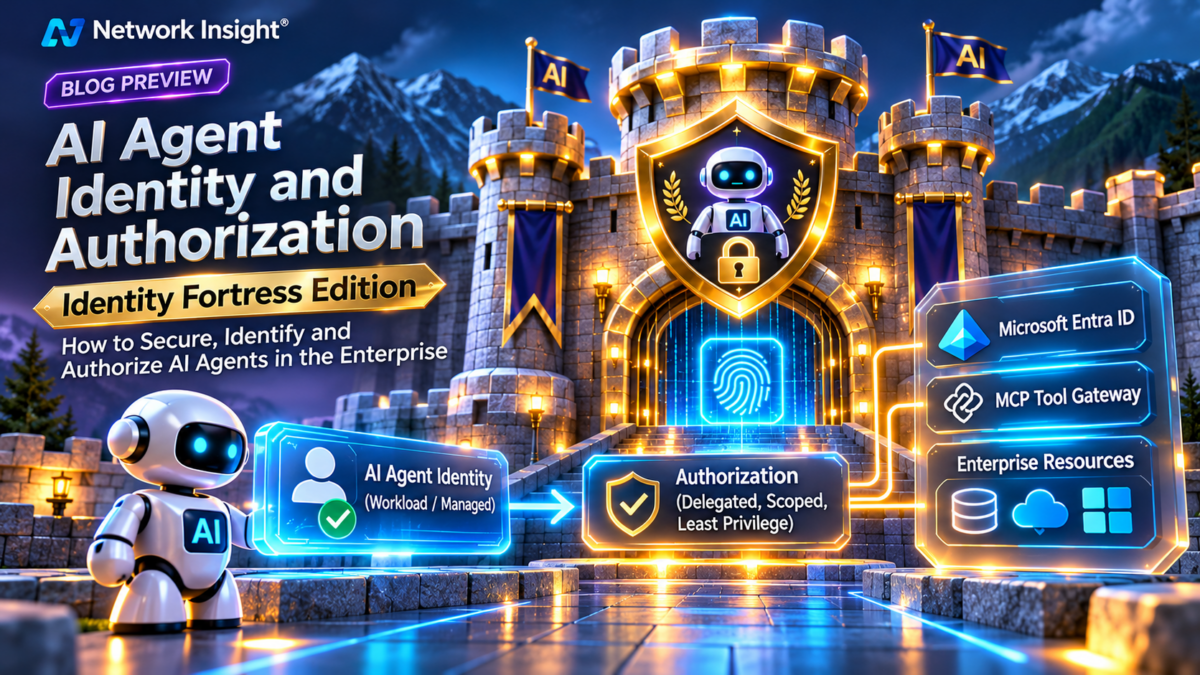
AI Agent Identity and Authorization Architecture Explained
Engineering secure, governed and auditable AI agent infrastructure with delegated authorization, workload identities, short-lived credentials, least-privilege access and runtime policy enforcement.
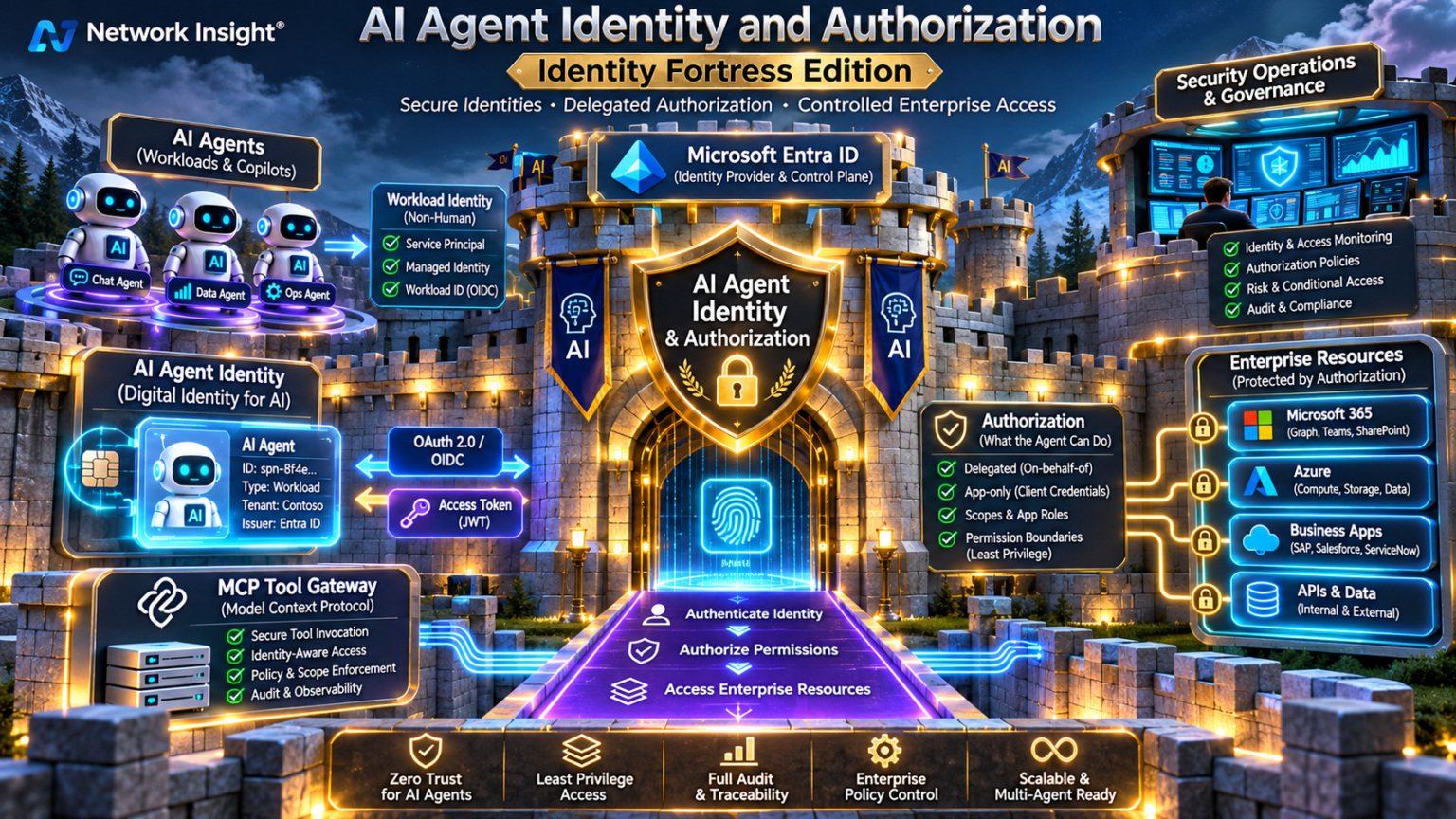
Conceptual enterprise architecture. Identity issuance, policy evaluation and enforcement may be distributed across multiple services. Protected resources must independently enforce their applicable authorization requirements rather than blindly trust an upstream gateway.
When Artificial Intelligence Becomes an Infrastructure Actor
Traditional artificial intelligence applications primarily receive information, process it and return a response. Agentic AI introduces a fundamentally different execution model. An AI agent can reason about an objective, select tools, retrieve information, invoke APIs and coordinate actions across multiple enterprise systems.
An enterprise troubleshooting agent might retrieve network telemetry, inspect Kubernetes workloads, query cloud configuration, correlate security alerts and propose remediation. A more autonomous implementation might also modify infrastructure, restart services or initiate operational workflows.
These capabilities transform the agent from a passive information-processing application into an active infrastructure participant. Every interaction with a protected resource therefore introduces questions of identity, authorization, trust, accountability and operational governance.
The language model can propose an operation. Trusted infrastructure must independently determine whether the agent is permitted to execute that operation.
Secure agent architecture requires more than placing an API key inside an application. Engineers must establish identifiable workloads, controlled credential issuance, explicit permission boundaries, independently enforced authorization policies and reliable evidence of every security-sensitive operation.
Four Questions Every AI Agent Must Answer
Who Is the Agent?
A trusted identity system associates the executing workload with an identifiable principal. This enables authentication, lifecycle management and attribution of infrastructure activity.
Who Initiated the Task?
Determine whether the operation originates from a human user, scheduled automation, another agent or an infrastructure event. Preserve the initiating context where appropriate.
What Is It Allowed to Do?
Authorization establishes which resources, operations and data the agent can access, subject to applicable scopes, roles, resource policies and contextual restrictions.
Can the Action Be Audited?
Security teams need evidence connecting the workload, initiating context, authorization decision, invoked operation and resulting outcome.
Establishing a Digital Identity for an AI Agent
A security principal represents an entity to which an identity and permissions can be associated. Depending on the platform, an agent may execute using a dedicated agent identity, a service principal, a managed identity, a federated workload identity or another supported non-human identity mechanism.
This digital identity passport represents a conceptual inventory record, not a real credential, JWT or standardized identity document. Actual identity attributes and token lifetimes depend on the platform and its security configuration.
The identity record should establish ownership and operational responsibility. An agent should not remain permanently active after its application has been decommissioned, its business purpose has changed or its permissions are no longer required.
Understanding the Different Identity Types
| Identity type | Primary purpose | Authentication mechanism | Agentic AI relevance |
|---|---|---|---|
| Human identity | Represents an individual user. | Passkeys, MFA, federation or other user authentication. | Establishes initiating user context and delegated authority. |
| Service principal | Represents an application in an identity system. | Certificates, secrets or federated credentials. | Supports application-level resource access. |
| Managed identity | Provides platform-managed workload identity. | Platform-mediated credential acquisition. | Reduces the need to manage application secrets. |
| Federated workload identity | Establishes trust between workload and identity domains. | Trusted assertions and credential exchange. | Enables short-lived access without distributing long-lived secrets. |
| Agent identity | Represents an agent or agent workload. | Platform-specific agent or workload authentication. | Supports agent-specific ownership, permissions and governance. |
These categories are not necessarily mutually exclusive. An agent identity may be implemented using a service principal or workload identity. The important engineering requirement is that the identity is distinguishable, appropriately governed and bound to the actual executing workload.
Authentication Is Not Authorization
Authentication
Establishes confidence in the identity of a user, application or workload. It answers whether the presented identity or credential can be trusted.
Authorization
Determines whether an authenticated principal can perform a specific operation against a particular resource under the applicable security policy.
A valid identity or access token does not automatically authorize every operation. The resource and applicable enforcement components must evaluate the request against the relevant security policy.
Separating Agent Intelligence from Agent Authority
A language model may determine that restarting a production application could resolve an incident. That recommendation does not establish permission to restart the application.
The execution environment must treat model-generated tool requests as proposed actions. Each request should be evaluated using trusted identity information, validated parameters, resource permissions and applicable authorization policies.
get_network_telemetry(device="router-01")
The diagnostics agent possesses read-only telemetry access. The request targets an authorized resource and satisfies the policy.
modify_router_configuration(device="router-01")
The same agent attempts a configuration change. Its read-only permission does not authorize infrastructure modification.
request_service_restart(service="production-api")
A separate remediation workflow requires human approval and an appropriately authorized execution identity before performing the restart.
This separation becomes particularly important when an agent processes untrusted documents, web pages, emails, tool responses or externally supplied instructions. Prompt injection may influence the model's reasoning, but independently enforced authorization boundaries can restrict the resulting infrastructure actions.
Authorization alone does not eliminate prompt injection. Secure systems also require data isolation, validated tool arguments, output controls, appropriate sandboxing and restrictions on external data transfers.
Delegated Access Versus Application Access
AI agents may operate on behalf of an authenticated user or independently as an application workload. These are different authorization models and should not be treated as interchangeable.
Logical comparison rather than an exact OAuth protocol message sequence. In a typical token-based implementation, the agent obtains a token from the authorization server and subsequently presents it to the protected API.
| Property | Delegated access | Application access |
|---|---|---|
| Execution context | Agent acting on behalf of a user. | Agent acting as an application workload. |
| Permission model | Delegated permissions and applicable user/resource rights. | Application permissions, roles and resource policies. |
| Typical use case | Retrieving information requested by a signed-in user. | Scheduled monitoring and automated infrastructure analysis. |
| Principal risk | Improper delegation or confused deputy behavior. | Overprivileged autonomous workloads. |
| Governance | Consent, delegation boundaries and user accountability. | Workload ownership, permission reviews and lifecycle controls. |
The AI Agent Authorization Lifecycle
Establish the initiating user, workload or automation context and the requested objective.
Establish the identity of the executing agent using a trusted workload authentication mechanism.
Obtain an appropriately scoped credential for the intended protected resource.
Validate identity, permissions, requested operation, resource and contextual conditions.
Perform only the authorized operation. Deny or defer requests that fail policy or approval requirements.
Capture the identity, decision, resource, operation and execution outcome for audit.
In production systems, these stages may repeat for each protected resource or tool invocation. Authorization should not be assumed to remain valid simply because an earlier step in the agent's workflow was permitted.
Where AI Agent Identity Becomes Essential
Network Operations
Agents retrieve routing tables, interface counters, telemetry and configuration state while remaining isolated from unauthorized configuration changes.
Kubernetes Infrastructure
Workload identities and Kubernetes authorization restrict agent access to namespaces, workloads, API operations and cloud resources.
Security Operations
Investigation agents correlate security alerts and identity events. Containment and remediation actions require separately governed authority.
Enterprise Knowledge Retrieval
Retrieval systems enforce applicable document permissions and tenant boundaries rather than allowing agents to retrieve unrestricted enterprise information.
MCP Tool Ecosystems
Remote MCP deployments combine appropriate transport authentication, resource authorization and tool-specific execution controls.
Multi-Agent Systems
Orchestrator and worker agents operate with distinguishable identities and bounded delegation rather than sharing unrestricted credentials.
What Happens When an Agent Exceeds Its Authority?
Consider a network troubleshooting agent that receives an instruction embedded inside an externally supplied diagnostic document. The instruction attempts to persuade the agent to modify a production router.
The model may incorrectly interpret the instruction as part of its task. However, the agent's identity possesses only telemetry-reading permissions. The execution gateway and protected resource therefore reject the configuration request.
10:42:01.104 TASK_RECEIVED
  agent       = network-diagnostics-agent
  objective   = investigate-interface-errors

10:42:01.280 IDENTITY_AUTHENTICATED
  principal   = workload:network-diagnostics
  context     = production

10:42:02.116 AUTHORIZATION_ALLOW
  operation   = telemetry.read
  resource    = router-01

10:42:03.491 TOOL_REQUEST_RECEIVED
  operation   = configuration.write
  resource    = router-01

10:42:03.493 AUTHORIZATION_DENY
  reason      = required_permission_missing
  execution   = blocked

10:42:03.498 SECURITY_EVENT_RECORDED
  trace_id    = demo-trace-001
  outcome     = no_configuration_change
Synthetic security event trace created for educational purposes. It is not output from a specific identity provider, MCP implementation or production security platform.
The important distinction is that authentication succeeded while authorization failed. The agent remained a valid workload identity, but the requested operation exceeded its permitted authority.
Engineers investigating this event should examine the origin of the instruction, the agent's execution trace, the applicable permission assignments and the authorization decision. Expanding the agent's permissions merely to eliminate the denial would undermine the intended security boundary.
Designing an Enterprise Agent Identity Architecture
| Engineering principle | Architectural implementation | Security objective |
|---|---|---|
| Distinct identities | Assign appropriately separated principals to agent workloads and security domains. | Reduce shared credential exposure and improve accountability. |
| Least privilege | Grant only the resource permissions required for the agent's defined responsibilities. | Restrict unauthorized operations and reduce blast radius. |
| Short-lived credentials | Prefer supported ephemeral credentials and automated credential acquisition. | Limit credential exposure windows. |
| Audience restriction | Validate that an access token is intended for the receiving resource. | Prevent inappropriate token reuse across services. |
| Bounded delegation | Constrain downstream authority using supported delegation and resource authorization mechanisms. | Prevent unintended privilege expansion. |
| Independent enforcement | Enforce authorization outside the model's reasoning process. | Contain unauthorized model-generated tool requests. |
| Human approval | Require trusted approval workflows for selected high-impact operations. | Control consequential infrastructure changes. |
| Lifecycle management | Provision, review, disable and retire agent identities and permissions. | Reduce orphaned and unnecessary access. |
| Security observability | Correlate identity, policy and execution events without exposing credentials in logs. | Support investigation, governance and incident response. |
What You Will Learn in This Engineering Guide
This guide explores the complete identity and authorization architecture of enterprise AI agents, progressing from identity fundamentals to distributed trust relationships and production security operations.
Agent principals, authentication, authorization, accountability and trust boundaries.
Service principals, managed identities, federation, Kubernetes identities and SPIFFE.
Token issuance, scopes, audiences, claims, credential exchange and expiration.
User delegation, application authority, permission boundaries and confused deputy risks.
Enterprise identity integration, Microsoft Foundry, agent governance and Azure resource access.
Protected resources, OAuth authorization, audience validation and tool-level controls.
Policy decision engines, contextual authorization, risk evaluation and execution boundaries.
Agent-to-agent authentication, bounded delegation, distributed identities and trust chains.
Audit evidence, credential revocation, permission failures, incident containment and governance.
Agent identity establishes who is acting. Authorization determines what that identity may do. Policy enforcement constrains execution, while observability establishes accountability. Together, these capabilities form the security foundation of production agentic AI infrastructure.
AI Agent Identity
Architecture Explorer
Explore the identity, authentication, authorization and trust architecture that protects autonomous AI agents across enterprise infrastructure.
Progress reflects your current position within the editorial guide, rather than verified completion of each section.
Understanding AI Agent Identity
Engineering the security foundations of autonomous infrastructure actors through identifiable principals, trusted execution contexts, authentication, authorization and independently enforced enterprise trust boundaries.
Conceptual architecture showing the separation between model reasoning, workload identity and protected resource access. Identity and authorization functions may be implemented across several infrastructure components.
What Is an AI Agent Identity?
An AI agent identity is the security identity associated with an agent or the workload executing its operations. It enables trusted infrastructure to identify, authenticate, authorize and audit the entity requesting access to protected resources.
An AI agent may contain a language model, orchestration logic, memory, retrieval components, tool integrations and an execution environment. However, these components do not automatically constitute an authenticated security principal.
The agent's operational identity must be established through a trusted identity mechanism that binds the executing workload to a recognized principal.
These are separate architectural responsibilities. Combining them without independent enforcement creates an unsafe trust model.
For example, an enterprise network troubleshooting agent may be designed to retrieve BGP routing information, interface counters and firewall telemetry. Its identity can be associated with read-only access to specific infrastructure resources without granting permission to change routing policy or firewall configuration.
Human, Application and Agent Identities
Human Identity
Represents an individual user, typically authenticated through passkeys, MFA, federation or another user authentication mechanism.
Application Identity
Represents a software application or workload that authenticates to services using a supported non-human identity mechanism.
AI Agent Identity
Represents an agent or agent workload whose reasoning and tool execution must remain within explicitly defined authorization boundaries.
An AI agent identity is not necessarily a completely new category of identity technology. Many agent deployments use established application identity mechanisms such as service principals, managed identities and federated workload identities.
What makes agent identity particularly important is the potentially dynamic nature of the agent's behavior. Unlike a narrowly programmed service, an agent may select different tools and execution paths in response to changing context.
| Property | Human identity | Traditional application | AI agent |
|---|---|---|---|
| Represented entity | Individual person | Software workload | Agent or executing workload |
| Task initiation | Human interaction | Programmed request or event | User request, event or agent workflow |
| Execution behavior | Human-selected operations | Predominantly programmed logic | Potentially dynamic tool selection |
| Authentication | User credentials and federation | Workload credentials | Workload identity and applicable user delegation |
| Authorization | User roles and permissions | Application roles and resource policies | Workload or delegated permissions plus execution controls |
| Accountability | Individual activity | Application and owner | Agent, initiating context, owner and operation |
Understanding the Agent Security Principal
A security principal is an entity recognized by an identity and authorization system. Permissions can be associated with that principal, allowing protected services to determine whether a requested operation should be permitted.
An agent's display name is not sufficient to establish its security identity. Trusted identity systems use identifiers and authentication mechanisms that allow the principal to be distinguished from other entities.
Logical identity relationships. A credential is not the principal itself: it is evidence used in an authentication or authorization process.
Principal Identifier
A stable identifier within an identity domain distinguishes the agent principal from other workloads. Identifiers must be interpreted in their applicable issuer or tenant context.
Identity Authority
The trusted identity system establishes or validates the principal and supports appropriate authentication and credential issuance mechanisms.
Credential
Certificates, assertions, access tokens and other credential mechanisms provide evidence used to establish identity or authorized access.
Identity Ownership
A designated team or accountable owner governs the agent's purpose, permission assignments, operational lifecycle and retirement.
The AI Agent Identity Architecture Stack
Enterprise agent identity should be understood as a layered architecture rather than a single token or authentication mechanism. Each layer performs a distinct security function.
Ownership, audit evidence, identity reviews, compliance and lifecycle management.
API, tool, application and data-level authorization controls.
Requested operation, permissions, resource restrictions, context and approval requirements.
Supported access tokens, certificates or other resource-appropriate credentials.
Trusted verification of the executing agent or workload identity.
Registered identity, identifier, tenant or trust domain and associated ownership.
Application runtime, orchestrator, model integration and tool execution components.
Conceptual responsibility stack rather than a standardized protocol stack. Real implementations may combine several responsibilities within a single platform component.
A failure at any layer can undermine the overall security architecture. A valid principal with excessive permissions remains dangerous. A correctly scoped token can still be mishandled by an insecure execution runtime. Strong authentication cannot compensate for missing resource-level authorization.
Identity, Authentication and Authorization
Identity — Who?
Establishes the entity represented by the security principal, including its identity domain and lifecycle ownership.
Authentication — Verified?
Establishes confidence that the requesting entity is associated with the claimed identity through a trusted authentication mechanism.
Authorization — Permitted?
Determines whether the authenticated principal may perform the requested operation against the specified resource.
Accounting — Recorded?
Establishes evidence of security-relevant requests, authorization decisions, resource access and execution outcomes.
Logical security decision sequence. Actual authentication and authorization may occur within the same resource server or across several enforcement components.
In HTTP-based enterprise systems, a missing or invalid authentication credential commonly results in an HTTP 401 response. A request with valid authentication but insufficient permission commonly results in an HTTP 403 response.
These status codes are useful troubleshooting signals, although implementations may deliberately return other responses, such as HTTP 404, to avoid disclosing the existence of protected resources.
The Language Model Is Not the Agent Principal
A common architectural mistake is to treat the language model as though it were the identity responsible for enterprise resource access.
In many deployments, the language model is accessed through an inference service. The agent application authenticates to that service, supplies context and receives generated responses or proposed tool calls. The agent runtime then determines whether and how those tool calls should be executed.
The two credential domains are illustrative. Specific authentication mechanisms depend on the inference platform and protected enterprise resource.
Permission to invoke an inference endpoint does not imply permission to access an enterprise database. Similarly, an access token issued for one protected API should not be accepted by an unrelated API unless the receiving resource is an intended audience under the applicable authorization design.
Credentials should remain within trusted execution components rather than being inserted into model prompts, conversation memory or untrusted tool responses.
Understanding Agent Execution Context
Identifying the executing agent is necessary but may not be sufficient to authorize a particular operation. Enterprise systems often need additional trusted information describing the circumstances under which the agent is acting.
Executing Principal
Identifies the authenticated agent workload responsible for requesting the operation.
Initiating Context
Identifies the authenticated user, automation trigger or upstream workload associated with the task where applicable.
Execution Environment
Establishes whether the workload is operating in development, testing, staging or production and within which trusted infrastructure domain.
Target Resource
Identifies the API, infrastructure device, namespace, application or data object being accessed.
Requested Operation
Distinguishes reading, modifying, deleting, transferring or executing operations against the protected resource.
Correlation Context
Associates related requests and execution events with a task or trace identifier to support operational investigation.
{
  "principal": {
    "id": "agent-network-diagnostics",
    "trust_domain": "enterprise.example",
    "type": "workload"
  },

  "initiator": {
    "type": "authenticated_user",
    "id": "operator-104"
  },

  "execution": {
    "environment": "production",
    "task_id": "incident-2026-001",
    "trace_id": "trace-0042"
  },

  "request": {
    "operation": "telemetry.read",
    "resource": "router-01"
  }
}
Illustrative application-level context record, not a standardized token format or a deployable policy. Security-sensitive attributes must originate from trusted authentication and infrastructure mechanisms, not arbitrary model-generated fields.
An agent cannot grant itself production authority simply by generating a request containing an administrator role, privileged user identifier or approved status.
Shared Versus Dedicated Agent Identities
Organizations must determine the appropriate identity granularity for their agent infrastructure. A single shared principal may simplify initial deployment, but it can create excessive permissions, weak attribution and unnecessary cross-agent exposure.
Dedicated identities can reduce cross-agent permission exposure when combined with correctly scoped credentials, runtime isolation and independently enforced resource policies.
Separate principals are particularly valuable when agents operate across different tenants, environments, business functions or security sensitivity levels.
However, a dedicated permanent principal for every transient execution is not always necessary. Some architectures use a stable workload identity together with short-lived execution credentials and task-specific authorization. The appropriate granularity depends on isolation requirements and platform capabilities.
Mapping Agent Identities to Resource Permissions
Consider an enterprise environment containing three specialized AI agents. Each agent receives only the permissions required for its defined operational responsibilities.
| Requested operation | Network diagnostics | Security investigation | Remediation agent |
|---|---|---|---|
| Read network telemetry | ALLOW | DENY | ALLOW |
| Read routing tables | ALLOW | DENY | ALLOW |
| Read security alerts | DENY | ALLOW | DENY |
| Modify routing policy | DENY | DENY | CONDITIONAL |
| Restart approved service | DENY | DENY | CONDITIONAL |
| Modify identity permissions | DENY | DENY | DENY |
| Export unrestricted enterprise data | DENY | DENY | DENY |
Illustrative permission matrix, not a universal production policy. Conditional access in this example requires both an appropriately authorized execution identity and satisfaction of an independent approval or contextual policy.
The matrix illustrates why agent identity architecture is closely related to blast-radius reduction. A compromised or misdirected diagnostics agent should not automatically inherit the capabilities of a remediation agent.
Least privilege must also consider resource granularity. Permission to read telemetry from one approved router does not necessarily authorize reading telemetry from every router across every enterprise tenant.
Understanding Agent Trust Boundaries
A trust boundary identifies a point at which information, credentials or requests move between components with different security assumptions.
AI agents introduce several important boundaries because they consume potentially untrusted information while also interacting with trusted enterprise execution infrastructure.
Content Boundary
External content enters the agent's reasoning environment. Information must not be mistaken for trusted system instructions or proof of authorization.
Execution Boundary
Model-generated operations cross into trusted execution infrastructure. Parameters, identity, permissions and applicable policies must be independently evaluated.
Resource Boundary
Protected services validate applicable credentials and enforce their own resource authorization requirements.
Trust boundaries must be backed by actual enforcement. A diagram separating components does not provide security unless the runtime, credential architecture, network controls and protected services enforce those separations.
The Agent Identity Lifecycle
Agent identities should be governed throughout their operational lifetime. Creating a principal and assigning permissions is only the beginning of the identity management process.
Establish the agent's business function, accountable owner and intended resource access.
Register the principal using the supported enterprise identity mechanism.
Grant narrowly scoped permissions and establish applicable resource restrictions.
Bind the executing workload to its trusted identity and acquire appropriate credentials.
Correlate identity, authorization and execution events for security observability.
Remove unnecessary access and reassess ownership, purpose and operational risk.
Contain compromised identities and prevent further unauthorized credential acquisition or resource access.
Remove obsolete assignments, credentials and identity objects while preserving required audit evidence.
Disabling a principal does not necessarily invalidate every previously issued credential immediately. Revocation behavior depends on the credential type, authorization infrastructure, token lifetime and resource enforcement capabilities.
Production incident response procedures must therefore account for both future credential issuance and credentials that may already be active.
Engineering Incident — The Agent With the Wrong Identity
Consider an enterprise environment containing a network diagnostics agent and a separate infrastructure remediation agent.
The diagnostics agent is intended to inspect BGP sessions and interface telemetry. The remediation agent has narrowly controlled configuration capabilities.
During a deployment update, the diagnostics workload is incorrectly associated with the remediation principal. The language model and application functionality remain unchanged, but the security authority available to the workload has changed.
Diagnostics workload executes using its dedicated read-only principal.
A deployment configuration change associates the workload with the remediation identity.
The identity platform issues a credential for the principal to which the workload is now incorrectly bound.
Monitoring detects a mismatch between the expected diagnostics identity and the observed remediation principal.
Operators isolate the affected deployment and apply appropriate credential and resource-access containment measures.
The workload identity association is corrected and the expected read-only authorization behavior is verified before resuming service.
EXPECTED WORKLOAD STATE
-----------------------------------------------
workload          : network-diagnostics
expectedPrincipal : network-diagnostics-agent
permissionProfile : read-only
environment       : production

OBSERVED WORKLOAD STATE
-----------------------------------------------
workload          : network-diagnostics
observedPrincipal : infrastructure-remediation
permissionProfile : controlled-write
environment       : production

SECURITY FINDING
-----------------------------------------------
identityBinding   : MISMATCH
authentication    : SUCCESS
expectedAuthority : READ_ONLY
observedAuthority : ELEVATED
risk              : UNINTENDED_PRIVILEGE

CONTAINMENT
-----------------------------------------------
workloadExecution : SUSPENDED
credentialReview  : REQUIRED
resourceAccess    : RESTRICTED
auditPreservation : ENABLED

RECOVERY VERIFICATION
-----------------------------------------------
identityBinding   : CORRECT
telemetry.read    : ALLOW
config.write      : DENY
workloadStatus    : RESTORED
Synthetic investigation scenario and diagnostic output. This is not an actual incident or the output of a specific identity management product.
Engineers must validate the relationship between the deployed workload, its expected principal and its effective resource permissions.
Troubleshooting AI Agent Identity Failures
| Observed symptom | Potential cause | Evidence to examine | Engineering response |
|---|---|---|---|
| Agent cannot authenticate | Invalid workload binding or credential | Identity provider events and runtime configuration | Verify principal registration and authentication mechanism. |
| HTTP 401 response | Missing, expired or unacceptable credential | Issuer, audience, expiration and resource authentication logs | Validate credential acquisition and resource requirements. |
| HTTP 403 response | Insufficient permissions or policy denial | Resource authorization and policy decision logs | Compare requested operation against intended authority. |
| Unexpected write access | Overprivileged or incorrectly assigned principal | Effective roles, identity binding and resource policies | Contain access and restore the intended permission boundary. |
| Cross-agent access | Shared credentials or weak runtime isolation | Principal identifiers, credential provenance and deployment configuration | Review identity separation and execution isolation. |
| Unknown task initiator | Missing or untrusted execution context | User authentication events and correlated request traces | Establish trusted initiating-context propagation. |
| Access persists after suspension | Previously issued credentials remain accepted | Credential lifetime, revocation behavior and resource logs | Apply resource-side containment and supported revocation controls. |
| Orphaned agent identity | Incomplete application retirement | Identity inventory, ownership and recent activity | Review and remove obsolete access and identity objects. |
Building the Foundation of Trustworthy Agent Execution
Identifiable
Every security-sensitive agent operation should be attributable to an appropriately identified principal.
Authenticated
The executing workload must establish its identity through trusted authentication mechanisms.
Authorized
Every protected operation must satisfy the applicable permission, resource and contextual authorization requirements.
Isolated
Identity and runtime separation should limit unnecessary cross-agent access and reduce security blast radius.
Auditable
Security events should connect the agent principal, initiating context, requested operation, policy decision and outcome.
Governed
Agent identities require accountable ownership, permission reviews, lifecycle management and effective retirement procedures.
Agent identity establishes the foundation for every subsequent authorization decision. Before designing OAuth token exchanges, delegated permissions, MCP security or multi-agent trust relationships, engineers must first establish which principal is acting, how it is authenticated and where its authority begins and ends.
AI Agent Identity Architecture Explorer
Enter the Identity Fortress. Establish an independent agent identity, examine its digital identity passport, trace authentication and authorization decisions, and discover how enterprise infrastructure establishes trust in autonomous software.
Select an identity architecture
Configure the execution context
From initiating intent to protected resource
Inspect the executing identity
Conceptual identity inventory record
This passport is an educational identity inventory record. It is not an OAuth access token, signed credential or authentication assertion.
Who is responsible for the action?
The owning team manages the identity lifecycle and is accountable for its assigned responsibilities.
The agent operates as a separately identifiable software principal.
Autonomous execution does not require an interactive human user session.
Owning an agent, initiating a request and executing an action are distinct relationships. Ownership does not automatically grant the agent the owner's personal permissions.
Five stages of accountable execution
Authentication is not authorization
No identity journey has been executed.
Inspect the execution evidence
Inspect the configured permission boundary
| RESOURCE | READ | WRITE | ADMIN | TRUST DOMAIN |
|---|
The matrix shows configured permissions for the selected identity and execution context. Authentication and governance checks must also pass before any operation is permitted.
Inject an identity architecture failure
Attribute each attempted operation
| REQUEST | INITIATOR | PRINCIPAL | OWNER | OPERATION | DECISION |
|---|
Secure the autonomous infrastructure agent
An autonomous infrastructure agent has been deployed with a shared identity, no assigned owner and an invalid credential. It must retrieve operational telemetry without acquiring administrative privileges.
Fundamental AI agent identity principles
An AI agent should have an appropriately scoped, identifiable execution identity. The model, application and execution identity are distinct architectural concepts.
A trusted credential provides evidence of identity. It does not automatically grant access to every enterprise resource.
Agent identities require lifecycle management, accountable ownership and traceable operational activity.
An autonomous agent can act under its own application or workload authorization without borrowing a human user's credentials.
Delegated execution requires an authorized relationship between the initiating user, client and requested resource. A user prompt is not itself proof of delegation.
Protected resources must enforce authorization independently of the agent's reasoning, intentions or generated instructions.
View simulation assumptions and limitations
This widget is a vendor-neutral conceptual identity simulator. It does not connect to an identity provider, generate real credentials or invoke enterprise APIs.
The simulated enterprise requires dedicated software identities, accountable owners and an available audit mechanism. These are explicit laboratory governance policies, not universal authentication requirements.
A shared or reused human identity may authenticate successfully in a real system. This laboratory rejects such identities at its separate governance boundary.
The delegated execution model uses a simplified intersection of agent permissions and user permissions. Actual OAuth delegated authorization depends on the authorization server, resource, consent and applicable security policy.
Identity ownership does not imply that the owner initiated a particular action or that the owner is personally responsible for every runtime decision.
The execution and audit stages are conceptual. Real systems require durable recording, failure handling and appropriate transaction semantics.
OAuth token exchange, workload identity federation, Microsoft Entra-specific implementation, MCP authorization and dynamic policy enforcement are covered in subsequent engineering sections.
Non-Human and Workload Identities
Engineering trusted machine identities for autonomous AI infrastructure through service principals, managed identities, workload federation, cryptographic attestation and short-lived credentials.
Conceptual multi-platform identity architecture. Credential issuance paths differ between managed identities, federated identities and other workload authentication systems. The identity authority is not necessarily in the application data path.
What Is a Non-Human Identity?
A non-human identity (NHI) represents a software application, service, automation process, device or other machine-operated entity within an identity and access management system.
Unlike human users, workloads generally cannot respond to interactive authentication challenges. They require machine-compatible mechanisms that establish identity without depending on a person manually entering credentials.
AI agents belong to this broader class of non-human infrastructure actors. Their operational identity can be associated with an application, container, virtual machine, managed service or another trusted execution environment.
AI Agents
Autonomous or semi-autonomous workloads that reason about tasks and invoke enterprise tools.
Microservices
Distributed applications requiring authenticated service-to-service communication.
Automation Pipelines
Build and deployment systems requiring controlled access to repositories and cloud infrastructure.
Container Workloads
Dynamically scheduled applications whose identities should remain independent of transient IP addresses and container instances.
Infrastructure location can contribute to an authentication decision, but location alone should not establish unrestricted authority.
Service Principals, Managed Identities and Federation
Several established identity mechanisms can support AI agent infrastructure. Although their terminology differs across cloud platforms, the fundamental requirement remains the same: bind the executing workload to a trusted security principal.
Service Principal
- Identity domain
- Microsoft Entra tenant
- Represents
- Application security identity
- Authentication
- Secret, certificate or federation
- Lifecycle
- Application and identity governance
Managed Identity
- Identity domain
- Microsoft Entra / Azure
- Represents
- Supported Azure workload identity
- Authentication
- Platform-managed mechanism
- Lifecycle
- System-assigned or user-assigned
Federated Identity
- Identity domain
- Cross-platform trust relationship
- Represents
- Externally authenticated workload
- Authentication
- Trusted signed assertion
- Lifecycle
- Issuer and principal trust configuration
In Microsoft Entra, an application object describes an application registration, while a service principal represents an application's security identity within a particular tenant.
Managed identities are also represented by service principals in Microsoft Entra, but their underlying credential management is handled by Azure. Consequently, service principals and managed identities should not be understood as entirely unrelated identity categories.
Workload identity federation is an authentication mechanism that allows a supported identity to trust assertions issued by another identity system, avoiding the need for an application-managed client secret in that authentication flow.
| Mechanism | Identity representation | Credential management | Typical application |
|---|---|---|---|
| Service principal with secret | Application principal | Application or secret-management system | Legacy application integration |
| Service principal with certificate | Application principal | Private key and certificate lifecycle | Cryptographic application authentication |
| System-assigned managed identity | Azure resource-associated principal | Azure-managed | Dedicated supported Azure resource |
| User-assigned managed identity | Independent Azure identity resource | Azure-managed | Reusable workload identity |
| Workload identity federation | Mapped target principal | Trusted external assertions | Kubernetes and cross-platform workloads |
| SPIFFE identity | SPIFFE ID in a trust domain | Workload identity infrastructure | Service-to-service workload authentication |
How Managed Identities Authenticate AI Agents
A managed identity enables supported Azure workloads to acquire Microsoft Entra access tokens without embedding an application-managed client secret in their configuration.
The workload requests a token for a particular resource through a supported identity endpoint or credential library. The Azure identity infrastructure manages the underlying authentication relationship with Microsoft Entra.
Logical managed identity flow. Endpoint behavior, token caching and underlying authentication implementation vary by Azure hosting service.
System-Assigned Identity
Associated with a supported Azure resource. Its lifecycle is tied to that resource, making it useful for dedicated workload identity isolation.
User-Assigned Identity
Created as an independent Azure resource and assignable to supported workloads. It can survive the replacement of a compute resource.
Resource Authorization
Identity creation does not automatically grant access. Appropriate Azure RBAC roles, application permissions or resource-specific policies must be configured separately.
A user-assigned identity can simplify deployments across multiple compute instances. However, sharing the same identity across unrelated agents can recreate the excessive-permission and attribution problems associated with shared service accounts.
Workload Identity Federation
Workload identity federation establishes a trust relationship between identity systems. Instead of authenticating using a permanently configured client secret, a workload presents an assertion issued by a trusted external identity provider.
The target identity platform validates the assertion and checks whether its attributes match a configured federation relationship. If the authentication requirements are satisfied, the platform can issue an access token for the mapped target principal.
The validation bridge represents logical functions performed by the target identity platform. It is not necessarily a separately deployed network appliance.
Understanding the Federation Trust Tuple
Issuer
Identifies the trusted authority that issued the workload assertion. The target platform must trust the issuer and its signing keys.
Subject
Identifies the workload within the issuer's identity domain, such as a particular Kubernetes service account.
Audience
Identifies the intended recipient or purpose of the assertion. A token intended for another audience should not be accepted.
Matching these identity attributes is not sufficient on its own. The target platform must also validate the assertion's cryptographic signature, lifetime and other applicable security requirements.
Broad subject matching or insufficient issuer restrictions can expand the number of workloads capable of authenticating as a privileged principal.
Kubernetes Service Accounts and Workload Identity
Kubernetes service accounts provide identities for processes running inside pods. They are namespaced Kubernetes objects and are distinct from the human identities used by cluster operators.
Kubernetes supports projected service account tokens with configurable audiences and lifetimes. These signed tokens can be used by supported external identity federation systems.
In an AKS workload identity deployment, an agent pod can use a projected service account token to authenticate to Microsoft Entra through a configured federated identity credential.
Illustrative Kubernetes Service Account
apiVersion: v1
kind: ServiceAccount
metadata:
  name: network-agent
  namespace: ai-agents
  annotations:
    azure.workload.identity/client-id:
      "<target-managed-identity-client-id>"

---

apiVersion: v1
kind: Pod
metadata:
  name: network-agent
  namespace: ai-agents
  labels:
    azure.workload.identity/use: "true"

spec:
  serviceAccountName: network-agent
  containers:
    - name: agent
      image: example.invalid/network-agent:1.0
Illustrative AKS configuration using placeholder identity and container image values. It requires a configured OIDC issuer, workload identity support, an existing namespace, a real container image, a federated identity credential and appropriate target resource permissions.
Corresponding Federation Relationship
{
  "name": "network-agent-federation",

  "issuer":
    "<AKS-OIDC-ISSUER-URL>",

  "subject":
    "system:serviceaccount:ai-agents:network-agent",

  "audiences": [
    "api://AzureADTokenExchange"
  ]
}
The projected Kubernetes token is an authentication assertion in this federation flow. It is not itself the Microsoft Entra access token used to call the protected Azure resource.
Kubernetes RBAC controls access to Kubernetes API resources. Azure resource authorization controls access to the relevant Azure service. Configuring one does not automatically configure the other.
SPIFFE and SPIRE Architecture
The Secure Production Identity Framework for Everyone (SPIFFE) defines standards for identifying workloads within distributed systems.
A SPIFFE identity is expressed as a URI containing a trust domain and a workload-specific path. It can be represented cryptographically using a SPIFFE Verifiable Identity Document (SVID).
SPIRE is an implementation of the SPIFFE standards that supports workload and node attestation, identity registration and SVID issuance.
SPIRE Server
Maintains registration information, supports node attestation and manages the signing infrastructure used for workload identity issuance.
SPIRE Agent
Operates on a compute node, identifies local workloads using configured attestation mechanisms and exposes the SPIFFE Workload API.
Workload Attestation
Examines trusted workload attributes, such as Kubernetes namespace and service account, according to configured attestation plugins.
Identity Issuance
Supplies an eligible workload with a verifiable identity document and relevant trust information through the supported Workload API.
Understanding the SPIFFE ID
spiffe://enterprise.example/agent/network

Scheme       : spiffe
Trust domain : enterprise.example
Workload path: /agent/network

Additional workload identities

spiffe://enterprise.example/agent/security
spiffe://enterprise.example/agent/remediation
spiffe://enterprise.example/service/telemetry
spiffe://enterprise.example/service/inventory
A SPIFFE ID identifies a workload within its trust domain. The string alone does not prove identity. Authentication depends on a valid SVID and the appropriate cryptographic trust verification.
X.509-SVIDs and JWT-SVIDs
SPIFFE defines two principal SVID formats: X.509-SVIDs and JWT-SVIDs. Both represent workload identity, but they support different authentication patterns.
X.509-SVID
An X.509 certificate containing a SPIFFE ID in its URI Subject Alternative Name. The workload uses the corresponding private key to establish cryptographic proof of identity.
Particularly suitable for mutually authenticated TLS connections between distributed workloads.
JWT-SVID
A signed JSON Web Token representing a SPIFFE workload identity and containing an intended audience and expiration.
Useful where application-layer token authentication is required and certificate-based authentication is not suitable.
| Property | X.509-SVID | JWT-SVID |
|---|---|---|
| Representation | X.509 certificate | Signed JSON Web Token |
| SPIFFE ID location | URI Subject Alternative Name | Subject claim |
| Authentication pattern | Proof of private-key possession | Bearer token presentation |
| Typical use | Mutual TLS | Application-layer authentication |
| Trust validation | Certificate chain and trust bundle | Trusted signing keys and token claims |
| Lifetime | Certificate validity interval | Token expiration |
| Authorization | Separate application or infrastructure policy | Separate application or infrastructure policy |
Conceptual mutual authentication diagram rather than an exact TLS handshake message sequence. Private keys are not transmitted between workloads.
A valid workload certificate must not automatically grant unrestricted access to every service within the same trust domain.
Ephemeral Credentials and Secretless Authentication
Long-lived application credentials create an operational security burden. They must be stored, protected, distributed, rotated and eventually revoked.
If a persistent credential is exposed, an attacker may be able to authenticate repeatedly until that credential expires or is effectively revoked.
Ephemeral credentials reduce this exposure by limiting credential validity to a shorter period and allowing trusted infrastructure to issue replacement credentials when required.
Hypothetical remaining validity periods for educational comparison. These are not default lifetimes for Microsoft Entra, Kubernetes or SPIRE. If an attacker compromises the underlying workload or credential issuance mechanism, they may obtain additional credentials beyond the illustrated window.
Limited Lifetime
Reduces the time during which a stolen individual credential may remain usable, provided the receiving resource enforces expiration.
Automatic Rotation
Trusted identity infrastructure refreshes credentials before expiration, reducing reliance on manual application credential replacement.
Secretless Integration
Supported workloads authenticate without an application-managed static client secret, using platform identity or federation instead.
Credential Isolation
Sensitive tokens and private keys remain within trusted execution components rather than being exposed to model prompts or conversation memory.
Secretless authentication does not mean that cryptographic secrets no longer exist. Identity systems still rely on signing keys, private keys, protected platform credentials or other trust mechanisms.
The architectural improvement is that the application no longer needs to manage a persistent authentication secret for the supported identity flow.
Cross-Domain Workload Trust
Enterprise AI agents may operate across Kubernetes, Azure, AWS, private data centres and external service environments. Each environment can have its own identity infrastructure and trust boundary.
Cross-domain trust allows workloads to authenticate across these boundaries using explicitly configured relationships rather than distributing a common credential to every environment.
SPIFFE federation enables validation of identities from explicitly trusted external trust domains. This is distinct from exchanging an OIDC workload assertion for a cloud access token.
Trust federation should not erase security boundaries. A service that trusts the signing infrastructure of another domain must still evaluate whether the particular authenticated workload is authorized to perform the requested operation.
The Workload Credential Lifecycle
Deploy the agent into an approved execution environment with its intended identity association.
Establish workload identity using the applicable platform authentication or attestation mechanism.
Validate identity bindings, external assertions and configured trust relationships.
Obtain the appropriate access token, certificate or verifiable identity document.
Present the credential to the intended service using its supported authentication protocol.
Evaluate the requested operation against resource permissions and contextual policy.
Renew eligible credentials before expiration through the trusted identity infrastructure.
Remove obsolete identity bindings and apply supported credential and access containment controls.
Credential renewal is an availability dependency. An agent may continue operating temporarily using cached credentials while its identity infrastructure is unavailable, but subsequent requests can fail when those credentials expire.
Production architecture should therefore include identity service availability, token refresh monitoring, certificate expiration alerts, signing-key rotation and appropriate clock synchronization.
Engineering Incident — The Broken Federation Relationship
Consider an AKS-hosted AI agent that retrieves network telemetry from an enterprise API protected by Microsoft Entra.
The agent initially operates in the Kubernetes namespace ai-agents. During a deployment migration, the application moves to a new namespace called ai-production.
The service account name remains unchanged, but its identity subject changes because Kubernetes service account identities include their namespace.
The projected service account assertion matches the configured federated identity credential.
The service account name remains network-agent, but its fully qualified identity subject changes.
The new assertion is correctly signed and represents the service account in ai-production.
The assertion subject no longer matches the configured federation relationship.
Engineers confirm that the failure occurs during credential acquisition rather than protected resource authorization.
The intended namespace identity is configured, obsolete trust is reviewed and resource access is verified against the original permission boundary.
EXPECTED FEDERATION CONFIGURATION
--------------------------------------------------
issuer   : approved-aks-oidc-issuer
subject  : system:serviceaccount:ai-agents:network-agent
audience : api://AzureADTokenExchange

OBSERVED ASSERTION METADATA
--------------------------------------------------
issuer   : approved-aks-oidc-issuer
subject  : system:serviceaccount:ai-production:network-agent
audience : api://AzureADTokenExchange

VALIDATION RESULT
--------------------------------------------------
issuerMatch    : PASS
audienceMatch  : PASS
signature      : PASS
lifetime       : PASS
subjectMatch   : FAIL

credentialAcquisition : REJECTED
resourceRequest       : NOT SENT

ROOT CAUSE
--------------------------------------------------
Kubernetes namespace migration changed
the service account identity subject.

RECOVERY VERIFICATION
--------------------------------------------------
approvedSubjectMatch : PASS
credentialAcquisition: SUCCESS
telemetry.read       : ALLOW
configuration.write  : DENY
Synthetic diagnostic evidence for an illustrative incident. This is not actual Microsoft Entra or Kubernetes command output.
Engineers must investigate the identity binding rather than granting additional resource permissions to compensate for an authentication failure.
Inspecting Workload Identity Configuration
Effective troubleshooting begins by identifying the layer at which the identity process failed. Kubernetes configuration, external federation, credential issuance and resource authorization provide different evidence.
# Inspect the agent pod identity association

kubectl get pod network-agent \
  -n ai-agents \
  -o jsonpath='{.spec.serviceAccountName}'

# Inspect the service account configuration

kubectl get serviceaccount network-agent \
  -n ai-agents -o yaml

# Inspect pod configuration and events

kubectl describe pod network-agent -n ai-agents

# Inspect the workload identity opt-in label

kubectl get pod network-agent \
  -n ai-agents \
  -o jsonpath='{.metadata.labels.azure\.workload\.identity/use}'

# Inspect namespace events

kubectl get events -n ai-agents \
  --sort-by=.metadata.creationTimestamp
# Inspect the user-assigned managed identity

az identity show \
  --resource-group <resource-group> \
  --name <identity-name>

# Inspect configured federated identity credentials

az identity federated-credential list \
  --resource-group <resource-group> \
  --identity-name <identity-name>

# Inspect AKS OIDC issuer configuration

az aks show \
  --resource-group <resource-group> \
  --name <cluster-name> \
  --query oidcIssuerProfile

# Inspect Azure role assignments

az role assignment list \
  --assignee <principal-object-id> \
  --all \
  --include-inherited
# Inspect registered workload identities

spire-server entry show

# Inspect attested agents

spire-server agent list

# Inspect server health

spire-server healthcheck

# Inspect local agent health

spire-agent healthcheck
Example read-only commands for authorized operators. CLI availability, flags, permissions and socket configuration depend on the installed platform version and deployment. Role assignment listings do not necessarily represent every effective permission or resource-specific authorization rule.
Diagnostic procedures should avoid printing raw access tokens, projected service account tokens or private keys into shared terminals, application logs, support tickets or AI prompts.
Production Troubleshooting Framework
| Observed symptom | Potential cause | Evidence to inspect | Engineering response |
|---|---|---|---|
| Managed identity unavailable | Identity not enabled or assigned | Hosting resource and identity configuration | Verify the intended identity association. |
| Wrong principal authenticated | Incorrect identity selection | Client ID, runtime configuration and identity logs | Restore the intended principal binding. |
| Projected token missing | Workload identity mutation or projection failure | Pod specification, labels and admission events | Verify workload identity configuration. |
| Federation rejected | Issuer, subject or audience mismatch | Trusted assertion metadata and federation settings | Correct the approved trust relationship. |
| Assertion signature rejected | Signing-key or issuer trust problem | Issuer metadata, trusted keys and validation logs | Verify issuer discovery and key rotation. |
| SPIRE workload not identified | Registration or selector mismatch | Registration entries and workload attestation logs | Validate workload registration and attestation. |
| mTLS authentication fails | Expired SVID or incorrect trust bundle | Certificate validity and trust configuration | Verify renewal and peer identity validation. |
| Access fails after operating normally | Credential renewal failure | Expiration times and identity service availability | Investigate the credential refresh dependency. |
| Token accepted but API returns 403 | Insufficient resource authorization | Effective permissions and resource policy logs | Verify intended authority without excessive grants. |
| Cross-agent privilege exposure | Shared identity or overly broad federation | Principal assignments and trust mappings | Separate security boundaries and narrow trust. |
Engineering Secure Non-Human Identity Infrastructure
Dedicated Identity Boundaries
Separate agent identities according to workload purpose, tenant, environment and required authority.
Platform-Managed Authentication
Prefer supported managed identity mechanisms where they satisfy workload and resource requirements.
Explicit Federation
Establish narrowly defined cross-domain trust relationships and verify assertion provenance.
Ephemeral Credentials
Use appropriately short credential lifetimes and reliable automated renewal mechanisms.
Cryptographic Workload Trust
Establish service-to-service identity using trusted certificates or other verifiable identity documents where appropriate.
Independent Authorization
Never treat successful workload authentication as permission to execute unrestricted operations.
Non-human identity infrastructure provides the authentication foundation for autonomous agents. Managed identities, federation and cryptographic workload identity reduce dependence on persistent application secrets, while independent authorization determines the operations those authenticated workloads may actually perform.
Workload Identity Provisioning Lab
Engineer the identity infrastructure behind autonomous AI agents. Compare persistent service credentials with managed identities, Kubernetes service accounts, workload identity federation and SPIFFE-based workload authentication.
Select an identity provisioning model
Configure the workload
From workload execution to trusted identity
Inspect identity binding conditions
Compare actual identity evidence
Trace the five-stage identity journey
Expiration, renewal and rotation
No credential issued
Laboratory time: 0 minutes
Inspect the current credential
Acquire a credential before testing resource authentication.
Compare credential management architectures
| IDENTITY MODEL | APPLICATION-MANAGED SECRET | SOURCE EVIDENCE | ISSUED CREDENTIAL | TRUST MECHANISM |
|---|---|---|---|---|
| Service principal — secret | Yes | Client secret | Access token | Registered application credential |
| Managed identity | No | Platform identity context | Access token | Platform-managed identity binding |
| Kubernetes service account | No persistent secret required | Pod and service account binding | Projected service account token | Kubernetes token issuer |
| Workload identity federation | No persistent client secret required | External signed assertion | Target access token | Configured federation relationship |
| SPIFFE / SPIRE | No persistent application secret required | Workload attestation | X.509-SVID and private key | SPIFFE trust domain |
Persistent application credential
One application-managed client secret in the laboratory baseline.
Service principal
Examine the conceptual deployment
Educational configuration representation. Not a deployable cloud, Kubernetes or SPIRE configuration file.
Inspect provisioning and authentication evidence
Inject a workload identity failure
Track issued credential generations
| CREDENTIAL | IDENTITY MODEL | ISSUED AT | EXPIRES AT | STATE |
|---|
Issuing a replacement credential does not automatically invalidate earlier credentials. This ledger tracks that distinction.
Migrate the AI agent to secretless federation
An AI operations agent currently runs inside Kubernetes using a persistent application client secret. Migrate it to workload identity federation, establish the correct trust relationship and demonstrate credential acquisition, expiration and renewal.
Workload identity architecture principles
A software principal represents an identity. A credential provides evidence that can be used to authenticate that identity.
Supported cloud platforms can manage credential acquisition on behalf of a workload, reducing application-level secret management.
Kubernetes service accounts identify workloads within the cluster. External cloud access requires an appropriate additional trust mechanism.
A target identity authority accepts trusted external identity evidence under explicitly configured conditions. This can eliminate stored client secrets.
SPIFFE defines workload identity standards. SPIRE implements workload and node attestation and can issue short-lived SPIFFE identity documents.
Short-lived credentials reduce the lifetime of exposed credentials. Renewal, rotation, revocation and identity decommissioning remain essential operational responsibilities.
View simulation assumptions and limitations
This is a vendor-neutral conceptual simulation. All identities, credentials, configuration records and event messages are fictional.
The service principal example uses a client secret. Service principals can also authenticate through other supported credential mechanisms.
The managed identity example assumes a supported cloud execution environment. Actual platform capabilities and identity endpoints differ.
The Kubernetes example uses a projected, bounded-lifetime service account token for a Kubernetes resource audience. It does not automatically grant external cloud access.
The federation example uses simplified issuer, subject and audience matching. Real implementations also require cryptographic verification, expiration validation and provider-specific policy.
The SPIFFE example represents X.509-SVID authentication. Its trust conditions are based on attestation, registration and trust-domain validation, rather than OAuth audience matching.
The credential lifetime slider controls laboratory time only. Production credential lifetimes are determined by the issuing infrastructure and applicable policies.
Resource authentication success is not resource authorization success. No enterprise API operation is executed.
Explicit resource-side invalidation is a laboratory abstraction. Not every token or certificate deployment supports immediate individual credential revocation.
OAuth 2.0 and OpenID Connect Architecture
Engineering trusted AI agent access through authorization servers, delegated permissions, resource-specific access tokens, cryptographic validation and secure protocol exchanges.
Conceptual OAuth architecture showing a delegated access scenario. Machine-to-machine client credentials flows do not require an interactive resource owner. Exact protocol exchanges depend on the selected authorization grant.
Understanding OAuth 2.0
OAuth 2.0 is an authorization framework that enables a client application to obtain limited access to protected resources without requiring the resource owner's primary credentials to be shared with that application.
For AI agent infrastructure, OAuth provides a standardized foundation for acquiring and presenting access tokens when invoking enterprise APIs, cloud services and protected tool endpoints.
Instead of embedding a user's password into an agent, the architecture establishes a controlled authorization relationship between the client, authorization server and protected resource.
Resource Owner
The entity capable of granting access to a protected resource. In delegated enterprise scenarios, this is commonly a human user.
OAuth Client
The application requesting access. An AI agent runtime, orchestration service or trusted backend can act as an OAuth client.
Authorization Server
Evaluates authorization grants and applicable policy before issuing tokens to eligible clients.
Resource Server
Hosts the protected API or resource and determines whether the presented credential authorizes the requested operation.
OpenID Connect adds an identity layer to OAuth 2.0 so applications can obtain standardized information about an authenticated end user.
OAuth 2.0 versus OpenID Connect
OpenID Connect (OIDC) extends OAuth 2.0 with standardized authentication semantics, identity claims, ID tokens and provider discovery.
An application can use OIDC to establish the identity of a signed-in user while using OAuth access tokens to access protected APIs.
| Property | OAuth 2.0 | OpenID Connect |
|---|---|---|
| Primary purpose | Resource authorization | End-user authentication |
| Primary token | Access token | ID token |
| Intended consumer | Protected resource server | OIDC client / relying party |
| Identity semantics | Not standardized as user authentication | Standardized authenticated user claims |
| Typical agent use | Invoking enterprise APIs and tools | Establishing the initiating user's identity |
| Protocol relationship | Authorization framework | Identity layer built on OAuth 2.0 |
Access Tokens, ID Tokens and Refresh Tokens
Modern identity infrastructure can issue several different token types. Each has a distinct purpose, intended recipient and security boundary.
Access Token
- Purpose
- Access protected resources
- Intended recipient
- Resource server
- Representation
- JWT or opaque token
- Authority
- Granted permissions and resource restrictions
ID Token
- Purpose
- Communicate authentication information
- Intended recipient
- OIDC client application
- Representation
- JSON Web Token
- Authority
- Not a substitute for API access permission
Refresh Token
- Purpose
- Acquire replacement access tokens
- Intended recipient
- Authorization server
- Representation
- Provider-specific credential
- Authority
- Subject to the existing grant and renewal policy
Sending an ID token to an API, forwarding a refresh token to a tool service or reusing an access token across unrelated resources can violate fundamental trust boundaries.
Refresh tokens are not guaranteed to be issued in every OAuth flow. In the client credentials grant, clients normally obtain replacement access tokens by authenticating again rather than using refresh tokens.
Inside a JSON Web Token
JSON Web Tokens (JWTs) provide a compact format for representing claims. A commonly encountered signed JWT uses the JSON Web Signature (JWS) compact serialization format, containing three Base64url-encoded components separated by periods.
Protected Header
{
 "alg": "RS256",
 "typ": "at+jwt",
 "kid": "key-2026"
}
Describes the signing algorithm, token type and signing-key identifier in this illustrative JWT access token profile.
Claims Payload
{
 "iss": "https://id.example",
 "sub": "network-agent",
 "aud": "https://api.example",
 "client_id": "agent-client",
 "scope": "telemetry.read",
 "iat": 1800000000,
 "exp": 1800000900,
 "jti": "token-example-01"
}
Carries claims describing the issuer, subject, intended resource, client and granted authority.
Digital Signature
RS256(
  encoded_header
  + "."
  + encoded_payload,

  issuer_private_key
)
Enables a trusted verifier to establish integrity and authenticity using the appropriate issuer public key.
Illustrative signed JWT structure, not an actual issued or cryptographically valid token. JWT access token claims vary by authorization server and token profile.
A signed JWT protects the integrity of its contents, but signing does not automatically provide confidentiality. Its header and payload can generally be decoded by anyone possessing the token.
Encrypted JWTs use a different serialization structure and provide confidentiality according to their encryption configuration.
An AI agent or API must never treat decoded claims as trusted authorization evidence until the applicable cryptographic and semantic validation requirements have succeeded.
Understanding JWT Claims
| Claim | Meaning | Engineering significance |
|---|---|---|
| iss | Issuer | Identifies the authority responsible for issuing the token. |
| sub | Subject | Identifies the subject within the issuer's identity context. |
| aud | Audience | Identifies the intended recipient or recipients. |
| exp | Expiration time | Defines when the token must no longer be accepted. |
| nbf | Not before | Defines the earliest permitted acceptance time when present. |
| iat | Issued at | Identifies the issuance time. |
| jti | JWT identifier | Provides a token identifier that may support replay detection or correlation. |
| scope | Granted OAuth scopes | Communicates permissions in profiles that use this claim. |
| scp | Delegated scopes | Used by Microsoft Entra access tokens for delegated permissions. |
| roles | Application or assigned roles | Can communicate app roles and application permissions in supported profiles. |
| client_id | OAuth client identifier | Identifies the client in applicable token profiles. |
| azp / appid | Authorized party / application ID | Provider and token-version-specific client identification. |
| cnf | Confirmation claim | Can bind a token to a particular cryptographic key. |
Claims must be interpreted according to the trusted issuer's documented token profile. A claim name that has one meaning in a particular platform should not automatically be assigned identical semantics in every identity system.
The combination of issuer and subject is important when identifying principals across multiple identity providers. A subject identifier should not be assumed to be globally unique by itself.
OAuth Client Credentials Flow
The client credentials grant is designed for confidential clients that authenticate to an authorization server and obtain access under their own application authority.
This is particularly relevant to autonomous AI agents performing approved background operations without a human user participating in each execution.
POST /oauth2/token HTTP/1.1
Host: identity.example
Content-Type: application/x-www-form-urlencoded

grant_type=client_credentials
&client_id=network-agent
&scope=telemetry.read
&client_assertion_type=
 urn:ietf:params:oauth:client-assertion-type:jwt-bearer
&client_assertion=<signed-client-assertion>
Conceptual request with line breaks for readability. Actual form parameters must be correctly encoded. This example assumes support for signed JWT client authentication and the requested scope.
{
  "access_token": "<issued-access-token>",
  "token_type": "Bearer",
  "expires_in": 900,
  "scope": "telemetry.read"
}
The example token has a hypothetical lifetime of 900 seconds. Actual token lifetimes and permission representations depend on the authorization server and resource configuration.
A client credentials token represents an application-level authorization context. It must not be interpreted as evidence that a particular human user approved the agent's current operation.
Authorization Code Flow with PKCE
When an AI agent operates on behalf of a human user, the authorization code flow provides a mechanism for obtaining delegated authorization through an interactive authorization process.
Proof Key for Code Exchange (PKCE) binds the authorization code exchange to a verifier generated by the initiating client.
Modern OAuth security guidance recommends authorization code flows with PKCE instead of relying on legacy implicit or password-based grants.
Simplified protocol sequence. OIDC-specific requirements, including nonce handling where applicable, must also be implemented when requesting user authentication.
PKCE helps prevent an intercepted authorization code from being redeemed by a party that does not possess the original verifier.
It does not replace secure redirect URI validation, transaction binding, client authentication where required, TLS or other applicable OAuth and OIDC security controls.
Discovery Metadata and JSON Web Key Sets
OpenID Connect discovery allows clients to obtain standardized metadata describing a trusted identity provider.
This metadata can identify authorization and token endpoints, supported algorithms and the location of the provider's JSON Web Key Set (JWKS).
GET /.well-known/openid-configuration
Host: identity.example

{
  "issuer":
    "https://identity.example",

  "authorization_endpoint":
    "https://identity.example/authorize",

  "token_endpoint":
    "https://identity.example/token",

  "jwks_uri":
    "https://identity.example/jwks",

  "response_types_supported": [
    "code"
  ],

  "code_challenge_methods_supported": [
    "S256"
  ],

  "id_token_signing_alg_values_supported": [
    "RS256"
  ]
}
The resource server or trusted token validation library obtains signing keys from the configured trusted issuer's key infrastructure.
The JWT header's key identifier, commonly represented by the kid field, can help select the appropriate verification key from that trusted key set.
Token validation components must enforce permitted issuers, algorithms and trusted signing-key sources.
The Token Validation Pipeline
A resource server accepting JWT access tokens must perform cryptographic and semantic validation before trusting the token's claims.
A valid signature establishes that the token was signed using the corresponding trusted key and that its signed content has not been modified. It does not establish that the token is intended for the current resource or operation.
Animated educational representation of a successful validation trace. It does not perform actual cryptographic token verification.
| Validation control | Security purpose | Failure response |
|---|---|---|
| Signature verification | Detect modified or untrusted signed tokens. | Reject invalid credential. |
| Issuer validation | Restrict accepted identity authorities. | Reject untrusted issuer. |
| Audience validation | Prevent use of tokens intended for another resource. | Reject incorrect audience. |
| Lifetime validation | Enforce expiration and applicable time restrictions. | Reject expired or premature token. |
| Token type validation | Prevent inappropriate substitution between token profiles. | Reject unexpected token type. |
| Sender constraint validation | Verify required proof of possession when configured. | Reject missing or invalid proof. |
| Permission evaluation | Restrict access to authorized operations. | Deny insufficient authority. |
| Resource policy | Enforce tenant, object and contextual restrictions. | Deny unauthorized resource access. |
Audience Restrictions and Token Substitution
An AI agent may interact with several protected resources during a single task. These could include a telemetry API, a configuration management service and an enterprise database.
Access tokens should be restricted to their intended resources. A token issued for a telemetry API must not automatically provide access to a configuration management API.
OAuth resource indicators, where supported, allow clients to identify the intended protected resource when requesting authorization or tokens.
In multi-service agent architectures, the trusted runtime should acquire an appropriate token for each resource rather than forwarding a single broadly privileged credential to every tool.
JWT Access Tokens versus Opaque Access Tokens
OAuth does not require access tokens to be JWTs. An authorization server can issue opaque tokens whose internal meaning is not available to the client or resource server through local decoding.
Where supported, a resource server can use OAuth token introspection to obtain information about the token's current active state and associated authorization context.
| Property | Locally validated JWT | Introspected opaque token |
|---|---|---|
| Validation location | Resource server or trusted gateway | Authorization server via introspection |
| Per-request dependency | Can avoid remote validation calls with cached keys | May require remote lookup unless safely cached |
| Revocation awareness | Requires additional controls for early invalidation | Can reflect server-side active state |
| Claim visibility | Signed payload commonly readable | Token value does not expose structured claims |
| Operational dependency | Signing-key distribution and rotation | Introspection availability and latency |
These are common architectural patterns rather than mutually exclusive token categories. JWT access tokens can also be introspected when the authorization server supports that validation model.
Bearer Tokens and Proof-of-Possession Architecture
A bearer access token can generally be used by any party possessing it, subject to the token's validity and resource authorization requirements.
Sender-constrained tokens introduce an additional cryptographic relationship between the token and the authorized sender.
Bearer Access Token
The resource validates the presented token. Token confidentiality is particularly important because possession may be sufficient for use.
Mutual TLS Binding
Certificate-bound access tokens can require the resource server to verify that the caller presents the certificate associated with the token's confirmation information.
Demonstrating Proof of Possession
DPoP binds supported OAuth tokens to a client-controlled asymmetric key and uses signed request proofs to demonstrate possession.
Sender constraints can reduce the usefulness of an access token stolen without its associated key. They do not eliminate the consequences of compromising the authorized runtime or the associated private key.
Access Token Acquisition, Renewal and Expiration
Determine the intended API, authorization context and required operation.
Select the supported grant and authenticate the client or user as required.
Apply identity, consent, client and authorization server policy.
Issue an access token with the applicable audience, authority and lifetime.
Retain credentials in trusted runtime components rather than model context.
Present the appropriate token and enforce resource-side validation and policy.
Reauthenticate or use a supported refresh mechanism before expiration.
Reject expired credentials and apply supported revocation or containment controls.
Token caches must preserve authorization boundaries. A cache entry associated with one user, tenant, client, resource or permission set must not be incorrectly reused for another.
Where refresh tokens are issued, rotation and replay detection can provide additional security according to the authorization server's policy.
Microsoft Entra OAuth Architecture for AI Agents
Microsoft Entra supports OAuth and OpenID Connect integration for enterprise applications, service principals, managed identities and supported workload federation mechanisms.
An AI agent accessing Microsoft-protected resources can operate under application permissions or delegated permissions, depending on the required authorization context.
Application Registration
Defines application identity configuration, supported authentication settings and declared API permission requirements.
Service Principal
Represents the application's security identity within a Microsoft Entra tenant.
Delegated Permissions
Permit supported operations on behalf of a signed-in user, subject to the granted scopes and applicable user and resource authority.
Application Permissions
Provide application-level access without requiring a signed-in user for each request, subject to configured grants and resource policy.
POST
https://login.microsoftonline.com/
<tenant-id>/oauth2/v2.0/token

Content-Type: application/x-www-form-urlencoded

grant_type=client_credentials

client_id=<application-client-id>

scope=api://<resource-app-id>/.default

client_assertion_type=
urn:ietf:params:oauth:client-assertion-type:jwt-bearer

client_assertion=<signed-client-assertion>
Illustrative certificate-based client authentication parameters for the Microsoft Entra v2 token endpoint. Use supported identity libraries to construct, encode and transmit actual requests.
The .default scope requests the statically configured permission context for the identified resource. In a client credentials scenario, the resulting application authority depends on the permissions actually granted to the application.
It is not a mechanism for automatically requesting arbitrary new permissions or bypassing administrator consent and resource authorization.
Engineering Incident — The Valid Token That Failed
Consider an enterprise network operations agent that reads telemetry from a monitoring API and retrieves device inventory from a separate infrastructure API.
During an application update, the token cache is changed so that credentials are indexed only by agent identity rather than by the complete authorization context.
The agent subsequently presents its cached telemetry access token to the inventory API. The token is correctly signed and has not expired, but it was issued for a different resource.
The agent acquires separate credentials for telemetry and inventory services.
Resource audience information is removed from the cache key.
The runtime retrieves an existing telemetry access token from its credential cache.
The inventory API rejects the credential despite its valid signature and lifetime.
Engineers identify incorrect cross-resource credential reuse in the agent runtime.
The agent obtains the correct inventory token without expanding its permissions or weakening API validation.
REQUEST CONTEXT
--------------------------------------------------
agent          : network-operations-agent
operation      : inventory.read
resource       : inventory-api

OBSERVED TOKEN METADATA
--------------------------------------------------
issuer         : https://identity.example
subject        : network-operations-agent
audience       : telemetry-api
scope          : telemetry.read

RESOURCE VALIDATION
--------------------------------------------------
signature      : PASS
issuer         : PASS
lifetime       : PASS
expectedAud    : inventory-api
observedAud    : telemetry-api
audience       : FAIL

HTTP response  : 401 Unauthorized
error          : invalid_token

ROOT CAUSE
--------------------------------------------------
Token cache failed to preserve resource context.

RECOVERY VERIFICATION
--------------------------------------------------
correctAudience     : PASS
inventory.read      : ALLOW
inventory.write     : DENY
configuration.write : DENY
Fictional incident and synthetic diagnostic evidence. Actual error descriptions and log fields depend on the API and identity platform.
The correct engineering response is to restore resource-specific credential acquisition and preserve the intended authorization boundary.
OAuth and OpenID Connect Troubleshooting
| Observed symptom | Potential cause | Evidence | Engineering response |
|---|---|---|---|
| invalid_client | Client authentication failure | Client registration and authentication logs | Verify the intended client identity and credential mechanism. |
| invalid_grant | Invalid, expired or mismatched authorization grant | Grant type, code lifetime, PKCE and redirect binding | Investigate the failed grant transaction. |
| invalid_scope | Unsupported or invalid requested scope | Resource registration and scope configuration | Request only supported, required permissions. |
| 401 invalid_token | Invalid, expired or inappropriate access token | Issuer, audience, lifetime and signature validation | Acquire the correct valid credential. |
| 403 insufficient_scope | Token lacks required authority | Granted scopes, roles and operation policy | Verify intended authorization without excessive grants. |
| Unknown signing key | Signing-key rotation or incorrect issuer | Trusted JWKS metadata and key cache | Refresh trusted keys using bounded, controlled logic. |
| Intermittent expiration failures | Clock skew or credential renewal problems | System time, expiration and refresh telemetry | Correct time synchronization and renewal behavior. |
| Cross-tenant access failure | Incorrect tenant or issuer context | Principal, tenant and resource trust configuration | Restore the approved tenant-specific identity binding. |
| Proof-of-possession failure | Incorrect key binding or invalid request proof | Confirmation metadata and proof validation logs | Verify the supported sender-constrained token flow. |
| Valid token but operation denied | Resource-level authorization restriction | Object policy, tenant ownership and contextual controls | Investigate resource policy rather than token issuance alone. |
HTTP 401 commonly indicates missing or invalid authentication credentials, while HTTP 403 commonly indicates that access is forbidden. Individual APIs may apply different error handling conventions.
# Inspect Microsoft Entra discovery metadata

curl -fsS \
 "https://login.microsoftonline.com/<tenant-id>/v2.0/.well-known/openid-configuration" \
 | jq '{
   issuer,
   authorization_endpoint,
   token_endpoint,
   jwks_uri
 }'

# Inspect public signing-key metadata from a trusted JWKS URL

curl -fsS "<trusted-jwks-uri>" \
 | jq '.keys[] | {
   kid,
   kty,
   use,
   alg
 }'

# Inspect system time on a Linux agent host

date -u
timedatectl status
Replace placeholders with approved environment values. These examples require curl, jq and applicable operating system utilities. Public discovery and key metadata do not contain private signing keys.
Production diagnostics should record safe validation results, resource identifiers, request correlation IDs and authorization decisions rather than raw access tokens, refresh tokens or private credentials.
Relevant Engineering Standards
| Standard | Engineering purpose |
|---|---|
| RFC 6749 | OAuth 2.0 authorization framework. |
| RFC 6750 | OAuth bearer token usage. |
| RFC 7519 | JSON Web Token representation. |
| RFC 7636 | Proof Key for Code Exchange. |
| RFC 7662 | OAuth token introspection. |
| RFC 8705 | OAuth mutual TLS and certificate-bound access tokens. |
| RFC 8707 | OAuth resource indicators. |
| RFC 8725 | JWT security best current practices. |
| RFC 9068 | JWT profile for OAuth access tokens. |
| RFC 9449 | Demonstrating Proof of Possession. |
| RFC 9700 | OAuth 2.0 security best current practice. |
| OpenID Connect Core 1.0 | Authentication and identity semantics built on OAuth 2.0. |
Engineering Secure AI Agent Authorization
Separate Authentication from Authorization
Use appropriate identity mechanisms and independently evaluate resource authority.
Select the Correct OAuth Grant
Distinguish autonomous application access from human-delegated authorization.
Preserve Audience Boundaries
Acquire resource-appropriate credentials and prevent incorrect cross-service token reuse.
Validate Every Credential
Enforce trusted issuers, cryptographic integrity, token type and applicable claims.
Protect the Credential Lifecycle
Secure token storage, renewal, expiration and supported containment mechanisms.
Keep Credentials Outside Model Context
Allow trusted runtime components to handle authentication without exposing raw tokens to prompts or model-generated content.
OAuth 2.0 and OpenID Connect establish the protocol foundations for trusted enterprise identity and authorization. Secure agent architecture extends these foundations with resource-specific credentials, least-privilege permissions, cryptographic validation, isolated credential handling and independent runtime policy enforcement.
Interactive Token Exchange Simulator
Explore OAuth 2.0 authorization flows, OpenID Connect identity tokens, delegated token exchange, JWT validation and sender-constrained access credentials. Investigate how enterprise AI agents acquire and use resource-specific tokens.
Select an OAuth authorization flow
Configure the token request
Follow the authorization and token journey
Inspect the five-stage token acquisition pipeline
Examine the token endpoint request
Synthetic protocol representation. No actual network request is transmitted.
Inspect the token endpoint response
The simulator does not generate usable access tokens, secrets or private keys.
Disassemble the JSON Web Token
Header
Token type, signing algorithm and signing-key identifier.
Payload
Identity, issuer, audience, validity and authorization claims.
Signature
Cryptographic integrity and authenticity verification.
Configure the protected resource request
Inspect the resource security decision
Acquire a token before testing the protected resource.
Investigate credential expiration
Laboratory time: 0 minutes
Acquire a replacement token
Expired access tokens must not be accepted. The appropriate renewal mechanism depends on the original authorization flow.
Inspect the delegated identity relationship
User authorization
Agent trust boundary
Resource-specific access
Compare bearer and sender-constrained tokens
| MECHANISM | REQUIRED EVIDENCE | STOLEN TOKEN ALONE | RESOURCE VALIDATION |
|---|---|---|---|
| Bearer token | Valid access token | Potentially usable | Token and authorization checks |
| DPoP | Access token and signed DPoP proof | Insufficient without bound key | Key binding, method, URI, token hash, freshness and replay controls |
| Mutual TLS | Access token and bound TLS certificate | Insufficient without corresponding key | Certificate binding and authenticated TLS connection |
Inject an authorization or validation failure
Inspect protocol and security events
Observe authorization outcomes
Counters reflect laboratory events, not real OAuth service telemetry.
Secure the autonomous agent token exchange
An AI agent must obtain delegated read-only access to the Network Management API. The existing token exchange relationship is broken, the agent requests excessive permissions and its bearer credential is not sender-constrained.
OAuth and OpenID Connect architecture principles
OAuth provides mechanisms for obtaining limited access to protected resources. It is not, by itself, a user authentication protocol.
OpenID Connect adds an identity layer to OAuth 2.0. An ID token conveys authentication information to its intended relying party.
A token issued for one resource should not automatically be accepted by another resource. Audience validation constrains cross-resource token misuse.
Proof Key for Code Exchange binds authorization code redemption to the client instance that generated the original code challenge.
Token exchange can establish a target-specific authorization context using existing token evidence and an explicitly trusted exchange policy.
DPoP and mutual TLS can bind access-token use to cryptographic key possession, reducing the replay value of stolen tokens.
View standards and simulation limitations
All credentials, identities, protocol messages and security events in this widget are synthetic. No real signing, cryptographic verification, TLS connection or authorization request is performed.
OAuth access tokens can be opaque or structured. This laboratory assumes a JWT access-token representation.
The authorization code example models a confidential client using PKCE and a valid user authorization context. Public clients have different client authentication requirements.
The token exchange example represents one possible delegated exchange policy. Actual token formats, actor claims and supported exchange mechanisms vary.
DPoP proof validation is abstracted into key-binding, request-binding, freshness and replay conditions. The laboratory does not implement RFC 9449 cryptographic processing.
Mutual TLS certificate binding is abstracted into a certificate/key possession condition.
Production resource servers must apply their own trusted token profiles, algorithm restrictions, issuer policies, audience checks, key management and authorization rules.
Engineering Delegated Trust Delegated Authorization and Token Exchange
An AI agent must be able to perform authorized actions on behalf of a user without becoming an unrestricted extension of that user's identity. Delegated authorization creates controlled, auditable relationships between users, autonomous agents, authorization servers and downstream enterprise resources.
Why AI Agents Need Delegated Authorization
Traditional applications typically operate through predictable request-response workflows. An AI agent, however, may dynamically select tools, invoke external APIs, delegate tasks to specialist agents and perform multiple operations before returning a result.
A user might ask an enterprise AI assistant to investigate a network incident. Completing that task could require querying monitoring systems, retrieving configuration documents, consulting an inventory service and invoking a specialist troubleshooting agent. Each operation crosses a potentially different authorization boundary.
Delegation allows the system to preserve the relationship between the original user and the software acting on their behalf while limiting the authority granted to each participating component.
User Authority
The permissions, entitlements and contextual restrictions associated with the requesting user.
Agent Authority
The operations that a particular agent identity is independently permitted to perform.
Delegated Authority
The constrained authority issued for a particular task, downstream resource and acting identity.
Resource Policy
The final authorization decision enforced by the target API, including object-level access restrictions.
An agent's ability to request an operation must never be confused with its authority to execute that operation. Authorization must be enforced outside the language model.
Subject, Actor and Audience Identities
Delegated authorization must distinguish the identity whose authority is being represented, the software component currently acting, and the resource for which the credential is intended. Collapsing these identities into a single generic service account can undermine both authorization and incident investigation.
IDENTITY CONTEXT
DELEGATION CONTEXT
RESOURCE BOUNDARY
| Claim | Purpose | Engineering significance |
|---|---|---|
| sub | Identifies the token subject. | Preserves the represented identity. |
| act | Identifies an actor in a delegation relationship. | Distinguishes acting software from the subject. |
| aud | Identifies the intended token audience. | Prevents acceptance by unintended resources. |
| iss | Identifies the token issuer. | Establishes the issuing trust domain. |
| scope | Describes granted OAuth permissions where represented. | Constrains the authorized operation set. |
| exp | Defines token expiration. | Limits the credential's usable lifetime. |
| jti | Provides a token identifier where present. | Supports correlation and replay controls when implemented. |
| may_act | Can identify a party eligible to become an actor. | Provides input to delegation policy evaluation. |
RFC 8693 — OAuth 2.0 Token Exchange
RFC 8693 defines an OAuth extension grant through which a client can request a security token by presenting an existing security token to an authorization server acting as a Security Token Service (STS).
Rather than forwarding an original credential indiscriminately across multiple services, an agent can request a new token appropriate for the intended downstream resource. The authorization server determines whether the exchange is permitted and what authority the resulting token receives.
| Request parameter | Purpose |
|---|---|
| grant_type | Identifies the token exchange extension grant. |
| subject_token | Represents the identity on whose behalf the request is made. |
| subject_token_type | Identifies the supplied subject token type. |
| actor_token | Optional token representing the acting party. |
| actor_token_type | Required when an actor token is supplied. |
| resource | Identifies a target resource using an absolute URI. |
| audience | Identifies a logical target service. |
| scope | Requests permissions for the issued token. |
| requested_token_type | Optionally identifies the desired output token type. |
Illustrative token exchange request
# Illustrative HTTP request
# Form fields shown on separate lines for readability.
# Client authentication is deployment-specific.

POST /oauth2/token
Host: identity.example.com
Content-Type: application/x-www-form-urlencoded

grant_type=urn:ietf:params:oauth:grant-type:token-exchange
&subject_token=REDACTED_SUBJECT_TOKEN
&subject_token_type=urn:ietf:params:oauth:token-type:access_token
&actor_token=REDACTED_ACTOR_TOKEN
&actor_token_type=urn:ietf:params:oauth:token-type:access_token
&audience=document-api
&scope=documents.read
&requested_token_type=urn:ietf:params:oauth:token-type:access_token
Illustrative successful response
HTTP/1.1 200 OK
Content-Type: application/json
Cache-Control: no-store

{
  "access_token": "REDACTED_ISSUED_TOKEN",
  "issued_token_type":
    "urn:ietf:params:oauth:token-type:access_token",
  "token_type": "Bearer",
  "expires_in": 300,
  "scope": "documents.read"
}
The five-minute lifetime above is illustrative. RFC 8693 does not prescribe this lifetime or require a particular access token format. The issued token may be opaque or structured according to the authorization server's implementation.
OAuth On-Behalf-Of Flows
The On-Behalf-Of (OBO) pattern is commonly used when a middle-tier API receives a user access token and needs to obtain another access token for a downstream API while preserving delegated user authority.
Microsoft Entra ID provides a specific OBO implementation using
a JWT bearer assertion grant and the
requested_token_use=on_behalf_of parameter.
This is conceptually related to token exchange but is not the
same wire protocol as the RFC 8693 extension grant.
# Illustrative Microsoft identity platform request.
# Form encoding and confidential-client authentication
# are required in a real implementation.

POST /{tenant}/oauth2/v2.0/token

grant_type=urn:ietf:params:oauth:grant-type:jwt-bearer
&client_id=AGENT_API_CLIENT_ID
&assertion=REDACTED_INCOMING_ACCESS_TOKEN
&requested_token_use=on_behalf_of
&scope=api://DOCUMENT_API/documents.read

# Confidential-client authentication omitted.
| Pattern | Identity context | Typical application |
|---|---|---|
| Authorization Code | User-delegated access obtained through an authorization flow. | User-facing AI assistant. |
| Client Credentials | Application or workload identity without delegated user context. | Background automation and service tasks. |
| On-Behalf-Of | Delegated user authority across a middle-tier API. | Enterprise agent calling downstream APIs. |
| RFC 8693 Token Exchange | Policy-controlled token transformation, supporting delegation or impersonation semantics. | Multi-service and multi-agent trust architectures. |
Permission Attenuation Across Delegation Chains
Permission attenuation is the deliberate reduction of authority as a task progresses through downstream components. Instead of allowing every specialist agent to inherit the complete set of user privileges, the system grants only the permissions required for the particular delegated operation.
Effective delegated authority is bounded by the user's applicable entitlements, the agent's permitted operations, the task's requirements, the delegation policy and the target resource's authorization rules. Token exchange does not automatically enforce attenuation; it must be designed into the issuing and enforcement policies.
Scope Restriction
Limit the permitted operation set, such as read-only document access instead of unrestricted document management.
Audience Restriction
Issue credentials for the specific intended downstream service rather than every service in the environment.
Temporal Restriction
Use credential lifetimes appropriate to the task, renewal model and risk of credential exposure.
Resource Restriction
Enforce tenant, project, document, database and object-level authorization at the resource boundary.
Multi-Agent Delegation Chain Architecture
Agentic AI platforms increasingly distribute tasks across orchestrators, research agents, analysis agents, security agents and execution agents. Each additional delegation introduces another trust relationship and another opportunity for excessive authority or identity confusion.
A research agent should not automatically acquire the execution agent's change-management permissions. Similarly, an execution agent should not be able to convert a read-only research token into a privileged administrative credential simply by requesting a broader scope.
Representing a delegation chain
RFC 8693 defines an actor claim that may contain a nested actor claim representing prior actors. This can preserve useful delegation history in structured tokens when supported by the issuer.
{
  "iss": "https://identity.example.com",
  "sub": "user-1042",
  "aud": "document-api",
  "scope": "documents.read",

  "act": {
    "sub": "research-agent",

    "act": {
      "sub": "orchestrator-agent"
    }
  },

  "iat": 1800000000,
  "exp": 1800000300,
  "jti": "example-token-004"
}
In this example, the user remains the represented subject, the research agent is the current actor and the orchestrator appears as a prior actor. RFC 8693 treats nested prior actors as informational history rather than additional current actors for access-control decisions.
Preventing the Confused Deputy Problem
A confused deputy vulnerability occurs when a component with legitimate privileges is manipulated into exercising those privileges for an unauthorized party or purpose.
AI agents are particularly exposed to this class of failure because they consume untrusted documents, user instructions, tool responses and external content that may influence their decisions. An agent must not interpret an instruction embedded in retrieved content as an authorization grant.
Validate Token Audience
Reject credentials that were issued for a different service or authorization boundary.
Authenticate the Actor
Verify the identity of the calling workload or agent using trusted authentication mechanisms.
Bind Authority to the Task
Evaluate the requested operation against independently established task context and policy.
Enforce Resource Ownership
Validate tenant membership, object ownership and resource-level entitlements at the target API.
Separate Instructions from Policy
Treat model-generated actions and retrieved instructions as requests, never as trusted authorization decisions.
Require Approval Where Appropriate
Use externally enforced approval workflows for high-impact, irreversible or sensitive operations.
End-to-End Delegated Authorization Lifecycle
Authenticate the Requesting User
Establish the user's identity, session context and applicable enterprise access policies.
Validate the Incoming Credential
The receiving agent or gateway validates the token's issuer, audience, lifetime and integrity using the applicable token validation mechanism.
Establish the Task Boundary
Determine the authorized task, target resources, allowed operation classes and approval requirements.
Select the Downstream Component
The orchestrator selects an appropriate specialist agent or API for the requested operation.
Request a Downstream Credential
Authenticate the requesting client and submit the relevant subject credential, actor context and target authorization requirements to the issuer.
Evaluate Delegation Policy
The authorization server checks whether the delegation relationship and requested authority are permitted.
Issue a Constrained Token
Issue an audience-specific credential with approved permissions, identity context and an appropriate lifetime.
Enforce Downstream Authorization
The resource validates the issued credential and independently evaluates the requested operation and object.
Record Delegation Evidence
Correlate the original subject, current actor, task identifier, resource, policy decision and outcome without recording raw access tokens.
Auditing Delegated Agent Operations
A production authorization architecture should enable engineers to reconstruct how a particular agent obtained authority, which resource it accessed and why the operation was permitted or denied. Application traces alone are insufficient when they cannot be correlated with identity and policy decisions.
{
  "event": "delegated_authorization_decision",
  "trace_id": "trace-8a7f",
  "task_id": "incident-analysis-2048",
  "subject": "user-1042",
  "actor": "research-agent",
  "prior_actor": "orchestrator-agent",
  "resource": "document-api",
  "requested_operation": "documents.delete",
  "granted_permissions": [
    "documents.read"
  ],
  "policy": "research-agent-read-only",
  "policy_version": "12",
  "decision": "DENY",
  "reason": "operation_not_authorized"
}
Raw access tokens, refresh tokens, client secrets and private keys must not be exposed in model prompts, ordinary application logs or distributed tracing attributes. Use appropriately protected credential-handling components and sanitized audit metadata.
Production Troubleshooting and Failure Domains
| Observed symptom | Potential failure domain | Engineering investigation |
|---|---|---|
| Downstream API returns 401 | Invalid, expired or incorrectly targeted token. | Inspect issuer, audience, expiration and validation configuration. |
| Downstream API returns 403 | Insufficient permission or resource policy denial. | Compare granted authority with the requested operation and object. |
| Token exchange fails | Unsupported token type, invalid input or delegation policy rejection. | Inspect the token endpoint error and sanitized issuer audit records. |
| OBO consent error | Missing downstream delegated permissions or consent. | Review application registrations, delegated grants and tenant policies. |
| Agent receives excessive permissions | Overly broad issuance or scope mapping policy. | Review requested versus granted authority and delegation constraints. |
| Wrong tenant resource accessed | Missing tenant or object-level authorization. | Validate tenant context, ownership and resource isolation. |
| Delegation history missing | Unsupported actor claims or incomplete audit propagation. | Inspect issuer token profiles and trusted identity correlation. |
| Repeated token exchanges | Credential cache misses or unsuitable token lifetime. | Inspect cache isolation, expiry handling and exchange latency. |
| Revoked upstream access remains usable | Independent lifetime of previously issued downstream tokens. | Review revocation propagation, introspection and token lifetime policy. |
| Unexpected privileged action | Confused deputy, excessive authority or missing enforcement. | Correlate actor, subject, task, policy and resource authorization evidence. |
HTTP status codes and OAuth error responses provide useful investigation starting points, but their exact interpretation depends on the resource server and identity provider.
Engineering a Secure Delegation Fabric
Independent Agent Identities
Assign distinct workload identities to agents with different responsibilities and trust requirements.
Centralized Issuance Policy
Govern permitted delegation relationships through trusted authorization infrastructure.
Distributed Enforcement
Enforce authorization at API gateways, tool boundaries and resource servers rather than relying on the orchestrator alone.
Bounded Delegation Depth
Restrict unnecessary delegation hops and prevent unauthorized or cyclic delegation relationships.
Sender-Constrained Credentials
Consider mTLS-bound access tokens or DPoP where supported to reduce the usefulness of stolen credentials.
Credential Cache Isolation
Prevent token reuse across incompatible subjects, actors, tenants, audiences or authorization contexts.
Revocation Strategy
Design explicit credential invalidation and session termination behavior. Token exchange alone does not guarantee cascading revocation.
Authorization Evidence
Maintain trustworthy, privacy-conscious records of delegation decisions and downstream resource operations.
Delegation Is a Controlled Transfer of Authority
Secure agentic AI architectures must preserve the distinction between the user, the acting agent and the downstream resource. OAuth On-Behalf-Of flows and RFC 8693 token exchange provide mechanisms for obtaining credentials appropriate to downstream authorization boundaries.
Their security depends on the surrounding architecture: independently authenticated agents, constrained issuance, permission attenuation, resource-level enforcement, credential protection and trustworthy audit evidence.
The objective is not to give AI agents unlimited access to enterprise infrastructure. It is to give each agent precisely the authority required to complete an authorized task, within independently enforced security boundaries.
Delegation and Permission Boundary Lab
Investigate how autonomous AI agents exercise delegated and application permissions across enterprise authorization boundaries. Explore permission attenuation, confused deputy vulnerabilities, transaction-specific approval and independent resource enforcement.
Select the execution identity model
Configure the authorization request
Observe the authorization boundary
Configure the authorization boundary
Calculate the candidate permission set
Candidate permissions are calculated before request-specific authentication, context, approval and resource enforcement checks. They do not guarantee successful execution.
Compare user, agent and effective permissions
| RESOURCE OPERATION | USER RIGHTS | AGENT RIGHTS | RUNTIME POLICY | CANDIDATE RIGHTS | APPROVAL |
|---|
Follow the six-stage security decision
Inspect the requested transaction
Approval is bound to the current laboratory transaction and consumed when execution completes. Configuration changes invalidate the pending approval context.
Inspect the final security outcome
Execute an authorization journey.
Investigate unintended privileged execution
A low-privilege user requests a sensitive infrastructure operation. A privileged AI agent has sufficient application rights to perform the operation, even though the user does not.
Infrastructure Viewer
Automation Agent
Network Control API
| ARCHITECTURE | USER AUTHORITY | AGENT AUTHORITY | EXPECTED DECISION | BOUNDARY VIOLATION |
|---|
Inspect the request identity envelope
Synthetic authorization metadata, not an actual access token or standardized OAuth message format.
Trace principal and operation accountability
Introduce a permission boundary failure
Inspect authorization evidence
Monitor permission boundary outcomes
Counters represent completed and pending laboratory authorization transactions. No real infrastructure operations occur.
Contain a privileged AI automation agent
An Infrastructure Viewer is using a Privileged Automation Agent. The agent substitutes its application identity, bypasses the user permission ceiling and operates without independent resource-side authorization.
Restore delegated authorization without removing the agent's legitimate privileged role. Demonstrate that low-privilege users cannot exercise that authority, while an authorized administrator can complete an approved firewall change.
Enterprise agent authorization principles
A delegated operation must respect the relevant user authorization and the authority granted to the application.
Autonomous workloads may require their own application identity. That authority must be explicitly assigned and governed independently.
Downstream authorization should be restricted to the permissions required for the intended operation, rather than inheriting every permission available to the agent.
Preserve the initiating authorization context and prevent a privileged intermediary from silently substituting its broader authority.
The protected resource must enforce its own authorization policy using trusted identity and credential information.
Approval is an additional control for sensitive transactions. It must not be treated as a substitute for missing identity permissions.
View architecture assumptions and limitations
This widget implements a deterministic educational authorization model. It does not authenticate real identities, issue tokens or invoke enterprise APIs.
User roles, agent roles and runtime policies are fictional laboratory permission sets.
The on-behalf-of model represents a trusted middle-tier service obtaining a downstream delegated credential. It does not implement Microsoft Entra's actual token exchange protocol.
The resource-side user enforcement control assumes the resource receives trustworthy caller context through an appropriate architecture. Arbitrary user identity headers must not be trusted in production.
Human approval is simulated locally. Production approval systems require authenticated approvers, transaction binding, expiration, tamper resistance and durable audit records.
The autonomous read-only policy and prohibition of application identity substitution are deliberate laboratory governance choices, not universal OAuth requirements.
Engineering the Decision Boundary AI Agent Authorization Policy and Fine-Grained Access Control
Authenticating an AI agent establishes its identity. Authorization determines what that identity is permitted to do. Production agentic AI systems require independently enforced, context-aware authorization policies that evaluate every sensitive operation against enterprise security boundaries.
Why Identity Alone Is Not Enough
An authenticated agent may possess a valid access token, a registered workload identity and a legitimate enterprise session. None of these facts necessarily authorizes every operation that the agent is capable of requesting.
Consider an AI troubleshooting assistant that can query network telemetry, retrieve device configurations and invoke an infrastructure automation platform. Reading interface statistics and changing a production routing policy represent fundamentally different authorization requirements.
The authorization architecture must distinguish between the agent's identity, the requested action, the target resource, the represented user and the operational context in which the request occurs.
Principal
The authenticated user, workload, agent or service requesting access.
Action
The operation being requested, such as reading a document, executing a query or changing a configuration.
Resource
The specific protected object, API, database, tool, infrastructure component or enterprise dataset.
Context
Trusted environmental information such as tenant, task, approval status, risk and execution environment.
A language model may decide which operation it wants to perform. It must not be the authoritative component that decides whether the operation is permitted.
RBAC, ABAC and ReBAC
Enterprise authorization systems commonly use role-based, attribute-based and relationship-based access control. These models express different dimensions of authorization and can be combined within a broader security architecture.
Role-Based Access Control
Permissions are assigned through roles associated with the requesting principal.
Attribute-Based Access Control
Policies evaluate principal, resource, action and environmental attributes.
Relationship-Based Access Control
Access is derived from defined relationships between identities and protected objects.
| Characteristic | RBAC | ABAC | ReBAC |
|---|---|---|---|
| Primary decision basis | Assigned roles | Attributes and conditions | Entity relationships |
| Typical agent use | Research, analysis or execution role | Risk-aware and tenant-aware operations | Project and document-level access |
| Context sensitivity | Limited in basic RBAC | High | Relationship-dependent |
| Operational challenge | Role proliferation | Policy and attribute complexity | Relationship graph consistency |
| Example | Monitoring agent can read telemetry | Agent can read internal data in its tenant | Agent can access documents within an authorized project |
Role-Based Access Control for Specialist Agents
RBAC provides a useful baseline for separating the responsibilities of specialist agents. A research agent, monitoring agent and infrastructure execution agent should not automatically receive identical privileges.
| Agent role | Read documents | Read telemetry | Modify configuration | Delete resource |
|---|---|---|---|---|
| Research agent | ALLOW | DENY | DENY | DENY |
| Monitoring agent | DENY | ALLOW | DENY | DENY |
| Analysis agent | ALLOW | ALLOW | DENY | DENY |
| Execution agent | DENY | ALLOW | CONDITIONAL | DENY |
Role assignment simplifies administration, but assigning broad roles to every autonomous agent can create excessive authority. Roles should represent clearly defined operational responsibilities rather than generic access to an entire enterprise platform.
Attribute-Based Access Control and Dynamic Policy
ABAC allows an authorization decision to depend on the circumstances surrounding an operation. An agent may be authorized to access a particular resource under one set of conditions but denied access when those conditions change.
Common authorization attributes
| Attribute | Trusted source | Authorization purpose |
|---|---|---|
| Agent identity | Validated identity credential | Establish the authenticated workload. |
| Tenant identifier | Verified identity and resource metadata | Prevent unauthorized cross-tenant access. |
| Resource classification | Resource registry or data governance system | Protect sensitive enterprise information. |
| Approval status | Trusted approval workflow | Control high-impact operations. |
| Task identifier | Server-side task registry | Bind authorization to an approved workflow. |
| Risk assessment | Security monitoring or risk service | Apply additional restrictions when risk increases. |
Relationship-Based Access Control
ReBAC represents authorization through relationships between principals, groups, projects, documents and other resources. It is particularly useful when access depends on object ownership, group membership or inherited permissions within a resource hierarchy.
Relationship-based systems can represent access through explicit relationship tuples. The authorization engine evaluates whether those relationships satisfy the access model defined for a particular resource.
# Conceptual Zanzibar-style relationships
# Exact syntax and semantics depend on the engine.

team:network#member@user:alice

project:x#viewer@team:network#member

document:101#parent@project:x

# The authorization model must define
# how viewer access is inherited from the parent.
#
# Agent delegation is checked separately.

CHECK

subject  = user:alice
relation = viewer
object   = document:101

RESULT   = ALLOW
The existence of a user-to-document relationship does not automatically authorize every agent to exercise that user's authority. Agent identity, delegated permission and the current operation must also satisfy the applicable policy.
Policy Decision and Enforcement Architecture
Externalized authorization separates policy evaluation from application business logic. Instead of embedding inconsistent authorization rules inside every AI agent, organizations can establish shared policy semantics and independently enforced resource boundaries.
Policy Administration Point
Manages policy authoring, review, testing, versioning, approval and controlled distribution.
Policy Decision Point
Evaluates authorization requests against policy and trusted contextual information.
Policy Enforcement Point
Intercepts protected operations and enforces the authorization decision before execution.
Policy Information Point
Supplies trusted identity, resource, relationship and environmental information for evaluation.
These functions may be implemented through separate services, embedded libraries, sidecars or integrated authorization platforms. A PDP does not necessarily require a remote network request.
Open Policy Agent and Rego
Open Policy Agent (OPA) is a general-purpose policy engine that evaluates structured input against policies written in Rego. It can be integrated with application gateways, Kubernetes environments, microservices and agent tool execution platforms.
OPA produces policy decisions. The surrounding application or enforcement component remains responsible for ensuring that a denied operation cannot reach the protected resource.
Illustrative Rego policy
package agent.authorization

import rego.v1

default allow := false

allow if {
    input.principal.authenticated == true

    input.principal.role == "research-agent"

    input.action == "documents.read"

    input.principal.tenant == input.resource.tenant

    input.resource.classification == "internal"

    input.context.delegation_authorized == true

    input.context.task_authorized == true
}
This policy permits a document-read operation only when the principal is authenticated, the agent has the expected role, tenant boundaries match, the resource classification is acceptable and the task and delegation are authorized.
Structured authorization input
{
  "principal": {
    "id": "research-agent-01",
    "authenticated": true,
    "role": "research-agent",
    "tenant": "enterprise-a"
  },

  "action": "documents.read",

  "resource": {
    "id": "document-101",
    "tenant": "enterprise-a",
    "classification": "internal"
  },

  "context": {
    "task_id": "incident-analysis-2048",
    "delegation_authorized": true,
    "task_authorized": true
  }
}
The authenticated flag, role, tenant, delegation status and task authorization must be derived by trusted infrastructure. Allowing the AI agent to freely populate these security attributes would undermine the policy. This example is intentionally simplified and is not a complete production authorization policy.
Cedar Authorization Architecture
Cedar is an authorization policy language designed around principals, actions, resources and context. Applications can evaluate authorization requests using policies and entity information without embedding every authorization rule directly inside application business logic.
Cedar supports permit and forbid policies. A matching forbid policy overrides matching permit policies, while requests without an applicable permit are denied.
permit (
    principal in AgentRole::"Research",
    action == Action::"ReadDocument",
    resource is Document
)
when {
    principal.tenant == resource.tenant &&
    resource.classification == "internal" &&
    context.delegationAuthorized == true &&
    context.taskAuthorized == true
};

forbid (
    principal,
    action,
    resource is Document
)
when {
    principal.tenant != resource.tenant
};
The example assumes a compatible Cedar schema and trusted entity data defining the relevant principal attributes, document attributes, group membership and context fields. A production implementation must validate its schema, policies, entity relationships and request construction.
| Technology | Primary abstraction | Typical application |
|---|---|---|
| OPA / Rego | General-purpose structured policy evaluation | Gateways, infrastructure and application policy |
| Cedar | Principal, action, resource and context | Fine-grained application authorization |
| OpenFGA | Relationship tuples and authorization models | Object-level and relationship-based access |
| SpiceDB | Relationship graph and permission evaluation | Distributed fine-grained authorization |
| Amazon Verified Permissions | Managed Cedar-based authorization service | Application authorization using managed policy stores |
These technologies address overlapping but different authorization requirements. Selection depends on policy expressiveness, relationship complexity, operational requirements, latency and consistency guarantees.
Tool-Level and Parameter-Level Authorization
Granting an agent access to a tool does not necessarily authorize every operation that the tool exposes. A database connector, infrastructure automation service or MCP server may provide operations with significantly different security consequences.
| Tool | Requested operation | Additional constraint | Example decision |
|---|---|---|---|
| Document search | Search documents | Authorized project only | ALLOW |
| Database connector | Read approved records | Tenant and row-level restrictions | ALLOW |
| Database connector | Delete records | Read-only agent role | DENY |
| Network automation | Modify routing policy | Verified change approval | REVIEW |
| Messaging service | Send external message | Destination and disclosure policy | CONDITIONAL |
| Secrets manager | Retrieve administrator credential | No authorized task requirement | DENY |
Parameter-level authorization may restrict the destination of a message, the identifiers of accessible objects, the amount of a transaction or the permitted configuration changes. These restrictions should be enforced using structured, validated arguments rather than relying on natural-language instructions alone.
Dynamic Authorization and Continuous Evaluation
Agentic AI workflows may continue for extended periods, during which user permissions, resource ownership, security posture and operational risk can change. An authorization decision made at the beginning of a workflow may no longer be valid when a later operation is executed.
Per-Operation Authorization
Evaluate sensitive tool calls and resource operations rather than granting unrestricted access for an entire agent session.
Policy Freshness
Monitor policy versions and define how quickly updated restrictions must reach distributed enforcement points.
Bounded Decision Caching
Cache decisions only within compatible identity, resource, action and context boundaries.
Execution-Time Validation
Revalidate critical conditions when the protected operation executes to reduce check-to-use inconsistencies.
Human Approval and Transaction-Level Authorization
High-impact operations may require authorization that goes beyond ordinary role membership or token scopes. A production infrastructure change, financial transaction or sensitive external disclosure may require an explicit approval bound to the proposed operation.
Agent proposes an operation
The agent submits a structured description of the requested action and its target resource.
Policy identifies an approval requirement
The authorization layer determines that the operation requires additional approval before execution.
Authorized approver reviews the request
A trusted workflow presents the actual operation, target, parameters and expected impact.
Approval is bound to the transaction
The approval record identifies the authorized action, resource, parameters, task and validity conditions.
Execution gateway validates the approval
The gateway verifies that the proposed execution matches the approved transaction and current policy.
Resource executes and records the outcome
The protected operation executes only after all applicable authorization requirements are satisfied.
Approval for one network configuration change must not authorize a different device, a modified set of parameters or unrelated future operations. Approval validity and replay protection must be enforced by trusted execution infrastructure.
Policy Decision Logs and Engineering Evidence
A production authorization architecture should enable engineers to explain why a particular operation was permitted or denied. Decision records should correlate the authenticated principal, delegated subject, target resource, operation, policy version and relevant authorization outcome.
{
  "event": "agent_authorization_decision",

  "decision_id": "authz-8f2041",
  "trace_id": "trace-2048",
  "task_id": "network-change-105",

  "principal": "execution-agent-02",
  "delegated_subject": "user-1042",

  "action": "routing.policy.modify",

  "resource": {
    "id": "router-edge-01",
    "tenant": "enterprise-a"
  },

  "policy": {
    "name": "production-change-control",
    "version": "18"
  },

  "evaluation": {
    "identity_valid": true,
    "tenant_match": true,
    "role_authorized": true,
    "approval_valid": false
  },

  "decision": "DENY",

  "reason": "required_approval_missing"
}
The example represents a custom normalized audit event, not a standard OPA or Cedar response format. Production logging should protect sensitive identity and resource information and avoid exposing raw credentials or unnecessary tool arguments.
Authorization Failure Domains
| Observed symptom | Potential failure domain | Engineering investigation |
|---|---|---|
| Valid token but access denied | Resource or contextual policy restriction. | Inspect the policy decision and evaluated attributes. |
| Agent receives excessive access | Broad role or overly permissive policy. | Review role assignments, policy conditions and negative tests. |
| Different gateways produce different decisions | Policy version drift or inconsistent input. | Compare policy revisions and normalized authorization context. |
| Unauthorized cross-tenant access | Missing tenant enforcement. | Validate trusted principal and resource tenant attributes. |
| Relationship-based access unexpectedly denied | Missing tuple, incorrect model or stale relationship data. | Inspect relationship traversal and consistency settings. |
| Authorization latency increases | Remote PDP latency or expensive policy evaluation. | Measure evaluation, attribute retrieval and network latency. |
| Revoked access remains usable | Stale decision cache or delayed policy distribution. | Inspect cache lifetime, invalidation and policy freshness. |
| Tool executes despite a deny decision | Missing or bypassable enforcement point. | Trace all execution paths and verify fail-closed enforcement. |
| Approval accepted for modified operation | Approval not bound to transaction parameters. | Compare approved and executed action, resource and arguments. |
| Policy engine becomes unavailable | Authorization infrastructure failure. | Verify timeout handling, redundancy and protected-operation failure behavior. |
Engineering a Reliable Authorization Fabric
Default Deny
Require an applicable authorization grant before permitting access to protected operations.
External Enforcement
Keep authoritative authorization decisions outside the model's reasoning and prompt-processing environment.
Trusted Policy Inputs
Derive security attributes from verified identity, resource and governance systems.
Fine-Grained Resource Access
Enforce authorization at the object and operation level rather than relying exclusively on broad API permissions.
Policy Lifecycle Management
Version, test, review and distribute policies through controlled engineering workflows.
Fail-Closed Enforcement
Deny protected operations when a required authorization decision cannot be obtained or validated.
Negative Authorization Testing
Test cross-tenant access, excessive permissions, missing approvals and unauthorized resource requests.
Decision Observability
Maintain trustworthy evidence of policy decisions, enforcement outcomes and policy versions.
Distributed Consistency
Define acceptable policy and relationship freshness, revocation propagation and cache behavior.
Authorization Is the Execution Boundary of Agentic AI
AI agent security requires more than authenticated identities and valid access tokens. It requires a programmable authorization architecture capable of evaluating the precise operation, resource, delegated authority and trusted execution context.
RBAC establishes operational responsibilities. ABAC introduces contextual decision-making. ReBAC expresses resource relationships. Externalized policy engines and enforcement gateways provide the infrastructure required to apply these models consistently.
An intelligent agent may determine what it wants to do. Only independently enforced authorization policy should determine what it is allowed to do.
Enterprise Agent Identity Architecture Explorer
Engineer secure AI agent identities across Microsoft Entra, Microsoft Foundry, managed identity infrastructure, Microsoft Graph and protected Azure resources.
Select the agent identity architecture
Configure the authentication chain
Observe the trusted credential pathway
Inspect the resource-facing principal
Inspect authentication ownership
Choose an enterprise operation
Grant resource-specific permissions
Compare resource permissions and expected access
| RESOURCE OPERATION | AUTHORIZATION MECHANISM | REQUIRED LAB GRANT | RESOURCE SCOPE | PROJECTED RESULT |
|---|
Projected results assume the selected operation receives the correct audience when automatic audience selection is enabled. Each row uses the current identity, policy and permission configuration.
Follow the enterprise identity transaction
Inspect the simulated access token
This is a synthetic credential envelope, not a signed JWT. Azure RBAC assignments are evaluated separately from token claims. The five-minute lifetime is a laboratory assumption, not an Azure default.
Inspect the authorization result
Execute a credential journey.
Compare system-assigned and user-assigned identities
Resource-bound lifecycle
Independent identity resource
Manage the identity throughout its lifecycle
Visualize the potential permission blast radius
Highlighted resources represent the potential data access reach of the configured role grants and scope. They do not imply that network connectivity, credential validity or other security checks have succeeded.
Introduce an authentication or authorization failure
Investigate authentication evidence
Monitor identity and resource outcomes
Restore a broken Foundry agent identity
A network operations agent cannot read its approved Azure Storage account. The identity has lost its sponsor, its federated credential trust is broken, and resource permissions are assigned to the hosting identity.
Restore the dedicated Agent ID architecture. Grant only the required data-plane permission at the target resource scope. Demonstrate authorized blob reads and rejection of unnecessary writes, unrelated account access and Key Vault secret retrieval.
Architecting secure enterprise AI agent identities
A dedicated resource-facing principal supports individual permission assignment, identity attribution and lifecycle governance. Avoid unnecessarily sharing privileged credentials across unrelated agents.
A managed identity can remove the need to distribute long-lived client secrets. Distinguish direct managed identity access from credential federation into a separate agent principal.
Obtaining an access token does not establish unrestricted access. The downstream service enforces its own supported permission model.
Technical administration and business accountability are separate responsibilities. Assign owners and sponsors and review permissions throughout the identity lifecycle.
Access tokens are intended for specific resource audiences. A token issued for management-plane operations should not be accepted as a Storage data access credential.
Preventing fresh token issuance is not necessarily equivalent to invalidating every previously issued access token. Resource-side enforcement and supported revocation mechanisms matter.
Architecture assumptions and laboratory limitations
This is a deterministic educational model. It does not connect to Microsoft Entra, Microsoft Foundry, Microsoft Graph or a live Azure subscription.
The dedicated Agent ID pathway represents a Foundry-managed federated identity architecture. Actual credential acquisition is performed by the supported platform implementation. The diagram is not a literal OAuth message trace.
Direct managed identity and classic service principal access are comparison architectures for supported workloads, not interchangeable settings available in every Foundry agent.
Delegated Microsoft Graph access is represented using simplified consent and user authorization controls. Delegated Azure data access and workload delegation to arbitrary APIs are outside this laboratory model.
Role assignments are evaluated immediately. Real deployments may experience permission propagation, caching and revocation delays. Deny assignments, inherited Graph permissions, PIM, Conditional Access complexity, network ACLs and Azure ABAC conditions are simplified or omitted.
All object identifiers, audit records, transaction codes and credential envelopes are synthetic. The optional immediate revocation control is an assumed independent resource policy, not a guarantee of universal Azure behavior.
The orphaned identity block is a deliberate laboratory governance policy. Missing ownership alone does not universally prevent token issuance.
Microsoft Foundry and Entra Agent ID integration
Securing the Agent-to-Tool Boundary MCP Authorization and Secure Tool Access
The Model Context Protocol connects AI applications to external tools, resources and services. In enterprise environments, these connections must be governed by explicit identity boundaries, resource-specific access tokens, independently enforced authorization policies and secure downstream credential management.
Understanding the MCP Security Boundary
MCP provides a standardized interface through which AI applications can discover and interact with external capabilities. These capabilities may include tools that execute operations, resources that expose contextual data, and prompts that provide reusable interaction templates.
MCP standardizes communication between clients and servers. It does not automatically grant an agent authority over every connected enterprise system.
A remote MCP server may expose interfaces to databases, cloud management platforms, document repositories, observability systems and infrastructure automation services. Each connection introduces a distinct authorization boundary.
MCP Host
The AI application responsible for orchestration, user interaction and management of MCP client connections.
MCP Client
The protocol component maintaining a connection to an MCP server and handling the relevant authorization interactions.
MCP Server
Exposes protocol capabilities and enforces access to protected tools and resources.
Authorization Server
Issues access tokens according to its configured identity, client, consent and authorization policies.
Protected Resource
The MCP server acting as an OAuth resource server when HTTP-based OAuth authorization is used.
Downstream Service
A separate enterprise API or infrastructure service accessed by the MCP server.
Discovering a tool, establishing an MCP connection or receiving a tool description does not prove that a principal is authorized to execute the operation exposed by that tool.
Local MCP Servers Versus Remote MCP Servers
MCP security requirements depend on the transport and deployment architecture. A local process communicating through standard input and output has a different trust model from a remote server exposed over HTTP.
| Security characteristic | Local stdio deployment | Remote HTTP deployment |
|---|---|---|
| Communication | Local process streams | HTTP transport, normally protected by TLS |
| Primary trust boundary | Operating system and process | Network and application resource server |
| Credential handling | Controlled process environment or credential provider | OAuth access tokens where authorization is required |
| Major security concerns | Untrusted executables, inherited privileges and local secrets | Token misuse, unauthorized clients and exposed endpoints |
| Tool enforcement | Local application and OS controls | Resource-server and downstream authorization |
Protected Resource Metadata and Authorization Server Discovery
An MCP client connecting to a protected HTTP server needs to determine which authorization server is responsible for issuing access tokens for that resource.
OAuth Protected Resource Metadata, defined in RFC 9728, allows a resource server to publish information about itself and its associated authorization servers. Authorization server metadata can then provide endpoint information and supported OAuth capabilities.
Example protected resource challenge
HTTP/1.1 401 Unauthorized

WWW-Authenticate: Bearer
  resource_metadata="https://mcp.example.com/.well-known/oauth-protected-resource"
Protected resource metadata
{
  "resource": "https://mcp.example.com",

  "authorization_servers": [
    "https://identity.example.com"
  ],

  "scopes_supported": [
    "documents.read",
    "telemetry.read",
    "network.change"
  ],

  "bearer_methods_supported": [
    "header"
  ]
}
Authorization server metadata
{
  "issuer": "https://identity.example.com",

  "authorization_endpoint":
    "https://identity.example.com/authorize",

  "token_endpoint":
    "https://identity.example.com/token",

  "jwks_uri":
    "https://identity.example.com/jwks",

  "response_types_supported": [
    "code"
  ],

  "grant_types_supported": [
    "authorization_code"
  ],

  "code_challenge_methods_supported": [
    "S256"
  ]
}
Clients must validate metadata and issuer relationships, use secure transport, and prevent untrusted discovery responses from directing privileged network requests toward unintended internal services. Discovery metadata must not be treated as unrestricted authority to contact arbitrary destinations.
OAuth Authorization Code Flow and PKCE
In a user-delegated remote MCP deployment, an OAuth authorization code flow can allow an MCP client to obtain an access token representing authorized access to a protected MCP server.
Proof Key for Code Exchange (PKCE) binds the authorization code exchange to the client instance that initiated the authorization request, reducing the risk associated with intercepted authorization codes.
Illustrative authorization request
GET https://identity.example.com/authorize

response_type         = code
client_id             = enterprise-agent-client
redirect_uri          = https://agent.example.com/callback

scope                 = documents.read

resource              = https://mcp.example.com

code_challenge        = [S256 challenge]
code_challenge_method = S256

state                 = [unpredictable session-bound value]
Illustrative token request
POST https://identity.example.com/token

Content-Type: application/x-www-form-urlencoded

grant_type    = authorization_code

client_id     = enterprise-agent-client

code          = [authorization code]

redirect_uri  = https://agent.example.com/callback

code_verifier = [original PKCE verifier]

resource      = https://mcp.example.com
These examples show decoded parameters for educational clarity rather than complete executable HTTP messages. Confidential clients must additionally use the applicable client authentication mechanism.
PKCE protects the authorization code exchange. Once a bearer access token has been issued, additional controls such as secure credential storage, short token lifetimes, TLS and supported sender-constraining mechanisms may be needed to reduce token theft and replay risks.
Resource Indicators and Token Audience Validation
OAuth scopes describe requested or granted access capabilities. Resource indicators, defined in RFC 8707, identify the protected resource for which access is being requested.
This distinction is critical in agentic AI environments. An agent may interact with multiple MCP servers and enterprise APIs during a single task. A token issued for one protected resource must not automatically be accepted by another.
MCP Access Token
https://identity.example.com
https://mcp.example.com
enterprise-agent-client
documents.read
https://mcp.example.com
Unrelated API Token
https://identity.example.com
https://storage.example.com
enterprise-agent-client
storage.read
https://mcp.example.com
An audience mismatch must not be ignored merely because the token was issued by a trusted identity provider. Trust in the issuer does not imply that every token issued by that provider is valid for every resource.
| Security element | Purpose | Example |
|---|---|---|
| Resource indicator | Identifies the intended protected resource during authorization. | https://mcp.example.com |
| Audience | Identifies the intended token recipient or recipients. | Configured MCP resource identifier |
| Scope | Represents granted access capabilities. | documents.read |
| Issuer | Identifies the authorization authority. | https://identity.example.com |
| Subject | Identifies the represented principal under the token profile. | Authorized user or workload |
| Client identifier | Identifies the OAuth client associated with authorization. | enterprise-agent-client |
Inside the MCP Token Inspection Chamber
Before an MCP server accepts a protected operation, it must validate the presented credential according to the applicable OAuth token format and authorization model.
Self-Contained Access Tokens
Where JWT access tokens are used, validate the signature, expected issuer, intended audience, time restrictions and applicable token profile. Do not merely decode the payload.
Opaque Access Tokens
Use a trusted validation mechanism, such as authorized token introspection, to determine token activity and resource-specific authorization.
Signing Key Management
Obtain verification keys from trusted configuration or validated metadata, handle key rotation and restrict accepted cryptographic algorithms.
Sender Constraints
Where supported, mechanisms such as DPoP or mutual-TLS-bound tokens can associate credentials with cryptographic proof held by the authorized client.
Authorizing Tools, Resources and Arguments
MCP tool discovery and invocation commonly involve operations such as tools/list and tools/call. These protocol operations must be distinguished from the business operation performed by the selected tool.
A client may be permitted to establish a connection and discover tools while remaining unauthorized to execute particular operations.
{
  "jsonrpc": "2.0",

  "id": 42,

  "method": "tools/call",

  "params": {
    "name": "get_network_telemetry",

    "arguments": {
      "device_id": "router-edge-01",
      "metric": "interface_utilization",
      "time_range": "15m"
    }
  }
}
The authorization layer must evaluate the actual tool, the operation it performs and the target resource identified by its arguments. The device identifier supplied by the agent must be resolved and checked against trusted enterprise resource metadata.
| MCP capability | Example requirement | Example outcome |
|---|---|---|
| tools/list | Authorized session and applicable discovery policy | ALLOW |
| get_network_telemetry | Telemetry scope and authorized device | ALLOW |
| read_customer_record | Record-level and tenant-level authorization | CONDITIONAL |
| modify_routing_policy | Change permission and transaction-bound approval | APPROVAL |
| delete_production_device | Not granted to the troubleshooting agent | DENY |
| resources/read | Authorization for the requested resource URI | CONDITIONAL |
Tool descriptions and annotations may help a client understand intended behavior. They must not replace authoritative server-side authorization, particularly when tool metadata originates from an untrusted server.
Why Token Passthrough Creates a Dangerous Trust Boundary
Token passthrough occurs when an MCP server accepts or forwards credentials intended for another service rather than enforcing its own resource-specific authorization boundary.
This undermines audience separation, obscures which component is exercising authority and can expose credentials to services that were never intended to receive them.
Secure downstream credential acquisition patterns
Workload Identity
The MCP server obtains a downstream credential using its own authorized workload identity. The server must still enforce the initiating user's or agent's applicable access restrictions.
Delegated Token Exchange
Where supported, an authorization server issues a new downstream token using an explicitly authorized delegation or token exchange mechanism.
Credential Broker
A trusted service supplies short-lived, resource-specific credentials subject to enterprise policy and workload identity.
Restricted Service Integration
Where legacy credentials remain necessary, isolate them in a protected integration service with narrowly scoped operations and auditing.
RFC 8693 token exchange and provider-specific on-behalf-of mechanisms can support delegated downstream access in compatible deployments. Their availability is not guaranteed merely because an MCP server supports OAuth authorization.
Confused Deputy Risks in MCP Integrations
An MCP server may possess greater authority over a downstream system than the agent or user invoking it. If the server performs operations without checking the initiating principal's authority, it can become a confused deputy.
This is especially important for MCP proxy services that connect to third-party OAuth providers using shared client registrations or existing user consent. Authorization granted to one client or workflow must not silently become available to another.
Client Isolation
Associate authorization transactions with the correct OAuth client and prevent one client from inheriting another client's authorization.
Consent Binding
Ensure that applicable user consent identifies the requesting client, requested authority and intended resource.
Transaction Integrity
Validate redirect URIs, authorization state, PKCE and other applicable transaction-binding requirements.
Downstream Permission Attenuation
Limit downstream operations to the authority actually granted for the initiating task rather than exposing all server-side privileges.
Prompt Injection and Untrusted MCP Tool Responses
An MCP server can return content originating from documents, websites, databases and other external sources. Such content may contain instructions designed to manipulate an AI agent into requesting unauthorized operations.
Tool output must therefore remain untrusted data. It must not be allowed to modify authorization policy, manufacture user consent or establish new security privileges.
MCP Session Security and Credential Isolation
A transport session identifier helps associate protocol messages with an established session. It must not be treated as a substitute for authentication or resource-specific authorization.
Encrypted Transport
Protect remote MCP communication using properly validated TLS and secure endpoint configuration.
Session Isolation
Associate sessions with the correct authenticated principal and prevent session identifiers from becoming standalone bearer credentials.
Origin Validation
Apply transport-specific Origin validation and protections against unauthorized browser access and DNS rebinding.
Credential Isolation
Keep access tokens and refresh tokens in trusted client infrastructure rather than exposing them to model context or ordinary tool arguments.
Outbound Network Policy
Restrict MCP server destinations and metadata retrieval paths to reduce unintended access to sensitive internal services.
Execution Limits
Apply rate limits, request size restrictions, execution timeouts and task-specific resource consumption boundaries.
Tracing an Authorized MCP Operation
Production MCP infrastructure should provide correlated evidence across identity validation, tool authorization, downstream credential acquisition and resource execution.
[MCP SECURITY TRACE]

trace_id      = mcp-trace-2048
task_id       = network-diagnostics-105
client_id     = enterprise-agent-client

[01] TRANSPORT VALIDATION

TLS validation ................. PASS
Session principal binding ...... PASS

[02] TOKEN VALIDATION

Issuer ......................... TRUSTED
Token validity ................. PASS
Token expiration ............... VALID
Resource audience .............. MATCH
Scope .......................... telemetry.read

[03] TOOL AUTHORIZATION

Method ......................... tools/call
Tool ........................... get_network_telemetry
Resource ....................... router-edge-01
Tenant boundary ................ MATCH
Resource permission ............ ALLOW

[04] ARGUMENT VALIDATION

Metric ......................... interface_utilization
Time range ..................... 15m
Parameter policy ............... PASS

[05] DOWNSTREAM AUTHORIZATION

Credential source .............. workload identity
Target resource ................ telemetry-api
Downstream permission .......... telemetry.read

[06] EXECUTION

API response ................... SUCCESS
Audit correlation .............. COMPLETE

FINAL DECISION ................. ALLOW
The event trace represents a conceptual normalized observability format rather than standardized MCP protocol output. Raw credentials, sensitive arguments and unnecessary personal information should not be included in production logs.
MCP Authorization Failure Domains
| Observed symptom | Potential failure domain | Engineering investigation |
|---|---|---|
| Repeated HTTP 401 responses | Missing, expired or invalid access token | Inspect the authentication challenge and token validation outcome. |
| Authorization server cannot be discovered | Protected resource metadata or issuer discovery failure | Validate metadata URLs, issuer relationships and secure connectivity. |
| Authorization code exchange fails | PKCE mismatch, redirect URI mismatch or expired code | Compare the original authorization transaction with the token request. |
| Valid token rejected by MCP server | Incorrect resource audience or unsupported token profile | Compare the issued token context with the configured MCP resource. |
| Insufficient scope response | Required access capability was not granted | Inspect the requested and granted scopes and applicable consent policy. |
| Tool discovery succeeds but invocation fails | Tool-level or resource-level authorization restriction | Inspect the specific tool decision and validated resource arguments. |
| MCP authorization succeeds but downstream API denies access | Incorrect downstream credential or missing API permission | Trace the separate downstream credential acquisition process. |
| Intermittent token validation failures | Signing key rotation, clock skew or validation service failure | Inspect trusted key refresh, time synchronization and validation availability. |
| One agent accesses another agent's session | Missing session-to-principal binding | Verify identity isolation across all session-associated requests. |
| Agent performs unauthorized cross-tenant operation | Missing resource-level authorization | Validate trusted tenant metadata and downstream enforcement. |
| Authorization succeeds after permission revocation | Stale token, decision cache or delayed revocation propagation | Inspect token lifetime, introspection and policy freshness. |
| Credentials appear in model output | Credential exposure to model context or tool responses | Contain the incident, revoke affected credentials and inspect secret-handling boundaries. |
HTTP authentication failures, insufficient-scope responses, JSON-RPC errors and application-level tool failures occur at different layers. Engineers should identify the failing layer before attempting to resolve the problem by granting broader permissions.
Engineering a Production-Grade MCP Security Boundary
Explicit Resource Identity
Define the canonical protected resource identity and validate access tokens against that identity.
Trusted OAuth Discovery
Validate resource metadata, authorization server metadata and issuer relationships before proceeding with credential acquisition.
Secure Client Authorization
Use supported OAuth flows, PKCE, validated redirect URIs and appropriate client authentication.
Independent Tool Enforcement
Evaluate each protected operation using trusted principal, resource and contextual policy inputs.
No Token Passthrough
Maintain separate authorization boundaries for the MCP server and downstream enterprise APIs.
Credential Protection
Prevent access tokens and other credentials from entering model prompts, ordinary tool responses or unprotected logs.
Tenant and Session Isolation
Bind requests and session state to authenticated principals and enforce resource-specific tenant restrictions.
Untrusted Content Handling
Treat tool descriptions, resource content and external responses as untrusted data rather than authorization instructions.
Correlated Security Evidence
Record authorization decisions, tool execution outcomes and downstream access events using privacy-conscious correlation identifiers.
MCP Is a Connectivity Protocol, Not an Unlimited Trust Relationship
Secure MCP integration requires explicit authorization boundaries between the AI host, MCP client, protected MCP server and downstream enterprise resources.
OAuth discovery establishes the appropriate authorization infrastructure. Resource indicators and token audience validation restrict credential use. Fine-grained policy controls determine which tools and resources may actually be accessed.
Separate downstream credentials, trusted policy enforcement, session isolation and correlated observability prevent MCP connectivity from becoming an uncontrolled pathway into enterprise systems.
An AI agent may discover a capability through MCP. Only independently enforced authorization should determine whether that capability can be exercised.
Model Context Protocol · RFC 9728 — Protected Resource Metadata · RFC 8414 — Authorization Server Metadata · RFC 8707 — Resource Indicators · RFC 7636 — PKCE · RFC 9700 — OAuth Security Best Current Practice · RFC 8693 — Token Exchange · RFC 9449 — DPoP
MCP authorization requirements evolve between protocol revisions. Validate implementation-specific requirements against the specification version supported by the deployed client and server.
MCP Tool Authorization Simulator
Engineer secure connections between AI agents, remote MCP servers, OAuth authorization services and independently protected enterprise tools.
Select an agent tool environment
Configure the authorization boundary
Observe the resource-bound authorization pathway
Inspect the MCP resource identity
Inspect the resource-specific authorization request
Configure application-specific OAuth scopes
Configure credential isolation
Inspect individual tool access decisions
| TOOL | REQUIRED SCOPE | SERVER POLICY | DOWNSTREAM GRANT | PROJECTED OUTCOME |
|---|
These are projected outcomes for fresh authorization transactions. Tool discovery is not proof of permission to invoke a tool.
Follow the eight-stage security transaction
Inspect the resource-bound credential
This synthetic credential envelope is not a signed JWT. MCP access tokens may be opaque or structured. The server must use an appropriate validation mechanism.
Inspect the second authorization boundary
Compare secure credential separation and token passthrough
Inspect the security decision
Execute an authorization journey.
Inspect the simulated protocol exchange
The transcript illustrates HTTP authorization and MCP JSON-RPC boundaries. It is not a complete transport capture or a live MCP session.
Introduce an authorization incident
Investigate the transaction evidence
Monitor the authorization boundary
Restore a compromised MCP authorization architecture
A network operations agent has been configured with an incorrect OAuth resource indicator, broken PKCE verification, excessive tool scopes and an unsafe downstream token passthrough policy.
Restore the secure connection. Permit only the inventory read tool, deny inspection and modification, and demonstrate that an expired cached credential cannot be used to invoke a tool.
Architecting trustworthy agent tool connections
Discover the authorization infrastructure associated with the intended MCP resource. Apply endpoint validation and appropriate authorization server trust policies.
The access token must be intended for the receiving MCP server. A valid credential for another resource must not be accepted.
Authentication establishes the caller's identity and authorization context. Each tool invocation still requires appropriate server-side authorization.
An MCP server must not blindly forward inbound access tokens to downstream APIs. Preserve separate credential audiences and independently enforced permissions.
Sensitive operations may require additional approval, argument validation, constrained execution and detailed audit evidence.
Revalidate credentials on protected requests. Account for expiration, revocation and authorization changes rather than trusting an established MCP session indefinitely.
Architecture assumptions and laboratory limitations
This is a deterministic browser-based educational simulation. It does not connect to a live MCP server, OAuth authority or enterprise API.
The laboratory models remote HTTP-based MCP using an interactive OAuth authorization code flow with PKCE. Local stdio transport and other supported authorization architectures are outside its scope.
Resource metadata, authorization requests and JSON-RPC messages are illustrative excerpts. Client registration, discovery fallback behavior, authorization server metadata and transport negotiation are simplified.
The simulated server requires an explicit resource indicator and uses application-specific tool scopes. Actual scope vocabularies and tool authorization policies depend on the server implementation.
The five-minute credential lifetime is a laboratory assumption. Access token format, validation, expiration and revocation behavior vary between authorization systems.
Cached token scopes remain fixed until a new token is issued. Current server-side policy is evaluated separately. The laboratory does not implement refresh tokens or universal immediate revocation.
The downstream credential represents an independently authorized service identity or supported delegation flow. It does not imply that every authorization server supports OAuth token exchange.
HTTP status codes are used for transport and credential failures. Tool-policy and downstream failures are represented as illustrative tool execution errors.
Governing Autonomous Execution Zero Trust and Runtime Policy Enforcement
Authentication establishes an identity. Authorization establishes permitted authority. Zero Trust architecture extends these principles into an execution environment where AI agents must continually operate within verified, context-aware and independently enforced security boundaries.
Why Autonomous AI Agents Require Zero Trust
Traditional application authorization frequently assumes that an authenticated application will execute a relatively predictable set of operations. AI agents introduce a different execution model because their actions may be dynamically selected in response to user requests, retrieved documents, tool results and model-generated reasoning.
An agent may begin a task by reading infrastructure telemetry, subsequently retrieve configuration information, invoke an external diagnostic service and eventually propose a production configuration change.
Each transition can introduce a new resource, security boundary, privilege requirement or business risk. Authorization granted at the beginning of a task cannot automatically justify every subsequent action.
Verify Explicitly
Evaluate the authenticated principal, credential validity, resource identity and applicable security context before protected operations are permitted.
Enforce Least Privilege
Restrict agent authority to the minimum capabilities, resources and execution conditions necessary for the authorized task.
Assume Compromise Is Possible
Design independent enforcement boundaries that limit the impact of compromised credentials, manipulated model output or malicious tool content.
Evaluate Resource Access
Do not grant implicit authority merely because an agent runs inside a trusted network, Kubernetes cluster or enterprise cloud environment.
Reassess Changing Context
Re-evaluate authorization when protected operations, security posture, policy or resource sensitivity change during execution.
Collect Security Evidence
Record which principal requested an operation, which policy evaluated it and which enforcement outcome actually occurred.
Model-generated reasoning can propose an operation, but it must not independently grant credentials, modify trusted authorization policy or manufacture approval for privileged actions.
Policy Decision, Administration and Enforcement Points
Separating policy evaluation from policy enforcement allows an enterprise to maintain consistent security decisions across multiple agents, applications, MCP servers and protected APIs.
NIST SP 800-207 describes logical Zero Trust components including a policy engine, policy administrator and policy enforcement point. Application authorization systems also commonly use the terminology of policy decision points, policy information points and policy administration points.
These architectural models are related but their terminology and component responsibilities are not identical in every implementation.
| Component | Responsibility | AI agent application |
|---|---|---|
| Policy Decision Point (PDP) | Evaluates authorization requests against policy. | Determines whether an agent may invoke a specific tool. |
| Policy Enforcement Point (PEP) | Applies the authorization decision at the protected boundary. | Blocks unauthorized API calls and tool executions. |
| Policy Information Point (PIP) | Supplies trusted attributes and contextual information. | Provides agent identity, resource ownership and runtime posture. |
| Policy Administration Point (PAP) | Supports policy authoring, management and distribution. | Maintains approved enterprise agent access policies. |
| Audit and telemetry services | Collect decision evidence and execution outcomes. | Support incident investigation and authorization accountability. |
A policy gateway provides little protection if an agent can bypass it and contact protected resources directly. Network restrictions, credential isolation and resource-side authorization must support the intended enforcement architecture.
Combining RBAC, ABAC and Relationship-Based Authorization
Role-Based Access Control (RBAC) assigns permissions through defined roles. Attribute-Based Access Control (ABAC) evaluates characteristics of the principal, resource, action and environment.
Relationship-Based Access Control (ReBAC) can additionally evaluate relationships between identities and protected objects, such as ownership, membership or delegated access to a particular project.
Enterprise agent authorization frequently benefits from combining these models rather than relying on a single static role.
| Model | Primary decision basis | Example agent policy | Engineering consideration |
|---|---|---|---|
| RBAC | Assigned role | Diagnostics agents may read telemetry. | Simple administration, but roles can become excessively broad. |
| ABAC | Trusted attributes | Allow access only to resources belonging to the authorized tenant. | Requires reliable attribute provenance and freshness. |
| ReBAC | Object relationships | Allow access to devices associated with the assigned incident. | Requires correct relationship data and efficient evaluation. |
| Context-aware authorization | Current execution context | Require additional approval for production changes. | Requires timely contextual information and explicit failure handling. |
Continuous Authorization Across the Agent Execution Lifecycle
An autonomous agent may execute a workflow over several minutes, hours or longer. During that period, its credentials may expire, its assigned task may be revoked, resource classifications may change or its runtime environment may become compromised.
Continuous authorization is an architectural objective in which access remains subject to relevant security changes rather than being permanently established by the initial authentication event.
Authorization re-evaluation triggers
New Protected Operation
Evaluate authority when the agent invokes a new tool, accesses another resource or changes from a read operation to a write operation.
Credential Expiration
Require valid credentials and prevent automatic renewal from silently extending revoked authority.
Policy Update
Apply updated restrictions within the defined policy distribution and decision freshness requirements.
Security Posture Change
Reassess access when trusted monitoring systems report workload compromise, integrity failures or suspicious execution conditions.
Task Revocation
Remove task-specific authority when an incident, workflow or delegated assignment is cancelled.
Resource Sensitivity Change
Re-evaluate access when a resource is reclassified, moved into another tenant or placed under additional security restrictions.
Context-Aware Risk Evaluation
Risk-aware authorization incorporates relevant security signals into the decision process. These signals may include workload integrity, credential characteristics, resource sensitivity, unusual access patterns and evidence of compromised execution.
Risk evaluation can influence whether an operation is allowed, denied, restricted or subjected to additional verification. It must not override mandatory security restrictions merely because an overall risk score appears low.
Agent security posture signals
| Signal | Potential source | Authorization relevance |
|---|---|---|
| Workload identity | Trusted identity provider or workload identity system | Establishes the principal requesting access. |
| Runtime integrity | Workload attestation or runtime security monitoring | Identifies whether the execution environment meets required conditions. |
| Deployment provenance | Signed artifacts and verified deployment metadata | Helps restrict access to approved agent deployments. |
| Resource classification | Enterprise resource inventory | Determines sensitivity and applicable access restrictions. |
| Task assignment | Trusted orchestration or workflow service | Restricts authority to an active authorized task. |
| Behavioural anomaly | Security analytics and execution telemetry | May trigger additional verification or containment. |
| Credential revocation | Identity or authorization infrastructure | May invalidate access independently of nominal token expiration. |
| Approval status | Trusted human approval service | Establishes whether a particular sensitive operation was approved. |
Inside the Runtime Policy Decision Engine
A robust policy decision engine evaluates structured requests against trusted information. The agent may propose an action and provide its arguments, but trusted infrastructure must establish the identity, resource attributes, applicable permissions and approval status.
Example structured authorization request
{
  "principal": {
    "id": "network-diagnostics-agent",
    "type": "workload",
    "tenant": "enterprise-a",
    "roles": ["network-diagnostics"],
    "credential_valid": true
  },

  "action": "network.telemetry.read",

  "resource": {
    "id": "router-edge-01",
    "tenant": "enterprise-a",
    "environment": "production",
    "classification": "internal"
  },

  "task": {
    "id": "incident-2048",
    "status": "active",
    "resource_in_scope": true
  },

  "context": {
    "runtime_posture": "healthy",
    "risk_level": "low",
    "policy_version": "2026-11-25.1"
  }
}
The example represents a normalized request assembled by trusted authorization infrastructure. An agent must not be permitted to establish its own verified identity, tenant membership, workload posture or approval status by simply including those values in generated JSON.
Example policy decision response
{
  "decision": "allow",

  "decision_id": "authz-78421",

  "policy_version": "2026-11-25.1",

  "reason": "authorized_read_within_incident_scope",

  "obligations": {
    "audit_required": true,
    "maximum_records": 1000,
    "redact_sensitive_fields": true,
    "external_disclosure": false
  }
}
A decision can include obligations that constrain how an operation must be performed. The enforcement point must understand and enforce all mandatory obligations before treating the decision as sufficient authorization.
Policy as Code for AI Agent Authorization
Policy as Code separates authorization rules from application orchestration logic and allows those rules to be reviewed, tested, versioned and distributed through controlled engineering workflows.
Technologies such as Open Policy Agent and Cedar can support fine-grained authorization architectures, although their policy languages, evaluation models and integration requirements differ.
package agent.authz

import rego.v1

default allow := false

deny if {
    input.principal.tenant != input.resource.tenant
}

deny if {
    input.context.runtime_posture != "healthy"
}

deny if {
    input.principal.credential_valid != true
}

deny if {
    input.task.status != "active"
}

allow if {
    not deny

    input.action == "network.telemetry.read"

    "network-diagnostics" in input.principal.roles

    input.task.resource_in_scope == true

    input.context.risk_level == "low"
}

allow if {
    not deny

    input.action == "network.configuration.write"

    "network-remediation" in input.principal.roles

    input.task.resource_in_scope == true

    input.context.risk_level == "low"

    input.approval.verified == true

    input.approval.transaction_match == true
}
This deliberately restricted policy denies requests by default and permits two example operation classes only when their explicit conditions are satisfied.
The example assumes that identity, task scope, risk classification and approval attributes have already been validated by trusted infrastructure. Production deployments additionally require input schema validation, policy tests, explicit error handling and protection against stale or forged contextual information.
Versioned Policy
Maintain approved policy revisions in controlled repositories and associate authorization decisions with the evaluated policy version.
Automated Policy Testing
Test permitted and prohibited operations, missing attributes, cross-tenant requests, revoked tasks and invalid approval conditions.
Controlled Distribution
Distribute authenticated policy artifacts to enforcement environments with freshness, integrity and rollback controls.
Decision Observability
Capture policy identifiers, decision reasons and enforcement outcomes without exposing credentials or unnecessary sensitive data.
Transaction-Level Authorization and Human Approval
Broad approval to operate an AI agent must not be confused with approval to execute every sensitive transaction that the agent subsequently proposes.
Operations such as modifying production routing, changing firewall policies, deleting infrastructure, exporting sensitive records or initiating financial transactions may require explicit transaction-level authorization.
Properties of a secure approval record
Verified Approver Identity
Establish that the approver is authenticated and authorized to approve the requested operation.
Principal and Task Binding
Associate the approval with the intended agent, task and authorized delegation context.
Exact Transaction Binding
Bind the approval to the operation, resource and canonicalized arguments that were reviewed.
Expiration and Replay Protection
Limit approval lifetime and prevent unauthorized reuse, including concurrent attempts to consume a single-use approval.
Execution-Time Revalidation
Confirm that the transaction remains authorized under current policy and resource conditions immediately before execution.
An approval is an additional authorization condition. It must not override explicit prohibitions, tenant isolation or mandatory resource restrictions unless a separately governed exception mechanism explicitly permits such an override.
Containing Prompt Injection Through Independent Authorization
Prompt injection can influence an agent's proposed behaviour through malicious instructions embedded within documents, websites, tool responses or other retrieved content.
Security controls that rely entirely on the model recognizing and rejecting malicious instructions cannot provide the same assurance as independent authorization boundaries.
Tool Allowlisting
Expose only approved capabilities to the agent and independently enforce access to each protected operation.
Argument Constraints
Validate tool arguments against schemas, permitted resource identifiers and business operation restrictions.
Data Minimization
Limit the data returned to an agent to what is necessary for the authorized task.
Destination Authorization
Restrict outbound network connections and data disclosure to approved destinations.
Execution Isolation
Isolate agent workloads and tool execution environments using appropriately restricted filesystem, network and process privileges.
Credential Isolation
Keep privileged credentials outside model context and prevent model-generated instructions from modifying credential-handling infrastructure.
Credential Revocation and Security Event Propagation
Credential expiration limits the nominal lifetime of a credential. Revocation addresses the requirement to invalidate authority before that lifetime naturally ends.
This distinction is particularly important when an agent is compromised while executing a long-running workflow.
A self-contained JWT may remain cryptographically valid until expiration even after the issuing system disables its associated principal. Resource servers need an additional mechanism if they must reject that token before its expiration time.
| Mechanism | Security purpose | Limitation |
|---|---|---|
| Short-lived access tokens | Limit the remaining usable credential lifetime. | Do not inherently provide immediate revocation. |
| Token introspection | Allows supported resource servers to obtain current token activity information. | Availability, caching and validation-service latency must be managed. |
| Revocation endpoint | Supports revocation of applicable OAuth tokens. | Resource servers must receive or otherwise enforce the resulting state. |
| Event-driven invalidation | Distributes relevant identity and security changes to enforcement systems. | Requires authenticated delivery, freshness and failure handling. |
| Principal-level deny policy | Blocks subsequent protected operations by an affected identity. | Depends on policy propagation and enforcement coverage. |
| Workload isolation | Restricts compromised runtime execution and network connectivity. | Does not independently invalidate credentials already copied elsewhere. |
Provider-specific Continuous Access Evaluation and shared security event mechanisms can improve access responsiveness where supported. They must not be assumed to provide universal immediate revocation across every OAuth client, MCP server or enterprise API.
Centralized Versus Distributed Policy Evaluation
Agent workflows may invoke numerous tools and protected APIs. A centralized policy decision service simplifies governance but introduces network dependencies and additional request latency.
Local or distributed policy evaluation can reduce decision latency and improve resilience, but requires reliable policy distribution, trusted contextual information and explicit freshness guarantees.
| Characteristic | Centralized evaluation | Distributed evaluation |
|---|---|---|
| Decision latency | Includes remote service communication. | Can evaluate locally available policy. |
| Policy governance | Shared decision infrastructure. | Central governance with distributed execution. |
| Availability | Depends on decision service and network resilience. | Can tolerate some control-plane connectivity failures. |
| Policy freshness | Depends on central policy and contextual data freshness. | Requires explicit distribution and synchronization guarantees. |
| Revocation | Can centrally evaluate updated state for new decisions. | Requires timely event delivery or bounded local state lifetime. |
| Operational complexity | Service scaling, network resilience and decision availability. | Policy distribution, local engines and consistency monitoring. |
Authorization decision caching
Decision caching can reduce repeated policy evaluation, but a cached authorization decision is valid only within the context for which it was established.
Cache keys must incorporate all relevant decision inputs, including principal, resource, operation, policy version and security context. Cache lifetimes must not exceed applicable credential validity, approval validity or security freshness requirements.
When trusted authorization information is unavailable, sensitive operations should be denied or suspended. Any deliberately permitted degraded operating mode must be explicitly designed, narrowly constrained and independently governed.
Building a Bounded Agent Execution Environment
Identity and authorization controls should be combined with operational limits that constrain how an agent exercises its granted capabilities.
Execution Time Boundaries
Restrict task duration, credential lifetime, approval lifetime and long-running tool operations.
Tool Invocation Limits
Apply task-specific operation quotas, concurrency restrictions and rate limits.
Data Access Boundaries
Limit accessible datasets, record counts, sensitive fields and permitted disclosure destinations.
Network Boundaries
Restrict communication to approved services, protected endpoints and authorized tool gateways.
Resource Consumption Limits
Enforce authorized compute, storage, API usage and financial consumption limits where applicable.
Delegation Boundaries
Restrict which identities an agent may delegate to and prevent delegated tasks from exceeding the originating authority.
Cancellation and Containment
Provide mechanisms to suspend workflows, terminate supported operations and prevent subsequent unauthorized execution.
Execution Accountability
Correlate agent identity, task ownership, policy decisions and actual resource-side execution outcomes.
Cancellation must be designed with the underlying operation semantics in mind. Stopping an agent does not automatically reverse a completed infrastructure change or cancel a request already accepted by an external service.
Investigating a Compromised Network Diagnostics Agent
Consider an enterprise network diagnostics agent authorized to retrieve telemetry and read selected configuration information for devices associated with an active incident.
During its investigation, the agent retrieves a document containing malicious instructions that attempt to redirect its behaviour toward exporting restricted configuration information to an external destination.
Agent identity verified
The diagnostics workload authenticates using its assigned identity and obtains task-specific read authority.
Telemetry operation authorized
The policy engine verifies that the requested device belongs to the active incident scope.
Untrusted document retrieved
Retrieved content contains instructions attempting to influence the agent's next operation.
Unauthorized disclosure proposed
The agent requests an operation that exceeds its read-only diagnostic authority.
Independent authorization denies execution
The requested disclosure capability and destination are not authorized. The enforcement point prevents the operation.
Security investigation initiated
Correlated decision and execution telemetry identifies suspicious agent behaviour.
Containment policy activated
The affected task is suspended and the agent's applicable authority is restricted while the incident is investigated.
Containment confirmed
Enforcement telemetry confirms that subsequent protected operations are denied. Investigators review whether any earlier permitted operations exposed sensitive information.
[AGENT SECURITY INVESTIGATION]

trace_id       = trace-zt-2048
task_id        = incident-2048
principal      = network-diagnostics-agent
policy_version = 2026-11-25.1

[INITIAL OPERATION]

Action ................ network.telemetry.read
Resource .............. router-edge-01
Credential ............ VALID
Tenant boundary ....... MATCH
Task scope ............ MATCH
Runtime posture ....... HEALTHY
Decision .............. ALLOW

[SUBSEQUENT OPERATION]

Action ................ configuration.export.external
Resource .............. router-edge-01
Destination ........... UNAPPROVED_EXTERNAL_SERVICE

Credential ............ VALID
Principal ............. VERIFIED
Granted capability .... NOT PRESENT
Destination policy .... DENY
Data disclosure ....... DENY

FINAL DECISION ........ DENY

[ENFORCEMENT]

Tool execution ........ BLOCKED
External request ...... NOT FORWARDED
Decision evidence ..... RECORDED

[CONTAINMENT]

Security event ........ CREATED
Task status ........... SUSPENDED
Principal policy ...... RESTRICTED
Decision cache ........ INVALIDATED

[VERIFICATION]

Subsequent operation .. DENIED

INVESTIGATION STATUS .. CONTAINMENT CONFIRMED
The critical observation is that the agent remained authenticated throughout the initial incident. The security boundary prevented the unauthorized operation because authentication was not treated as sufficient authorization.
Runtime Authorization Failure Domains
| Observed symptom | Potential failure domain | Engineering investigation |
|---|---|---|
| Authenticated agent cannot invoke a tool | Missing capability or explicit policy restriction | Inspect the evaluated action, principal roles and decision reason. |
| Agent accesses an unrelated tenant | Missing or untrusted resource attributes | Verify resource ownership and tenant enforcement at every relevant boundary. |
| Revoked agent continues executing operations | Stale decisions, credentials or policy state | Trace revocation propagation and resource-side enforcement freshness. |
| Approved transaction executes with different arguments | Missing transaction binding | Compare the approved transaction with the actual execution request. |
| Approval is reused unexpectedly | Replay protection or concurrency failure | Inspect approval consumption, expiration and atomic single-use enforcement. |
| Policy decisions differ between gateways | Policy version or contextual data inconsistency | Compare policy revisions, attribute provenance and evaluation inputs. |
| Authorization service adds excessive latency | Remote decision dependencies or inefficient policy evaluation | Measure decision latency, contextual lookups and safe caching opportunities. |
| Agent bypasses the policy gateway | Incomplete enforcement coverage | Inspect direct resource connectivity, credential exposure and resource-side policy. |
| Operations succeed during a policy service outage | Unintended fail-open behaviour | Validate timeout handling and explicitly authorized degraded modes. |
| Risk classification changes unexpectedly | Stale, manipulated or inconsistent telemetry | Verify signal provenance, freshness and risk policy configuration. |
| Authorized data is disclosed externally | Missing destination or data-use restrictions | Inspect output authorization, egress controls and data classification policy. |
| Audit shows allow but no operation occurred | Execution failure after authorization | Correlate the policy decision with tool and resource execution outcomes. |
Engineering Production-Grade Zero Trust Agent Infrastructure
Separate Reasoning From Authority
Allow models to propose actions while trusted authorization infrastructure determines whether those actions may execute.
Default to Denial
Require explicit granted authority rather than treating the absence of a known prohibition as permission.
Enforce Resource Boundaries
Evaluate the actual protected object, tenant, operation and relevant arguments rather than authorizing only the general tool name.
Use Trusted Context
Obtain identity, posture, resource ownership and approval information from authoritative infrastructure.
Bound Delegated Authority
Prevent agent-to-agent delegation from expanding the permissions available to the originating task.
Bind Sensitive Approvals
Associate approval with the exact intended transaction and revalidate relevant conditions before execution.
Design Revocation Explicitly
Define how security changes propagate across credentials, policy engines, gateways and protected resources.
Engineer Failure Behaviour
Establish explicit responses to unavailable policy services, missing context and stale authorization information.
Verify Actual Enforcement
Test that prohibited operations cannot bypass enforcement and that mandatory decision obligations are correctly applied.
Autonomous Intelligence Must Operate Within Independently Enforced Authority
Zero Trust architecture transforms AI agent security from a one-time authentication event into a governed execution environment.
Policy decision engines evaluate trusted identity, resource, task and security context. Enforcement points prevent unauthorized operations. Transaction approval mechanisms constrain sensitive actions, while revocation and containment infrastructure respond to changing security conditions.
Policy as Code, bounded execution, resource isolation and correlated security evidence allow enterprises to govern autonomous workflows without depending entirely on the reliability of model-generated behaviour.
An AI agent can determine what it wants to do next. Trusted authorization infrastructure must determine whether it is permitted to do it.
Dynamic Agent Policy Decision Engine
Explore how enterprise AI agent actions are independently authorized using identity attributes, resource relationships, contextual risk, temporary privileges and runtime policy enforcement.
Select an autonomous agent scenario
Configure the agent execution context
Observe the runtime policy control plane
Contextual risk assessment
Just-in-time access and human approval
Compare the three authorization models
Determines whether the assigned agent role permits the requested operation.
Evaluates tenant, environment, identity risk, resource sensitivity and contextual attributes.
Evaluates the relationship between the agent and the requested enterprise resource.
Inspect the base permission architecture
| AGENT ROLE | READ | MODIFY | ADMINISTER | ADDITIONAL CONDITIONS |
|---|
These are base role permissions, not final access decisions. Every operation must also satisfy the remaining runtime policy requirements.
Follow the eight-stage authorization transaction
Separate model-generated instructions from authorization
Retrieve approved network inventory.
A document attempts to induce an unrelated privileged configuration operation.
Inspect the normalized authorization request
Inspect the illustrative policy definition
This is a descriptive JSON policy representation, not executable Rego, Cedar or a vendor-specific policy language.
Inspect the final policy decision
Execute an authorization transaction.
Inspect the policy response
Re-evaluate a previously authorized execution
The laboratory re-evaluates ongoing access whenever relevant security context changes. Real systems require appropriate event delivery, enforcement checkpoints and support for cancelling ongoing operations.
Introduce a runtime security fault
Investigate authorization evidence
Monitor the Zero Trust boundary
Contain a compromised autonomous network agent
A network operations agent is attempting to modify production infrastructure from an unapproved execution environment. Its identity risk is elevated, its resource relationship is invalid and the proposed action does not match the authorized task.
Restore legitimate read access, demonstrate that modification is denied without temporary privilege, authorize a narrowly scoped maintenance operation, and terminate ongoing access when the privilege expires.
Architecting independently authorized agent actions
A language model may propose an operation, but it must not grant itself permission to execute that operation.
The PDP evaluates policy. The PEP controls access to protected resources and enforces the resulting authorization decision.
Roles establish baseline permissions. Attributes and relationships constrain those permissions to legitimate contexts.
Sensitive operations should use appropriately scoped temporary privileges and independently governed approval workflows.
Authorization can change after an operation begins. Identity revocation, increased risk and expired privileges may require access termination at supported enforcement points.
Record the principal, resource, action, policy version, decision reason and relevant context without exposing sensitive credentials.
Laboratory architecture assumptions and limitations
This is a deterministic educational simulation. No real enterprise resources, credentials, agents or authorization services are contacted.
The policy engine uses a fixed deny-by-default policy combining RBAC, ABAC and a simplified direct resource relationship model.
Temporary privileges supplement rather than replace base role permissions. Privileges and approvals are bound to the selected environment, role, resource and operation.
Transaction approvals are modeled as reusable authorization for one simulated execution context until the approval expires or is revoked. Production approvals may require single-use semantics and stronger transaction binding.
The PEP interception and final enforcement blocks represent logical stages of the same controlled execution boundary.
Continuous verification terminates a modeled ongoing operation. It cannot undo an operation that has already completed.
The prompt injection experiment assumes an independently established task-intent signal. It does not implement a real prompt injection detector or semantic authorization classifier.
Governing Autonomous Execution Zero Trust and Runtime Policy Enforcement
Authentication establishes an identity. Authorization establishes permitted authority. Zero Trust architecture extends these principles into an execution environment where AI agents must continually operate within verified, context-aware and independently enforced security boundaries.
Why Autonomous AI Agents Require Zero Trust
Traditional application authorization frequently assumes that an authenticated application will execute a relatively predictable set of operations. AI agents introduce a different execution model because their actions may be dynamically selected in response to user requests, retrieved documents, tool results and model-generated reasoning.
An agent may begin a task by reading infrastructure telemetry, subsequently retrieve configuration information, invoke an external diagnostic service and eventually propose a production configuration change.
Each transition can introduce a new resource, security boundary, privilege requirement or business risk. Authorization granted at the beginning of a task cannot automatically justify every subsequent action.
Verify Explicitly
Evaluate the authenticated principal, credential validity, resource identity and applicable security context before protected operations are permitted.
Enforce Least Privilege
Restrict agent authority to the minimum capabilities, resources and execution conditions necessary for the authorized task.
Assume Compromise Is Possible
Design independent enforcement boundaries that limit the impact of compromised credentials, manipulated model output or malicious tool content.
Evaluate Resource Access
Do not grant implicit authority merely because an agent runs inside a trusted network, Kubernetes cluster or enterprise cloud environment.
Reassess Changing Context
Re-evaluate authorization when protected operations, security posture, policy or resource sensitivity change during execution.
Collect Security Evidence
Record which principal requested an operation, which policy evaluated it and which enforcement outcome actually occurred.
Model-generated reasoning can propose an operation, but it must not independently grant credentials, modify trusted authorization policy or manufacture approval for privileged actions.
Policy Decision, Administration and Enforcement Points
Separating policy evaluation from policy enforcement allows an enterprise to maintain consistent security decisions across multiple agents, applications, MCP servers and protected APIs.
NIST SP 800-207 describes logical Zero Trust components including a policy engine, policy administrator and policy enforcement point. Application authorization systems also commonly use the terminology of policy decision points, policy information points and policy administration points.
These architectural models are related but their terminology and component responsibilities are not identical in every implementation.
| Component | Responsibility | AI agent application |
|---|---|---|
| Policy Decision Point (PDP) | Evaluates authorization requests against policy. | Determines whether an agent may invoke a specific tool. |
| Policy Enforcement Point (PEP) | Applies the authorization decision at the protected boundary. | Blocks unauthorized API calls and tool executions. |
| Policy Information Point (PIP) | Supplies trusted attributes and contextual information. | Provides agent identity, resource ownership and runtime posture. |
| Policy Administration Point (PAP) | Supports policy authoring, management and distribution. | Maintains approved enterprise agent access policies. |
| Audit and telemetry services | Collect decision evidence and execution outcomes. | Support incident investigation and authorization accountability. |
A policy gateway provides little protection if an agent can bypass it and contact protected resources directly. Network restrictions, credential isolation and resource-side authorization must support the intended enforcement architecture.
Combining RBAC, ABAC and Relationship-Based Authorization
Role-Based Access Control (RBAC) assigns permissions through defined roles. Attribute-Based Access Control (ABAC) evaluates characteristics of the principal, resource, action and environment.
Relationship-Based Access Control (ReBAC) can additionally evaluate relationships between identities and protected objects, such as ownership, membership or delegated access to a particular project.
Enterprise agent authorization frequently benefits from combining these models rather than relying on a single static role.
| Model | Primary decision basis | Example agent policy | Engineering consideration |
|---|---|---|---|
| RBAC | Assigned role | Diagnostics agents may read telemetry. | Simple administration, but roles can become excessively broad. |
| ABAC | Trusted attributes | Allow access only to resources belonging to the authorized tenant. | Requires reliable attribute provenance and freshness. |
| ReBAC | Object relationships | Allow access to devices associated with the assigned incident. | Requires correct relationship data and efficient evaluation. |
| Context-aware authorization | Current execution context | Require additional approval for production changes. | Requires timely contextual information and explicit failure handling. |
Continuous Authorization Across the Agent Execution Lifecycle
An autonomous agent may execute a workflow over several minutes, hours or longer. During that period, its credentials may expire, its assigned task may be revoked, resource classifications may change or its runtime environment may become compromised.
Continuous authorization is an architectural objective in which access remains subject to relevant security changes rather than being permanently established by the initial authentication event.
Authorization re-evaluation triggers
New Protected Operation
Evaluate authority when the agent invokes a new tool, accesses another resource or changes from a read operation to a write operation.
Credential Expiration
Require valid credentials and prevent automatic renewal from silently extending revoked authority.
Policy Update
Apply updated restrictions within the defined policy distribution and decision freshness requirements.
Security Posture Change
Reassess access when trusted monitoring systems report workload compromise, integrity failures or suspicious execution conditions.
Task Revocation
Remove task-specific authority when an incident, workflow or delegated assignment is cancelled.
Resource Sensitivity Change
Re-evaluate access when a resource is reclassified, moved into another tenant or placed under additional security restrictions.
Context-Aware Risk Evaluation
Risk-aware authorization incorporates relevant security signals into the decision process. These signals may include workload integrity, credential characteristics, resource sensitivity, unusual access patterns and evidence of compromised execution.
Risk evaluation can influence whether an operation is allowed, denied, restricted or subjected to additional verification. It must not override mandatory security restrictions merely because an overall risk score appears low.
Agent security posture signals
| Signal | Potential source | Authorization relevance |
|---|---|---|
| Workload identity | Trusted identity provider or workload identity system | Establishes the principal requesting access. |
| Runtime integrity | Workload attestation or runtime security monitoring | Identifies whether the execution environment meets required conditions. |
| Deployment provenance | Signed artifacts and verified deployment metadata | Helps restrict access to approved agent deployments. |
| Resource classification | Enterprise resource inventory | Determines sensitivity and applicable access restrictions. |
| Task assignment | Trusted orchestration or workflow service | Restricts authority to an active authorized task. |
| Behavioural anomaly | Security analytics and execution telemetry | May trigger additional verification or containment. |
| Credential revocation | Identity or authorization infrastructure | May invalidate access independently of nominal token expiration. |
| Approval status | Trusted human approval service | Establishes whether a particular sensitive operation was approved. |
Inside the Runtime Policy Decision Engine
A robust policy decision engine evaluates structured requests against trusted information. The agent may propose an action and provide its arguments, but trusted infrastructure must establish the identity, resource attributes, applicable permissions and approval status.
Example structured authorization request
{
  "principal": {
    "id": "network-diagnostics-agent",
    "type": "workload",
    "tenant": "enterprise-a",
    "roles": ["network-diagnostics"],
    "credential_valid": true
  },

  "action": "network.telemetry.read",

  "resource": {
    "id": "router-edge-01",
    "tenant": "enterprise-a",
    "environment": "production",
    "classification": "internal"
  },

  "task": {
    "id": "incident-2048",
    "status": "active",
    "resource_in_scope": true
  },

  "context": {
    "runtime_posture": "healthy",
    "risk_level": "low",
    "policy_version": "2026-11-25.1"
  }
}
The example represents a normalized request assembled by trusted authorization infrastructure. An agent must not be permitted to establish its own verified identity, tenant membership, workload posture or approval status by simply including those values in generated JSON.
Example policy decision response
{
  "decision": "allow",

  "decision_id": "authz-78421",

  "policy_version": "2026-11-25.1",

  "reason": "authorized_read_within_incident_scope",

  "obligations": {
    "audit_required": true,
    "maximum_records": 1000,
    "redact_sensitive_fields": true,
    "external_disclosure": false
  }
}
A decision can include obligations that constrain how an operation must be performed. The enforcement point must understand and enforce all mandatory obligations before treating the decision as sufficient authorization.
Policy as Code for AI Agent Authorization
Policy as Code separates authorization rules from application orchestration logic and allows those rules to be reviewed, tested, versioned and distributed through controlled engineering workflows.
Technologies such as Open Policy Agent and Cedar can support fine-grained authorization architectures, although their policy languages, evaluation models and integration requirements differ.
package agent.authz

import rego.v1

default allow := false

deny if {
    input.principal.tenant != input.resource.tenant
}

deny if {
    input.context.runtime_posture != "healthy"
}

deny if {
    input.principal.credential_valid != true
}

deny if {
    input.task.status != "active"
}

allow if {
    not deny

    input.action == "network.telemetry.read"

    "network-diagnostics" in input.principal.roles

    input.task.resource_in_scope == true

    input.context.risk_level == "low"
}

allow if {
    not deny

    input.action == "network.configuration.write"

    "network-remediation" in input.principal.roles

    input.task.resource_in_scope == true

    input.context.risk_level == "low"

    input.approval.verified == true

    input.approval.transaction_match == true
}
This deliberately restricted policy denies requests by default and permits two example operation classes only when their explicit conditions are satisfied.
The example assumes that identity, task scope, risk classification and approval attributes have already been validated by trusted infrastructure. Production deployments additionally require input schema validation, policy tests, explicit error handling and protection against stale or forged contextual information.
Versioned Policy
Maintain approved policy revisions in controlled repositories and associate authorization decisions with the evaluated policy version.
Automated Policy Testing
Test permitted and prohibited operations, missing attributes, cross-tenant requests, revoked tasks and invalid approval conditions.
Controlled Distribution
Distribute authenticated policy artifacts to enforcement environments with freshness, integrity and rollback controls.
Decision Observability
Capture policy identifiers, decision reasons and enforcement outcomes without exposing credentials or unnecessary sensitive data.
Transaction-Level Authorization and Human Approval
Broad approval to operate an AI agent must not be confused with approval to execute every sensitive transaction that the agent subsequently proposes.
Operations such as modifying production routing, changing firewall policies, deleting infrastructure, exporting sensitive records or initiating financial transactions may require explicit transaction-level authorization.
Properties of a secure approval record
Verified Approver Identity
Establish that the approver is authenticated and authorized to approve the requested operation.
Principal and Task Binding
Associate the approval with the intended agent, task and authorized delegation context.
Exact Transaction Binding
Bind the approval to the operation, resource and canonicalized arguments that were reviewed.
Expiration and Replay Protection
Limit approval lifetime and prevent unauthorized reuse, including concurrent attempts to consume a single-use approval.
Execution-Time Revalidation
Confirm that the transaction remains authorized under current policy and resource conditions immediately before execution.
An approval is an additional authorization condition. It must not override explicit prohibitions, tenant isolation or mandatory resource restrictions unless a separately governed exception mechanism explicitly permits such an override.
Containing Prompt Injection Through Independent Authorization
Prompt injection can influence an agent's proposed behaviour through malicious instructions embedded within documents, websites, tool responses or other retrieved content.
Security controls that rely entirely on the model recognizing and rejecting malicious instructions cannot provide the same assurance as independent authorization boundaries.
Tool Allowlisting
Expose only approved capabilities to the agent and independently enforce access to each protected operation.
Argument Constraints
Validate tool arguments against schemas, permitted resource identifiers and business operation restrictions.
Data Minimization
Limit the data returned to an agent to what is necessary for the authorized task.
Destination Authorization
Restrict outbound network connections and data disclosure to approved destinations.
Execution Isolation
Isolate agent workloads and tool execution environments using appropriately restricted filesystem, network and process privileges.
Credential Isolation
Keep privileged credentials outside model context and prevent model-generated instructions from modifying credential-handling infrastructure.
Credential Revocation and Security Event Propagation
Credential expiration limits the nominal lifetime of a credential. Revocation addresses the requirement to invalidate authority before that lifetime naturally ends.
This distinction is particularly important when an agent is compromised while executing a long-running workflow.
A self-contained JWT may remain cryptographically valid until expiration even after the issuing system disables its associated principal. Resource servers need an additional mechanism if they must reject that token before its expiration time.
| Mechanism | Security purpose | Limitation |
|---|---|---|
| Short-lived access tokens | Limit the remaining usable credential lifetime. | Do not inherently provide immediate revocation. |
| Token introspection | Allows supported resource servers to obtain current token activity information. | Availability, caching and validation-service latency must be managed. |
| Revocation endpoint | Supports revocation of applicable OAuth tokens. | Resource servers must receive or otherwise enforce the resulting state. |
| Event-driven invalidation | Distributes relevant identity and security changes to enforcement systems. | Requires authenticated delivery, freshness and failure handling. |
| Principal-level deny policy | Blocks subsequent protected operations by an affected identity. | Depends on policy propagation and enforcement coverage. |
| Workload isolation | Restricts compromised runtime execution and network connectivity. | Does not independently invalidate credentials already copied elsewhere. |
Provider-specific Continuous Access Evaluation and shared security event mechanisms can improve access responsiveness where supported. They must not be assumed to provide universal immediate revocation across every OAuth client, MCP server or enterprise API.
Centralized Versus Distributed Policy Evaluation
Agent workflows may invoke numerous tools and protected APIs. A centralized policy decision service simplifies governance but introduces network dependencies and additional request latency.
Local or distributed policy evaluation can reduce decision latency and improve resilience, but requires reliable policy distribution, trusted contextual information and explicit freshness guarantees.
| Characteristic | Centralized evaluation | Distributed evaluation |
|---|---|---|
| Decision latency | Includes remote service communication. | Can evaluate locally available policy. |
| Policy governance | Shared decision infrastructure. | Central governance with distributed execution. |
| Availability | Depends on decision service and network resilience. | Can tolerate some control-plane connectivity failures. |
| Policy freshness | Depends on central policy and contextual data freshness. | Requires explicit distribution and synchronization guarantees. |
| Revocation | Can centrally evaluate updated state for new decisions. | Requires timely event delivery or bounded local state lifetime. |
| Operational complexity | Service scaling, network resilience and decision availability. | Policy distribution, local engines and consistency monitoring. |
Authorization decision caching
Decision caching can reduce repeated policy evaluation, but a cached authorization decision is valid only within the context for which it was established.
Cache keys must incorporate all relevant decision inputs, including principal, resource, operation, policy version and security context. Cache lifetimes must not exceed applicable credential validity, approval validity or security freshness requirements.
When trusted authorization information is unavailable, sensitive operations should be denied or suspended. Any deliberately permitted degraded operating mode must be explicitly designed, narrowly constrained and independently governed.
Building a Bounded Agent Execution Environment
Identity and authorization controls should be combined with operational limits that constrain how an agent exercises its granted capabilities.
Execution Time Boundaries
Restrict task duration, credential lifetime, approval lifetime and long-running tool operations.
Tool Invocation Limits
Apply task-specific operation quotas, concurrency restrictions and rate limits.
Data Access Boundaries
Limit accessible datasets, record counts, sensitive fields and permitted disclosure destinations.
Network Boundaries
Restrict communication to approved services, protected endpoints and authorized tool gateways.
Resource Consumption Limits
Enforce authorized compute, storage, API usage and financial consumption limits where applicable.
Delegation Boundaries
Restrict which identities an agent may delegate to and prevent delegated tasks from exceeding the originating authority.
Cancellation and Containment
Provide mechanisms to suspend workflows, terminate supported operations and prevent subsequent unauthorized execution.
Execution Accountability
Correlate agent identity, task ownership, policy decisions and actual resource-side execution outcomes.
Cancellation must be designed with the underlying operation semantics in mind. Stopping an agent does not automatically reverse a completed infrastructure change or cancel a request already accepted by an external service.
Investigating a Compromised Network Diagnostics Agent
Consider an enterprise network diagnostics agent authorized to retrieve telemetry and read selected configuration information for devices associated with an active incident.
During its investigation, the agent retrieves a document containing malicious instructions that attempt to redirect its behaviour toward exporting restricted configuration information to an external destination.
Agent identity verified
The diagnostics workload authenticates using its assigned identity and obtains task-specific read authority.
Telemetry operation authorized
The policy engine verifies that the requested device belongs to the active incident scope.
Untrusted document retrieved
Retrieved content contains instructions attempting to influence the agent's next operation.
Unauthorized disclosure proposed
The agent requests an operation that exceeds its read-only diagnostic authority.
Independent authorization denies execution
The requested disclosure capability and destination are not authorized. The enforcement point prevents the operation.
Security investigation initiated
Correlated decision and execution telemetry identifies suspicious agent behaviour.
Containment policy activated
The affected task is suspended and the agent's applicable authority is restricted while the incident is investigated.
Containment confirmed
Enforcement telemetry confirms that subsequent protected operations are denied. Investigators review whether any earlier permitted operations exposed sensitive information.
[AGENT SECURITY INVESTIGATION]

trace_id       = trace-zt-2048
task_id        = incident-2048
principal      = network-diagnostics-agent
policy_version = 2026-11-25.1

[INITIAL OPERATION]

Action ................ network.telemetry.read
Resource .............. router-edge-01
Credential ............ VALID
Tenant boundary ....... MATCH
Task scope ............ MATCH
Runtime posture ....... HEALTHY
Decision .............. ALLOW

[SUBSEQUENT OPERATION]

Action ................ configuration.export.external
Resource .............. router-edge-01
Destination ........... UNAPPROVED_EXTERNAL_SERVICE

Credential ............ VALID
Principal ............. VERIFIED
Granted capability .... NOT PRESENT
Destination policy .... DENY
Data disclosure ....... DENY

FINAL DECISION ........ DENY

[ENFORCEMENT]

Tool execution ........ BLOCKED
External request ...... NOT FORWARDED
Decision evidence ..... RECORDED

[CONTAINMENT]

Security event ........ CREATED
Task status ........... SUSPENDED
Principal policy ...... RESTRICTED
Decision cache ........ INVALIDATED

[VERIFICATION]

Subsequent operation .. DENIED

INVESTIGATION STATUS .. CONTAINMENT CONFIRMED
The critical observation is that the agent remained authenticated throughout the initial incident. The security boundary prevented the unauthorized operation because authentication was not treated as sufficient authorization.
Runtime Authorization Failure Domains
| Observed symptom | Potential failure domain | Engineering investigation |
|---|---|---|
| Authenticated agent cannot invoke a tool | Missing capability or explicit policy restriction | Inspect the evaluated action, principal roles and decision reason. |
| Agent accesses an unrelated tenant | Missing or untrusted resource attributes | Verify resource ownership and tenant enforcement at every relevant boundary. |
| Revoked agent continues executing operations | Stale decisions, credentials or policy state | Trace revocation propagation and resource-side enforcement freshness. |
| Approved transaction executes with different arguments | Missing transaction binding | Compare the approved transaction with the actual execution request. |
| Approval is reused unexpectedly | Replay protection or concurrency failure | Inspect approval consumption, expiration and atomic single-use enforcement. |
| Policy decisions differ between gateways | Policy version or contextual data inconsistency | Compare policy revisions, attribute provenance and evaluation inputs. |
| Authorization service adds excessive latency | Remote decision dependencies or inefficient policy evaluation | Measure decision latency, contextual lookups and safe caching opportunities. |
| Agent bypasses the policy gateway | Incomplete enforcement coverage | Inspect direct resource connectivity, credential exposure and resource-side policy. |
| Operations succeed during a policy service outage | Unintended fail-open behaviour | Validate timeout handling and explicitly authorized degraded modes. |
| Risk classification changes unexpectedly | Stale, manipulated or inconsistent telemetry | Verify signal provenance, freshness and risk policy configuration. |
| Authorized data is disclosed externally | Missing destination or data-use restrictions | Inspect output authorization, egress controls and data classification policy. |
| Audit shows allow but no operation occurred | Execution failure after authorization | Correlate the policy decision with tool and resource execution outcomes. |
Engineering Production-Grade Zero Trust Agent Infrastructure
Separate Reasoning From Authority
Allow models to propose actions while trusted authorization infrastructure determines whether those actions may execute.
Default to Denial
Require explicit granted authority rather than treating the absence of a known prohibition as permission.
Enforce Resource Boundaries
Evaluate the actual protected object, tenant, operation and relevant arguments rather than authorizing only the general tool name.
Use Trusted Context
Obtain identity, posture, resource ownership and approval information from authoritative infrastructure.
Bound Delegated Authority
Prevent agent-to-agent delegation from expanding the permissions available to the originating task.
Bind Sensitive Approvals
Associate approval with the exact intended transaction and revalidate relevant conditions before execution.
Design Revocation Explicitly
Define how security changes propagate across credentials, policy engines, gateways and protected resources.
Engineer Failure Behaviour
Establish explicit responses to unavailable policy services, missing context and stale authorization information.
Verify Actual Enforcement
Test that prohibited operations cannot bypass enforcement and that mandatory decision obligations are correctly applied.
Autonomous Intelligence Must Operate Within Independently Enforced Authority
Zero Trust architecture transforms AI agent security from a one-time authentication event into a governed execution environment.
Policy decision engines evaluate trusted identity, resource, task and security context. Enforcement points prevent unauthorized operations. Transaction approval mechanisms constrain sensitive actions, while revocation and containment infrastructure respond to changing security conditions.
Policy as Code, bounded execution, resource isolation and correlated security evidence allow enterprises to govern autonomous workflows without depending entirely on the reliability of model-generated behaviour.
An AI agent can determine what it wants to do next. Trusted authorization infrastructure must determine whether it is permitted to do it.
Multi-Agent Trust and Delegation Explorer
Investigate how distributed AI agents authenticate one another, exchange constrained authority, traverse enterprise trust boundaries and execute independently authorized downstream operations.
Select a multi-agent architecture
Configure the distributed trust chain
Observe the distributed authorization journey
Control the authority available at every delegation hop
Delegated authority must remain within the original authorization envelope, the requested delegated scope and the receiving agent's independently assigned permissions.
Effective child authority = parent authority ∩ requested child scope ∩ child identity permissions.
This laboratory rejects requests that attempt to expand the parent's authority. Other secure implementations may explicitly downscope them.
Compare the projected permission envelope at each hop
The funnel is a conceptual representation of non-increasing delegated authority. Permission counts are calculated from the current configuration.
Inspect the federation boundary
Inspect delegated authorization expiration
Follow the eight-stage delegation transaction
Inspect authorization lineage and actor identity
| PRINCIPAL | AUTHORITY SOURCE | DEPTH | DOMAIN | PERMISSIONS | EXPIRY |
|---|
Projected delegation request
Projected downstream authorization
These are synthetic authorization records, not signed JWTs, OAuth token exchange messages or credentials that can be used against real services.
Inspect the final enforcement result
Execute a delegation journey.
Inspect the downstream policy result
Investigate the consequences of a compromised worker
This comparison assumes the insecure shared identity possesses the union of the configured identity permissions. The isolated comparison considers only the delegated task envelope, not every credential a compromised worker might possess in a real environment.
Revoke authorization across an active delegation chain
The simulation assumes a resource enforcement point receives revocation and trust-change information. Real bearer credentials may remain usable until expiration unless an appropriate revocation or continuous authorization mechanism is supported.
Introduce an isolated trust-chain failure
Investigate the delegation sequence
Inspect authorization and containment evidence
Contain a cascading multi-agent privilege incident
An enterprise network orchestrator is delegating authority to a specialist agent and an external configuration worker. The worker requests an administrative permission absent from the original authorization envelope. Federation is missing, credential audiences are incorrect and the maximum delegation depth is insufficient.
Repair the distributed trust architecture without granting additional root privileges. Demonstrate legitimate read access, administrative denial, confused deputy containment and downstream revocation following withdrawal of root authority.
Designing trustworthy distributed agent systems
Orchestrators, specialist agents and workers should have independently governed identities, credentials, permissions and lifecycle controls.
Downstream authority must remain constrained by the original authorization, applicable delegation policy and receiving agent permissions.
Cross-domain identity relationships require explicit trust configuration and appropriate validation of issuers, subjects and audiences.
Distributed execution should retain evidence of the originating task, delegating principals, executing identity and applicable permissions.
Limit how far authority can propagate and ensure downstream authorization cannot outlive the authorization from which it derives.
Separate agent credentials, minimize independent permissions and implement supported runtime enforcement and revocation.
Laboratory assumptions and implementation limitations
This deterministic simulation does not contact real agents, identity providers, token services or enterprise resources.
Delegation brokers represent logical authorization services. They are not implementations of a particular OAuth, SPIFFE or vendor-specific protocol.
The original task authority is a synthetic grant. The model uses permission-set intersections and rejects attempted authority amplification.
All credential lifetimes are calculated from the root authorization issuance time. Production systems normally calculate child credential lifetimes at their respective issuance times, subject to remaining parent authorization.
The compromise comparison is illustrative. Permission counts are not a quantitative measure of real enterprise security risk.
The simulation assumes independently verified task intent and a functioning resource enforcement boundary. It does not perform semantic prompt analysis or cryptographic verification.
Revocation terminates a modeled ongoing execution. It does not reverse previously completed actions.
ENGINEERING KNOWLEDGE SERIES
09. Production Security, Governance and Troubleshooting
Engineering AI agent infrastructure that remains secure, observable, accountable and operationally manageable throughout its production lifecycle.
Designing an AI agent with a secure authentication mechanism is only the beginning. Production environments must continuously manage the identities, credentials, permissions and trust relationships that allow agents to interact with enterprise infrastructure.
Unlike conventional applications, AI agents may dynamically select tools, interpret untrusted information, delegate work to other agents and initiate actions that were not explicitly enumerated in a traditional application workflow. This makes independent authorization enforcement, identity governance and operational visibility essential.
1. Establishing an Agent Identity Inventory
An enterprise cannot effectively govern identities that it cannot discover. Every production agent should have an identifiable security principal, an accountable owner and a documented operational purpose.
Associate each agent identity with an accountable application owner, engineering team and business function.
Record effective permissions, role assignments, delegated grants and accessible resources.
Track credential types, issuers, expiration policies and federated trust relationships without storing secrets in the inventory itself.
Identify inactive, abandoned, duplicated and unnecessarily privileged agent identities.
{
  "agent_id": "network-diagnostics-prod",
  "owner": "network-operations",
  "environment": "production",
  "principal_type": "federated_workload",
  "credential_type": "short_lived_access_token",
  "approved_permissions": [
    "telemetry.read",
    "incident.read"
  ],
  "approved_resources": [
    "network-monitoring-api",
    "incident-management-api"
  ],
  "write_access": false,
  "delegation_allowed": false,
  "review_interval_days": 30,
  "status": "active"
}
The registry is a governance record rather than an authorization mechanism. Actual permissions must be independently verified against identity providers, resource policies and enforcement points.
2. Continuous Authorization Monitoring
Successful authentication does not guarantee that every subsequent action is legitimate. Security monitoring should examine the relationship between the authenticated principal, the requested operation, the target resource and the authorization decision.
Principal identifiers, credential issuers, authentication failures and workload identity changes.
Requested permissions, policy decisions, denied actions, approval requirements and policy versions.
Unexpected tool invocation, abnormal request rates, unusual resource access and changes in execution patterns.
API operations, infrastructure changes, data access events and downstream execution outcomes.
3. Engineering an Agent Security Audit Trail
An audit trail should allow an investigator to reconstruct why an agent performed an action, which identity was used, what permissions were evaluated and whether the protected resource actually executed the operation.
{
  "event_type": "agent.authorization.decision",
  "timestamp": "2026-11-25T14:32:08Z",
  "trace_id": "trace-8f21c",
  "agent_id": "network-diagnostics-prod",
  "principal_id": "workload-identity-042",
  "tool": "network.telemetry.query",
  "resource": "production-network-monitoring",
  "requested_permission": "telemetry.read",
  "policy_version": "2026.11.04",
  "decision": "ALLOW",
  "reason": "approved_read_only_operation",
  "execution_status": "completed"
}
4. Credential Compromise and Revocation
When an agent credential is compromised, disabling future authentication may not immediately invalidate every previously issued access token.
A self-contained access token can remain acceptable until expiration unless the resource server supports an effective revocation mechanism, continuous access evaluation or an additional runtime deny policy.
5. Understanding Token Replay
A bearer access token can potentially be reused by another party that obtains it, subject to its expiration, audience, permissions and the resource server's validation rules.
TLS protects credentials during transport, but it does not prevent replay after a credential has been exposed through an application log, compromised runtime or insecure storage.
Reduce the period during which a stolen credential may remain useful.
Prevent a token intended for one resource from being accepted by an unrelated resource.
Where supported, use DPoP or certificate-bound access tokens to require proof of possession of an associated key.
Evaluate current authorization policies and emergency restrictions independently of the original token issuance.
6. Production Security Incident Investigation
Consider a network diagnostics agent designed to investigate connectivity incidents. Its approved role allows telemetry retrieval but prohibits production configuration changes.
During an investigation, the agent retrieves an external document containing malicious instructions. The model interprets the document as a request to invoke a network configuration tool.
The agent authenticates using its approved workload identity.
Read-only monitoring requests are successfully authorized.
A retrieved document influences the agent's tool selection.
The agent attempts to invoke a privileged network tool.
The required configuration permission is absent.
The attempted operation is associated with the agent, session, tool and authorization policy.
[AUTHN] Principal authenticated
        agent=network-diagnostics-prod

[TOOL]  Requested operation
        tool=network.configuration.update

[AUTHZ] Evaluating effective permissions
        required=config.write
        granted=telemetry.read

[POLICY] Decision: DENY
         reason=insufficient_permission

[EXEC]  Downstream execution not initiated

[AUDIT] Security event recorded
        category=unauthorized_tool_attempt

[SIEM]  Correlation rule matched
        investigation_required=true
7. Identity Security Operations Dashboard
Security teams need operational metrics that expose identity governance gaps and changes in authorization behaviour. The following dashboard illustrates useful measurements using synthetic example values.
8. Troubleshooting AI Agent Authorization
| Observed Symptom | Possible Cause | Engineering Investigation |
|---|---|---|
| Token acquisition fails | Incorrect federation configuration or disabled principal | Inspect issuer, subject, audience and identity-provider logs. |
| HTTP 401 response | Missing, expired or invalid access token | Check token lifetime, signature validation, issuer and audience. |
| HTTP 403 response | Insufficient permissions or resource policy denial | Inspect effective permissions, policy decisions and resource assignments. |
| MCP tool invocation denied | Missing tool permission or incorrect resource authorization | Verify protected-resource authorization and server-side tool policy. |
| Intermittent authorization failure | Credential refresh failure, clock skew or inconsistent policy state | Correlate token expiry, runtime timestamps and enforcement logs. |
| Access persists after identity disablement | Previously issued token remains valid or enforcement state is cached | Verify token lifetime, revocation support and emergency deny controls. |
| Unexpected privileged operation succeeds | Excessive role assignment or missing enforcement | Contain the identity and inspect effective permissions and resource logs. |
| Worker agent receives excessive access | Improper delegation or shared privileged credentials | Inspect trust chains, token exchange and worker-specific permissions. |
| Missing investigation evidence | Incomplete telemetry or inconsistent correlation identifiers | Verify audit configuration across identity, gateway and resource layers. |
9. Identity Incident Response Lifecycle
10. Governance and Access Review
Agent permissions should evolve through controlled engineering processes rather than unrestricted autonomous expansion. Governance must cover both the initial approval of an identity and subsequent changes to its capabilities.
| Governance Control | Engineering Objective |
|---|---|
| Identity ownership | Ensure every production identity has an accountable owner. |
| Permission approval | Require documented justification for new privileges. |
| Periodic access reviews | Remove permissions that are no longer operationally necessary. |
| Environment separation | Prevent development agents from inheriting production access. |
| High-impact action approval | Bind approval to the specific operation, resource and validity period. |
| Policy version control | Make authorization changes reviewable, testable and auditable. |
| Emergency access restriction | Provide tested procedures for containing compromised identities. |
| Identity decommissioning | Remove obsolete principals, credentials, grants and trust relationships. |
11. Production Architecture Principles
Assign independently governable identities to agents with different responsibilities and trust boundaries.
Prefer supported managed identities and workload federation over embedded long-lived credentials.
Grant only the permissions required for approved operations against approved resources.
Keep security decisions outside the language model and enforce them at trusted infrastructure boundaries.
Prevent delegated authority from expanding beyond approved trust and permission boundaries.
Correlate authentication, authorization and actual resource execution through protected audit records.
Design and test emergency restrictions before credential compromise or unauthorized execution occurs.
Review identities, credentials, permissions and trust relationships throughout their lifecycle.
Conclusion — Engineering Trustworthy Autonomous Infrastructure
AI agent identity and authorization architecture represents a fundamental security boundary between autonomous reasoning and real-world execution.
Language models may determine which operations appear useful, but trusted infrastructure must independently determine whether those operations are permitted.
Workload identities establish accountable principals. OAuth and federated credentials enable controlled access. Delegated authorization constrains authority. MCP security protects tool invocation. Zero Trust enforcement evaluates requests against policy, while governance and observability provide operational accountability.
AI Agent Security Incident Simulator
Investigate enterprise AI identity incidents, correlate distributed authorization evidence, contain compromised authority and verify secure operational recovery.
Security operations overview
Select an investigation
Observe the affected identity infrastructure
Reconstruct the security event
Inspect independent security evidence sources
Collect identity, credential, policy, tool execution, resource access and governance evidence. Each source provides a different perspective on the same incident.
Evidence inspection terminal
Select an evidence source.
Identify the failed security boundary
Expected versus observed infrastructure state
| CONTROL | EXPECTED | OBSERVED |
|---|
Implement targeted security remediation
Select the controls that address the diagnosed incident. Broad permission grants and disabling security validation are not acceptable recovery actions.
Prove that the security boundary has been restored
Awaiting verification tests.
Engineering incident response checklist
Investigation activity
Generate investigation and recovery evidence
Building governable AI agent infrastructure
Maintain ownership, inventory, purpose, permission reviews and decommissioning procedures for every agent identity.
Minimize credential exposure, use appropriate short-lived credentials and implement supported revocation or resource-side invalidation controls.
Resource services must independently enforce permissions rather than trusting an agent's assertion that an operation is authorized.
Model outputs and retrieved instructions are action proposals, not authorization decisions. Sensitive operations require independent policy.
Correlate originating identity, executing actor, credential context, policy decisions and actual resource operations using consistent identifiers.
Confirm that the original security failure is prevented while approved business operations remain available.
Laboratory assumptions and implementation limitations
All incidents, identities, credentials, timestamps, evidence and security events are fictional.
The laboratory uses deterministic incident-specific policy rules. It does not perform live authentication, cryptographic verification, actual resource access or real identity-provider administration.
Containment and verification outcomes represent modeled security controls rather than real penetration tests or production remediation.
Immediate credential invalidation assumes an appropriate resource-side enforcement mechanism. Disabling an identity alone does not necessarily invalidate previously issued bearer tokens.
Incident closure does not undo previously completed operations or establish that historical data exposure has been fully investigated.
Progress and reports are held in browser memory during the current widget session. They are not submitted to a server or stored persistently.

- AI Agent Identity and Authorization Architecture Explained - November 25, 2026
- eBPF Runtime Security and Observability Explained - November 25, 2026
- NVIDIA BlueField DPU Architecture Explained - November 25, 2026