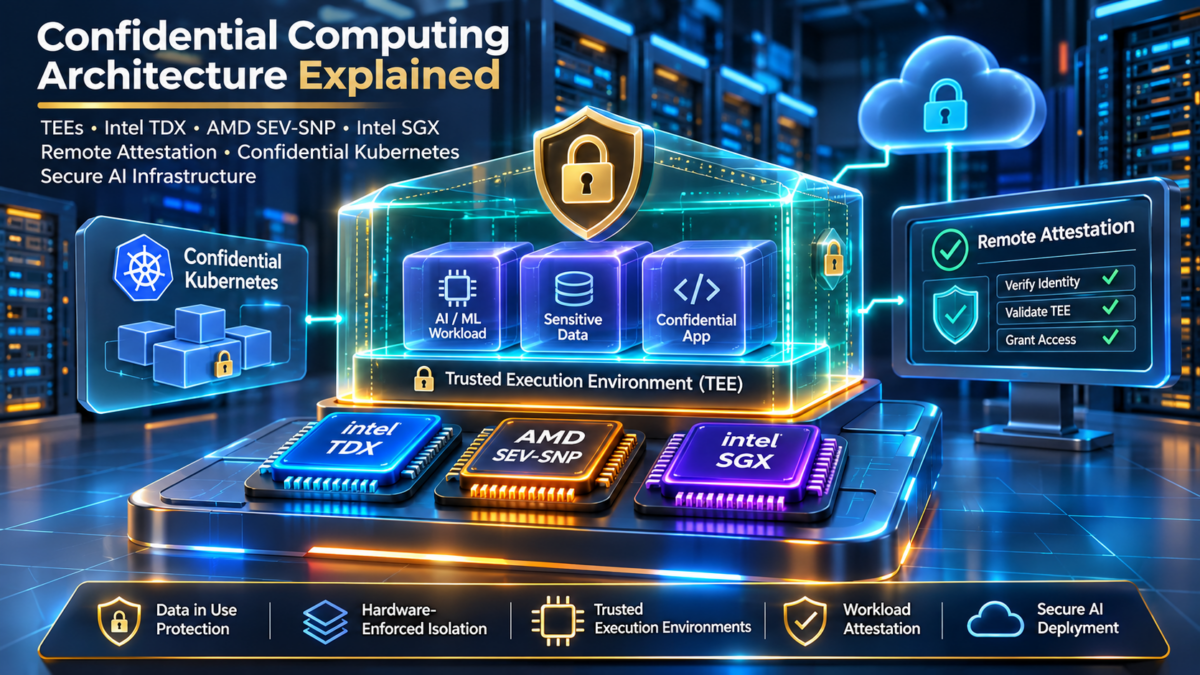
Confidential Computing Architecture Explained
The Next Security Boundary
Modern enterprise security architectures have traditionally concentrated on protecting data while it is stored and while it travels across networks. Storage encryption, TLS, IPsec, identity management and network segmentation form the foundations of these architectures.
However, applications must also process information. Databases execute queries, artificial intelligence models perform inference, applications evaluate business logic and containers manipulate sensitive information in memory. During these operations, conventional storage and transport encryption do not necessarily protect the data from privileged components of the underlying infrastructure.
Confidential computing introduces a hardware-enforced security boundary around executing workloads. It aims to protect sensitive code and data in use through trusted execution environments, hardware-backed isolation and mechanisms that allow external parties to verify the security properties of an execution environment.
Conceptual architecture. Exact trust boundaries, memory protections, attestation flows and key-release mechanisms depend on the selected TEE and deployment. Encrypted application input and output require appropriate application or transport security.
The Three States of Data Security
Confidential computing complements existing encryption technologies by addressing the third major state of information: data being actively processed.
Data at Rest
Information stored on disks, databases, object storage and backup systems. Storage encryption and key management reduce exposure when storage media or stored ciphertext is accessed without authorisation.
Data in Transit
Information moving between applications, networks, cloud regions and infrastructure components. TLS, mTLS and IPsec provide cryptographic protection across communication paths.
Data in Use
Information actively processed by applications and compute systems. Trusted execution environments provide hardware-backed isolation and, depending on the platform, memory encryption and integrity protection.
Confidential computing changes the infrastructure trust model. Rather than automatically trusting every privileged software component, engineers establish a smaller, hardware-backed trusted computing base and verify the properties of the protected execution environment.
Why Traditional Infrastructure Trust Is Changing
In a conventional virtualised environment, the hypervisor and other privileged infrastructure components may possess significant control over guest workloads. Depending on the architecture, privileged software may be able to inspect guest memory or influence execution.
Confidential virtual machine technologies such as AMD SEV-SNP and Intel TDX are designed to reduce this exposure by introducing processor-enforced protections around guest execution and private memory. Application enclave technologies such as Intel SGX establish a different, more granular protection model.
These technologies do not eliminate the need for trust. Instead, they change which components must be trusted, which security properties can be verified and which threats remain outside the protection model.
| Security dimension | Conventional compute | Confidential compute |
|---|---|---|
| Workload isolation | OS and hypervisor controls | Additional hardware-enforced protection |
| Memory protection | Conventional memory access controls | TEE-specific encryption and isolation |
| Infrastructure trust | Privileged infrastructure commonly trusted | Reduced trust in selected privileged components |
| Workload verification | Software and infrastructure evidence | Hardware-backed attestation evidence |
| Secret provisioning | Identity and access policy | Can additionally require verified TEE evidence |
| Threat model | Conventional infrastructure assumptions | Explicit hardware and software trust boundaries |
The Six Architectural Building Blocks
Hardware Root of Trust
Processor and platform security mechanisms provide the foundation for establishing and verifying selected security properties of the execution environment.
Trusted Execution Environment
A protected execution environment designed to isolate sensitive code and data from specified components outside its trust boundary.
Memory Protection
Hardware mechanisms restrict access to protected memory. Encryption, integrity and ownership protections vary between processor architectures.
Remote Attestation
Signed evidence allows a verifier to evaluate measurements, platform security state and other claims against an established trust policy.
Secure Key Release
A key broker or key management service can make secret provisioning conditional on successful attestation and workload authorisation.
Confidential Workloads
Applications, virtual machines, containers and AI workloads consume protected compute capabilities according to the security model of their platform.
From Hardware Security to Cloud Architecture
Confidential computing is increasingly relevant to public cloud infrastructure, regulated industries, distributed applications, enterprise Kubernetes platforms and artificial intelligence systems.
Consider an enterprise deploying an AI inference service that processes sensitive customer information. Network encryption protects requests travelling to the service, while storage encryption protects persisted information. A confidential execution environment can provide additional protection while the model processes the request.
Where confidential GPU computing is required, the architecture must also account for accelerator security, GPU memory, device attestation, CPU-to-GPU communication and the supported confidential computing capabilities of the complete platform.
Confidential Cloud
Hardware-protected virtual machines and attestation services for sensitive enterprise workloads.
Confidential Kubernetes
Protected container execution using appropriate confidential runtimes, workload measurements and policy-controlled secret provisioning.
Confidential AI
Protected model execution and sensitive inference processing across supported CPU and accelerator trust boundaries.
What Confidential Computing Does Not Solve
Confidential computing is an additional security layer, not a replacement for a complete enterprise security architecture.
Vulnerable application code, compromised identities, insecure APIs, malicious inputs, denial-of-service attacks and some side-channel attacks may remain relevant. Hardware vulnerabilities, firmware security, attestation policy design and software supply-chain integrity must also be considered.
A successful attestation does not automatically prove that an application is free from vulnerabilities. It provides evidence about specific measured components and security claims. Engineers must determine whether that evidence satisfies their threat model and authorisation requirements.
Nine Engineering Domains
Throughout this engineering guide, we will move from processor-level security mechanisms to production cloud, Kubernetes and AI architectures. Each section will be supported by a dedicated interactive engineering experience.
The Engineering Objective
By the end of this guide, engineers should be able to explain confidential computing architectures, identify hardware trust boundaries, compare confidential processor technologies, interpret attestation evidence and evaluate confidential workload deployment decisions.
More importantly, they should understand how to investigate failures, distinguish infrastructure trust from application security and determine whether a confidential computing architecture actually satisfies its intended threat model.
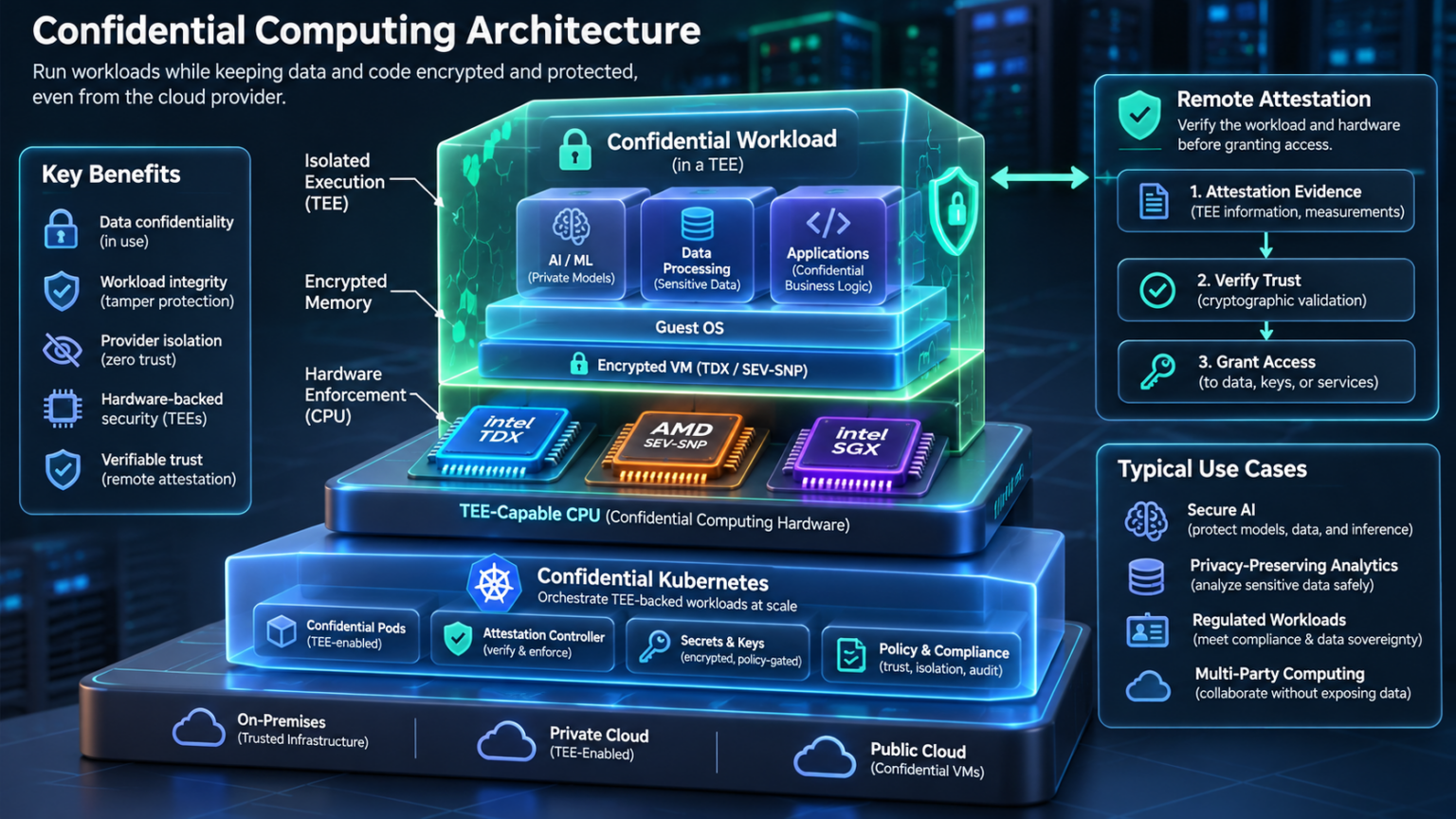
Confidential Computing Architecture Explorer
Explore the complete architecture of hardware-backed confidential computing, from protected processor execution and encrypted memory to remote attestation, confidential Kubernetes, secure AI infrastructure and production security engineering.
Understanding Confidential Computing
Understand how hardware-backed isolation protects data in use and changes the traditional infrastructure trust model.
Understanding Confidential Computing
- Explain why data in use requires additional protection.
- Compare conventional and confidential infrastructure.
- Identify hardware-enforced security boundaries.
- Understand the trusted computing base.
- Recognise enterprise confidential computing use cases.
- Identify threats outside confidential computing protection.
1.1 The Problem with Conventional Data Protection
Encryption is a fundamental component of modern enterprise security architecture. Organisations encrypt storage systems, databases, network communications, backups and sensitive application information to reduce the risk of unauthorised access.
However, protecting stored information and network traffic does not automatically protect information while an application processes it.
Consider a financial application that retrieves an encrypted customer record from a database. The application establishes a secure connection, receives the information and decrypts it before performing calculations.
During conventional processing, the decrypted information may exist in application memory, processor registers and other execution-related structures. The security of this information depends on the isolation mechanisms and trust assumptions of the underlying compute environment.
In a traditional virtualised architecture, privileged infrastructure components may have sufficient access to inspect guest memory. A compromised hypervisor or another privileged component could therefore become part of the workload's security threat model.
Encryption at rest and encryption in transit do not automatically provide protection during execution. Confidential computing addresses this gap by introducing additional hardware-backed isolation around selected executing workloads.
1.2 Understanding the Data Lifecycle
Data at Rest
Stored information is protected using mechanisms such as disk encryption, database encryption and managed cryptographic keys. The protection depends on key security and how authorised applications access data.
Data in Transit
Information moving between systems is protected using cryptographic communication protocols. Authentication, confidentiality and integrity depend on the protocol and its configuration.
Data in Use
Information being actively processed receives additional protection through hardware-backed isolation and platform-specific memory security mechanisms.
1.3 What Is Confidential Computing?
Confidential computing is an approach to protecting data in use by performing computation inside a hardware-based, attestable trusted execution environment.
A trusted execution environment, commonly abbreviated to TEE, establishes a security boundary around selected code and data. Hardware security mechanisms enforce restrictions on how components outside that boundary can access protected resources.
Different confidential computing technologies establish different protection boundaries. Some protect an entire virtual machine, while others protect selected application components inside a process.
Confidential Virtual Machines
Technologies such as AMD SEV-SNP and Intel TDX provide hardware-backed protection for guest virtual machines. The guest operating system and applications execute within the protected environment, while the hypervisor is outside the guest's confidentiality boundary.
Application Enclaves
Technologies such as Intel SGX allow selected application code and data to execute inside an enclave. The surrounding application, operating system and hypervisor can remain outside the enclave's trust boundary.
1.4 Conventional Versus Confidential Infrastructure
The most important architectural difference is not simply whether memory is encrypted. It is the relationship between the workload and the privileged infrastructure responsible for hosting it.
A confidential virtual machine still depends on the surrounding infrastructure for resources such as CPU scheduling, networking, storage and device availability. The hypervisor does not disappear from the architecture.
Instead, hardware mechanisms restrict selected privileged operations against protected guest resources. This allows the workload to operate with a different confidentiality and integrity trust model.
| Architecture dimension | Conventional VM | Confidential VM |
|---|---|---|
| Guest memory | Conventional virtualisation isolation. | Additional hardware-backed private memory protection. |
| Hypervisor trust | Typically trusted for guest confidentiality. | Reduced trust for protected guest confidentiality. |
| Guest OS | Trusted by applications executing within it. | Generally remains inside the guest trust model. |
| Attestation | May use conventional measured boot and platform evidence. | TEE-specific evidence about protected execution. |
| Device access | Conventional virtual and physical device mechanisms. | Requires consideration of private and shared resources. |
| Availability | Depends on infrastructure operation. | Still depends on infrastructure operation. |
| Application vulnerabilities | Require application security controls. | Still require application security controls. |
1.5 The Trusted Computing Base
The Trusted Computing Base (TCB) consists of the hardware, firmware and software components whose correct operation is necessary to enforce a particular security property.
If a component belongs to the trusted computing base, a security failure in that component may undermine the protection being provided.
One objective of confidential computing is to reduce the number of components that must be trusted for selected workload security properties.
In a confidential VM architecture, the guest operating system generally remains trusted by the applications running inside it. A malicious guest administrator or compromised guest kernel may still be capable of accessing application information.
An application enclave can establish a narrower protection boundary, potentially excluding the guest operating system from the enclave's confidentiality trust model. However, this approach introduces its own application design, interface and operational requirements.
Reducing the trusted computing base is valuable only when the resulting trust boundary matches the threat model. Protecting an entire VM does not automatically isolate one application from another application or administrator inside that VM.
1.6 Hardware-Enforced Isolation
Conventional operating systems and hypervisors enforce isolation through privilege levels, virtual memory, page tables and access-control mechanisms.
Confidential computing extends these mechanisms with processor-specific security capabilities that can restrict access to protected execution state even when requests originate from selected privileged infrastructure components.
Memory Encryption
Hardware-managed cryptographic mechanisms protect selected memory contents against unauthorised observation. Encryption alone does not establish every required integrity or ownership property.
Memory Ownership
Platform-specific metadata and access checks help determine which protected execution environment is permitted to access particular memory resources.
Execution State Protection
Depending on the processor architecture, sensitive execution state may receive additional protection against inspection or modification by components outside the trusted environment.
Memory encryption, access restrictions, integrity mechanisms and execution-state protection are related but distinct capabilities. Their implementation and security guarantees differ between confidential computing technologies.
1.7 Establishing Trust Before Processing Sensitive Data
A workload owner must be able to determine whether a remote execution environment provides the security properties required by the application.
Remote attestation provides a mechanism for evaluating signed evidence about a platform or protected workload. A verifier evaluates that evidence against reference values, endorsements and security policies.
A production architecture can combine attestation with workload identity and authorisation policies. For example, a key broker may release a database decryption key only when the requesting workload presents acceptable evidence and satisfies its access policy.
The attestation result should be securely bound to the intended workload or communication channel so that an attacker cannot simply reuse another environment's valid evidence to obtain secrets.
Confidential computing complements Zero Trust by introducing hardware-backed execution evidence into security decisions. It does not replace identity verification, least-privilege access, segmentation or continuous security monitoring.
1.8 Enterprise Confidential Computing Use Cases
Financial Services
Protect sensitive financial records, risk calculations, transaction analysis and proprietary algorithms while executing on supported infrastructure.
Healthcare
Reduce infrastructure-level exposure of sensitive medical information during analytics, research and supported AI inference workloads.
Public Cloud
Deploy sensitive enterprise applications with reduced reliance on selected privileged cloud infrastructure components for confidentiality.
Kubernetes
Combine confidential container execution with workload attestation, policy enforcement and controlled access to application secrets.
Artificial Intelligence
Protect sensitive prompts, proprietary models and inference data within supported CPU and accelerator security boundaries.
Collaborative Analytics
Enable organisations to contribute sensitive data to a mutually approved protected computation, subject to appropriate attestation, output controls and governance.
1.9 Threat Models and Security Limitations
Confidential computing is not a universal defence against every infrastructure or application attack. Engineers must explicitly identify which adversaries and security properties the selected architecture is designed to address.
| Threat | Confidential computing contribution | Additional considerations |
|---|---|---|
| Hypervisor memory inspection | Can restrict access to protected private memory. | Platform capabilities and configuration. |
| Unauthorised memory modification | May provide platform-specific integrity and ownership protections. | Exact guarantees differ between TEEs. |
| Unapproved workload deployment | Attestation can support verification of measured components. | Reference measurements, identity and policy. |
| Application vulnerability | Does not inherently prevent exploitation. | Secure development, testing and patching. |
| Compromised application identity | Does not automatically prevent identity misuse. | IAM, workload identity and least privilege. |
| Denial of service | Generally does not guarantee availability. | Resilience, redundancy and recovery. |
| Side-channel attacks | Protection varies by platform and threat. | Mitigations, updates and workload design. |
| Unprotected output data | Does not automatically protect exported information. | TLS, access policy and data governance. |
| Firmware or hardware vulnerabilities | May undermine the trusted execution environment. | Security updates and attestation policy. |
1.10 Production Architecture Scenario
Imagine an enterprise deploying a sensitive financial analytics application in a public cloud environment. The organisation wants to reduce the risk of privileged infrastructure components inspecting customer information during processing.
The engineering team selects a supported confidential virtual machine platform and establishes an approved workload image. The workload retrieves attestation evidence and presents it to a verification service.
Once the evidence and workload identity satisfy the organisation's policy, a key broker releases the authorised cryptographic material over a protected communication channel.
The application can then decrypt and process approved information within the confidential execution environment. Results are transmitted using appropriate transport encryption and stored using approved storage security controls.
- Define the adversaries and required security properties.
- Select a supported confidential computing platform.
- Identify the protected workload boundary and trusted components.
- Establish approved workload measurements and reference values.
- Validate attestation evidence and platform security versions.
- Bind secret release to the authorised workload.
- Protect storage, networking and shared device communication.
- Monitor security updates, policy changes and workload health.
- Design recovery procedures for unavailable or rejected environments.
Section 01 — Key Engineering Takeaways
Protect the Complete Data Lifecycle
Confidential computing complements storage and transport encryption by adding protection during execution.
Change the Trust Model
Hardware-backed isolation can reduce reliance on selected privileged infrastructure components.
Verify Before Authorising
Attestation provides evidence that can inform workload authorisation and controlled secret release.
Design Around the Threat Model
Security guarantees depend on the selected technology, trusted components, workload configuration and operational security controls.
Confidential Computing Architecture Explorer
The accompanying interactive engineering widget will allow you to compare conventional and confidential workloads, inspect infrastructure trust boundaries, experiment with privileged memory access, evaluate attestation decisions and observe how different security controls protect the data lifecycle.
INTERACTIVE ENGINEERING LABS
Confidential Computing
Architecture Explorer
Investigate how hardware-enforced workload isolation changes the infrastructure trust model. Configure a computing environment, execute a sensitive workload and observe how different protection mechanisms affect data exposure.
Change the controls independently to investigate the role of each protection mechanism.
Infrastructure Threat Simulator
Select an infrastructure threat and examine which protection mechanism applies.
Environment Ready
Configure the architecture and select a threat to investigate its effect on sensitive workload data.
The Three States of Data
Data at Rest
Databases, disks, object storage and persistent files. Encryption protects stored data against unauthorized offline access when keys remain secure.
PROTECTEDData in Transit
Application requests, API traffic and network communication. Correctly configured TLS protects data between authenticated endpoints.
PROTECTEDData in Use
Data being processed by applications. Confidential computing adds hardware-enforced isolation from privileged infrastructure software within the supported threat model.
EXPOSED TO HOSTWorkload Evidence and Memory Investigation
The authorized application can process plaintext inside its execution environment. Confidential computing does not prevent the application itself from accessing its own data.
Compare the simulated host-visible evidence with the guest view. Protected private memory is not equivalent to ordinary host-readable application memory.
Engineering Event Console
Engineering Challenge Laboratory
Confidential Computing Foundations
Trusted Execution Environments (TEEs)
- Explain the architectural purpose of a TEE.
- Distinguish application enclaves from confidential VMs.
- Understand processor-enforced security boundaries.
- Identify private and shared memory resources.
- Understand communication across a trust boundary.
- Evaluate TEE selection against a production threat model.
2.1 What Is a Trusted Execution Environment?
A Trusted Execution Environment is a protected execution environment that uses hardware-backed security mechanisms to isolate selected code and data from components outside its security boundary.
In confidential computing architectures, the TEE provides the foundation for protecting information during execution. It changes the relationship between an application and the privileged infrastructure responsible for hosting that application.
A conventional application relies on the operating system and other privileged software to enforce memory isolation. If those trusted components are compromised, the application's confidentiality may also be compromised.
A TEE introduces additional hardware-enforced restrictions that can prevent specified privileged software components from directly accessing protected memory and execution state.
Privilege does not necessarily imply access to protected execution state. A TEE introduces a hardware-backed security domain whose access rules are not determined solely by conventional operating system privilege levels.
2.2 Inside a Hardware-Protected Execution Environment
Confidentiality
Restricts unauthorised observation of protected information by components outside the defined security boundary.
Integrity
Platform-specific mechanisms can protect selected execution state and memory against unauthorised modification. Exact guarantees vary by technology.
Attestability
Hardware-backed evidence allows an external verifier to evaluate claims about the protected environment and its security configuration.
2.3 Processor Privilege Levels and Security Domains
Modern processors implement privilege mechanisms that distinguish application execution from privileged operating system execution.
In conventional x86 architectures, applications commonly execute at Ring 3 while operating system kernels execute at Ring 0. Hardware virtualisation introduces additional execution modes that distinguish guest software from virtual machine monitors.
Confidential computing introduces security mechanisms that operate alongside these conventional privilege and virtualisation controls.
For example, a hypervisor may retain authority to schedule a confidential virtual machine without retaining unrestricted access to its protected private memory.
Conventional privilege determines which operations software may perform. Confidential computing adds restrictions associated with protected security domains. These are related but distinct architectural concepts.
2.4 Application Enclaves Versus Confidential Virtual Machines
Trusted execution environments can be implemented at different levels of the software architecture. Two important approaches are application enclaves and confidential virtual machines.
Application enclaves protect selected application components. Confidential virtual machines protect a broader guest execution environment that can include the operating system, application runtime and multiple applications.
| Architecture dimension | Application enclave | Confidential VM |
|---|---|---|
| Protection scope | Selected application code and data. | Protected guest VM execution environment. |
| Representative technologies | Intel SGX. | AMD SEV-SNP and Intel TDX. |
| Operating system trust | Can exclude the OS from enclave confidentiality trust. | Guest OS generally remains trusted by applications. |
| Application adaptation | May require partitioning, libraries or enclave-aware runtimes. | Often supports existing VM workloads with fewer changes. |
| Communication model | Controlled enclave entry and exit interfaces. | Guest interfaces, virtual devices and shared memory. |
| Software trusted computing base | Potentially smaller, depending on the runtime. | Generally includes a larger guest software stack. |
| Deployment considerations | Application design and enclave lifecycle. | VM images, guest configuration and platform compatibility. |
| Typical use cases | Selected cryptographic operations and sensitive algorithms. | Enterprise applications, databases and confidential cloud workloads. |
2.5 Protected Execution and the Workload Lifecycle
A TEE must be established before sensitive information is processed within it. Depending on the technology, this involves creating the execution environment, configuring protected memory and establishing measurements associated with its initial state.
Hardware-backed attestation can then provide evidence about the environment. A relying party can use this evidence, together with identity and authorisation controls, to decide whether sensitive information should be provisioned.
This lifecycle represents a common deployment pattern. Attestation is not necessarily a mandatory hardware gate before execution. Instead, a production architecture can require successful verification before releasing sensitive information.
The initial measurement of a protected environment also does not automatically describe every subsequent runtime operation. Runtime security, software updates and ongoing policy evaluation remain important.
2.6 Private Memory and Shared Memory
Confidential virtual machines must communicate with resources outside their protected security domain. These resources can include virtual network adapters, storage devices, host services and management interfaces.
Depending on the processor and device architecture, communication may require memory that is explicitly shared with components outside the confidential guest.
Private memory and shared memory therefore represent different security properties. Information placed in a shared buffer must not automatically be assumed to receive the same confidentiality guarantees as information stored in protected private memory.
Private Memory
Holds protected application information, guest execution state and other data covered by the selected TEE's hardware security mechanisms. Access is governed by platform-specific ownership and protection rules.
Shared Memory
Enables selected communication with external infrastructure. Shared buffers must be treated according to their actual visibility, integrity and access-control properties.
Sensitive information can become exposed when it leaves protected memory. Engineers must consider shared buffers, device communication, logging, application responses and other explicit data release paths.
2.7 Communication Across an Enclave Boundary
Application enclaves frequently require services provided by software outside the protected environment. These services may include file access, network communication, time information and operating system functionality.
In Intel SGX software architectures, enclave-aware interfaces commonly use the concepts of ECALLs and OCALLs to represent controlled calls into and out of an enclave.
An ECALL allows external application code to invoke an enclave function. An OCALL allows enclave code to request functionality implemented outside the enclave.
Code executing inside an enclave must not automatically trust information supplied by external components. Inputs require validation, external service results require appropriate verification, and sensitive outputs must be deliberately controlled.
Hardware isolation protects the execution boundary, but the application remains responsible for the security of its interfaces and business logic.
2.8 Understanding the TEE Trusted Computing Base
The trusted computing base contains the components whose correct operation is necessary to enforce the required security properties.
For an application enclave, the software TCB may consist primarily of the trusted application code, enclave runtime and selected libraries. Processor security mechanisms and trusted firmware also form part of the wider security foundation.
For a confidential virtual machine, the guest kernel, application runtime, libraries and privileged guest software may all be relevant to application confidentiality and integrity.
Hardware
Processor security mechanisms, memory access enforcement and relevant hardware cryptographic capabilities.
Firmware and Microcode
Trusted platform components responsible for establishing or enforcing selected confidential computing security properties.
Trusted Software
Workload code, libraries, runtimes and other software whose correctness is required by the selected protection model.
The complete production system also depends on external trust services. Attestation verifiers, certificate infrastructure, key brokers and reference-value management systems can be critical to the end-to-end security decision.
These external services are not necessarily part of the local processor TEE's TCB, but their compromise may undermine the wider confidential computing deployment.
2.9 Security Threats at the Execution Boundary
Trusted execution environments are designed around explicit threat models. A security property provided by one technology should not automatically be assumed to exist in another.
| Threat | Architectural consideration | Engineering response |
|---|---|---|
| Privileged host memory access | Hardware restrictions can protect private memory. | Verify the selected TEE protection model. |
| Malicious shared-buffer contents | External components may influence shared data. | Validate and authenticate external inputs. |
| Compromised trusted application | The attacker may execute inside the protected boundary. | Secure development, isolation and patching. |
| Malicious guest administrator | A confidential VM may include the guest OS in its TCB. | Evaluate narrower protection boundaries and guest access controls. |
| Side-channel observation | Timing, resource usage and other metadata may reveal information. | Platform-specific mitigations and workload design. |
| Untrusted external service results | Hardware isolation does not establish external data correctness. | Validate responses and protect communication integrity. |
| Rollback of persistent state | Encrypted storage alone may not establish freshness. | Use appropriate freshness and state-verification mechanisms. |
| Denial of service | Host infrastructure may still control resource availability. | Design redundancy, recovery and availability controls. |
2.10 Selecting the Appropriate TEE Architecture
Choosing a confidential computing technology is fundamentally an architectural decision. The appropriate protection boundary depends on the workload, its threat model and the operational requirements of the deployment.
Existing Enterprise Application
An organisation wants to move an existing enterprise application into a protected cloud environment while minimising application changes. A confidential VM may provide an appropriate starting point if the guest operating system remains within the accepted trust model.
Sensitive Cryptographic Function
An application needs to isolate a selected cryptographic operation from surrounding software, including the operating system. An enclave-based architecture may provide a more suitable protection boundary.
Confidential Containers
A Kubernetes platform needs to protect selected workloads from privileged host infrastructure. Confidential container runtimes can use protected guest environments, workload attestation and policy-controlled secret provisioning.
Confidential AI Inference
An inference service must protect sensitive prompts and model information across CPU and GPU execution. The architecture must evaluate accelerator trust boundaries, device attestation and protected communication between components.
- Define which privileged components are considered potential adversaries.
- Determine whether VM-level or application-level isolation is required.
- Identify all trusted hardware, firmware and software components.
- Document private memory and shared-memory communication paths.
- Validate the platform's memory confidentiality and integrity guarantees.
- Establish attestation and workload authorisation requirements.
- Protect external communication and persistent storage.
- Evaluate performance, memory and device compatibility constraints.
- Design secure update, recovery and workload termination procedures.
- Document residual risks and threats outside the TEE security model.
Section 02 — Key Engineering Takeaways
Hardware Defines Additional Boundaries
A TEE adds security-domain enforcement beyond conventional operating system privilege and virtualisation isolation.
Protection Granularity Matters
Application enclaves and confidential virtual machines establish different trust boundaries and introduce different software dependencies.
Boundary Crossings Require Security
Shared memory, external calls, virtual devices and exported information require explicit validation and protection.
Isolation Is Not Complete Security
Hardware-backed protection must be combined with attestation, secure software, identity controls and an explicit production threat model.
Hardware Trust Boundary Simulator
The accompanying interactive engineering widget will allow you to construct confidential VM and enclave architectures, inspect protected execution domains, experiment with privileged access requests, compare private and shared memory, and investigate how security decisions change when trusted components are compromised.
INTERACTIVE ENGINEERING LABS
Inside the Processor
Hardware Trust Boundary Simulator
Explore how hardware-enforced isolation changes memory access decisions. Select an execution architecture, choose a requesting component and investigate whether a memory transaction crosses an authorized trust boundary.
Memory visibility, ownership and execution privilege are evaluated independently.
Hardware Access Engine Ready
Select a requesting component, memory page and operation. Submit the request to observe the hardware access decision.
Hardware Access Decision Pipeline
Memory Ownership and Permission Table
These synthetic pages represent different ownership and sharing domains. All pages in this laboratory are data pages configured as non-executable.
| PAGE | ILLUSTRATIVE ADDRESS | OWNER | VISIBILITY | PERMISSIONS |
|---|
Trusted Computing Base Explorer
Observe how changing the execution architecture changes the components that must be trusted for application confidentiality and integrity.
Memory Transaction Evidence
Hardware Security Event Console
Engineering Challenge Laboratory
Hardware Trust Boundary Engineering
Intel TDX, AMD SEV-SNP and Intel SGX
- Understand Intel Trust Domain Extensions.
- Explain AMD SEV-SNP security architecture.
- Understand Intel SGX application enclaves.
- Identify PAMT, SEPT, RMP, EPC and EPCM mechanisms.
- Compare processor memory protection and attestation.
- Select a protection architecture based on workload requirements.
3.1 Three Approaches to Confidential Computing
Confidential computing is not implemented through a single universal processor architecture. Hardware vendors have developed different mechanisms for protecting executing workloads, enforcing memory ownership and generating cryptographic evidence about protected environments.
Intel Trust Domain Extensions, AMD Secure Encrypted Virtualization with Secure Nested Paging and Intel Software Guard Extensions represent three important approaches to hardware-backed confidential execution.
Trust Domain Extensions
Protects virtual machine execution through Trust Domains, a processor-isolated TDX Module, private memory management and hardware-backed attestation.
SEV-SNP
Protects confidential virtual machines through hardware-managed memory encryption, protected guest execution state and Reverse Map Table ownership and validation mechanisms.
Software Guard Extensions
Protects selected application code and data inside hardware-enforced enclaves using Enclave Page Cache resources and associated processor security metadata.
Intel TDX and AMD SEV-SNP primarily provide confidential virtual machine protection. Intel SGX provides application-level enclave protection. The appropriate choice depends on which software components must remain inside or outside the workload's trust boundary.
3.2 Intel Trust Domain Extensions Architecture
Intel Trust Domain Extensions, commonly abbreviated to TDX, introduces a hardware-backed confidential virtual machine architecture based on protected execution environments called Trust Domains.
A Trust Domain can contain a guest operating system, application runtime and enterprise applications. Its protected execution state and private memory are isolated from selected privileged infrastructure components, including the conventional host virtual machine monitor.
A central component of this architecture is the Intel TDX Module. This Intel-signed security module operates within a processor-isolated environment using Secure Arbitration Mode, or SEAM.
The module participates in Trust Domain lifecycle management, protected memory management, security metadata enforcement and generation of local attestation reports.
3.3 Intel TDX Memory Management and Trust Domains
Protecting a confidential virtual machine requires more than encrypting memory contents. The processor architecture must also control how private memory is assigned, translated, accessed and managed throughout the Trust Domain lifecycle.
Secure Arbitration Mode
SEAM provides a processor-isolated execution environment used by the TDX Module. It separates security-sensitive module operations from the conventional host virtual machine monitor.
Secure Extended Page Tables
Secure EPT structures support private guest physical address translation under TDX security controls. Their protected management helps prevent arbitrary host manipulation of private Trust Domain mappings.
Physical Address Metadata Table
PAMT records security-related metadata for managed physical memory pages, including ownership and page-type information used by the TDX Module.
Memory Encryption
TDX uses hardware memory encryption capabilities derived from Intel multi-key total memory encryption mechanisms, with protected key identifiers associated with Trust Domains.
Protected vCPU State
Trust Domain execution-state management restricts conventional host visibility into protected guest processor state during supported execution transitions.
TDREPORT and Quotes
The TDX architecture supports generation of local reports containing Trust Domain claims. Quoting infrastructure converts appropriate report evidence into remotely verifiable quotes.
TDX is not simply a conventional virtual machine with encrypted RAM. Its security architecture combines protected execution state, security metadata, controlled address translation, hardware-managed encryption and attestation.
3.4 AMD Secure Encrypted Virtualization
AMD Secure Encrypted Virtualization introduces hardware-backed security capabilities for virtualised workloads running on supported AMD processors.
The architecture has evolved through several generations of protection. Understanding these generations is important because memory encryption, processor-state protection and memory ownership enforcement address different security problems.
AMD SEV
Introduces hardware-managed virtual machine memory encryption, reducing exposure of guest memory contents to selected infrastructure components.
AMD SEV-ES
Secure Encrypted Virtualization with Encrypted State extends protection to selected guest processor register state associated with virtual machine execution transitions.
AMD SEV-SNP
Secure Nested Paging adds stronger memory ownership and mapping protections, including Reverse Map Table mechanisms designed to address malicious hypervisor manipulation of protected guest memory mappings.
3.5 Inside AMD SEV-SNP Architecture
AMD SEV-SNP combines processor-enforced security mechanisms, hardware-managed memory encryption, protected guest state and security firmware running on the AMD Secure Processor.
The AMD Secure Processor is a dedicated security component that participates in confidential virtual machine lifecycle management, cryptographic key management and attestation operations.
A particularly important SEV-SNP mechanism is the Reverse Map Table (RMP), which associates system physical memory pages with security-related ownership and validation metadata.
3.6 Reverse Map Table and Secure Nested Paging
Conventional virtualisation uses nested page tables to translate guest physical addresses into system physical addresses.
A malicious hypervisor with unrestricted control over these mappings could potentially manipulate how guest memory is associated with physical memory resources.
SEV-SNP introduces additional hardware-enforced checks using the Reverse Map Table. These checks help ensure that protected memory pages are associated with the expected guest and address mapping according to the architecture's rules.
Page Ownership
RMP metadata helps associate protected physical memory with the appropriate confidential guest and restrict incompatible access or mapping operations.
Page Validation
Guest validation operations, including PVALIDATE, participate in establishing whether assigned private pages are accepted for use according to the SNP memory management model.
Mapping Integrity
Hardware checks help defend against selected malicious remapping, aliasing and page ownership violations. This is distinct from providing a universal cryptographic integrity guarantee for every byte of external memory.
3.7 AMD Secure Processor and Protected Guest State
The AMD Secure Processor executes trusted security firmware that supports important SEV-SNP operations. These operations include aspects of guest launch, security configuration, cryptographic management and attestation.
Guest processor state is another important part of the security architecture. SEV-ES and SEV-SNP protect selected state stored in the Virtual Machine Save Area, commonly abbreviated to VMSA.
Because the host still provides virtualisation services, the guest requires controlled mechanisms for communicating information that must be shared with the hypervisor.
VMSA
The Virtual Machine Save Area contains guest processor state used during virtualised execution. SEV-ES and SNP introduce protections around this sensitive state.
GHCB
The Guest-Hypervisor Communication Block provides a defined mechanism for exchanging selected information between an encrypted-state guest and its hypervisor.
VMPL
Virtual Machine Privilege Levels allow supported SNP guest architectures to distinguish additional privilege domains and memory access permissions within a confidential guest.
3.8 Intel Software Guard Extensions Architecture
Intel Software Guard Extensions, or SGX, takes a different approach to confidential computing. Rather than primarily protecting an entire virtual machine, SGX allows selected application code and data to execute inside protected enclaves.
An enclave can establish a confidentiality boundary that excludes surrounding application code, the operating system and the hypervisor from direct access to protected enclave memory.
SGX is therefore particularly relevant when an application requires a narrower protection boundary than an entire guest operating system.
3.9 Enclave Page Cache and EPCM
The Enclave Page Cache, or EPC, provides protected memory pages used by Intel SGX enclaves. These pages can contain enclave code, data and security-related structures.
The operating system participates in memory allocation and enclave resource management, but processor security mechanisms restrict its direct access to protected enclave contents.
The Enclave Page Cache Map, or EPCM, maintains processor-managed metadata associated with EPC pages. This metadata includes information relevant to enclave ownership, page type, address association and access permissions.
Enclave Page Cache
Protected physical memory resources used for enclave pages. Available EPC capacity and paging behaviour can influence application performance.
EPCM
Processor-managed security metadata used to enforce enclave page ownership, address association, page type and permitted access.
Enclave Measurement
MRENCLAVE represents a measurement of the enclave's initial construction. MRSIGNER identifies the enclave signing authority through a measurement of its signing key.
Enclave Transitions
Processor mechanisms control entry into and exit from protected enclave execution. Software runtimes provide interfaces for application calls and external services.
Memory Protection
SGX provides processor-enforced enclave memory isolation and platform-specific protections for enclave memory outside the processor package.
Sealing and Attestation
SGX supports mechanisms for deriving enclave-associated keys and producing attestation evidence. Sealing policies can protect persistent information, subject to appropriate freshness controls.
An enclave's protection boundary can be smaller than a confidential VM, but a smaller boundary does not automatically guarantee a small trusted computing base. Enclave libraries, language runtimes and library operating systems may substantially increase the trusted software footprint.
3.10 Comparing Hardware Memory Protection Mechanisms
Intel TDX, AMD SEV-SNP and Intel SGX use different security metadata structures and processor mechanisms to protect workload memory.
Although PAMT, RMP and EPCM all participate in memory security, they are not interchangeable implementations of an identical mechanism. Each belongs to a different processor architecture and enforces different security rules.
| Mechanism | Technology | Architectural purpose |
|---|---|---|
| PAMT | Intel TDX | Tracks security metadata for managed physical memory pages, including ownership and page types. |
| Secure EPT | Intel TDX | Supports protected management of private guest physical address translation. |
| RMP | AMD SEV-SNP | Supports hardware enforcement of memory ownership, mapping and validation properties. |
| PVALIDATE | AMD SEV-SNP | Allows guest participation in private memory page validation. |
| EPC | Intel SGX | Provides protected physical memory resources for enclave pages. |
| EPCM | Intel SGX | Maintains processor-managed enclave page security metadata. |
3.11 Hardware Attestation Across Processor Architectures
Confidential computing platforms must provide mechanisms that allow external parties to evaluate the security properties of protected workloads.
Intel TDX, AMD SEV-SNP and Intel SGX support different attestation evidence formats and cryptographic trust infrastructures.
Trust Domain Measurements
TDX evidence can include MRTD, runtime measurement registers, Trust Domain attributes, report data and security-version information. Remote verification uses appropriate TDX quote and collateral validation mechanisms.
Signed Attestation Reports
SNP attestation reports contain claims such as launch measurement, guest policy, report data and TCB versions. Verification can use AMD endorsement infrastructure, including VCEK or supported VLEK mechanisms.
Enclave Identity
SGX evidence can include enclave measurements, signer identity, product identifiers, security versions, attributes and report data. DCAP-based quoting infrastructure supports remote verification deployments.
A cryptographically valid report is not necessarily an acceptable report. The verifier must also evaluate workload identity, approved measurements, security versions, debug configuration, evidence freshness and binding to the intended workload or communication channel.
3.12 Confidential Processor Architecture Comparison
| Security dimension | Intel TDX | AMD SEV-SNP | Intel SGX |
|---|---|---|---|
| Protection granularity | Virtual machine / Trust Domain. | Confidential virtual machine. | Application enclave. |
| Primary security foundation | Processor mechanisms and TDX Module. | Processor mechanisms and AMD Secure Processor firmware. | Processor-enforced enclave architecture. |
| Memory security metadata | PAMT and Secure EPT structures. | Reverse Map Table. | EPCM associated with EPC pages. |
| Memory protection | Hardware-managed private memory encryption and access controls. | Guest-associated encryption and SNP ownership checks. | Enclave memory isolation and platform-specific encryption protections. |
| Guest OS trust | Generally inside application trust model. | Generally inside application trust model. | Can remain outside enclave confidentiality trust. |
| Protected execution state | Trust Domain vCPU protection. | Protected VMSA and guest execution state. | Enclave execution-state protection. |
| Attestation evidence | TDX quote. | Signed SNP attestation report. | SGX quote. |
| Application adaptation | Often limited, subject to guest and device compatibility. | Often limited, subject to guest and device compatibility. | May require enclave-aware application design or runtime. |
| Memory considerations | Private/shared memory management and platform capacity. | Private/shared pages, RMP management and platform capacity. | EPC capacity and enclave paging behaviour. |
| Representative workloads | Enterprise VMs and confidential cloud workloads. | Enterprise VMs and confidential cloud workloads. | Protected application components and sensitive algorithms. |
3.13 Confidential Computing Performance Considerations
Hardware-backed workload protection introduces additional architectural considerations that can affect performance and operational behaviour.
Performance characteristics depend on processor generation, workload behaviour, memory access patterns, virtualisation configuration, device architecture and the selected confidential computing technology.
Memory Access
Memory encryption, additional access checks and protected address translation can influence memory latency and bandwidth. The actual effect requires workload-specific benchmarking.
Execution Transitions
Protected execution transitions, virtual machine exits and enclave boundary calls can introduce additional overhead depending on the application and platform.
Device Communication
Shared buffers, protected device support, memory copying and software encryption may affect storage and networking performance.
Protected Memory Capacity
SGX EPC capacity, confidential VM memory allocation limits and platform-specific resource constraints can influence deployment scalability.
Attestation Latency
Evidence generation, certificate retrieval, verification and key provisioning may contribute to workload startup latency and dependency availability.
Operational Compatibility
Migration, snapshots, debugging, accelerators and other infrastructure capabilities may have technology-specific restrictions or require additional security mechanisms.
3.14 Selecting a Confidential Processor Architecture
Engineers should select a confidential computing platform by evaluating the required security boundary rather than simply choosing a processor technology based on its name.
Confidential Enterprise Database
An existing database application requires protection from privileged host infrastructure. Intel TDX or AMD SEV-SNP may provide suitable VM-level protection if the database software and guest operating system remain trusted.
Protected Cryptographic Service
A sensitive cryptographic function must be isolated from surrounding application and operating system code. An SGX enclave may provide a more appropriate protection boundary, subject to its threat model and deployment support.
Confidential Kubernetes Platform
A container platform requires workload isolation from privileged worker-node infrastructure. Confidential VM technologies can provide a hardware foundation for compatible confidential container runtimes and attestation services.
Confidential AI Infrastructure
Sensitive AI workloads require protection across CPU memory, accelerator memory and communication paths. A confidential CPU environment must be combined with compatible accelerator security capabilities where required.
3.15 Production Security and Residual Risks
Confidential processor architectures reduce exposure to selected infrastructure-level threats, but they do not remove all security dependencies.
Hardware vulnerabilities, firmware defects, side-channel attacks, malicious application inputs, compromised workload software and unprotected external communication can remain relevant.
Production deployments must also account for changes in processor security versions and attestation collateral. A workload that previously satisfied a security policy may no longer satisfy it after a vulnerability disclosure or policy update.
- Confirm that the exact processor and firmware support the required technology.
- Document the hardware and software trusted computing base.
- Validate private memory ownership and shared memory handling.
- Understand platform-specific confidentiality and integrity guarantees.
- Reject unacceptable debug or security configurations.
- Validate attestation signatures, endorsements and security versions.
- Bind attestation evidence to workload identity and freshness requirements.
- Benchmark representative production workloads.
- Establish secure firmware, microcode and guest software update procedures.
- Evaluate device, migration, snapshot and recovery requirements.
- Document residual side-channel and availability risks.
Section 03 — Key Engineering Takeaways
Intel TDX Protects Trust Domains
TDX combines processor-isolated security module execution, protected address translation, memory metadata and hardware-managed encryption to establish confidential VM environments.
AMD SNP Strengthens Memory Ownership
SEV-SNP extends encrypted virtualisation with additional memory ownership and mapping protections using Reverse Map Table mechanisms.
Intel SGX Protects Application Enclaves
SGX provides a finer-grained protection boundary around selected application code and data using enclave memory resources and processor-enforced access controls.
Attestation Is Technology-Specific
Evidence formats, measurement semantics, endorsement infrastructure and security policies must be evaluated according to the selected processor architecture.
Confidential Hardware Architecture Explorer
The accompanying interactive engineering widget will allow you to switch between Intel TDX, AMD SEV-SNP and Intel SGX architectures, inspect processor security components, investigate memory ownership decisions, compare trusted computing bases and examine technology-specific attestation evidence.
INTERACTIVE ENGINEERING LABS
Inside Confidential Silicon
Hardware Architecture Explorer
Explore Intel TDX, AMD SEV-SNP and Intel SGX from an engineering perspective. Investigate how each architecture establishes protected execution, manages memory ownership and changes the infrastructure trust model.
TDX Module
Hardware Protection Decision Pipeline
Hardware Explorer Ready
Select a processor architecture and trace its conceptual hardware protection pipeline.
Hardware Security Mechanism Investigation
Compare the same security scenario across Intel TDX, AMD SEV-SNP and Intel SGX. The outcome depends on the selected protection boundary.
Investigation Ready
Select a mechanism to generate evidence.
Confidential Hardware Architecture Comparison
| ENGINEERING PROPERTY | INTEL TDX | AMD SEV-SNP | INTEL SGX |
|---|---|---|---|
| Protection boundary | Trust Domain / VM | Confidential VM | Application enclave |
| Protected memory | Private TD pages | Validated private guest pages | Enclave pages in EPC |
| Security mechanisms | TDX Module and processor hardware | AMD Secure Processor firmware and CPU enforcement | Processor enclave mechanisms |
| Memory metadata | PAMT and Secure EPT | Reverse Map Table | Enclave Page Cache Map |
| Guest OS trusted for application data | Yes, for ordinary guest applications | Yes, for ordinary guest applications | Outside enclave confidentiality boundary |
| Application changes | Often limited; compatible guest stack required | Often limited; compatible guest stack required | Enclave integration or compatible runtime required |
| Attestation evidence | TDREPORT and quote infrastructure | Signed SNP attestation report | Enclave report and quote infrastructure |
| Typical design objective | Protect an entire guest workload | Protect an entire guest workload | Minimize the application trust boundary |
| Availability guaranteed | No | No | No |
Enterprise Architecture Selection Laboratory
Architecture Not Yet Evaluated
Configure the workload requirements and available hardware. The design engine will assess the suitable protection boundary.
Hardware Security Module Integration
A Hardware Security Module (HSM) can protect application cryptographic keys and perform controlled cryptographic operations. It is not the same component as a processor memory encryption engine, and it does not automatically establish a trusted execution environment.
Cryptographic Service Ready
Submit a synthetic signing request. Both evidence approval and application authorization are required by this laboratory's policy.
Hardware Security Event Console
Engineering Challenge Laboratory
Confidential Hardware Engineering
Memory Encryption and Isolation
- Understand hardware memory encryption.
- Trace encrypted memory read and write operations.
- Explain workload-associated cryptographic key domains.
- Distinguish private and shared memory.
- Understand memory ownership and address translation.
- Investigate DMA, IOMMU and confidential I/O.
- Distinguish confidentiality from memory integrity.
- Diagnose confidential memory architecture failures.
4.1 Why Conventional Memory Is a Security Boundary
Traditional infrastructure security architectures protect information using storage encryption, network encryption, identity controls and operating system access restrictions.
However, applications must process information during execution. Database records, cryptographic keys, AI model parameters and sensitive application state can exist in plaintext within processor execution resources and system memory.
Conventional virtualisation relies heavily on privileged infrastructure software to enforce isolation between virtual machines. A compromised or malicious privileged component can therefore represent a significant threat to sensitive workload memory.
Data at Rest
Storage encryption protects persistent information on disks, storage systems and backup infrastructure, subject to appropriate key management.
Data in Transit
TLS, IPsec and other secure communication mechanisms protect information while it traverses communication channels.
Data in Use
Confidential computing combines hardware isolation, memory protection and protected execution to reduce exposure while information is actively processed.
Memory encryption alone does not establish a complete trusted execution environment. Confidential execution also requires appropriate access controls, ownership enforcement, protected execution state and a verifiable security architecture.
4.2 Hardware Memory Encryption Architecture
Hardware memory encryption moves selected cryptographic operations into processor and memory subsystem hardware.
In a typical confidential computing architecture, the processor can operate on plaintext within authorised execution resources while protected memory contents are encrypted before being written to external memory.
When protected memory is subsequently accessed, hardware performs the required decryption according to the relevant key domain and access-control rules.
4.3 The Memory Write and Read Lifecycle
Understanding the lifecycle of a memory transaction helps explain where confidential computing protection is applied and where additional security controls remain necessary.
This sequence describes logical dependencies. Real processors can cache translations, permissions and data, and may combine or pipeline operations. Not every application memory instruction results in an external DRAM transaction.
4.4 Cryptographic Key Domains
Encrypting every workload with a single shared platform key does not provide the same isolation properties as an architecture that associates protected memory with distinct workload cryptographic contexts.
Confidential virtualisation technologies can associate protected guest memory with hardware-managed encryption keys or key identifiers.
The architecture must prevent untrusted infrastructure software from freely extracting protected keys or selecting another workload's private encryption context.
Hardware Key Management
Sensitive memory encryption keys are managed through trusted hardware and firmware mechanisms rather than being exposed as ordinary application configuration.
Key Identifiers
Platform-specific identifiers associate memory operations with an appropriate cryptographic context. A key identifier is not the cryptographic key itself.
Lifecycle Management
Key allocation, guest termination, memory reclamation and context reuse must follow architecture-specific security procedures to prevent unintended exposure.
4.5 Private and Shared Memory
Confidential virtual machines still need to communicate with external infrastructure. They must send network packets, access storage, receive interrupts and interact with virtual devices.
Traditional virtual device implementations frequently require communication buffers that can be accessed by both the guest and selected host components.
Confidential computing therefore distinguishes between protected private memory and memory intentionally made available for external communication.
| Security property | Private memory | Shared memory |
|---|---|---|
| Primary purpose | Protected workload execution. | External communication and device interaction. |
| Host visibility | Restricted by confidential computing mechanisms. | Accessible to authorised external components. |
| Encryption context | Protected workload-associated context. | Platform-specific shared memory context. |
| Sensitive plaintext | Appropriate within the defined workload trust boundary. | Should not be exposed without explicit security justification. |
| Device communication | Requires compatible protected device mechanisms. | Commonly used by conventional virtual devices. |
| Security responsibility | Hardware isolation plus trusted workload software. | Protocol protection, validation and controlled disclosure. |
4.6 Memory Ownership and Page State Transitions
A confidential computing architecture must establish which workload owns a protected memory page and which access operations are permitted.
A page may transition between host-managed, guest-private and shared states according to technology-specific memory management rules.
These transitions are security-sensitive. Incorrect page conversion, stale mappings or failure to initialise memory appropriately can cause access violations, application failures or unintended information exposure.
4.7 Secure Address Translation
Virtualised workloads typically use multiple stages of address translation.
An application generates a guest virtual address. Guest page tables translate that address into a guest physical address. A second translation stage associates guest physical addresses with system physical memory.
Confidential virtualisation introduces additional security mechanisms to restrict malicious manipulation of protected memory mappings.
Secure EPT and PAMT
TDX uses protected private address translation and physical memory metadata managed through its security architecture to enforce Trust Domain memory rules.
Reverse Map Table
SNP supplements nested translation with hardware checks involving RMP ownership, address association and validation metadata.
EPC and EPCM
SGX enforces enclave-specific memory access restrictions using processor-managed metadata associated with protected EPC pages.
4.8 Confidentiality, Integrity and Replay Protection
Encryption protects information confidentiality by making protected data unintelligible without the appropriate cryptographic context.
Confidentiality does not automatically provide integrity, authenticity or freshness. An architecture must separately consider whether an adversary can modify encrypted memory, substitute pages or replay previously observed data.
Confidentiality
Restricts unauthorised disclosure of protected memory contents.
Access Integrity
Enforces applicable ownership, permissions and mapping restrictions for protected memory operations.
Cryptographic Data Integrity
Detects unauthorised modification where supported integrity mechanisms authenticate protected data or associated metadata.
Freshness and Replay Resistance
Prevents or detects inappropriate reuse of older data or security state within the architecture's defined protection scope.
Memory ownership enforcement, cryptographic integrity and replay protection are different security properties. Engineers must evaluate the precise guarantees of their processor generation, firmware and deployment model. They should not assume that every encrypted memory architecture provides identical protection against physical memory attacks.
4.9 DMA and the Confidential Computing I/O Problem
Direct Memory Access allows compatible hardware devices to transfer information to and from system memory without requiring the CPU to perform every individual data movement.
Network interface cards, storage controllers and accelerators frequently depend on DMA for efficient high-throughput operation.
In a confidential computing environment, unrestricted device access to protected memory would conflict with the workload's confidentiality boundary.
Conventional devices may therefore use shared memory buffers, while more advanced protected device architectures establish additional mechanisms for secure assignment and protected communication.
4.10 IOMMU and Device Isolation
An Input-Output Memory Management Unit, or IOMMU, provides address translation and access-control capabilities for device-generated memory transactions.
The IOMMU helps restrict devices to authorised memory mappings. However, a conventional IOMMU configuration alone does not necessarily establish a trusted confidential device path when privileged infrastructure software is outside the workload's trust boundary.
4.11 Confidential I/O and Trusted Device Architecture
Confidential computing increasingly extends beyond CPU execution into accelerator, storage and networking architectures.
Protecting CPU memory is insufficient when sensitive information must subsequently traverse an untrusted device interface or enter unprotected accelerator memory.
Emerging and supported confidential I/O architectures combine device identity, secure communication, protected assignment and device-specific security mechanisms.
SPDM
Security Protocol and Data Model supports device authentication, measurement exchange and secure session establishment between compatible components.
PCIe IDE
Integrity and Data Encryption provides cryptographic protection for supported PCI Express transaction streams.
PCIe TDISP
TEE Device Interface Security Protocol supports security-sensitive management of compatible device interfaces assigned to trusted execution environments.
Device Attestation
Device identity and security measurements can provide evidence about accelerator firmware, configuration and supported security properties.
Protected Accelerator Memory
Compatible accelerator security architectures can protect selected device execution and memory resources according to their own threat models.
End-to-End Trust
CPU, device, firmware, communication path and workload security properties must collectively satisfy the enterprise protection policy.
A confidential VM running an AI inference service does not automatically make its GPU execution confidential. The accelerator, accelerator memory, host-device communication path and attestation architecture must also be evaluated.
4.12 Secure Networking Through Shared Memory
Network communication illustrates why private memory protection must be combined with conventional cryptographic protocols.
A confidential application can establish a TLS session inside its protected execution environment. Sensitive application data is encrypted before being copied into shared network communication buffers.
The host may observe ciphertext and communication metadata, but the TLS-protected application payload remains confidential when the protocol is correctly implemented and its keys remain protected.
4.13 Confidential Memory Troubleshooting
Confidential memory failures can originate from hardware configuration, guest memory management, device compatibility, firmware versions or security policy enforcement.
Engineers must distinguish an expected security rejection from an infrastructure fault. A denied memory access may indicate that the protection mechanism is operating correctly.
| Observed symptom | Possible cause | Investigation direction |
|---|---|---|
| Confidential VM fails to launch | Unsupported processor or firmware configuration. | Inspect platform capabilities, firmware and VMM support. |
| Guest memory access failure | Incorrect page ownership, acceptance or mapping. | Inspect guest logs and architecture-specific memory state. |
| Virtual NIC fails | Incompatible DMA or shared buffer configuration. | Inspect device support, DMA mappings and guest drivers. |
| Storage throughput degradation | Additional copying or shared buffer overhead. | Benchmark I/O paths and memory copy behaviour. |
| GPU workload unavailable | Unsupported confidential device assignment. | Verify accelerator, firmware and platform compatibility. |
| Unexpected plaintext exposure | Sensitive data copied into shared buffers. | Review encryption termination and application data flow. |
| Attestation policy rejection | Unacceptable platform security version or configuration. | Inspect verified claims and approved security policy. |
| SGX performance degradation | Protected memory pressure or excessive enclave paging. | Measure EPC utilisation and workload working-set size. |
4.14 Engineering Investigation — Private Memory Access Failure
Consider a confidential virtual machine that experiences a memory access failure after a virtual device configuration change.
The application starts successfully, but its network interface fails when the guest attempts to transmit information.
The investigation identifies a device buffer associated with protected private memory rather than a compatible shared I/O region.
[00:00:01] Confidential workload launch       SUCCESS
[00:00:02] Private memory initialisation      SUCCESS
[00:00:03] Virtual network device discovery  SUCCESS
[00:00:04] Device buffer allocation          COMPLETE
[00:00:05] DMA mapping request              REJECTED

Memory region       : PRIVATE
Device mode         : CONVENTIONAL VIRTUAL I/O
Protected assignment: NOT ESTABLISHED
Expected buffer     : AUTHORISED SHARED MEMORY

Investigation result:
Device access conflicts with memory security policy.

Remediation direction:
Use the supported confidential-guest I/O mechanism.
Protect sensitive payloads before sharing buffers.
Revalidate device mappings and connectivity.

Expected outcome:
Private memory protection remains enforced.
Supported device communication is restored.
This synthetic evidence illustrates an engineering investigation rather than actual Intel, AMD or Linux diagnostic output. Production error messages and remediation procedures depend on the specific platform and driver implementation.
Do not resolve a confidential memory access failure by indiscriminately disabling isolation or making sensitive memory shared. Restore communication using the platform's supported security architecture while preserving the intended workload protection boundary.
4.15 Production Memory Security Checklist
- Document the exact hardware memory protection guarantees.
- Identify which processor and firmware components are trusted.
- Validate workload-associated encryption context management.
- Understand private memory ownership and page state transitions.
- Identify every shared memory communication path.
- Protect sensitive network and storage payloads before sharing.
- Validate DMA mappings and device isolation.
- Confirm confidential accelerator support where required.
- Evaluate memory integrity and replay protection separately.
- Benchmark memory bandwidth, latency and I/O overhead.
- Review memory reclamation and workload termination procedures.
- Document side-channel, availability and physical attack assumptions.
- Validate firmware updates and attestation security versions.
- Test failure recovery without weakening memory protection.
Section 04 — Key Engineering Takeaways
Encryption Is One Security Layer
Confidential memory protection combines encryption with ownership enforcement, access restrictions and protected execution context management.
Shared Memory Changes the Trust Boundary
Information intentionally exposed through shared buffers must be protected according to its sensitivity and the trustworthiness of external infrastructure.
Devices Require Their Own Security Architecture
DMA isolation, device authentication, protected communication and compatible confidential device assignment are important components of end-to-end workload protection.
Integrity Is Not Identical to Confidentiality
Encryption, memory mapping integrity, cryptographic authentication and replay resistance must be evaluated as distinct security properties.
Confidential Memory Protection Simulator
The accompanying interactive engineering experience will allow you to trace memory transactions through a conceptual processor security pipeline, examine private and shared memory states, compare encryption contexts, investigate ownership violations and observe permitted or rejected device memory operations.
INTERACTIVE ENGINEERING LABS
Inside Protected Memory
Encrypted Memory Investigation Lab
Investigate what happens when sensitive application data leaves a protected CPU execution context and enters physical memory. Explore encryption boundaries, hardware-managed key contexts, private and shared memory pages, ownership enforcement and the limitations of memory encryption without additional isolation mechanisms.
Memory Engine Ready
Select a memory page and execute a write or read transaction.
Use fictional data only. This laboratory is an educational model, not a secure environment for processing real secrets.
Interactive Physical Memory Map
Changing a page between private and shared memory requires a controlled transition. This laboratory clears the existing page contents during the transition to demonstrate safe data handling.
Plaintext and Ciphertext Investigation
CPU Execution Context
The authorized application operates on usable data inside its execution context.
Physical DRAM Representation
Inspect the modeled representation stored outside the protected CPU execution boundary.
Hardware-Managed Encryption Key Contexts
VM-A
Financial workload memory encryption context.
KEY MATERIAL: NOT EXPOSED
VM-B
Independent analytics workload encryption context.
KEY MATERIAL: NOT EXPOSED
Shared Domain
Outside the guest-private encryption context.
GUEST-PRIVATE PROTECTION: NO
The following experiment compares representations of identical application data under two simulated encryption contexts. Different contexts produce different demonstration byte sequences. These sequences are not real cryptographic ciphertext.
Memory Security Investigation Laboratory
Investigation Ready
Write demonstration data into a memory page, select a security scenario and examine the resulting evidence.
Physical Memory Dump Forensics
Generate a synthetic physical memory dump containing all eight simulated memory pages. Identify which pages contain readable application data and which contain modeled encrypted representations.
Encryption, Isolation and Integrity Comparison
| SECURITY PROPERTY | CONVENTIONAL VM MODEL | ENCRYPTION-ONLY MODEL | CONFIDENTIAL VM MODEL |
|---|---|---|---|
| Private DRAM representation | Plaintext in this model | Encrypted representation | Encrypted representation |
| Host logical memory access | Permitted | Not independently prevented | Restricted for private pages |
| Hardware page ownership | Not modeled | Not modeled | Enforced |
| Unauthorized host remapping | Possible | Not independently prevented | Restricted by ownership and mapping mechanisms |
| Shared page confidentiality | Requires separate protection | Requires separate protection | Requires separate protection |
| Physical ciphertext replay | Not applicable to plaintext model | Encryption alone is insufficient | Depends on platform-specific integrity mechanisms and threat model |
| Availability guarantee | No | No | No |
Memory Security Event Console
Engineering Challenge Laboratory
Encrypted Memory Engineering
Remote Attestation and Cryptographic Trust
- Understand hardware roots of trust.
- Distinguish measured boot from secure boot.
- Understand attestation evidence and claims.
- Trace endorsement certificate validation.
- Explain nonce-based evidence freshness.
- Understand the IETF RATS architecture.
- Design attestation appraisal policies.
- Understand attestation-gated key release.
- Compare TDX, SEV-SNP and SGX evidence.
- Troubleshoot production attestation failures.
5.1 Moving from Assumed Trust to Verifiable Trust
Traditional infrastructure security frequently relies on organisational and operational trust. An enterprise trusts its cloud provider, infrastructure administrators, virtualisation platform and security controls to protect sensitive workloads.
Confidential computing changes this relationship by introducing mechanisms through which a workload can produce cryptographically protected evidence about its execution environment.
A remote party can evaluate this evidence before deciding whether to establish a trusted communication session, release sensitive information or authorise a protected workload operation.
Assumed Trust
Security decisions depend primarily on trust in infrastructure operators, administrative controls and organisational procedures.
Identity-Based Trust
Authentication establishes the identity of a workload or infrastructure component, but does not necessarily establish its current security configuration.
Evidence-Based Trust
Cryptographically protected claims about a workload are evaluated against explicit security requirements before trust-dependent operations are authorised.
Attestation does not make an environment inherently trustworthy. It provides evidence that a verifier can evaluate against a defined threat model and security policy.
5.2 The Remote Attestation Architecture
Remote attestation establishes a structured relationship between an entity producing evidence, an entity evaluating that evidence and an entity making a security decision.
The confidential workload generates hardware-backed evidence. A verifier authenticates and appraises the evidence. A relying party uses the resulting assessment to decide whether a requested operation should proceed.
5.3 Hardware Roots of Trust
A root of trust is a foundational component whose security properties are relied upon by other components within a security architecture.
Hardware roots of trust can provide protected capabilities for measurement, cryptographic identity, secure storage, firmware verification and attestation.
The precise implementation varies across processor architectures. Confidential computing platforms may use dedicated security processors, protected processor modes, immutable boot code and trusted firmware modules.
Measurement
Establishes trusted measurements of security-relevant components and configuration within a defined measurement scope.
Reporting
Produces cryptographically protected evidence that a remote verifier can authenticate.
Storage
Protects selected cryptographic keys and security state against unauthorised access according to the platform's threat model.
5.4 Secure Boot, Measured Boot and Attestation
Secure boot and measured boot are complementary security mechanisms, but they solve different architectural problems.
Secure boot typically verifies that software components satisfy an authorised signature policy before allowing them to execute.
Measured boot records cryptographic measurements of selected components and configuration. These measurements can subsequently be evaluated to establish what was loaded.
Remote attestation allows an external party to authenticate relevant evidence and assess whether the measured environment satisfies its security requirements.
| Mechanism | Primary function | Security outcome |
|---|---|---|
| Secure Boot | Verify authorised software signatures. | Restrict execution of unauthorised boot components. |
| Measured Boot | Record cryptographic measurements. | Provide evidence about selected boot components. |
| Measured Launch | Measure a protected execution environment during creation. | Establish an initial workload measurement. |
| Runtime Measurement | Record selected security-relevant runtime events. | Extend visibility beyond initial launch where supported. |
| Remote Attestation | Authenticate and appraise evidence remotely. | Support evidence-based trust decisions. |
5.5 Cryptographic Measurements
A cryptographic measurement is commonly derived from a hash function applied to a defined set of bytes or security-relevant information.
Measurements can represent initial memory contents, firmware components, workload configuration or other information defined by the platform's measurement architecture.
A change to measured content will normally produce a different cryptographic digest. However, the digest itself does not establish whether the measured content is trustworthy.
5.6 Anatomy of Attestation Evidence
Attestation evidence contains claims about an entity and its execution environment. These claims are authenticated using the relevant attestation architecture.
Evidence formats differ across technologies. A confidential virtual machine report, an SGX quote and a cloud attestation token should not be treated as interchangeable structures.
Workload Measurement
Identifies measured launch content or other security-relevant measured state.
TCB Security Version
Describes security-relevant version information associated with trusted platform components.
Security Attributes
Provides architecture-specific information about execution configuration, including debug-related settings where applicable.
Report Data
Can bind caller-supplied information, such as a challenge or public-key digest, to authenticated evidence.
Platform Identity
May include or be associated with platform-specific identity and endorsement information, subject to privacy mechanisms.
Cryptographic Authentication
Allows a verifier to authenticate the origin and integrity of evidence through the appropriate trust architecture.
{
  "evidence_type": "illustrative-confidential-vm",
  "workload_measurement": "9f7c...a821",
  "platform_security_version": {
    "status": "requires-verifier-appraisal"
  },
  "security_attributes": {
    "debug_enabled": false
  },
  "report_data": {
    "challenge_binding": "sha256:81c4...092f",
    "public_key_binding": "sha256:a721...bf30"
  },
  "authentication": {
    "signature": "illustrative-signature",
    "endorsement_reference": "platform-specific"
  }
}
This is a synthetic normalised representation for architectural teaching. It is not an actual AMD SNP report, Intel TDX quote, Intel SGX quote or standardised attestation token.
5.7 Endorsements and Certificate Trust Chains
A valid digital signature is meaningful only when the verifier can establish an appropriate trust relationship with the signing key.
Hardware manufacturers and other trusted authorities can provide endorsements, certificates and security collateral that help a verifier authenticate evidence.
The verifier must evaluate the relevant certificate chain, trust anchors, security version information, revocation status and platform-specific collateral.
5.8 Freshness, Nonces and Replay Resistance
An attacker might attempt to reuse previously generated valid attestation evidence after the original workload or infrastructure environment has changed.
A verifier therefore needs a mechanism for establishing that evidence is sufficiently fresh and relevant to the current interaction.
One common approach uses a cryptographically unpredictable challenge, or nonce. The attester incorporates the challenge, or a digest that binds it, into authenticated evidence.
The verifier checks that the returned evidence corresponds to its outstanding challenge and that the challenge has not expired or already been consumed.
5.9 The IETF RATS Architecture
The Remote ATtestation procedureS architecture, commonly known as RATS, defines a general architectural model for remote attestation.
RFC 9334 distinguishes the roles, information objects and appraisal policies involved in establishing evidence-based trust.
Attester
Produces evidence containing claims about itself or an associated target environment.
Verifier
Appraises evidence using applicable endorsements, reference values and evidence appraisal policy.
Relying Party
Appraises attestation results and makes a trust-dependent application or authorisation decision.
Endorser
Provides statements supporting the appraisal of an attester's capabilities or security properties.
Reference Value Provider
Supplies expected values that can be used when appraising claims in evidence.
Verifier / Relying Party Owners
Establish the respective appraisal policies that govern evidence evaluation and trust-dependent decisions.
| Information object | Purpose | Typical consumer |
|---|---|---|
| Evidence | Authenticated claims about the attester. | Verifier |
| Endorsements | Statements supporting evidence appraisal. | Verifier |
| Reference Values | Expected security-relevant values. | Verifier |
| Appraisal Policy for Evidence | Defines how evidence is evaluated. | Verifier |
| Attestation Results | Conveys the verifier's assessment. | Relying Party |
| Appraisal Policy for Attestation Results | Defines how results influence authorisation. | Relying Party |
Evidence and attestation results are different information objects. Evidence originates from the attester, while attestation results communicate the verifier's appraisal to a relying party. A cloud attestation token may represent an attestation result rather than raw hardware evidence.
5.10 Passport and Background-Check Models
The RATS architecture describes different interaction models for transferring evidence and attestation results.
5.11 Attestation Verification Pipeline
Production verification requires more than checking whether a report contains a valid digital signature.
The verifier must evaluate the evidence format, authentication mechanism, endorsement collateral, freshness and security-relevant claims according to its appraisal policy.
This is a logical verification pipeline. Actual verification order and required checks depend on the evidence format, protocol and security architecture.
5.12 Intel TDX, AMD SEV-SNP and Intel SGX Attestation
Although these technologies share the objective of providing hardware-backed evidence, they differ in their protected execution models, measurement structures and attestation mechanisms.
| Architecture | Measurement examples | Attestation mechanism | Protected scope |
|---|---|---|---|
| Intel TDX | MRTD, RTMRs and additional TD identity claims. | TD report and remotely verifiable TDX quote through the applicable quoting architecture. | Confidential virtual machine / Trust Domain. |
| AMD SEV-SNP | Launch measurement, guest policy and report data. | Signed SNP attestation report, commonly using VCEK or supported VLEK mechanisms. | Confidential virtual machine. |
| Intel SGX | MRENCLAVE, MRSIGNER and enclave security version claims. | Enclave report and remotely verifiable quote using the applicable quoting infrastructure. | Application enclave. |
Trust Domain Measurements
MRTD represents the initial Trust Domain measurement. Runtime Measurement Registers can record additional measurements according to the guest's measurement architecture.
Signed Guest Evidence
SNP reports provide authenticated claims about launch measurement, guest policy, TCB information and caller-supplied report data.
Enclave Identity
MRENCLAVE identifies measured enclave content, while MRSIGNER identifies the enclave signing authority through its architecture-defined measurement.
5.13 Attestation Appraisal Policies
An attestation policy translates enterprise security requirements into explicit conditions that can be evaluated against authenticated evidence or attestation results.
For example, an organisation processing sensitive financial information might require an approved workload measurement, an acceptable TCB security status, disabled debugging and a valid binding between the attested workload and its communication key.
policy: confidential-financial-workload-v3

require:
  evidence_authentic: true
  freshness_valid: true
  endorsement_status: acceptable
  tcb_status: approved
  workload_measurement: approved_reference_set
  debug_enabled: false
  session_key_binding: valid

on_success:
  result: eligible_for_secret_release

on_failure:
  result: deny
  record_security_reason: true

default:
  deny
This example is conceptual policy pseudocode. It is not directly executable by a specific cloud attestation service or policy engine.
Exact Measurement Allowlist
Accept only explicitly approved measurements. This offers precise workload identification but requires careful management of approved software updates.
Signer and Version Policy
Where supported, evaluate trusted software identity together with minimum security versions and other required claims.
Platform Security Requirements
Require acceptable platform security status, supported hardware capabilities and approved security configuration.
Context-Aware Authorisation
Combine attestation results with workload identity, tenant authorisation, requested resource and communication context.
5.14 Secure Secret Provisioning and Attestation-Gated Key Release
One of the most powerful confidential computing use cases is withholding sensitive cryptographic material until a workload demonstrates that it satisfies an enterprise security policy.
A key management service or key broker can act as a relying party. It evaluates a trusted attestation result together with the workload's identity, authorisation and cryptographic session binding.
If all required conditions are satisfied, the service can release a protected secret to the intended confidential workload.
A valid attestation result must not be treated as a transferable permission to obtain arbitrary secrets. Secret release must be bound to the intended workload identity, authorised resource, cryptographic recipient and relevant session.
5.15 Attested TLS and Communication Identity
Traditional TLS authentication establishes a cryptographic relationship between a communication endpoint and an authenticated certificate identity.
Attested communication architectures can additionally bind evidence about a protected execution environment to a communication key.
This helps a remote client determine whether the endpoint controlling the communication key is associated with an appropriately attested workload.
Endpoint Authentication
Validate the communication identity and establish possession of the relevant cryptographic private key.
Evidence Binding
Establish an authenticated relationship between the communication key and the attested execution environment.
Policy Enforcement
Evaluate the attestation evidence or results before allowing sensitive application communication.
Attestation-aware TLS designs must address evidence freshness, certificate validation, key possession, endpoint identity and protocol-specific channel binding. Merely attaching an unrelated attestation report to a TLS connection is insufficient.
5.16 Continuous Trust and Attestation Lifecycle
Attestation is an assessment based on evidence available at a particular time and within a defined measurement scope.
Workloads can subsequently change. Firmware vulnerabilities can be disclosed, reference values can be updated and previously acceptable security versions can become unacceptable.
Production systems therefore need lifecycle controls that determine when evidence must be refreshed, when trust decisions expire and how existing access is revoked.
Denying future secret release does not erase secrets already delivered to a workload. Effective lifecycle management may require short-lived credentials, key rotation, session termination and additional workload security controls.
5.17 Production Attestation Troubleshooting
Attestation failures can originate from hardware configuration, endorsement services, evidence generation, workload updates, verification policy or communication binding.
Engineers must identify which stage failed rather than treating every attestation rejection as a generic connectivity problem.
| Observed symptom | Possible cause | Investigation direction |
|---|---|---|
| Evidence generation fails | Unsupported hardware or attestation service configuration. | Inspect platform capabilities, guest drivers and quoting services. |
| Signature validation fails | Incorrect signing key, malformed evidence or invalid authentication. | Validate evidence format and trusted endorsement data. |
| Certificate path rejected | Missing intermediate certificate or incorrect trust anchor. | Inspect certificate chain and configured trust roots. |
| TCB appraisal rejected | Unacceptable security version or collateral status. | Review vendor security information and enterprise policy. |
| Measurement mismatch | Workload update, changed configuration or unexpected content. | Compare against approved build artifacts and reference values. |
| Freshness validation fails | Expired challenge, incorrect binding or replayed evidence. | Inspect challenge generation, expiry and report data. |
| Debug policy rejected | Workload launched with disallowed debug configuration. | Inspect confidential workload launch policy. |
| Key binding rejected | Evidence is not bound to the intended communication key. | Inspect report data and cryptographic recipient binding. |
| Verifier approves but KMS denies | Resource authorisation or relying party policy failure. | Inspect workload identity, requested key and release policy. |
| Intermittent attestation failures | Collateral retrieval, service availability or inconsistent policy versions. | Inspect dependency health, cache validity and deployment consistency. |
5.18 Engineering Investigation — The Rejected Confidential Workload
Consider an enterprise confidential database that successfully launches after a scheduled software upgrade but cannot retrieve its database encryption key.
Network connectivity is available, hardware evidence is generated successfully and the verifier authenticates the evidence.
However, the new workload measurement does not match the approved reference value set. The verifier rejects the evidence appraisal, and the key broker correctly refuses to release the database key.
[09:00:00] Confidential VM deployment       SUCCESS
[09:00:04] Protected workload launch       SUCCESS
[09:00:06] Attestation challenge received  SUCCESS
[09:00:07] Hardware evidence generated     SUCCESS
[09:00:08] Evidence signature verified     SUCCESS
[09:00:08] Endorsement validation          SUCCESS
[09:00:08] Freshness validation            SUCCESS
[09:00:09] TCB appraisal                   ACCEPTABLE
[09:00:09] Debug policy                    COMPLIANT
[09:00:09] Workload measurement            MISMATCH
[09:00:10] Attestation appraisal           REJECTED
[09:00:10] Database key release            DENIED

Expected reference:
  workload-v2.4 : 9f7c...a821

Observed measurement:
  workload-v2.5 : d842...f091

Investigation:
  Deployment pipeline upgraded the workload.
  Approved reference values were not updated.

Required action:
  Authenticate the new build artifacts.
  Review the software and configuration changes.
  Approve the new measurement through change control.
  Update the reference value policy.
  Generate and appraise fresh attestation evidence.

Security outcome:
  No database key released to unapproved workload.
The investigation demonstrates why confidential computing security policy must be integrated with software delivery and infrastructure change management.
Automatically approving a new measurement simply because it appears in a failed attestation would undermine the purpose of the reference value policy.
A rejected attestation may indicate that the security architecture is functioning correctly. Engineers should investigate the evidence and policy decision rather than bypassing verification to restore application availability.
5.19 What Remote Attestation Does Not Guarantee
Remote attestation is a powerful security mechanism, but its guarantees remain bounded by the evidence scope, hardware threat model, verification architecture and trusted software.
Application Vulnerabilities
An approved workload measurement does not prove that the application is free from exploitable software vulnerabilities.
Runtime Compromise
Initial launch measurements do not necessarily reveal subsequent malicious changes to application runtime state.
Availability
A malicious or compromised infrastructure operator may still be able to interrupt workload execution or communication.
Side-Channel Exposure
Attestation does not automatically establish protection against every timing, access-pattern or microarchitectural side channel.
Incorrect Appraisal Policy
Authentic evidence can still lead to an unsafe trust decision when the appraisal policy is incomplete or incorrectly configured.
External Dependency Security
Attesting a CPU workload does not automatically establish trust in every connected device, storage service or external application.
5.20 Production Remote Attestation Checklist
- Document the platform's hardware trust model.
- Identify the exact evidence format and measurement scope.
- Configure approved trust anchors.
- Validate evidence authentication and certificate chains.
- Maintain current endorsement and revocation collateral.
- Enforce appropriate evidence freshness requirements.
- Maintain approved workload reference values.
- Integrate measurement approval with CI/CD change control.
- Define acceptable TCB security status and version requirements.
- Evaluate debug, migration and other relevant security attributes.
- Bind evidence to the intended communication or recipient key.
- Authenticate attestation results received by relying parties.
- Validate result audience, expiry and applicable policy.
- Enforce workload identity and resource authorisation separately.
- Use protected secret delivery mechanisms.
- Define credential expiry, rotation and revocation procedures.
- Protect attestation services against unauthorised policy changes.
- Monitor verifier and endorsement service availability.
- Minimise unnecessary exposure of platform identity information.
- Test rejection paths without weakening security policy.
Section 05 — Key Engineering Takeaways
Trust Requires Evidence and Appraisal
Hardware-backed evidence provides security claims. A verifier must authenticate and appraise those claims before a relying party makes a trust-dependent decision.
Authenticity Is Not Approval
Valid signatures and certificate chains establish important authenticity properties, but measurements, security configuration and policy must also be evaluated.
Freshness and Binding Matter
Attestation must be relevant to the intended workload, communication endpoint and current interaction. Otherwise valid evidence may be misapplied.
Secrets Follow Verified Authorisation
Sensitive cryptographic material should be released only after applicable attestation, identity, resource authorisation and recipient-binding requirements are satisfied.
Remote Attestation and Trust Verification Simulator
The accompanying interactive engineering experience will allow you to generate conceptual attestation evidence, inspect cryptographic claims, evaluate certificate trust chains, modify reference values, investigate replayed evidence and observe how attestation policies control access to protected cryptographic secrets.
INTERACTIVE ENGINEERING LABS
Engineering Verifiable Trust
Remote Attestation Simulator
Explore how a confidential workload presents hardware-backed evidence to a remote verifier. Investigate platform endorsements, workload measurements, freshness challenges, security version requirements, reference values and relying-party authorization before releasing sensitive application secrets.
Attestation Engine Ready
Select a platform and execute the remote attestation transaction.
All evidence, signing claims, certificates and secret-release decisions in this laboratory are simulated.
Platform-Specific Attestation Architecture
Trust Domain Evidence
Attestation can provide claims about a Trust Domain, including MRTD, runtime measurement registers, attributes and platform security information. Quote verification uses Intel attestation collateral and appropriate verification procedures.
SNP Attestation Report
An SNP attestation report includes guest measurement, policy, reported TCB information and REPORT_DATA. Verification uses the appropriate AMD endorsement certificates and signing-key architecture, such as VCEK or VLEK.
Enclave Evidence
SGX attestation can establish claims about enclave identity, including MRENCLAVE, MRSIGNER, attributes and security version information. An enclave is a different protection scope from a confidential virtual machine.
Attestation Evidence Inspector
Hardware Endorsements and Certificate Trust
Why a valid signature is not enough
A signature must be evaluated against trusted endorsement material. Accepting a signing certificate supplied by an untrusted workload without establishing its trust path does not establish genuine hardware-backed evidence.
Verification may also require certificate revocation information, signed TCB information, quoting-enclave identity checks and other platform-specific collateral.
Architecture-specific trust paths
The adjacent diagram is a normalized educational representation. Intel DCAP quote verification includes additional certification and quoting-enclave relationships; AMD SNP report verification follows a different endorsement and signing architecture.
Configurable Attestation Appraisal Policy
Non-bypassable laboratory requirements
The following checks remain mandatory in both production and relaxed test policies:
Production Policy
Measurement, debug and minimum TCB requirements are enforced.
Attestation Verification Decision Matrix
| SECURITY CHECK | EXPECTED CONDITION | OBSERVED EVIDENCE | DECISION |
|---|
A skipped optional policy check is not a successful verification of that security property. Relaxing appraisal requirements may permit workloads that would be rejected under a production policy.
Freshness, Nonces and Replay Detection
Fresh challenge generated for the current attestation transaction.
Challenge represented in the modeled evidence binding.
Previously valid evidence must not satisfy an unrelated fresh challenge.
First execute a healthy attestation, then replay its evidence. The simulator issues a new challenge and checks the old evidence-bound challenge against it.
Attestation-Based Secret Release
Complete successful attestation and authorization before requesting a demonstration secret.
Production secret delivery must bind authorization to the intended workload and recipient key. A successful attestation result should not become an unrestricted bearer credential for accessing unrelated secrets.
Attestation Security Event Console
Remote Attestation Engineering Challenges
Remote Attestation Engineering
Confidential Virtual Machines and Cloud Infrastructure
- Understand confidential virtual machine architecture.
- Compare conventional and confidential cloud execution.
- Understand cloud hypervisor trust boundaries.
- Explore Microsoft Azure Confidential VMs.
- Understand AWS Nitro Enclaves architecture.
- Explore Google Cloud Confidential Computing.
- Design attestation-gated cloud deployments.
- Understand confidential storage and network security.
- Evaluate performance and operational trade-offs.
- Troubleshoot confidential cloud infrastructure.
6.1 Moving Confidential Computing into the Cloud
Cloud computing has fundamentally changed how enterprises deploy and operate infrastructure. Applications execute on shared physical systems managed through virtualisation platforms, orchestration services and distributed control planes.
Conventional virtualisation provides strong logical isolation between virtual machines. However, privileged infrastructure components can remain within the security trust boundary of the workload.
Confidential cloud computing introduces additional hardware-enforced protections designed to reduce the extent to which sensitive workloads must trust the underlying infrastructure.
Rather than relying exclusively on hypervisor access controls, confidential virtual machines use processor security mechanisms to protect selected guest memory and execution state according to the platform's threat model.
Infrastructure Isolation
Virtualisation, network segmentation and infrastructure access controls separate workloads and administrative domains.
Hardware-Enforced Protection
Processor security mechanisms protect confidential guest memory and selected execution state from unauthorised access.
Verifiable Execution
Attestation provides evidence about security-relevant workload and platform properties before sensitive operations are authorised.
6.2 Conventional VM versus Confidential VM
In a conventional virtual machine architecture, the hypervisor manages memory allocation, processor scheduling, virtual devices and communication with physical infrastructure.
Confidential virtual machines retain many of these virtualisation mechanisms while introducing hardware-enforced restrictions on access to protected guest memory and execution state.
| Security property | Conventional VM | Confidential VM |
|---|---|---|
| Guest isolation | Hypervisor-enforced isolation. | Virtualisation plus additional hardware-enforced protection. |
| Private guest memory | Privileged host access may be possible. | Protected against specified host access mechanisms. |
| Execution state | Depends on conventional virtualisation architecture. | Additional protection according to processor architecture. |
| Remote attestation | May support TPM-based or software attestation. | Hardware-backed confidential execution evidence. |
| Storage encryption | Requires storage encryption controls. | Still requires appropriate storage encryption controls. |
| Network encryption | Requires TLS, IPsec or equivalent controls. | Still requires end-to-end communication protection. |
| Guest compromise | Application and guest vulnerabilities remain relevant. | Application and guest vulnerabilities remain relevant. |
| Availability | Depends on infrastructure operation. | Host infrastructure can still interrupt execution. |
6.3 Confidential Cloud Infrastructure Building Blocks
A production confidential cloud deployment consists of more than a hardware-protected virtual machine. It requires an integrated security architecture spanning identity, attestation, networking, storage, key management and operational lifecycle controls.
Confidential Compute
Hardware-supported virtual machines or isolated execution environments that protect sensitive processing.
Attestation Service
Authenticates and appraises evidence about workload and platform security properties.
Key Management
Protects cryptographic material and controls authorised key operations and secret release.
Workload Identity
Establishes the identity and resource permissions associated with a confidential workload.
Secure Networking
Provides network segmentation, private connectivity, authenticated communication and controlled egress.
Protected Storage
Protects persistent data, boot volumes, application datasets, snapshots and backups using appropriate encryption.
6.4 Enterprise Confidential Cloud Reference Architecture
Consider an enterprise application that processes sensitive customer information in a public cloud. The application must protect data in transit, at rest and during processing while limiting access to cryptographic secrets.
The architecture combines a confidential virtual machine with private network connectivity, a remote attestation verifier and an attestation-aware key broker.
6.5 Microsoft Azure Confidential Computing
Microsoft Azure provides confidential computing capabilities across supported virtual machine families and selected managed services.
Azure Confidential VMs can use hardware technologies such as AMD SEV-SNP and Intel TDX to establish protected guest execution environments, depending on the selected virtual machine family and configuration.
Confidential VM deployment can be combined with Microsoft Azure Attestation, Azure Key Vault, Managed HSM, managed identities, virtual networks and private connectivity to construct an enterprise confidential computing architecture.
Confidential Virtual Machines
Hardware-protected guest execution using supported confidential VM families and compatible operating system images.
Microsoft Azure Attestation
Provides attestation capabilities for supported trusted execution environments and security evidence formats.
Azure Key Vault / Managed HSM
Supports protected cryptographic operations and applicable secure key release configurations.
Managed Identity
Provides workload authentication for authorised access to supported Azure resources without embedded credentials.
Private Networking
Virtual networks, network security groups, private endpoints and controlled routing reduce unnecessary public exposure.
Confidential OS Disk Protection
Supported confidential VM configurations can provide additional OS disk protection. Data disks require their own appropriate encryption configuration.
6.6 AWS Nitro Enclaves and Confidential Execution
AWS Nitro Enclaves provides a different confidential execution model from a full confidential virtual machine.
An enclave is an isolated execution environment created from resources allocated to a supported Amazon EC2 parent instance.
The enclave receives dedicated processor and memory resources. It does not have conventional external network connectivity, persistent storage or interactive administrative access.
Communication between the parent instance and enclave uses a local virtual socket mechanism known as vsock.
This architecture is particularly useful for isolating sensitive cryptographic operations, credential processing and selected application functions from the larger parent instance.
AWS Nitro Enclaves is not equivalent to protecting an entire parent EC2 instance with AMD SEV-SNP or Intel TDX. The enclave model protects a smaller, explicitly isolated execution environment. AWS also offers AMD SEV-SNP capabilities on selected EC2 configurations, representing a different confidential computing model.
6.7 Google Cloud Confidential Computing
Google Cloud Confidential Computing provides hardware-backed protection for supported Compute Engine virtual machine configurations and selected higher-level cloud services.
Depending on the machine family and deployment configuration, supported confidential computing technologies can include AMD SEV, AMD SEV-SNP and Intel TDX.
These technologies have different security properties. For example, memory encryption alone should not be treated as equivalent to the additional memory ownership and integrity protections introduced by more advanced architectures.
Confidential VM
Supported Compute Engine configurations provide hardware-backed confidential execution capabilities.
Confidential Space
A confidential workload environment designed for controlled processing and collaboration involving sensitive data.
Attestation
Supported attestation mechanisms provide evidence about security-relevant workload and execution environment properties.
Cloud KMS
Protects cryptographic keys and authorises cryptographic operations according to configured access policies.
Workload Identity Federation
Can support credential exchange based on trusted identity assertions and configured attribute conditions.
VPC Security Architecture
Private networking, firewall policies and supported private service connectivity complement confidential execution.
6.8 Comparing Confidential Cloud Platforms
Confidential virtual machines and integrated enterprise identity, attestation and cryptographic key management.
- Supported AMD SEV-SNP and Intel TDX VM families.
- Microsoft Azure Attestation.
- Key Vault and Managed HSM.
- Managed identities.
- Confidential disk protection options.
Nitro-based isolation, enclave execution and selected confidential EC2 capabilities.
- AWS Nitro Enclaves.
- Selected AMD SEV-SNP EC2 configurations.
- Nitro attestation documents.
- Attestation-aware AWS KMS operations.
- IAM and VPC security architecture.
Confidential virtual machines and controlled confidential data collaboration architectures.
- Supported confidential Compute Engine configurations.
- AMD SEV, SEV-SNP and Intel TDX options.
- Confidential Space.
- Cloud KMS and IAM.
- Workload Identity Federation.
| Architecture | Protected scope | Typical use case | Engineering consideration |
|---|---|---|---|
| Azure Confidential VM | Supported confidential guest VM. | Enterprise application migration. | VM family, image and disk compatibility. |
| AWS Nitro Enclave | Isolated enclave execution environment. | Cryptographic services and sensitive application functions. | Application partitioning and parent-mediated I/O. |
| EC2 AMD SEV-SNP | Supported protected guest VM. | Hardware-protected EC2 workloads. | Instance compatibility and attestation integration. |
| Google Confidential VM | Supported confidential guest VM. | Sensitive compute workloads. | Machine type and security technology selection. |
| Google Confidential Space | Controlled confidential workload environment. | Multi-party data collaboration. | Workload identity, data access and output policy. |
Select a confidential computing architecture based on the required protected scope, threat model, evidence properties and application requirements. Cloud products with similar marketing descriptions may provide substantially different security guarantees and operational capabilities.
6.9 Confidential Virtual Machine Deployment Lifecycle
A confidential cloud workload should follow a controlled deployment lifecycle that establishes both infrastructure security and workload authorisation before sensitive data becomes available.
6.10 Infrastructure as Code for Confidential Deployments
Confidential infrastructure should be provisioned through repeatable, reviewed and version-controlled deployment processes.
Infrastructure as Code can help enforce approved machine families, trusted image references, network isolation, storage encryption and identity configuration.
However, successful infrastructure provisioning does not prove that a workload satisfies its attestation policy.
confidential_workload:

  compute:
    execution_model: confidential_vm
    hardware_protection: required
    approved_platforms:
      - amd_sev_snp
      - intel_tdx

  image:
    source: approved_image_registry
    provenance_validation: required
    reference_values: approved_release_set

  identity:
    workload_identity: required
    embedded_credentials: prohibited

  network:
    public_ip: prohibited
    ingress: authorised_private_networks
    egress: explicitly_allowed_services
    application_tls: required

  storage:
    boot_volume_encryption: required
    data_volume_encryption: required
    backup_encryption: required

  attestation:
    evidence_authentication: required
    freshness_validation: required
    acceptable_tcb_status: required
    debug_enabled: false
    recipient_key_binding: required

  secret_provisioning:
    identity_authorisation: required
    attestation_policy: required
    protected_delivery: required
    default_decision: deny

  lifecycle:
    credential_rotation: required
    security_update_review: required
    reference_value_change_control: required
    recovery_testing: required
This is a conceptual deployment specification, not an executable Terraform, ARM, Bicep, CloudFormation or Google Cloud configuration. Actual implementations require provider-specific resource definitions and supported integrations.
6.11 Confidential Storage and the Data Lifecycle
Hardware-enforced memory protection does not automatically protect every copy of application data outside the confidential execution environment.
Persistent storage, temporary files, swap space, application logs, crash dumps, snapshots and backups require explicit security controls.
Infrastructure-Level Encryption
Protects stored data according to the cloud storage service's encryption and key management architecture. It does not necessarily exclude the storage service from the plaintext trust boundary.
Guest-Level Encryption
Encryption performed within the guest can protect data before it reaches underlying virtual storage infrastructure, provided key handling is appropriately secured.
Application-Level Encryption
Protects selected records, files or datasets within the application and enables more granular control over plaintext exposure.
Attestation-Gated Decryption
Restricts access to decryption material or cryptographic operations based on applicable attestation, identity and resource authorisation requirements.
6.12 Confidential Networking and Virtual I/O
Confidential virtual machines still require communication with external networks, virtual devices and storage systems.
Many confidential VM architectures distinguish private guest memory from shared memory used for communication with host-managed devices.
Virtual network and storage drivers may use shared buffers or bounce buffers to exchange data with infrastructure outside the protected private memory boundary.
Sensitive plaintext should not be placed into externally accessible buffers without an appropriate security justification. Application-layer encryption can protect data before it crosses this boundary.
A private subnet establishes a network reachability boundary. A confidential virtual machine establishes a hardware-backed execution boundary. TLS establishes a cryptographic communication boundary. These mechanisms solve different problems and should be combined appropriately.
6.13 TLS Termination and Confidential Trust Boundaries
The location of TLS termination is particularly important in confidential cloud architectures.
If a conventional reverse proxy or load balancer terminates TLS outside the confidential execution environment, sensitive application data may become available in plaintext within that external component.
External TLS Termination
Client TLS terminates at a conventional application gateway. The gateway processes plaintext before establishing a separate connection to the confidential workload.
Protected TLS Termination
Encrypted traffic is forwarded to the confidential workload, where TLS terminates inside the intended protected environment. External infrastructure handles encrypted application traffic.
External TLS termination may be appropriate when the gateway is explicitly trusted. However, it changes the confidentiality guarantees of the complete application path.
Layer 4 forwarding, TLS passthrough or confidential proxy architectures can help reduce plaintext exposure where supported. These choices also affect application-layer inspection, web application firewall functionality and operational visibility.
6.14 Identity, Attestation and Resource Authorisation
Cloud identity services and confidential computing attestation provide complementary security properties.
A workload identity establishes which application or service is requesting access to a cloud resource.
Attestation provides evidence about security-relevant properties of the workload's execution environment.
Resource authorisation determines whether that identity, operating within the required security context, may access a specific resource or perform a cryptographic operation.
Who Is Requesting Access?
Managed identity, service identity or another authenticated workload credential establishes the requester.
Where Is It Executing?
Attestation evidence establishes relevant properties of the protected execution environment.
What May It Access?
Resource policy evaluates the identity, applicable attestation result and requested operation before authorisation.
REQUEST
  workload_identity: confidential-payments-service
  resource: customer-data-key
  operation: protected_key_release

IDENTITY EVALUATION
  authenticated: true
  resource_permission: granted

ATTESTATION EVALUATION
  evidence_authentic: true
  approved_measurement: true
  acceptable_tcb: true
  freshness_valid: true
  recipient_binding_valid: true

RESOURCE POLICY
  confidential_execution_required: true
  identity_authorised: true
  attestation_approved: true

FINAL DECISION
  protected_key_release: authorised

NOTE
  Identity approval alone is insufficient.
  Attestation approval alone is insufficient.
  Both must satisfy the applicable resource policy.
6.15 Confidential Computing Performance Considerations
Confidential computing introduces additional security mechanisms that can affect workload performance and infrastructure compatibility.
The actual performance impact depends on processor architecture, workload characteristics, memory access patterns, virtual I/O behaviour and cloud implementation.
It is therefore inappropriate to assume a universal confidential computing performance overhead.
| Performance domain | Potential impact | Engineering validation |
|---|---|---|
| Memory access | Encryption and memory protection mechanisms. | Measure memory bandwidth and access latency. |
| Virtual I/O | Shared buffer transitions and additional copying. | Measure storage IOPS, throughput and network latency. |
| CPU processing | Architecture-specific protected execution costs. | Benchmark representative application transactions. |
| Workload startup | Measurement, attestation and secret provisioning. | Measure time to application readiness. |
| Elastic scaling | Attestation and key service dependency. | Measure concurrent instance launch behaviour. |
| Accelerator access | Device compatibility and protected I/O limitations. | Validate supported GPU and device architectures. |
Compare conventional and confidential deployments using equivalent processor resources, operating systems, workload versions, storage configurations and network conditions wherever possible. Measure application-level outcomes rather than relying exclusively on synthetic processor benchmarks.
6.16 Availability, Scaling and Disaster Recovery
Confidential computing protects selected security properties of execution environments. It does not remove the requirement for resilient infrastructure design.
A confidential workload may become unavailable because of host failures, capacity constraints, network interruptions, attestation service outages or key management failures.
Confidential Capacity
Validate supported hardware availability across the required regions and zones, including failover capacity.
Security Service Availability
Account for attestation, identity, key management and endorsement dependencies during outages.
Protected Recovery
Restore encrypted data only into appropriately authorised environments using approved recovery procedures.
6.17 Operational Visibility and Confidential Workloads
Confidential computing can change how infrastructure teams observe and troubleshoot applications.
Traditional host-level memory inspection, debugging and crash analysis may be restricted or unavailable within protected execution environments.
Engineers must therefore design observability into the guest operating system and application while preventing monitoring systems from becoming unintended plaintext exposure paths.
Guest-Level Metrics
Collect application health, resource utilisation and performance measurements from authorised guest monitoring agents.
Security Decision Logs
Record attestation outcomes, policy decisions, credential issuance and key access events without exposing secrets.
Network Telemetry
Monitor connection health, latency, routing and traffic metadata while respecting encrypted application payloads.
Controlled Diagnostics
Use approved guest diagnostic procedures. Avoid enabling insecure debugging modes merely to simplify troubleshooting.
6.18 Engineering Investigation — The Confidential VM That Cannot Start Its Application
Consider an enterprise deploying a confidential payment processing service into a private cloud subnet.
The virtual machine starts successfully, the application authenticates using its workload identity and hardware-backed attestation completes successfully.
However, the application remains unavailable because it cannot retrieve the cryptographic material required to decrypt its database.
[10:00:00] Infrastructure deployment       SUCCESS
[10:00:08] Confidential VM allocation      SUCCESS
[10:00:21] Guest operating system boot     SUCCESS
[10:00:25] Private network configuration   SUCCESS
[10:00:28] Workload identity authentication SUCCESS
[10:00:30] Hardware evidence generation    SUCCESS
[10:00:31] Attestation verification        SUCCESS
[10:00:32] Application initialisation      STARTED
[10:00:34] Key service DNS resolution      SUCCESS
[10:00:36] Key service connection          TIMEOUT
[10:00:41] Key service retry               TIMEOUT
[10:00:46] Application readiness           FAILED

NETWORK INVESTIGATION

  Key service DNS:
    private address returned

  Route lookup:
    expected private path selected

  Outbound firewall:
    TCP 443 to key service denied

  Key service authorisation:
    request not received

ROOT CAUSE

  Confidential workload subnet policy does not
  permit the required private key service connection.

REMEDIATION

  Validate the expected service destination.
  Confirm private endpoint and DNS configuration.
  Approve the required restricted egress rule.
  Retry the authorised key operation.
  Verify application readiness.

SECURITY OUTCOME

  No bypass of attestation or key policy required.
This incident illustrates why confidential cloud troubleshooting requires a layered investigation across networking, identity, attestation and resource authorisation.
A successful attestation result does not guarantee that every infrastructure dependency is reachable or correctly configured.
6.19 Production Confidential Cloud Troubleshooting Matrix
| Observed symptom | Possible cause | Investigation direction |
|---|---|---|
| VM allocation fails | Unsupported machine type, region or capacity. | Validate confidential hardware availability and quotas. |
| Guest boot fails | Incompatible image or launch configuration. | Inspect supported OS images and boot requirements. |
| Attestation evidence unavailable | Guest driver or attestation component failure. | Inspect guest attestation interfaces and dependencies. |
| Attestation rejected | Unapproved measurement or unacceptable security status. | Inspect verifier appraisal and approved reference values. |
| Identity authentication fails | Incorrect workload identity configuration. | Inspect identity assignment and credential acquisition. |
| Key service unreachable | DNS, routing, firewall or private endpoint failure. | Validate the complete network path. |
| Key release denied | Resource policy or attestation binding failure. | Inspect identity permissions and release conditions. |
| Unexpected plaintext exposure | TLS terminates outside intended protected boundary. | Trace application data and encryption termination points. |
| Reduced network throughput | Virtual I/O overhead or resource contention. | Compare guest, application and network performance metrics. |
| Scaling failures | Confidential capacity or security service limits. | Inspect quotas, launch dependencies and attestation throughput. |
| Recovery fails | Unsupported migration or incompatible key policy. | Validate recovery architecture and destination authorisation. |
| Sensitive logs detected | Application exports plaintext through telemetry. | Review log sanitisation and monitoring trust boundaries. |
6.20 Enterprise Confidential Cloud Security Checklist
- Document the complete confidential computing threat model.
- Identify the exact protected execution scope.
- Select an approved confidential processor architecture.
- Validate cloud machine family and regional availability.
- Use supported and reviewed operating system images.
- Establish trusted workload image provenance.
- Define approved workload reference values.
- Configure appropriate attestation appraisal policies.
- Require authenticated workload identity.
- Enforce resource-specific authorisation.
- Bind sensitive key release to the intended recipient.
- Protect boot volumes and application data disks.
- Review shared memory and virtual device exposure.
- Use appropriate end-to-end application encryption.
- Document every TLS termination point.
- Restrict unnecessary public network connectivity.
- Validate private endpoint DNS and routing.
- Protect application logs, crash dumps and temporary files.
- Benchmark representative production workloads.
- Validate scaling and confidential hardware capacity.
- Design resilient attestation and key service dependencies.
- Test encrypted backup restoration and recovery.
- Maintain processor and trusted firmware security updates.
- Integrate attestation policy with release change management.
- Test security rejection paths without bypassing controls.
Section 06 — Key Engineering Takeaways
Confidential Computing Changes the Trust Boundary
Hardware-enforced protection reduces reliance on selected privileged infrastructure components but does not eliminate every hardware, software or operational dependency.
Cloud Execution Models Differ
Full confidential virtual machines, isolated enclaves and confidential collaboration environments provide different protected scopes and application integration requirements.
Security Extends Beyond Protected Memory
Networking, storage, identity, cryptographic keys, virtual I/O and operational telemetry must be designed around the intended confidentiality boundary.
Production Requires Integrated Engineering
Confidential infrastructure must combine verifiable security properties with performance, availability, observability, change management and recovery planning.
Confidential Cloud Deployment Builder
The accompanying interactive engineering experience will allow you to construct confidential cloud architectures, select execution models, configure private networks, choose TLS termination points, establish attestation-aware resource policies and investigate deployment failures.
The objective is to understand how individual cloud infrastructure decisions influence the complete workload confidentiality boundary.
INTERACTIVE ENGINEERING LABS
Engineering Trusted Infrastructure
Confidential Cloud Deployment Builder
Design a confidential cloud deployment across Azure, AWS or Google Cloud. Configure hardware isolation, private networking, boot integrity, encrypted storage, attestation and key-management policies. Execute the deployment pipeline and investigate how infrastructure configuration affects workload security.
Select Confidential Cloud Architecture
Microsoft Azure
Confidential virtual machines, AMD SEV-SNP or Intel TDX where supported, Azure Virtual Network, attestation and Azure Key Vault or Managed HSM integration.
Amazon Web Services
EC2 parent instances, Nitro Enclaves, isolated enclave memory, vsock communication, signed attestation documents and AWS KMS attestation-aware authorization.
Google Cloud
Confidential VM architectures, supported AMD or Intel confidential computing technologies, VPC networking, workload attestation and Cloud KMS integration patterns.
Interactive Confidential Cloud Architecture
Architecture Builder Ready
Configure the cloud environment and execute the deployment.
Cloud-Specific Hardware Trust Boundaries
The cloud host provides compute, scheduling, networking and virtual devices. Confidential guest protection reduces trust placed in privileged host software for protected guest memory.
The guest operating system and sensitive application execute inside the confidential VM protection boundary.
Azure Confidential Virtual Machines
Important protection boundary
Confidential Cloud Security Posture
Hardened Design
This score is a weighted teaching checklist, not a measured probability of compromise or a compliance certification. Runtime failures are evaluated separately.
| SECURITY CONTROL | CONFIGURATION | WEIGHT | ASSESSMENT |
|---|
Cloud Deployment Fault Injection
Select a fault, apply it and redeploy the infrastructure.
Generated Confidential Infrastructure Blueprint
From logical design to cloud deployment
Before translating this blueprint into Terraform, Bicep, CloudFormation or other infrastructure-as-code tooling, validate the selected region, machine family, operating system, image compatibility and confidential computing capabilities.
The generated JSON is an educational architecture description. It is not executable cloud-provider configuration.
Sensitive Application Request Investigation
Available does not necessarily mean confidential
A workload can be operational while missing hardware isolation, attestation enforcement or other security requirements. Conversely, a securely configured deployment may be unavailable because its key service, network or attestation dependencies fail.
Awaiting Application Request
Deploy the infrastructure before testing application processing.
Confidential Cloud Architecture Comparison
| ARCHITECTURE | AZURE CONFIDENTIAL VM | AWS NITRO ENCLAVE | GOOGLE CONFIDENTIAL VM |
|---|---|---|---|
| Protection scope | Confidential guest VM | Isolated enclave associated with a parent EC2 instance | Confidential guest VM |
| Hardware architecture | AMD SEV-SNP or Intel TDX on supported offerings | AWS Nitro System isolation | Supported AMD SEV-family or Intel TDX offerings |
| Application networking | Guest VM networking | Parent-mediated communication using vsock | Guest VM networking |
| Persistent storage | VM disk and application storage | Parent-mediated external storage; no enclave persistent disk | VM disk and application storage |
| Attestation | Platform-specific evidence and attestation services | Nitro attestation document and PCR claims | Technology-specific attestation mechanisms |
| Key management | Key Vault / Managed HSM secure-release patterns where supported | AWS KMS attestation-aware policy conditions | Cloud KMS with appropriate verification and authorization integration |
| Migration model | VM-oriented workload deployment | Application decomposition into parent and enclave components | VM-oriented workload deployment |
Cloud Deployment Engineering Event Console
Confidential Cloud Engineering Challenges
Confidential Cloud Engineering
Confidential Kubernetes and Containers
- Understand conventional container trust boundaries.
- Understand Confidential Containers architecture.
- Explore Kata Containers and VM-backed isolation.
- Understand Kubernetes RuntimeClass selection.
- Trace confidential pod creation.
- Understand Trustee and Key Broker Services.
- Explore protected container image delivery.
- Design confidential Kubernetes networking.
- Understand confidential workload scheduling.
- Investigate production confidential pod failures.
7.1 Why Kubernetes Needs Confidential Computing
Kubernetes provides a powerful platform for orchestrating distributed applications across shared infrastructure. Containers enable applications to execute within isolated environments while sharing operating system resources.
Conventional container isolation relies on mechanisms such as Linux namespaces, control groups, capabilities, seccomp profiles and mandatory access control frameworks.
These mechanisms are essential security controls. However, conventional containers generally share the worker node's operating system kernel, making that kernel a critical component of the workload's trust boundary.
Confidential Kubernetes introduces hardware-backed execution environments designed to reduce reliance on selected privileged infrastructure components, including the host operating system and hypervisor where supported by the underlying confidential computing technology.
Conventional Containers
Process-level isolation using operating system security mechanisms and a shared host kernel.
VM-Isolated Containers
Container workloads execute inside a lightweight virtual machine with a separate guest kernel.
Confidential Containers
VM-backed or other supported isolated workloads combined with hardware-backed protection and attestation mechanisms.
7.2 Container Isolation versus Hardware Isolation
| Security property | Conventional container | VM-isolated container | Confidential container |
|---|---|---|---|
| Kernel architecture | Shared host kernel. | Separate guest kernel. | Guest kernel inside protected environment. |
| Isolation mechanism | Operating system controls. | Virtualisation boundary. | Virtualisation and hardware security. |
| Host memory access | Privileged host access possible. | Depends on hypervisor trust. | Restricted for protected private memory. |
| Hardware attestation | Not inherent. | Not inherent. | Supported by applicable confidential architecture. |
| Secret provisioning | Conventional Kubernetes mechanisms. | Runtime-dependent. | Can be gated by attestation policy. |
| Application compatibility | Broad container compatibility. | Guest and runtime constraints. | Additional platform and security constraints. |
| Resource overhead | Typically lower sandbox overhead. | Additional guest VM resources. | Guest VM and confidential security costs. |
7.3 What Is the Confidential Containers Project?
Confidential Containers, commonly abbreviated as CoCo, is a cloud-native project focused on enabling confidential workloads within container orchestration environments.
Its architecture combines container runtimes, trusted execution environments, attestation mechanisms and protected resource provisioning to support workloads that need stronger confidentiality guarantees than conventional container isolation provides.
A central architectural objective is to keep sensitive workload data and cryptographic material within an intended protected execution environment while reducing the trust placed in the infrastructure hosting it.
Kubernetes Orchestration
Schedules and manages workload lifecycle using familiar Kubernetes APIs and deployment abstractions.
Confidential Runtime
Creates an isolated workload environment using supported runtime and confidential computing technologies.
Guest Security Components
Support attestation, protected resource retrieval, container image handling and enforcement of applicable guest policies.
Trusted Execution Environment
Establishes hardware-backed protection for supported private memory and execution state.
Trustee
Provides attestation and resource provisioning capabilities for confidential workloads.
Protected Resources
Encryption keys, application credentials, certificates and other resources released according to applicable security policy.
7.4 Kata Containers Architecture
Kata Containers provides an OCI-compatible container runtime architecture that uses lightweight virtual machines to strengthen workload isolation.
Instead of executing every container directly against the worker node's kernel, Kata Containers can create a virtual machine sandbox containing a guest kernel and an agent responsible for managing container processes inside that environment.
When integrated with supported confidential computing hardware and guest security components, this architecture can form the foundation of a confidential pod.
7.5 Kubernetes RuntimeClass and Confidential Runtime Selection
Kubernetes RuntimeClass allows workloads to select a configured container runtime handler rather than relying exclusively on the cluster's default runtime.
A confidential Kubernetes cluster may support conventional containers alongside VM-isolated and hardware-protected confidential workloads.
RuntimeClass provides a Kubernetes-level abstraction for selecting the intended runtime configuration.
apiVersion: node.k8s.io/v1
kind: RuntimeClass

metadata:
  name: confidential-snp

handler: kata-snp

scheduling:
  nodeSelector:
    confidential-computing: sev-snp

overhead:
  podFixed:
    memory: "256Mi"
    cpu: "100m"
This illustrative configuration associates a RuntimeClass with a runtime handler, compatible node selection and an example fixed pod resource overhead.
The runtime handler, node labels and resource overhead values must match the actual confidential runtime installation. The example values are not measured performance or capacity recommendations.
apiVersion: v1
kind: Pod

metadata:
  name: confidential-analytics

spec:
  runtimeClassName: confidential-snp

  automountServiceAccountToken: false

  containers:
    - name: analytics
      image: registry.example.com/analytics:1.0

      resources:
        requests:
          cpu: "500m"
          memory: "512Mi"

        limits:
          cpu: "1"
          memory: "1Gi"

      securityContext:
        allowPrivilegeEscalation: false
        runAsNonRoot: true
        capabilities:
          drop:
            - ALL
Selecting a RuntimeClass does not prove that the workload is executing inside an approved confidential environment. RuntimeClass expresses orchestration intent. Hardware-backed attestation provides evidence that can be evaluated against the intended security requirements.
7.6 Confidential Kubernetes Scheduling Architecture
A Kubernetes cluster can contain multiple worker node pools with different processor architectures, runtime capabilities and security configurations.
Confidential workloads must be scheduled onto infrastructure that supports the requested trusted execution environment and associated runtime.
Node Labels and Affinity
Identify compatible worker nodes and constrain placement according to workload infrastructure requirements.
Taints and Tolerations
Reserve specialised confidential computing capacity for appropriate workloads.
Admission Policies
Enforce approved runtime selection, workload configuration and other deployment requirements before scheduling.
7.7 Confidential Pod Creation Lifecycle
Confidential pod creation introduces additional dependencies beyond conventional Kubernetes container startup.
A protected sandbox must be established, security-relevant evidence generated, and required resources authorised before sensitive application processing can begin.
This sequence represents a conceptual attestation-gated deployment. The precise ordering of image retrieval, guest policy initialisation and attestation depends on the runtime and deployment configuration.
7.8 Trustee — Attestation and Trusted Resource Provisioning
Trustee provides infrastructure for attestation and controlled resource provisioning to confidential workloads.
Its architecture separates the protected workload from the services responsible for evaluating evidence and deciding whether sensitive resources may be released.
Key Broker Service — KBS
Coordinates attestation-related interactions and authorises access to protected resources according to applicable resource policies.
Attestation Service — AS
Evaluates attestation evidence using supported verification mechanisms and appraisal policies.
Reference Value Provider Service
Supplies trusted reference values used when evaluating applicable workload and platform measurements.
Attestation Agent
Obtains evidence and participates in attestation interactions from within the protected guest environment.
Confidential Data Hub
Supports protected resource retrieval and applicable confidential data operations within the guest.
Protected Resource Repository
Holds authorised resources such as image decryption keys, application credentials or other sensitive material.
7.9 Evidence-Driven Secret Provisioning
Conventional Kubernetes Secrets are commonly delivered through environment variables or mounted volumes.
These mechanisms can be appropriate for conventional workloads, but they do not automatically exclude the Kubernetes control plane, kubelet or other privileged infrastructure from the secret's trust boundary.
Confidential workload architectures can instead retrieve selected sensitive resources directly from a trusted provisioning service after the protected environment has satisfied applicable attestation and authorisation requirements.
Infrastructure-Mediated Secrets
Secrets may pass through the Kubernetes API, backing storage, kubelet and workload configuration mechanisms. Encryption at rest protects stored representations but does not remove every privileged plaintext access path.
Attestation-Gated Resources
A protected guest retrieves authorised resources through a security protocol that evaluates applicable evidence and binds delivery to the intended confidential recipient.
resource:
  identifier: production/database/decryption-key

requirements:

  evidence:
    authentic: required
    freshness: required
    acceptable_tcb: required

  platform:
    approved_tee: required
    debug_mode: prohibited

  workload:
    approved_guest_measurement: required
    approved_workload_binding: required

  delivery:
    protected_recipient_binding: required

decision:
  default: deny
  release: only_when_all_requirements_pass
This is a conceptual policy specification, not executable Trustee policy syntax. Actual attestation claims, resource policy formats and workload bindings depend on the selected implementation.
7.10 Confidential Container Images
Container images can contain proprietary application code, intellectual property, configuration and other sensitive material.
Conventional container image security mechanisms include registry authentication, TLS, image signing, vulnerability scanning and immutable image digests.
Confidential Containers can introduce additional protection by retrieving and decrypting protected image content within the confidential guest rather than exposing plaintext image layers to conventional host-side image handling.
Image Encryption
Protects selected image content from unauthorised plaintext access before execution in the intended environment.
Image Signing
Supports verification of image provenance and integrity according to trusted signing and verification policies.
Immutable Image References
Image digests help identify exact image content rather than relying exclusively on mutable registry tags.
7.11 Guest Policy and the Untrusted Control Plane
Confidential computing does not automatically make every Kubernetes API request trustworthy.
The control plane and host runtime may still influence workload creation, configuration, lifecycle and communication.
Where these components are outside the intended confidentiality trust boundary, the protected guest must not blindly accept every externally supplied instruction.
Guest-side policy enforcement can restrict operations such as container creation, process execution, mounting resources and other runtime requests according to the supported implementation.
Unauthorised Container Injection
An additional container or sidecar may expand the workload trust boundary. Guest policy should restrict unapproved container creation where supported.
Unauthorised Process Execution
Administrative execution requests may expose sensitive application state. Supported guest policies can restrict process execution operations.
Configuration Manipulation
Environment variables, command arguments and mounted configuration can influence application behaviour and must be validated against security requirements.
Untrusted Storage Mounts
Externally supplied filesystems and volumes can introduce untrusted data or expose sensitive writes unless appropriate protections are applied.
A valid hardware attestation report does not necessarily identify every container image, environment variable or application configuration inside a pod. Engineers must establish how approved workload identity, image verification and guest policy are bound to the attested environment.
7.12 Confidential Kubernetes Networking
Confidential pods continue to participate in Kubernetes networking architectures. They require connectivity to other workloads, services, registries and trusted security infrastructure.
The host-side Container Network Interface implementation may manage interfaces, routing, network policy and traffic forwarding outside the protected guest.
Confidential memory protection does not automatically extend to packets after they cross into shared virtual I/O buffers or host networking infrastructure.
Container Network Interface
Establishes workload connectivity using supported runtime and host networking integrations.
NetworkPolicy
Restricts workload communication where enforced by the selected network plugin. Host-enforced policy is not a substitute for guest cryptographic protection.
Application Encryption
Protects application payloads across virtual networking, service forwarding and physical network infrastructure.
7.13 Service Mesh and Confidential Workload Identity
Service mesh architectures commonly provide workload authentication, mutual TLS, traffic policy and application telemetry.
In confidential Kubernetes environments, the placement of service mesh proxies becomes a security architecture decision.
A proxy terminating TLS outside the protected environment can introduce an additional plaintext exposure point. A trusted proxy executing inside the confidential sandbox can preserve a narrower plaintext boundary, subject to runtime compatibility and policy.
| Mesh architecture | Plaintext location | Security consideration |
|---|---|---|
| External gateway termination | Gateway and protected workload. | Gateway must be included in the trust model. |
| Guest-resident sidecar | Inside confidential pod sandbox. | Sidecar code and configuration become security-critical. |
| Host-resident proxy | Potentially outside protected guest. | Evaluate exact encryption termination points. |
| Application-native mTLS | Protected application endpoints. | Requires application-managed identity and certificate lifecycle. |
| Layer 4 passthrough | Protected TLS endpoint. | Limits external application-layer inspection. |
Workload identity frameworks such as SPIFFE can complement confidential computing by establishing authenticated service identities.
However, a workload identity credential does not inherently prove confidential hardware execution. That relationship requires an appropriate attestation-aware identity issuance or authorisation design.
7.14 Confidential Persistent Storage
Kubernetes workloads frequently depend on persistent volumes provisioned through Container Storage Interface drivers.
These volumes can exist outside the confidential execution environment and may be managed by infrastructure that is not part of the intended trusted computing base.
Confidential applications must therefore explicitly address persistent data encryption, key management, integrity, snapshots, backup and recovery.
7.15 Enterprise Confidential Kubernetes Reference Architecture
Consider an enterprise deploying a sensitive financial analytics platform onto a shared Kubernetes cluster.
The platform must protect proprietary application images, customer datasets and database credentials while supporting elastic workload scaling and controlled communication between microservices.
7.16 Confidential Kubernetes Performance Engineering
Confidential container architectures introduce additional resource requirements associated with guest virtual machines, protected memory, image handling, attestation and resource provisioning.
The resulting performance characteristics depend on the workload, runtime, confidential processor architecture and infrastructure implementation.
| Performance domain | Potential impact | Engineering measurement |
|---|---|---|
| Pod startup | Guest VM boot and security initialisation. | Time from scheduling to readiness. |
| Attestation | Evidence generation and remote verification. | Attestation latency and failure rate. |
| Image handling | Guest-side retrieval, verification and decryption. | Image preparation and startup duration. |
| Memory utilisation | Guest kernel and runtime overhead. | Per-pod memory and node density. |
| Network I/O | Virtual device transitions and shared buffers. | Throughput, latency and CPU utilisation. |
| Storage I/O | Guest encryption and virtual storage path. | IOPS, throughput and tail latency. |
| Elastic scaling | Concurrent guest creation and attestation demand. | Scale-out completion and service readiness. |
| Resource provisioning | Dependency on KBS and key services. | Resource retrieval latency and availability. |
7.17 Autoscaling and Confidential Workload Availability
Kubernetes autoscaling can increase the number of workload replicas in response to application demand.
Confidential workloads introduce additional considerations because each new protected sandbox may require its own attestation and resource provisioning sequence.
Confidential Node Capacity
Ensure sufficient compatible hardware is available to accommodate additional protected workload replicas.
Attestation Throughput
Verification services must accommodate concurrent confidential workload initialisation and policy evaluation.
Resource Broker Capacity
Key and resource provisioning services must handle increased authorised resource requests during scale-out.
Do not silently fall back to conventional containers when confidential hardware or attestation services are unavailable. A workload that requires confidential execution should fail safely rather than lose its required security properties.
7.18 Engineering Investigation — The Pod That Cannot Decrypt Its Image
Consider a confidential Kubernetes deployment that retrieves an encrypted application image from a private container registry.
The workload is scheduled successfully, the confidential virtual machine starts, and hardware attestation evidence is generated.
However, the application container never becomes ready because the Key Broker Service refuses to release the required image decryption key.
INCIDENT: CC-K8S-007

WORKLOAD
  pod: confidential-analytics
  runtime: confidential-snp
  requested_resource: analytics-image-key

TIMELINE

[12:00:00] Pod admission             SUCCESS
[12:00:02] Worker node scheduling    SUCCESS
[12:00:05] Runtime selection         SUCCESS
[12:00:09] Confidential VM boot      SUCCESS
[12:00:12] Guest initialisation      SUCCESS
[12:00:14] Registry connectivity     SUCCESS
[12:00:16] Attestation evidence      GENERATED
[12:00:17] Evidence signature       VALID
[12:00:17] Hardware security state   ACCEPTABLE
[12:00:18] Guest measurement policy  REJECTED
[12:00:18] Image key request         DENIED
[12:00:20] Image decryption          UNAVAILABLE
[12:00:25] Application readiness    FAILED

INVESTIGATION

  Previous guest image:
    approved-release-A

  Current guest image:
    release-B

  Reference value configuration:
    approved-release-A only

ROOT CAUSE

  A guest image update changed an evaluated
  measurement. The corresponding trusted
  reference values were not updated through
  the approved release process.

REMEDIATION

  1. Verify the provenance of release-B.
  2. Review its security configuration.
  3. Validate the expected measurements.
  4. Approve the new reference values.
  5. Retry confidential pod creation.
  6. Verify resource authorisation.
  7. Confirm application readiness.

SECURITY OUTCOME

  Resource access remains denied until
  the approved security policy is satisfied.
The failure is not caused by Kubernetes scheduling, container registry connectivity or invalid hardware evidence.
The attestation policy is correctly rejecting an environment whose evaluated measurement is not currently approved.
7.19 Production Troubleshooting Commands
Conventional Kubernetes commands remain useful for identifying the infrastructure layer at which confidential workload creation has failed.
# Inspect workload state
kubectl get pods -o wide

# Inspect pod configuration and events
kubectl describe pod confidential-analytics

# Inspect available runtime classes
kubectl get runtimeclass

# Inspect selected runtime configuration
kubectl get runtimeclass confidential-snp -o yaml

# Inspect node labels
kubectl get nodes --show-labels

# Inspect recent cluster events
kubectl get events \
  --sort-by=.metadata.creationTimestamp

# Discover security service deployments
kubectl get deployments -A

# Discover security service pods
kubectl get pods -A

# Discover service endpoints
kubectl get services -A
Runtime-specific logs, guest diagnostics and Trustee service logs can provide additional evidence. Their locations and availability depend on the installed components and deployment configuration.
Operations such as interactive guest execution, container log retrieval or debugging may be restricted by guest security policy. Engineers should not weaken these controls merely to make conventional troubleshooting commands work.
7.20 Confidential Kubernetes Troubleshooting Matrix
| Observed symptom | Possible cause | Investigation direction |
|---|---|---|
| Pod remains Pending | No compatible confidential worker node. | Inspect scheduling events, affinity and capacity. |
| Runtime handler unavailable | Incorrect RuntimeClass or runtime installation. | Validate configured handler and node runtime. |
| Sandbox creation fails | Unsupported hardware or VMM configuration. | Inspect runtime and virtualisation diagnostics. |
| Guest fails to boot | Incompatible guest image or configuration. | Validate supported guest components. |
| Evidence unavailable | Attestation interface or guest agent failure. | Inspect supported guest evidence interfaces. |
| KBS connection timeout | DNS, routing or network policy failure. | Validate connectivity from the protected guest. |
| Attestation rejected | Measurement or platform policy mismatch. | Inspect verifier results and reference values. |
| Resource access denied | Resource-specific authorisation failure. | Inspect resource identifier and applicable policy. |
| Image decryption fails | Missing or incompatible decryption material. | Validate protected image and key configuration. |
| Container creation rejected | Guest policy violation. | Compare requested workload against approved policy. |
| Persistent volume fails | Unsupported storage integration. | Validate runtime and CSI compatibility. |
| Service mesh connection fails | Certificate, proxy or identity configuration. | Trace TLS termination and identity issuance. |
| Slow pod startup | Guest boot, image retrieval or attestation latency. | Measure each startup dependency independently. |
| Scaling fails under load | Hardware capacity or security service saturation. | Inspect node resources and provisioning throughput. |
| Unexpected data exposure | External logging, storage or TLS termination. | Trace every plaintext boundary. |
7.21 Production Confidential Kubernetes Security Checklist
- Document the confidential workload threat model.
- Identify the intended protected execution boundary.
- Validate supported confidential processor technologies.
- Deploy compatible confidential runtime components.
- Configure approved Kubernetes RuntimeClasses.
- Validate confidential worker node scheduling.
- Protect node placement configuration from unauthorised modification.
- Enforce appropriate workload admission policies.
- Establish trusted guest image provenance.
- Configure supported guest-side security policies.
- Validate approved container image provenance.
- Use immutable image references where appropriate.
- Protect sensitive container image content.
- Configure trusted attestation verification services.
- Maintain approved reference values.
- Validate evidence freshness and security status.
- Establish appropriate workload-to-attestation bindings.
- Require resource-specific authorisation.
- Bind protected resource delivery to the intended recipient.
- Review conventional Kubernetes Secret exposure paths.
- Validate network connectivity to trusted security services.
- Document every application TLS termination point.
- Protect persistent data outside the confidential guest.
- Validate service mesh and storage compatibility.
- Prevent sensitive plaintext from entering external telemetry.
- Benchmark confidential pod startup and application performance.
- Validate confidential hardware and attestation scaling capacity.
- Integrate reference value changes with release management.
- Test security rejection and dependency failure scenarios.
- Prevent unauthorised fallback to non-confidential execution.
Section 07 — Key Engineering Takeaways
Container Isolation Is Not Confidential Computing
Namespaces, separate guest kernels and hardware-backed confidential execution provide different isolation properties and trust boundaries.
Runtime Selection Is Not Security Evidence
Kubernetes RuntimeClass and scheduling policies establish deployment intent. Attestation provides evidence about the resulting protected environment.
Trustee Enables Controlled Resource Provisioning
Confidential workloads can obtain authorised resources after evidence appraisal and applicable resource policy evaluation.
Guest Policy Matters
Hardware protection alone does not prevent unauthorised workload configuration changes or unsafe application behaviour.
Networking Extends Beyond the TEE
Host-managed networking, shared I/O, service meshes and storage systems require explicit confidentiality and integrity controls.
Confidential Kubernetes Is a Systems Engineering Problem
Secure production deployment requires coordination across hardware, runtime, orchestration, networking, identity, attestation and operational lifecycle.
Confidential Kubernetes Security Explorer
The accompanying interactive engineering experience will explore confidential pod creation, runtime selection, worker node placement, guest policy, protected image retrieval and Trustee resource decisions.
Engineers will investigate failed scheduling, incompatible runtime configurations, rejected guest measurements, denied resource requests and unintended plaintext exposure across Kubernetes networking boundaries.
INTERACTIVE ENGINEERING LABS
Beyond Container Isolation
Confidential Kubernetes Security Explorer
Deploy sensitive Kubernetes workloads into hardware-isolated guest environments. Investigate RuntimeClass selection, confidential node scheduling, encrypted container images, Trustee attestation services and conditional secret delivery. Observe how the workload trust boundary changes when the Kubernetes worker host is compromised.
Kubernetes Worker Node Inventory
worker-standard-01
Conventional Kubernetes worker with a shared host kernel.
Ready · Standard workload pool
worker-confidential-01
AMD SEV-SNP worker supporting confidential guest isolation.
Ready · Confidential workload pool
worker-confidential-02
Intel TDX worker supporting hardware-isolated trust domains.
Ready · Confidential workload pool
Interactive Confidential Kubernetes Architecture
Confidential Cluster Ready
Configure the workload and deploy the pod.
Container and Confidential Guest Trust Boundaries
Container namespaces, cgroups, capabilities and security policies provide software isolation while relying on the host kernel.
A privileged compromised host may inspect or manipulate container processes and application memory.
Host infrastructure manages resources but is outside the modeled confidential guest memory protection boundary.
Guest kernel, Kata agent, attestation components and application processes operate within the protected environment.
| SECURITY PROPERTY | RUNC | KATA WITHOUT TEE | CONFIDENTIAL KATA |
|---|---|---|---|
| Application kernel | Shared host kernel | Separate guest kernel | Separate protected guest kernel |
| Isolation mechanism | Namespaces and cgroups | Virtual machine boundary | Hardware-backed confidential guest |
| Privileged host memory inspection | Potentially accessible | Not prevented by VM isolation alone | Protected private guest memory |
| Hardware-backed guest attestation | Not provided by runc | Not inherent | Supported with appropriate platform integration |
| Guest compromise protection | Not guaranteed | Not guaranteed | Not guaranteed |
| Host denial of service protection | Not guaranteed | Not guaranteed | Not guaranteed |
Trustee and Confidential Resource Delivery
Attestation Agent
A guest-side component participates in collecting hardware evidence and establishing a protected resource-access session with the external trust infrastructure.
Attestation Service
Evaluates evidence against applicable verification policies and trusted reference information. Reference values help establish whether measured components meet expectations.
Key Broker Service
Applies resource authorization policy using the relevant attestation results and delivers permitted resources through the configured protected communication mechanism.
| RESOURCE | DELIVERY REQUIREMENT | OBSERVED RESULT |
|---|
Confidential Pod Threat Investigation Laboratory
Awaiting Investigation
Deploy a workload before investigating its security boundary.
Kubernetes Fault Injection and Troubleshooting
No injected failure.
Interactive Kubernetes Diagnostic Terminal
Confidential Kubernetes Manifest Explorer
RuntimeClass is not a security guarantee
RuntimeClass selects a configured runtime handler and can carry scheduling constraints. It does not independently establish that a workload is executing inside a valid TEE.
Runtime handler names, node labels and annotations in this laboratory are illustrative. The YAML requires corresponding cluster configuration and a real container image before use.
Confidential Kubernetes Engineering Event Console
Confidential Kubernetes Engineering Challenges
Confidential Kubernetes Engineering
Confidential AI and GPU Computing
- Understand confidential AI infrastructure.
- Identify sensitive AI workload assets.
- Understand CPU-to-GPU trust boundaries.
- Explore NVIDIA confidential GPU architecture.
- Understand GPU memory protection.
- Explore SPDM and device authentication.
- Understand combined CPU and GPU attestation.
- Trace protected model provisioning.
- Explore confidential inference architecture.
- Understand multi-GPU security boundaries.
- Evaluate confidential AI performance.
- Investigate production security failures.
8.1 Why Artificial Intelligence Needs Confidential Computing
Modern artificial intelligence infrastructure processes some of the most valuable information within an enterprise. Large language models, recommendation systems, financial analytics platforms and medical AI applications frequently operate on sensitive datasets and proprietary intellectual property.
Traditional encryption protects information while stored on disk or transmitted across networks. However, AI workloads must ultimately process usable data inside CPU and accelerator execution environments.
Model weights, prompts, embeddings, intermediate tensors and inference results may exist in system memory or GPU memory during execution. Conventional accelerator infrastructure does not automatically protect these assets from every privileged infrastructure component.
Confidential AI extends confidential computing principles into accelerated computing environments, combining protected CPU execution, supported GPU security mechanisms, authenticated device communication and evidence-driven resource provisioning.
Model Intellectual Property
Proprietary model weights, fine-tuned parameters, adapters and specialised inference algorithms.
Enterprise Data
Financial records, medical information, customer datasets, source code and confidential business documents.
Inference Requests
User prompts, uploaded documents, conversation history and application context supplied to AI models.
Intermediate Tensors
Activations, embeddings and intermediate mathematical representations created during model execution.
KV Cache
Attention key-value tensors retained during transformer inference, potentially containing sensitive derived context.
Inference Results
Generated tokens, classifications, predictions and other sensitive application outputs.
8.2 Conventional AI Infrastructure and the Accelerator Trust Gap
A confidential virtual machine can protect supported CPU-side private memory and execution state. However, an AI application frequently transfers substantial amounts of information to an external accelerator.
If the accelerator does not provide suitable confidential execution guarantees, sensitive information may leave the original CPU trust boundary when transferred to the GPU.
8.3 NVIDIA Confidential Computing Architecture
NVIDIA introduced hardware-backed confidential computing capabilities with the Hopper GPU architecture, enabling supported accelerated workloads to operate within a more restrictive infrastructure trust model.
Confidential GPU architectures combine device security processors, secure firmware boot, device identity, protected execution modes, attestation and controlled communication with a confidential CPU environment.
NVIDIA Blackwell extends the accelerated computing platform with additional security and confidential computing capabilities. Exact support depends on the GPU product, firmware, driver, deployment topology and platform configuration.
GPU Hardware Root of Trust
Establishes foundational device identity and security mechanisms supporting trusted firmware execution.
Secure Firmware Boot
Uses cryptographic verification to establish an authorised firmware execution chain.
Device Attestation
Provides security-relevant evidence about GPU identity, firmware measurements and applicable device configuration.
Protected GPU Memory
Restricts unauthorised access to protected accelerator memory according to the device architecture and mode.
Secure Device Communication
Supports authenticated communication and protected transfers between trusted host software and the GPU.
Restricted Debugging
Production confidential modes restrict selected debugging and profiling interfaces that could expose workload state.
8.4 Inside a Confidential GPU
8.5 Hopper and Blackwell Confidential Computing
GPU confidential computing is not a single universal capability shared identically by every accelerator.
Engineers must distinguish processor architecture, individual GPU products, supported confidential modes, driver capabilities and validated system topologies.
| Architecture domain | NVIDIA Hopper | NVIDIA Blackwell |
|---|---|---|
| Representative products | H100 and supported Hopper products. | B200 and supported Blackwell platforms. |
| Confidential execution | Hardware-backed GPU confidential computing on supported configurations. | Expanded confidential computing architecture on supported configurations. |
| Device attestation | GPU identity and security evidence. | Platform-specific GPU identity and security evidence. |
| Host communication | Protected CPU-GPU transfer mechanisms. | Protected communication capabilities according to supported platform design. |
| Memory protection | Device-enforced protected memory access. | Generation-specific memory security mechanisms. |
| Multi-GPU architecture | Requires validation of supported confidential topology. | Additional protected scale-up capabilities on supported systems. |
| Deployment validation | Firmware, driver, CPU TEE and GPU compatibility. | Firmware, driver, interconnect and complete system compatibility. |
A GPU belonging to a particular architecture generation does not establish that every confidential computing feature is available. Validate the exact product, firmware, confidential mode, driver, hypervisor and supported interconnect configuration.
8.6 GPU Memory Protection and High Bandwidth Memory
High Bandwidth Memory, commonly abbreviated as HBM, provides the memory bandwidth required by modern accelerated AI workloads.
During inference, GPU memory can contain model weights, attention caches, intermediate activations and application data.
Confidential GPU architecture must restrict unauthorised access to these assets through device-specific memory protection and execution controls.
Memory access isolation, encryption of data transferred across an external interface, and physical memory encryption are distinct security properties. They must not be treated as interchangeable guarantees.
Model Weights
Parameters loaded into accelerator memory for matrix operations and neural network execution.
KV Cache
Attention state retained across token generation steps. Cache isolation and lifecycle management remain essential.
Intermediate Activations
Temporary tensor representations created during neural network computation.
Input and Output Buffers
Application data transferred into and out of accelerator execution domains.
Runtime Workspace
Temporary allocations used by CUDA libraries, inference engines and mathematical kernels.
Shared Transfer Buffers
Memory involved in communication across CPU and device trust boundaries. Sensitive payloads require appropriate protection.
8.7 SPDM — Security Protocol and Data Model
SPDM is a standard developed by the Distributed Management Task Force for establishing security-related interactions between platform components.
SPDM supports mechanisms such as capability negotiation, certificate retrieval, device authentication, measurement retrieval and establishment of secure sessions.
In supported confidential GPU architectures, SPDM can participate in establishing an authenticated relationship between trusted host software and an accelerator.
8.8 Protected CPU-to-GPU Communication
Accelerated applications transfer data between CPU memory and GPU memory using mechanisms such as DMA and PCI Express.
In confidential virtual machines, devices generally cannot directly access arbitrary private guest memory. Shared communication buffers or other supported secure device integration mechanisms may be required.
Supported confidential GPU implementations can protect sensitive payloads before they cross an untrusted shared-memory or accelerator communication boundary.
8.9 GPU Confidential Computing Operating Modes
Supported NVIDIA confidential computing implementations distinguish production confidential execution from conventional operation and development-oriented modes.
| Mode | Purpose | Security consideration |
|---|---|---|
| CC-Off | Conventional accelerator operation. | Confidential GPU guarantees are not enabled. |
| CC-On | Supported production confidential execution. | Security protections and applicable interface restrictions are enabled. |
| CC-DevTools | Development and performance investigation on supported devices. | Does not provide equivalent production confidentiality guarantees. |
Mode names and availability must be verified against the exact accelerator and software release. Production resource policies should explicitly reject configurations that do not satisfy the intended threat model.
8.10 Combined CPU and GPU Remote Attestation
A confidential AI workload can depend on multiple hardware security domains.
CPU attestation establishes evidence about the confidential guest environment. GPU attestation establishes evidence about the accelerator and applicable device security state.
The relying party must establish that the verified GPU is the accelerator actually assigned to and used by the intended confidential CPU workload.
Independently valid reports are insufficient if the deployment cannot establish the required association between those reports, the workload and the active communication session.
8.11 NVIDIA Remote Attestation Services
NVIDIA provides attestation tooling and services for supported confidential GPU environments.
Depending on the implementation, evidence verification can involve device certificates, signed measurements, firmware reference information, revocation information and security policy evaluation.
GPU Attestation Report
Device-generated security evidence containing supported measurements and security-relevant claims.
Device Certificate Chain
Supports validation of the device's cryptographic identity against trusted certificate authorities.
Reference Integrity Manifests
Trusted reference information used to evaluate applicable firmware and software measurements.
Freshness Validation
Uses supported challenge and evidence mechanisms to reduce acceptance of replayed attestation evidence.
Revocation and Security Status
Evaluates relevant certificate and platform security information according to the supported verification procedure.
Relying-Party Policy
Determines whether verified evidence satisfies enterprise requirements for protected resource access.
8.12 Confidential AI Model Provisioning
Model providers may wish to deploy proprietary AI models onto infrastructure operated by another organisation without exposing plaintext model weights to selected infrastructure administrators.
Confidential computing enables an architecture in which encrypted model artifacts remain protected until an approved execution environment has been established.
8.13 Confidential AI Inference Lifecycle
8.14 Confidential LLM Inference and KV Cache Security
Transformer-based inference frequently consists of two major computational phases: prefill and decode.
During prefill, the model processes the input context and establishes attention state. During decode, the model generates additional tokens while reusing previously computed key-value tensors.
The resulting KV cache can contain sensitive information derived from user prompts and application context.
Prefix caching, semantic caching and disaggregated inference introduce additional security boundaries. Cache entries and transferred attention state must remain associated with authorised tenants, workloads and execution environments.
8.15 Confidential Multi-GPU Infrastructure
Large AI models frequently require multiple GPUs because their computational and memory requirements exceed the capacity of a single accelerator.
Tensor parallelism, pipeline parallelism and expert parallelism distribute model execution across multiple accelerator devices.
This introduces additional trust boundaries because sensitive tensors may move across PCIe, NVLink, NVSwitch or external network fabrics.
| Parallelism model | Data movement | Confidential computing consideration |
|---|---|---|
| Tensor parallelism | Partial tensors and collective operations. | Protect sensitive inter-GPU communication. |
| Pipeline parallelism | Intermediate activations between stages. | Validate every stage and transfer boundary. |
| Data parallelism | Replicated models and training gradients. | Validate all replicas and collective communication. |
| Expert parallelism | Token representations routed to model experts. | Protect routing and expert execution domains. |
| Disaggregated inference | KV cache and execution state between workers. | Establish trusted cache transfer and recipient authorisation. |
8.16 Confidential AI Networking and RDMA
Distributed AI infrastructure frequently uses high-performance networking technologies such as InfiniBand, RoCEv2 and GPUDirect RDMA.
These technologies reduce communication overhead by enabling efficient transfers between memory and network devices.
However, a confidential computing deployment must explicitly establish whether direct memory access, peer-to-peer communication and network adapter integration are compatible with the intended security model.
GPUDirect RDMA
Validate whether direct accelerator memory access is supported within the selected confidential configuration.
InfiniBand and RoCEv2
High-performance transport does not inherently establish end-to-end workload confidentiality.
Collective Communication
Distributed training and inference libraries must operate through supported protected communication paths.
SmartNICs and DPUs
Offloaded networking and security services introduce additional device identities and trust decisions.
Traffic Metadata
Encryption may protect payloads while leaving packet timing, sizes and communication patterns observable.
Availability
Confidential execution does not prevent network congestion, packet loss or deliberate service disruption.
8.17 Enterprise Confidential AI Reference Architecture
Consider an enterprise deploying a private large language model that processes confidential financial and customer data.
The architecture must protect the model, inference requests, retrieved enterprise documents and generated results while operating on shared cloud infrastructure.
8.18 Confidential AI Performance Engineering
Confidential computing introduces security mechanisms that can affect application startup, accelerator communication, memory management and operational visibility.
The performance impact is workload-dependent. A GPU-bound inference workload may behave differently from an application that frequently transfers data between CPU and GPU memory.
| Performance domain | Potential impact | Engineering metric |
|---|---|---|
| Environment startup | Confidential VM and device initialisation. | Deployment-to-ready duration. |
| Attestation | Evidence generation and verification. | Attestation latency and success rate. |
| Model loading | Artifact verification, decryption and protected transfer. | Model initialisation time. |
| CPU-GPU transfers | Cryptographic processing and shared buffer handling. | Effective transfer bandwidth and latency. |
| Prefill | Prompt processing and accelerator scheduling. | Time to first token. |
| Decode | Token generation and cache utilisation. | Inter-token latency and tokens per second. |
| GPU memory | Runtime allocations and protected memory management. | Memory utilisation and maximum batch size. |
| Distributed inference | Protected communication and topology restrictions. | Collective latency and scaling efficiency. |
| Observability | Restricted profiling and debugging interfaces. | Available metrics and diagnostic coverage. |
8.19 Confidential AI Threat Model and Limitations
Confidential computing reduces reliance on selected privileged infrastructure components. It does not make AI applications inherently trustworthy or eliminate every attack surface.
| Threat | Confidential computing contribution | Additional requirement |
|---|---|---|
| Privileged host memory inspection | Restricts access to supported protected memory. | Validate hardware threat model and configuration. |
| Unapproved GPU firmware | Secure boot and attestation can support detection or rejection. | Maintain trusted references and security policies. |
| Model artifact theft | Encrypted artifacts and attestation-gated key release. | Model provenance and resource authorisation. |
| Prompt injection | Not inherently prevented. | Application-level instruction and tool security. |
| Model extraction through API queries | Does not inherently prevent authorised output analysis. | Rate limits, access control and extraction monitoring. |
| Cross-tenant cache leakage | Hardware isolation may protect separate execution domains. | Application-level cache partitioning and lifecycle controls. |
| Malicious model code | Does not establish that approved code is safe. | Supply-chain verification and sandboxing. |
| Side-channel attacks | Mitigations vary by hardware and threat model. | Platform-specific security assessment. |
| Denial of service | Not inherently prevented. | Capacity, resilience and availability engineering. |
| Sensitive external logging | Cannot protect plaintext intentionally exported. | Telemetry filtering and trusted logging design. |
8.20 Engineering Investigation — The GPU That Cannot Access Its Model
Consider a confidential inference service deployed using a protected CPU virtual machine and a confidential-capable GPU.
The CPU environment starts successfully, the GPU is visible to the application, and the encrypted model is retrieved.
However, the enterprise key broker refuses to release the model decryption key.
INCIDENT: CC-AI-008

WORKLOAD
  service: enterprise-private-llm
  resource: models/production/decryption-key
  accelerator: confidential-capable GPU

TIMELINE

[14:00:00] Confidential VM creation    SUCCESS
[14:00:05] CPU guest initialisation    SUCCESS
[14:00:08] GPU assignment              SUCCESS
[14:00:12] GPU driver initialisation   SUCCESS
[14:00:15] Model artifact retrieval    SUCCESS
[14:00:18] CPU evidence verification   PASSED
[14:00:20] GPU evidence signature      VALID
[14:00:21] GPU firmware appraisal      PASSED
[14:00:21] GPU security mode           CC-DevTools
[14:00:22] Production mode policy      REJECTED
[14:00:23] Composite appraisal         FAILED
[14:00:24] Model key request           DENIED
[14:00:30] Inference readiness         FAILED

INVESTIGATION

  Required GPU security mode:
    CC-On

  Observed GPU security mode:
    CC-DevTools

  CPU attestation:
    Approved

  GPU identity:
    Authentic

  Production confidentiality policy:
    Not satisfied

ROOT CAUSE

  The accelerator was configured in a
  development-oriented confidential mode
  rather than the approved production mode.

REMEDIATION

  1. Confirm the supported GPU configuration.
  2. Drain the affected inference workload.
  3. Restore the approved production mode.
  4. Reinitialise the device as required.
  5. Obtain fresh CPU and GPU evidence.
  6. Validate the required device association.
  7. Repeat composite policy evaluation.
  8. Verify authorised model key retrieval.
  9. Confirm inference service readiness.

SECURITY OUTCOME

  The model remains encrypted until the
  required production security policy passes.
The important distinction is that the GPU evidence is authentic, but the observed security configuration is unacceptable.
Cryptographic verification and security policy evaluation are separate operations. Authentic evidence can describe a device that must not receive sensitive resources.
8.21 Production GPU Troubleshooting Commands
Standard GPU and operating system diagnostics can help identify accelerator assignment, driver and infrastructure problems.
# List visible NVIDIA GPUs
nvidia-smi -L

# Inspect GPU and driver information
nvidia-smi

# Query detailed supported GPU information
nvidia-smi -q

# Inspect GPU topology where supported
nvidia-smi topo -m

# Inspect available confidential computing commands
nvidia-smi conf-compute --help

# Inspect NVIDIA PCI devices
lspci -nn | grep -i nvidia

# Inspect kernel version
uname -r

# Inspect recent NVIDIA-related kernel messages
journalctl -k | grep -i nvidia

# Kubernetes: inspect GPU workload placement
kubectl get pods -A -o wide

# Kubernetes: inspect available node resources
kubectl describe node NODE_NAME

# Kubernetes: inspect failed workload events
kubectl describe pod POD_NAME
Command availability and diagnostic visibility depend on the GPU, driver, operating system and confidential computing mode.
These commands do not independently establish hardware attestation or prove confidential workload execution. Use the supported attestation tooling and verification procedure for the deployed platform.
8.22 Confidential AI Resource Authorisation Policy
resource:
  identifier: models/enterprise-llm/decryption-key

cpu_requirements:
  authentic_evidence: required
  fresh_evidence: required
  approved_guest_measurement: required
  acceptable_tcb: required
  production_security_state: required

gpu_requirements:
  authentic_device_identity: required
  fresh_evidence: required
  approved_firmware: required
  acceptable_security_state: required
  production_confidential_mode: required

composition_requirements:
  approved_device_assignment: required
  cpu_gpu_association: required
  protected_transfer_path: required
  all_participating_gpus_approved: required

workload_requirements:
  approved_inference_runtime: required
  authorised_model_identity: required
  approved_application_configuration: required

delivery_requirements:
  protected_recipient_binding: required
  resource_specific_authorisation: required

decision:
  default: deny
  release: only_when_all_requirements_pass
This example expresses a conceptual enterprise policy. It is not executable NVIDIA, Trustee or cloud-provider policy syntax. Each required property must be mapped to evidence or trusted controls that the actual platform can establish.
8.23 Confidential AI Troubleshooting Matrix
| Observed symptom | Possible cause | Investigation direction |
|---|---|---|
| GPU unavailable inside guest | Device assignment or compatibility failure. | Inspect supported virtualisation and accelerator configuration. |
| Driver initialisation fails | Unsupported driver, firmware or security mode. | Validate platform compatibility. |
| Secure session fails | Device authentication or protocol negotiation problem. | Inspect supported secure communication diagnostics. |
| CPU evidence rejected | Guest measurement or TCB policy mismatch. | Inspect CPU verifier appraisal results. |
| GPU evidence rejected | Certificate, firmware or measurement failure. | Inspect GPU evidence and trusted reference information. |
| Composite policy fails | Unapproved device association or security configuration. | Validate the complete workload and accelerator relationship. |
| Model key denied | Resource authorisation requirements not satisfied. | Inspect key broker decision and policy evidence. |
| Model decryption fails | Incorrect key or incompatible artifact. | Validate model manifest and encryption configuration. |
| Slow model loading | Storage, cryptography or transfer overhead. | Measure each model loading stage. |
| Reduced transfer bandwidth | Protected transfer processing or buffer overhead. | Benchmark supported CPU-GPU transfer paths. |
| Multi-GPU initialisation fails | Unsupported confidential interconnect topology. | Validate the complete system configuration. |
| Inference fails under load | GPU memory pressure or runtime capacity limits. | Inspect batch size, cache utilisation and model allocation. |
| Profiler unavailable | Production confidential mode restrictions. | Use approved diagnostics or separate development environments. |
| Unexpected plaintext exposure | External proxy, cache, logging or retrieval service. | Trace every application plaintext boundary. |
8.24 Production Confidential AI Security Checklist
- Document the AI workload threat model.
- Identify sensitive model and application assets.
- Validate the supported CPU confidential computing architecture.
- Validate the exact confidential GPU product.
- Confirm supported CPU and GPU integration.
- Validate accelerator firmware and driver compatibility.
- Enforce the required production confidential mode.
- Establish trusted GPU device identity.
- Verify CPU attestation evidence.
- Verify GPU attestation evidence.
- Maintain trusted firmware reference information.
- Evaluate applicable revocation and security status.
- Validate evidence freshness.
- Establish the required CPU-to-GPU association.
- Protect sensitive CPU-to-GPU transfers.
- Validate all participating accelerator devices.
- Validate NVLink, NVSwitch and network communication paths.
- Confirm supported RDMA and device access configurations.
- Protect model artifacts at rest.
- Verify model provenance and integrity.
- Require attestation-gated model key release.
- Bind protected resource delivery to the intended recipient.
- Terminate application encryption within the approved trust boundary.
- Protect prompts, embeddings and intermediate tensors.
- Implement appropriate KV cache isolation.
- Validate external RAG and vector search trust boundaries.
- Prevent sensitive plaintext from entering external telemetry.
- Measure model loading and inference performance.
- Validate approved diagnostic and profiling procedures.
- Test attestation rejection and resource denial scenarios.
- Prevent fallback to unauthorised accelerator execution.
- Maintain a controlled firmware and driver update process.
Section 08 — Key Engineering Takeaways
Confidential AI Extends Beyond the CPU
Accelerated workloads require explicit protection of GPU execution, accelerator memory and communication paths.
GPU Identity Is Not Sufficient
An authentic GPU must also satisfy applicable firmware, security mode and deployment policy requirements.
Composite Attestation Matters
CPU evidence, GPU evidence and the required association between the devices must support the relying party's security decision.
Protect the Model Lifecycle
Model storage, key provisioning, accelerator loading, inference and retirement require coordinated security controls.
Multi-GPU Security Is a System Property
Every accelerator and sensitive communication path must satisfy the validated deployment architecture.
Confidential AI Is Not Complete AI Security
Hardware-backed protection complements application security, identity, model governance, network security and operational resilience.
Secure AI Inference Simulator
The accompanying interactive engineering experience will introduce a confidential AI infrastructure laboratory featuring a protected CPU virtual machine, confidential GPU, model registry, attestation verifier and key broker.
Engineers will trace protected model deployment, observe CPU-to-GPU tensor transfers, evaluate combined attestation evidence and investigate failed confidential inference scenarios.
The simulator will focus on accelerator trust boundaries and model authorisation rather than repeating the general attestation and Kubernetes exercises introduced in previous sections.
INTERACTIVE ENGINEERING LABS
Inside the Confidential GPU
Secure AI Inference Simulator
Follow sensitive AI prompts and proprietary model weights through a confidential inference pipeline. Explore how hardware-backed CPU isolation, GPU confidential computing, device attestation and protected CPU-to-GPU communication contribute to the security of AI workloads.
Confidential AI Hardware Architecture
Protected Guest VM
Intel TDX or AMD SEV-SNP can provide hardware-backed protection for private guest memory containing application logic, inference orchestration and sensitive prompt data.
CPU-to-GPU Communication
A supported confidential GPU stack establishes protected communication between the confidential guest and GPU. Encryption and authentication protect applicable transfers through untrusted shared transport buffers.
Protected GPU Execution
Confidential GPU mode restricts unauthorized access to protected GPU resources. Device evidence, firmware state and platform security configuration contribute to trust.
Interactive Confidential AI Inference Architecture
Confidential AI Infrastructure Ready
Configure the CPU and GPU security environment and execute inference.
GPU Memory and Sensitive Data Explorer
No inference data currently loaded.
No model weights currently loaded.
Sensitive Prompt and Inference Response Laboratory
Illustrative prompt fragments — not actual tokenizer output.
Illustrative generated output fragments.
Composite CPU and GPU Trust Evidence
Not verified
CPU attestation evaluates applicable guest measurements, platform security state and evidence authenticity.
Not verified
GPU evidence can establish device identity and evaluate measured firmware and confidential computing security state.
Not evaluated
The modeled key broker requires acceptable CPU and GPU evidence bound to the intended inference environment.
Confidential AI Data Protection Matrix
| DATA ASSET | PROTECTION MECHANISM | CURRENT EXECUTION EVIDENCE |
|---|
AI Infrastructure Threat Investigation
Awaiting Investigation
Execute an inference workload before inspecting its data protection.
Confidential GPU Fault Injection Laboratory
No injected failure.
Confidential AI Engineering Diagnostic Terminal
Confidential AI Engineering Event Console
Confidential AI Engineering Challenges
Confidential AI Engineering
Production Security, Threat Models and Troubleshooting
- Construct a confidential computing threat model.
- Identify trusted and untrusted infrastructure.
- Evaluate residual security risks.
- Manage trusted computing base changes.
- Understand side-channel limitations.
- Engineer attestation verification policies.
- Design secure key release architecture.
- Investigate attestation failures.
- Manage firmware and platform updates.
- Design security monitoring and observability.
- Investigate production security incidents.
- Construct an enterprise reference architecture.
9.1 From Confidential Computing Technology to Production Security Architecture
Deploying a confidential virtual machine, trusted execution environment or confidential GPU does not automatically establish a trustworthy production application.
Hardware-backed isolation provides specific security guarantees under a defined threat model. Enterprise engineers must integrate those guarantees into a wider architecture encompassing workload identity, software integrity, network security, key management, resource authorisation and operational resilience.
The objective is not simply to enable confidential computing. It is to establish an environment in which sensitive information becomes available only to an appropriately verified and authorised execution environment.
Hardware Trust
Processor security architecture, protected execution, memory isolation and hardware-backed evidence generation.
Software Integrity
Approved guest images, trusted application components, verified dependencies and controlled configuration changes.
Evidence-Based Trust
Attestation evidence, endorsements, reference values, security appraisal and explicit relying-party decisions.
Protected Resources
Attestation-gated keys, credentials, encrypted datasets and protected application artifacts.
Operational Assurance
Security monitoring, controlled updates, incident response and continuous evaluation of relevant trust properties.
Resilience
Availability engineering, disaster recovery, protected backups and secure workload replacement.
9.2 Constructing the Confidential Computing Threat Model
A threat model defines the assets requiring protection, potential adversaries, trusted components, security boundaries and assumptions under which the architecture operates.
Different confidential computing technologies establish different trust boundaries. Intel SGX enclaves, Intel TDX trust domains, AMD SEV-SNP virtual machines and confidential accelerators must therefore be evaluated against their individual security models.
9.3 Trusted and Untrusted Infrastructure Components
Confidential computing changes the traditional infrastructure trust model by reducing reliance on selected privileged software components.
A hypervisor may remain responsible for scheduling, virtual device presentation and resource allocation while being excluded from the confidentiality trust boundary for supported private guest memory.
| Component | Trust relationship | Engineering consideration |
|---|---|---|
| Processor security hardware | Trusted for defined isolation properties. | Validate platform security status and supported guarantees. |
| Security firmware | Part of the applicable hardware TCB. | Track security versions and vulnerability remediation. |
| Guest operating system | Generally trusted within confidential VM architectures. | Guest compromise remains a significant threat. |
| Host operating system | May be excluded from workload confidentiality trust. | Still influences availability and external I/O. |
| Hypervisor | May be excluded from selected private-memory guarantees. | Controls scheduling and other infrastructure resources. |
| Application runtime | Trusted for application-level data handling. | Secure dependencies, configuration and application logic. |
| Attestation verifier | Trusted for evidence appraisal. | Protect verification logic and trusted reference information. |
| Key broker | Trusted for protected resource authorisation. | Enforce least privilege and recipient binding. |
| External storage | Not automatically trusted with plaintext. | Protect data integrity, confidentiality and rollback-sensitive state. |
| External accelerator | Requires separate security evaluation. | Validate device identity, mode and protected communication. |
9.4 Understanding Residual Security Risks
Confidential computing provides defence against particular classes of infrastructure threats. It does not eliminate the need for application security or traditional security engineering.
Application Vulnerabilities
Injection attacks, memory corruption, authentication bypass and unsafe application logic can still compromise workloads inside a TEE.
Side-Channel Leakage
Timing, resource utilisation, cache behaviour and other observable properties may reveal information under certain conditions.
Denial of Service
Infrastructure controlling scheduling, connectivity or power can disrupt confidential workload availability.
Supply-Chain Compromise
An approved measurement may identify software that already contains malicious or vulnerable components.
Unsafe External Interfaces
Shared memory, virtual devices, external APIs and untrusted input remain important security boundaries.
State Rollback
Previously valid encrypted application state may be replayed unless the application implements suitable freshness or version controls.
9.5 Side-Channel Risks and Observable Execution
Encryption protects information content, but computation can expose observable characteristics associated with that information.
A side channel is an indirect information path through which an observer may infer properties of protected execution. The availability and effectiveness of particular side channels depend on the processor architecture, workload and adversary capabilities.
Constant-Time Cryptography
Use appropriately reviewed cryptographic implementations designed to avoid secret-dependent timing behaviour.
Platform Hardening
Apply relevant processor, firmware and operating system mitigations according to vendor guidance.
Workload Isolation
Evaluate dedicated resources, co-tenancy restrictions and scheduling controls where required by the threat model.
9.6 Trusted Computing Base Lifecycle Management
The trusted computing base includes the components whose correct operation is necessary to enforce the security properties of a particular execution environment.
Security vulnerabilities discovered in processor microcode, security firmware, TEE modules or trusted guest components can change the acceptability of an otherwise functional deployment.
Production architecture must therefore treat trust as a lifecycle property, not a permanent attribute established when hardware is first installed.
9.7 Attestation Evidence Is Not the Same as Trust
Remote attestation provides evidence about a target environment. A verifier evaluates that evidence using applicable endorsements, reference values and appraisal policies.
A relying party subsequently determines whether the resulting security claims satisfy its own resource-specific authorisation requirements.
These operations are related but distinct. An authentic attestation report can describe a vulnerable, outdated or otherwise unacceptable execution environment.
9.8 Production Attestation Verification Requirements
| Verification domain | Required assessment | Failure implication |
|---|---|---|
| Evidence format | Supported report structure and evidence type. | Evidence cannot be reliably interpreted. |
| Cryptographic authenticity | Valid signature and applicable trust chain. | Evidence authenticity is not established. |
| Freshness | Challenge, nonce or supported freshness mechanism. | Potential acceptance of stale or replayed evidence. |
| Platform security status | Applicable TCB appraisal and security version requirements. | Platform may not satisfy security policy. |
| Workload measurement | Approved measurement or validated measurement chain. | Workload identity or integrity is not sufficiently established. |
| Debug configuration | Production-compatible security configuration. | Debug capabilities may violate the intended threat model. |
| Revocation status | Applicable certificate and platform security information. | Trust material may no longer be acceptable. |
| Recipient binding | Cryptographic association with the intended recipient. | Protected resource delivery may target the wrong endpoint. |
| Accelerator evidence | Required device security and workload association. | Accelerated execution boundary remains unverified. |
| Resource authorisation | Identity, entitlement and resource-specific policy. | Verified workload is not authorised for the requested resource. |
9.9 Attestation-Gated Key Management
A central architectural benefit of confidential computing is the ability to condition access to sensitive resources on verified execution environment properties.
An encrypted database, AI model or enterprise application artifact can be stored outside the confidential environment. The corresponding decryption key is released only after the required identity, evidence and authorisation conditions are satisfied.
9.10 Key Rotation, Revocation and Trust Expiration
Attestation-gated key release controls access at the point of provisioning. It does not automatically revoke plaintext keys that have already been delivered to a running workload.
Production systems must therefore establish explicit key lifetimes, credential expiration, resource access policies and workload termination procedures.
Short-Lived Credentials
Reduce the period during which a previously authorised credential remains useful.
Re-attestation
Require fresh evidence at defined intervals or relevant security lifecycle events.
Key Rotation
Replace keys according to policy, resource sensitivity and incident response requirements.
Resource Revocation
Prevent further access by workloads that no longer satisfy the required security or identity conditions.
Workload Retirement
Terminate affected execution environments and apply supported secret and memory lifecycle controls.
Data Re-encryption
Where required, protect affected stored data with replacement keys and evaluate previously exposed copies.
Revoking future key access cannot make a previously disclosed key unknown. Incident response must consider the complete lifetime of keys, decrypted data, active workloads and external copies of sensitive information.
9.11 Workload Identity and Software Supply-Chain Security
Hardware evidence does not necessarily establish the integrity of every application component loaded after initial measurement.
Engineers must understand precisely what a measurement represents and how subsequent boot stages, container images, configuration and dynamically loaded components are validated.
9.12 Firmware Updates and Confidential Computing Rollouts
Firmware, microcode, guest image and TEE module updates can change measurements or security claims used by attestation verification policies.
An update that improves security may nevertheless cause resource authorisation failures if trusted reference information and relying-party policies are not coordinated with the rollout.
9.13 Confidential Computing and Network Security
Confidential execution protects supported workload state, but network communication still crosses trust boundaries.
Enterprise confidential computing must integrate network segmentation, workload authentication, encrypted communication, service identity and controlled external connectivity.
Protected TLS Termination
Where the threat model requires it, terminate application encryption inside the intended confidential execution environment.
Workload Identity
Use authenticated service identities and resource-specific authorisation rather than relying solely on IP addresses.
Microsegmentation
Restrict communication between confidential workloads, management services and external applications.
Private Service Access
Reduce unnecessary public exposure of attestation, storage and key management services.
Controlled Egress
Restrict external destinations and prevent unauthorised export of sensitive application information.
Availability Engineering
Design resilient connectivity to verifiers, key brokers, storage and enterprise application services.
9.14 Security Monitoring Without Exposing Confidential Data
Confidential computing introduces an important operational challenge: engineers require visibility into application behaviour without exposing the sensitive information that the architecture is intended to protect.
Monitoring should therefore prioritise security decisions, health indicators, approved measurements, performance statistics and carefully controlled diagnostic information.
| Workload | Evidence | Security appraisal | Resource access |
|---|---|---|---|
| Finance-Analytics-01 | Authentic | Approved | Authorised |
| Private-LLM-02 | Authentic | Approved | Authorised |
| Data-Processor-03 | Authentic | TCB rejected | Denied |
| AI-Worker-04 | Authentic | GPU mode rejected | Denied |
| Secure-API-05 | Freshness failed | Rejected | Denied |
| Analytics-Canary-06 | Pending | Awaiting appraisal | Not authorised |
9.15 Production Security Telemetry
| Telemetry domain | Useful evidence | Operational objective |
|---|---|---|
| Attestation | Verification result, evidence type and rejection category. | Identify trust establishment failures. |
| TCB status | Applicable security versions and appraisal status. | Identify outdated or unacceptable platforms. |
| Resource access | Authorisation decision, workload identity and resource identifier. | Investigate protected resource provisioning. |
| Workload integrity | Approved image identity and relevant measurements. | Detect unauthorised deployment changes. |
| Accelerator security | GPU security mode and supported evidence appraisal. | Validate confidential AI execution requirements. |
| Network security | Connection metadata and policy decisions. | Investigate communication failures and unexpected access. |
| Application health | Latency, error rate and resource utilisation. | Maintain service reliability. |
| Security policy changes | Policy version, change identity and approval record. | Correlate security decisions with configuration changes. |
Logs should not contain plaintext secrets, private keys, sensitive prompts, raw confidential datasets or unnecessary workload memory contents.
Attestation evidence and device identifiers can themselves contain sensitive metadata. Their retention and distribution should follow the organisation's privacy and security requirements.
9.16 Engineering Investigation — The Confidential Workload That Suddenly Lost Trust
Consider an enterprise operating a fleet of confidential virtual machines processing sensitive financial information.
The infrastructure team deploys an approved security update to a small canary group. The updated virtual machines boot successfully, establish network connectivity and retrieve encrypted application artifacts.
However, the application cannot start because the key broker refuses to release its database decryption key.
Production Baseline Healthy
Existing confidential workloads satisfy the approved evidence and resource policies.
Approved Guest Security Update
A new signed guest image is deployed to the confidential canary environment.
Confidential VM Boot Successful
Processor security initialisation, guest startup and network connectivity succeed.
Evidence Signature Validated
The verifier confirms evidence authenticity and the applicable freshness requirements.
Workload Measurement Rejected
The observed guest launch measurement does not match the currently approved reference measurement.
Protected Key Release Denied
The relying party denies access to the database decryption key.
Engineering Investigation
Engineers correlate the rejected measurement with the authorised guest image update.
Reference Validation
The new reference measurement is independently validated against the approved build and security change records.
Controlled Policy Update
The authorised reference policy is updated through the security approval process.
Fresh Evidence Accepted
The workload obtains fresh evidence, satisfies resource policy and securely retrieves its authorised database key.
9.17 Engineering Evidence Investigation Board
Platform Initialisation
Confidential execution is supported and the workload has successfully initialised.
Network Connectivity
The workload can communicate with the verifier and key broker. This is not a routing or DNS failure.
Cryptographic Authenticity
The attestation report satisfies the applicable authenticity checks.
Approved Workload Measurement
The new image produces a measurement that is absent from the current authorised reference policy.
Protected Resource Access
The key broker correctly refuses to release the protected database decryption key.
Security Lifecycle Coordination
The approved guest image rollout was not coordinated with validation and publication of its corresponding reference measurement.
INCIDENT: CC-PROD-009

WORKLOAD
  identity: finance-analytics-canary
  deployment: guest-image-v2
  resource: finance/database/decryption-key

INFRASTRUCTURE
  confidential_vm_boot: SUCCESS
  network_connectivity: SUCCESS
  verifier_reachable: TRUE
  key_broker_reachable: TRUE

ATTESTATION
  evidence_signature: VALID
  freshness: VALID
  platform_tcb_policy: PASSED
  debug_policy: PASSED

WORKLOAD APPRAISAL
  observed_measurement: IMAGE_V2_MEASUREMENT
  approved_measurement: IMAGE_V1_MEASUREMENT
  measurement_policy: FAILED

RESOURCE AUTHORISATION
  workload_identity: VALID
  resource_entitlement: VALID
  attestation_policy: FAILED
  key_release: DENIED

ROOT CAUSE
  Authorised guest image update was not
  coordinated with the approved reference
  measurement lifecycle.

SECURITY RESPONSE
  Preserve evidence.
  Halt rollout.
  Validate build provenance.
  Validate the new reference measurement.
  Approve the required policy change.
  Obtain fresh attestation evidence.
  Re-evaluate resource authorisation.
  Confirm application readiness.

FINAL OUTCOME
  Confidential workload: HEALTHY
  Attestation policy: PASSED
  Protected resource access: AUTHORISED
A rejected confidential workload is not necessarily compromised. The rejection establishes that a required security condition was not satisfied. Engineers must investigate the underlying evidence rather than disable verification or automatically approve the observed state.
9.18 Production Incident Response Workflow
9.19 Production Confidential Computing Troubleshooting Matrix
| Observed symptom | Possible cause | Investigation direction |
|---|---|---|
| Confidential VM fails to launch | Unsupported hardware or virtualisation configuration. | Validate CPU, firmware, hypervisor and guest compatibility. |
| Attestation device unavailable | Missing guest support or device interface. | Inspect kernel and platform-specific attestation tooling. |
| Evidence generation fails | TEE interface, firmware or guest integration failure. | Inspect supported evidence generation diagnostics. |
| Evidence signature invalid | Incorrect evidence, trust chain or verification configuration. | Validate evidence format and trusted verification material. |
| Freshness validation fails | Incorrect challenge association or stale evidence. | Inspect challenge lifecycle and evidence binding. |
| TCB appraisal rejected | Unacceptable security version or platform status. | Review vendor security information and policy requirements. |
| Measurement mismatch | Changed image, configuration or measured component. | Validate build provenance and approved reference values. |
| Debug policy rejected | Development configuration used in production. | Validate production security attributes. |
| Verifier unreachable | DNS, routing, firewall or service availability failure. | Investigate network and service dependencies. |
| Verification collateral unavailable | Certificate, reference or revocation service failure. | Validate trusted collateral retrieval and cache freshness. |
| Key broker denies resource | Attestation or resource entitlement policy failure. | Correlate verification results with relying-party decisions. |
| Recipient binding rejected | Evidence not associated with the intended recipient key. | Validate the supported binding protocol. |
| Confidential container fails | Guest runtime, image or protected resource failure. | Inspect sandbox creation and guest-side evidence. |
| GPU evidence rejected | Firmware, security mode or device association mismatch. | Evaluate composite CPU and GPU security requirements. |
| Service fails after firmware update | Changed security claims or reference information. | Correlate update history and attestation appraisal. |
| Unexpected data exposure | External logging, proxy, cache or application interface. | Trace the complete plaintext data lifecycle. |
| Previously authorised workload becomes unacceptable | Security advisory, revocation or policy change. | Evaluate active credentials, key lifetime and containment. |
| High application latency | Protected I/O, memory, attestation or startup overhead. | Measure individual application and security stages. |
9.20 Linux and Kubernetes Investigation Commands
Production troubleshooting should begin by identifying the failing layer before collecting architecture-specific evidence.
# Identify operating system and kernel
uname -a
cat /etc/os-release

# Inspect visible processor capabilities
lscpu

# Inspect relevant kernel messages
journalctl -k -b | grep -Ei 'tdx|sev|snp|sgx|coco'

# Inspect potential attestation interfaces
ls -l /dev/tdx_guest /dev/sev-guest /dev/sgx_enclave

# Inspect TSM report interface if available
ls -ld /sys/kernel/config/tsm/report

# Inspect network interfaces
ip -br address

# Inspect routing
ip route

# Inspect local DNS configuration
cat /etc/resolv.conf

# Resolve an authorised verifier endpoint
getent hosts verifier.example.internal

# Inspect time synchronisation
timedatectl status

# Test an authorised HTTPS service endpoint
curl -I --connect-timeout 5 \
  https://verifier.example.internal

# Inspect recent service errors
journalctl -b -p warning
# Inspect workload placement
kubectl get pods -A -o wide

# Inspect available runtime classes
kubectl get runtimeclass

# Inspect confidential workload runtime configuration
kubectl get pod POD_NAME -n NAMESPACE \
  -o jsonpath='{.spec.runtimeClassName}'

# Inspect pod events and configuration
kubectl describe pod POD_NAME -n NAMESPACE

# Inspect recent namespace events
kubectl get events -n NAMESPACE \
  --sort-by=.metadata.creationTimestamp

# Inspect node information
kubectl describe node NODE_NAME

# Inspect approved workload diagnostic logs
kubectl logs POD_NAME -n NAMESPACE \
  --all-containers=true --tail=100
These are preliminary infrastructure investigation commands. Device paths, kernel interfaces and diagnostic capabilities depend on the actual deployment architecture.
A visible CPU feature, device interface or Kubernetes RuntimeClass does not independently prove that a workload satisfies confidential computing security requirements.
9.21 Enterprise Confidential Computing Reference Architecture
The following architecture integrates the major engineering domains introduced throughout this guide.
It combines confidential virtual machines, confidential containers, confidential accelerators, trusted hardware, protected storage, remote attestation, workload identity, key management and production security operations.
9.22 Production Confidential Computing Security Policy
policy:
  name: enterprise-confidential-production
  default_decision: deny

platform:
  approved_tee_type: required
  authentic_hardware_evidence: required
  acceptable_tcb_status: required
  production_security_configuration: required

evidence:
  supported_format: required
  valid_signature: required
  trusted_endorsements: required
  acceptable_reference_values: required
  freshness: required

workload:
  approved_identity: required
  validated_measurement_chain: required
  authorised_artifact: required
  approved_configuration: required

accelerators:
  when_required_by_workload:
    approved_device_identity: required
    acceptable_device_security_state: required
    protected_communication: required
    workload_device_association: required

resources:
  workload_entitlement: required
  resource_specific_policy: required
  protected_recipient_binding: required

operations:
  approved_security_telemetry: required
  controlled_update_lifecycle: required
  defined_credential_lifetime: required
  incident_response_process: required

decision:
  allow:
    only_if_all_applicable_requirements_pass

  deny:
    when_required_evidence_is_missing
    when_security_appraisal_fails
    when_resource_entitlement_is_missing
    when_recipient_binding_fails
This policy is an architectural illustration, not executable policy syntax. Production implementations must map each requirement to supported evidence, trusted claims or independently enforced controls.
9.23 Availability and Fail-Closed Security Architecture
Attestation verifiers, key brokers and trusted reference services become important production dependencies.
If these services are unavailable, new confidential workloads may be unable to obtain protected resources even when their hardware and application components are functioning correctly.
Redundant Trust Services
Deploy appropriate verifier and resource authorisation redundancy across validated failure domains.
Trusted Collateral Caching
Cache verification material only within supported freshness and revocation requirements.
Controlled Retry
Use bounded retries, backoff and dependency health checks to reduce cascading service failures.
Protected Recovery
Restore encrypted data only into appropriately authorised recovery environments.
Credential Lifecycle
Define how existing sessions and previously issued credentials behave during trust service outages.
No Silent Security Downgrade
Do not automatically move sensitive workloads into conventional execution environments when confidential infrastructure becomes unavailable.
9.24 Production Performance and Security Validation
Confidential computing performance must be evaluated against representative production workloads rather than assumed from processor generation or isolated benchmark results.
| Engineering domain | Validation metric | Test objective |
|---|---|---|
| Workload startup | Deployment-to-ready duration. | Measure confidential environment initialisation. |
| Attestation | Verification latency and rejection rate. | Evaluate trust service performance and correctness. |
| Key provisioning | Authorisation latency and availability. | Identify protected resource dependencies. |
| Memory operations | Latency, throughput and application utilisation. | Evaluate workload-specific memory overhead. |
| Network I/O | Throughput, latency and CPU utilisation. | Assess protected communication paths. |
| Storage I/O | Read/write latency and throughput. | Evaluate encrypted data access. |
| Accelerated computing | Transfer bandwidth, inference latency and throughput. | Assess confidential GPU execution. |
| Security enforcement | Expected rejection of unauthorised configurations. | Verify that negative security tests fail safely. |
| Disaster recovery | Recovery time and recovery point objectives. | Validate secure service restoration. |
9.25 Complete Production Confidential Computing Checklist
- Document the intended workload threat model.
- Identify protected assets and adversary capabilities.
- Validate the exact processor security architecture.
- Confirm firmware and microcode compatibility.
- Inventory applicable trusted computing base components.
- Track relevant hardware and firmware security advisories.
- Enforce production-compatible security configurations.
- Evaluate residual side-channel risks.
- Validate supported evidence formats.
- Verify applicable evidence signatures and trust chains.
- Maintain trusted endorsements and reference values.
- Validate evidence freshness.
- Evaluate relevant platform security status.
- Validate the required workload measurement chain.
- Enforce approved workload identity.
- Validate protected recipient binding.
- Encrypt sensitive stored application data.
- Enforce resource-specific authorisation.
- Gate sensitive key release on required security claims.
- Protect key management and broker services.
- Define credential expiration and key rotation.
- Evaluate state rollback and replay protection.
- Protect shared memory and external device interfaces.
- Trace plaintext boundaries across application components.
- Authenticate workload communication.
- Validate application encryption termination points.
- Implement appropriate network segmentation.
- Restrict unnecessary external connectivity.
- Validate confidential container runtime architecture.
- Validate GPU security mode and device evidence.
- Establish required CPU-to-GPU association.
- Validate sensitive inter-device communication paths.
- Establish controlled firmware and software update procedures.
- Coordinate reference policy changes with deployment changes.
- Validate updates through canary environments.
- Collect security telemetry without exporting sensitive data.
- Monitor attestation and protected resource failures.
- Test security policy rejection scenarios.
- Maintain incident response and evidence preservation procedures.
- Validate confidential disaster recovery and workload replacement.
9.26 The Complete Confidential Computing Engineering Journey
Section 09 — Key Engineering Takeaways
Trust Must Be Explicit
Define exactly which components are trusted, which assets are protected and which adversary capabilities are within scope.
Authentic Evidence Is Not Authorisation
Cryptographic verification must be followed by security appraisal and resource-specific policy evaluation.
Trust Changes Over Time
Firmware updates, vulnerabilities, policy changes and workload deployments can alter the acceptability of an execution environment.
Security Requires Evidence
Troubleshooting should correlate observed measurements, platform state, identity and authorisation decisions rather than rely on assumptions.
Protect the Complete Data Lifecycle
Confidential execution must be integrated with protected storage, communication, resource provisioning and application data handling.
Confidential Computing Is Defence in Depth
Hardware-backed protection complements identity, network security, application hardening, software integrity and operational resilience.
Confidential Computing Incident Investigation Lab
The final interactive engineering experience will introduce a production confidential computing security operations centre.
Engineers will investigate failed workloads, compare baseline and incident security states, inspect attestation evidence, analyse trusted computing base changes and identify the root cause of protected resource authorisation failures.
The experience will focus on incident investigation and evidence correlation, combining the concepts introduced throughout all nine sections without simply repeating the earlier attestation or hardware exploration exercises.
Beyond Encryption. Engineering Trust.
Confidential computing represents a fundamental change in how engineers establish trust across shared infrastructure.
Rather than relying exclusively on infrastructure ownership or privileged administrators, sensitive workloads can use hardware-backed isolation, verifiable evidence and explicit resource authorisation to establish a more restrictive execution model.
Understanding the boundaries, limitations and operational responsibilities of these technologies is essential to engineering trustworthy cloud, Kubernetes and AI infrastructure.
Explore the Engineering Knowledge HubINTERACTIVE ENGINEERING LABS
Confidential Infrastructure
Incident Investigation Command Centre
Investigate production failures across confidential virtual machines, trusted execution environments, Kubernetes workloads, GPU infrastructure, remote attestation and secret delivery. Collect forensic evidence, identify the underlying security failure, implement remediation and verify the recovered infrastructure against its expected baseline.
Confidential Infrastructure Digital Twin
Production Baseline Established
Select an incident to begin the engineering investigation.
INCIDENT: NONE
All modeled infrastructure baseline checks are passing.
Baseline Versus Incident State Comparison
| SECURITY CONTROL | EXPECTED BASELINE | OBSERVED STATE | STATUS |
|---|
Security Incident Timeline
No active incident
A failed security control does not automatically prove that confidential information has been disclosed. Investigators must distinguish observed failures, potential exposure and confirmed compromise.
Interactive Engineering Forensic Evidence Board
Select evidence sources to collect diagnostic records. Correlate independent observations before submitting a root-cause diagnosis.
Awaiting evidence selection
Confidential Infrastructure Diagnostic Terminal
Root-Cause Analysis and Engineering Decision
Diagnosis pending
Collect the required independent evidence before submitting your engineering conclusion.
Remediation pending
Confirm the root cause and choose an appropriate corrective action.
Post-Remediation Infrastructure Verification
Verify the complete security baseline
A successful configuration change is not sufficient evidence of recovery. Re-evaluate the modeled trust controls, authorization policy, protected communication and workload readiness before closing the incident.
Verification not executed
Apply the appropriate remediation before verifying recovery.
Security Operations Event Console
Confidential Computing Engineering Capstone
Complete all twelve evidence-based incident investigations.
Collect the required forensic evidence, validate the correct root cause, apply the appropriate remediation and successfully verify the recovered infrastructure. Each distinct incident can contribute one completed challenge.
This is a deterministic educational incident simulator. It does not connect to real cloud infrastructure, execute privileged commands, inspect physical memory, validate cryptographic evidence or modify Kubernetes resources. The architecture represents one possible confidential AI deployment. Actual trust boundaries, attestation claims, firmware requirements, workload identity mechanisms and recovery procedures depend on the selected platform. Recovery verification demonstrates restoration of the modeled controls. It does not establish that a real incident has been fully contained, that historical exposure did not occur, or that forensic and regulatory obligations have been satisfied.

- Confidential Computing Architecture Explained - November 24, 2026
- Kubernetes Multi-Cluster Networking Architecture Explained - November 24, 2026
- Post-Quantum Cryptography and Network Security - November 24, 2026