
Interactive BGP Learning Environment
BGP is often introduced as the protocol that exchanges routing information between Autonomous Systems. While that definition is accurate, understanding BGP properly requires looking beyond the protocol itself and understanding the environment in which it operates.
The Internet is made up of thousands of independently operated networks, each with its own infrastructure, routing requirements, and policies. BGP provides the mechanism that allows these networks to exchange reachability information and make decisions about how destinations can be reached.
The four interactive widgets in this section build that understanding progressively.
Widget 1 — The Internet: A Network of Networks establishes the foundation. It introduces Autonomous Systems, ASNs, connectivity between networks, and the role BGP plays in connecting independently operated routing domains. The objective is to understand why a protocol such as BGP is necessary at Internet scale.
Widget 2 — Inside an Autonomous System moves inside those routing domains. An Autonomous System can contain many routers and internal links, with different technologies performing different roles. The widget demonstrates how eBGP, iBGP, and the IGP interact, and why BGP cannot be viewed in isolation from the underlying network.
Widget 3 — How BGP Routes Move Through the Network then follows the routing information itself. A prefix is advertised, received, propagated, and carried between BGP speakers. Along the way, the route can acquire important attributes that provide information about its path and allow routing policy to influence how it is handled.
Widget 4 — How BGP Selects a Path brings these concepts together. A router may receive multiple valid routes to the same destination, requiring BGP to evaluate those alternatives and determine which path should be preferred. Attributes such as LOCAL_PREF, AS_PATH, MED, Weight, NEXT_HOP, and COMMUNITY can influence that process depending on the scenario and implementation.
Together, the four widgets provide a visual foundation for understanding BGP:
The network → The Autonomous System → Route movement → Path selection
The aim is not to reproduce every detail of a production BGP implementation. Instead, the widgets make the underlying relationships and decision processes visible, providing a foundation for the more detailed protocol concepts, configuration examples, and BGP labs that follow.
The Internet: A Network of Network
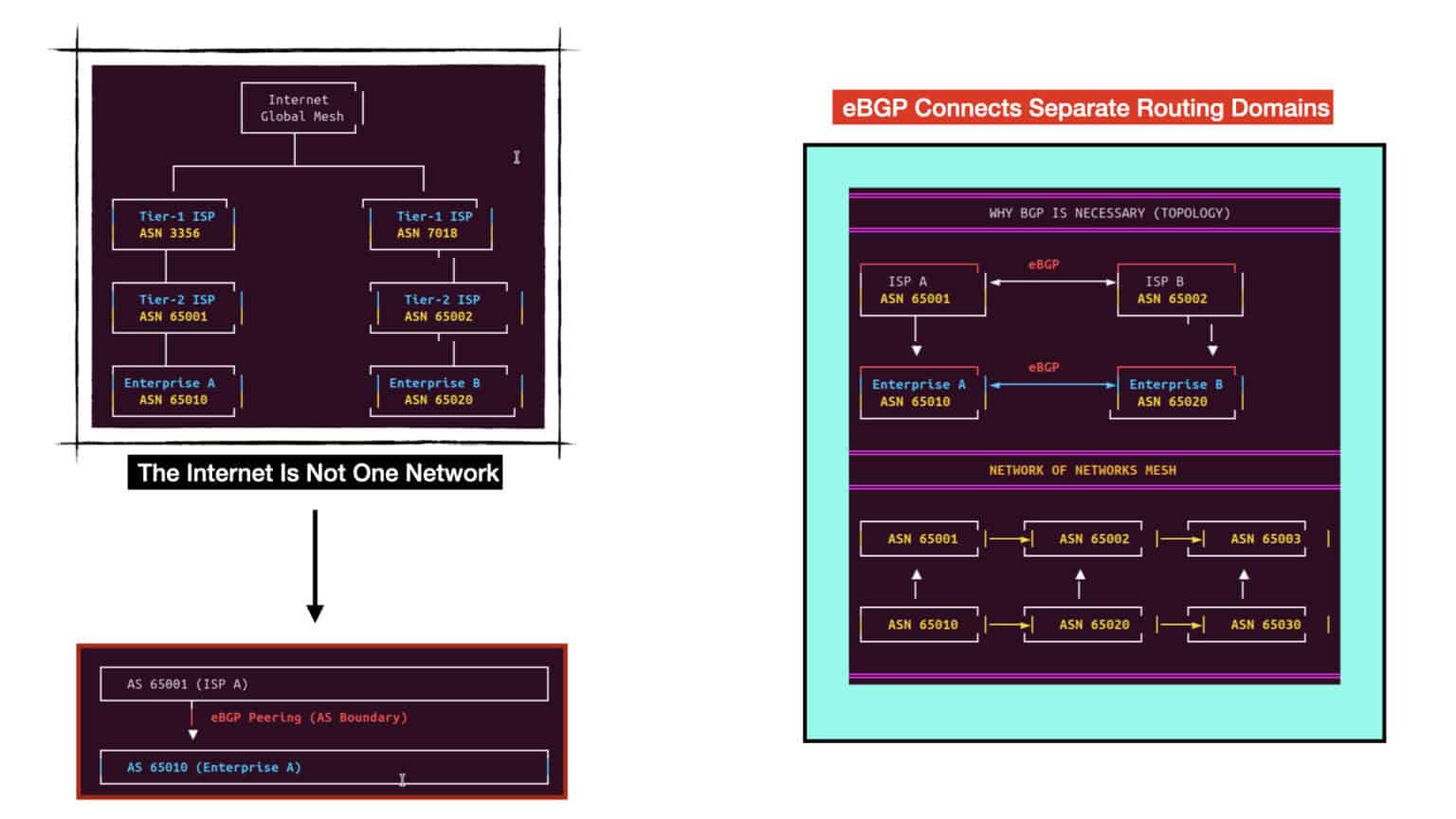
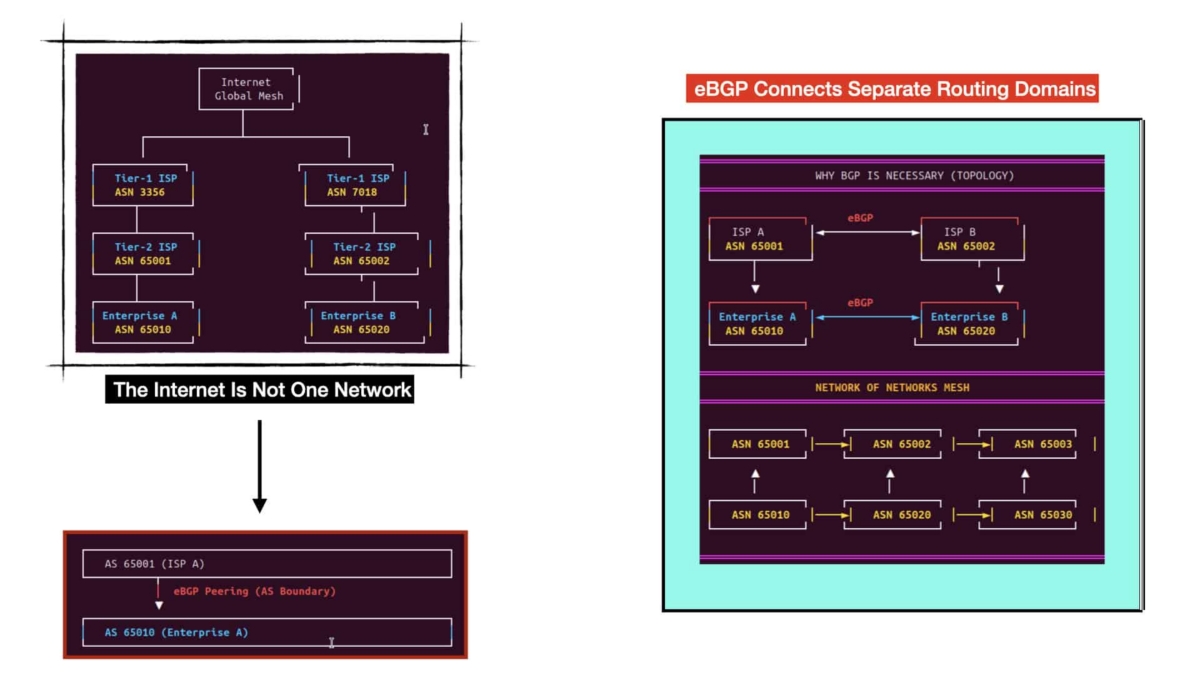
The Internet is a vast “network of networks,” a global system where thousands of independently operated networks—ISPs, enterprises, cloud providers, universities, governments—interconnect using shared protocols like TCP/IP and BGP. Each network manages its own routing, policies, and infrastructure, yet they cooperate to exchange traffic, forming a resilient, decentralized fabric. This architecture allows data to move seamlessly across autonomous systems, enabling worldwide communication, access to information, and the distributed, fault‑tolerant design that makes the Internet scalable, open, and remarkably durable
Each of these autonomous systems (ASes) contributes its own routing footprint to the global Internet, advertising the IP prefixes it owns and learning routes to every other reachable network. BGP acts as the glue between them, allowing independently governed networks to exchange reachability information without requiring any central authority. This decentralized model ensures that even if one provider fails or withdraws routes, traffic can dynamically shift across alternative paths, preserving global connectivity. The Internet’s resilience comes from this diversity — thousands of ASes cooperating, competing, and adapting in real time.
Because the Internet is composed of so many independent networks, no single organization controls its routing or topology. Instead, stability emerges from shared standards, mutual agreements, and the distributed nature of BGP route propagation. Each AS decides which routes to accept, prefer, or filter based on its own policies, shaping how traffic flows across the global fabric. This creates a constantly evolving mesh of interconnections where routes can change due to policy updates, link failures, congestion, or business relationships. Despite this complexity, the Internet remains remarkably robust, capable of rerouting around failures and maintaining global reachability through its cooperative, multi‑network design.
How the Internet Connects
Before understanding BGP, understand the network it was designed for: an Internet made from thousands of independently operated Autonomous Systems that exchange reachability and carry traffic between one another.
Follow traffic across the Internet
Run the scenario to see how traffic moves between independently operated networks and where BGP fits into the process.
The Internet
The Internet is not one network. It is a collection of independently operated networks interconnected using common protocols.
How the Internet Connects
The Internet is a network of independently operated Autonomous Systems. Explore how those networks connect, exchange traffic, use transit and peering, and where BGP fits into the picture.
A Network of Networks
The Internet is not one centrally operated network. It is a collection of independently operated Autonomous Systems that interconnect to exchange traffic.
Inside an Autonomous System
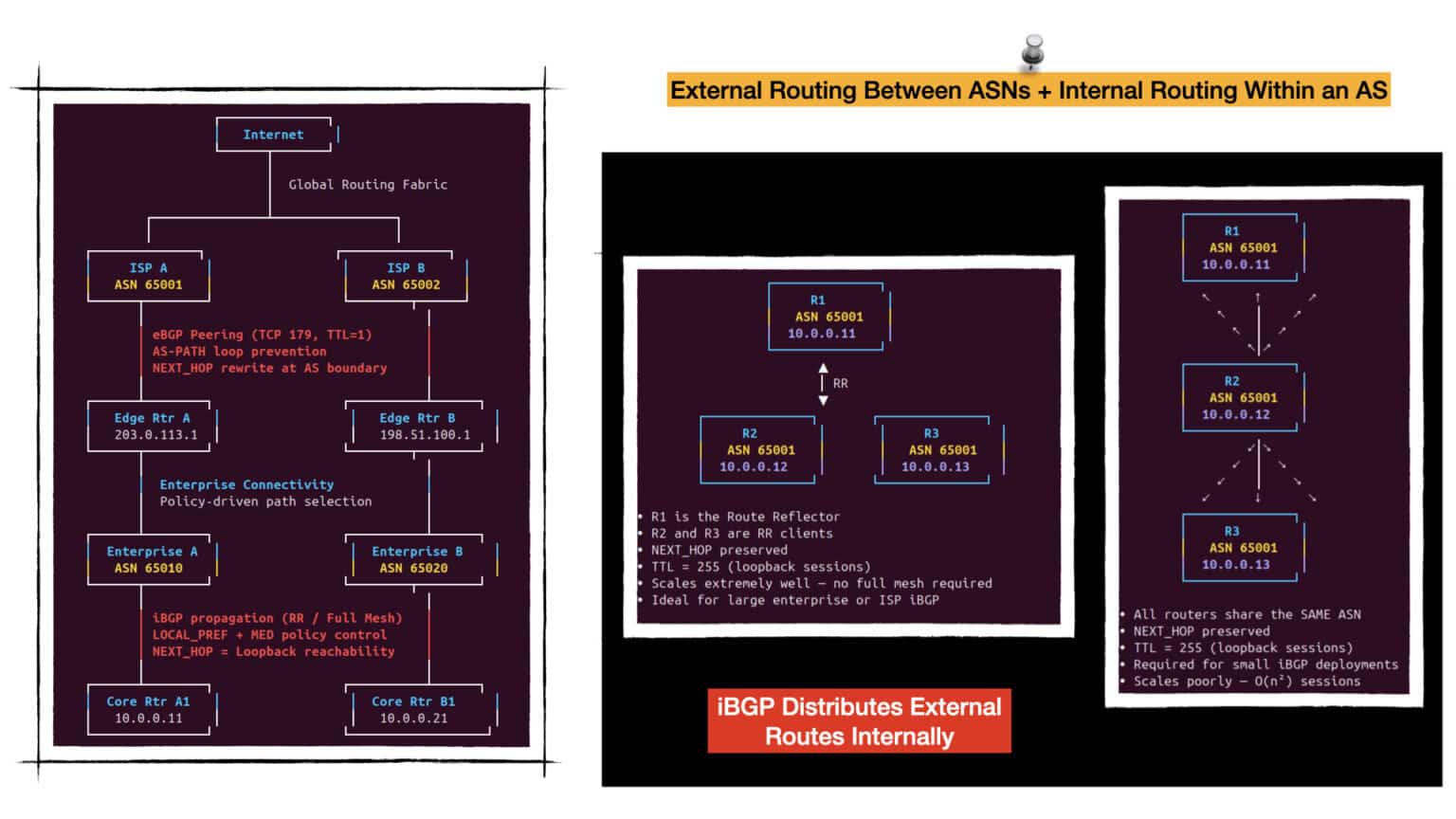
Inside an autonomous system (AS), all routers operate under a single administrative domain, following a unified routing policy and typically using an Interior Gateway Protocol such as OSPF, IS‑IS, or EIGRP to exchange reachability information. The AS maintains full control over its internal topology, addressing, and traffic engineering, allowing operators to optimize paths, enforce security, and manage redundancy without external influence. While the AS appears as a single entity to the outside world, internally it can contain thousands of routers, multiple regions, and complex hierarchies — all coordinated to present a stable, consistent routing footprint to the global Internet.
Within an autonomous system, internal routing is designed to be fast, deterministic, and highly optimized for local performance rather than global Internet considerations. Operators can shape traffic using metrics, areas, summarization, and policy controls that reflect the AS’s internal priorities—whether that’s minimizing latency, maximizing redundancy, or isolating sensitive workloads. Because all routers share the same administrative control, changes can be coordinated centrally, allowing the AS to evolve its topology, add new regions, or adjust routing behavior without needing permission from external networks. This internal cohesion is what enables large service providers and enterprises to maintain predictable, stable routing even as their infrastructures grow to massive scale.
The internal structure of an AS often includes multiple layers—core, distribution, and access—each serving a distinct role in forwarding and resilience. Core routers provide high‑speed backbone connectivity, distribution routers aggregate regional traffic, and access routers connect end systems or edge devices. In more advanced designs, the AS may include dedicated data‑center fabrics, MPLS backbones, or SD‑WAN overlays, all unified under the same routing domain. Despite this complexity, the AS presents a single, consistent routing identity to the outside world, advertising only the prefixes it owns and hiding its internal topology. This abstraction allows the AS to operate independently while still participating seamlessly in the global Internet ecosystem.
Inside an Autonomous System
Before understanding BGP, understand where it operates. Explore how an Autonomous System connects internally, how IGP provides reachability, and how BGP connects that network to other Autonomous Systems.
Explore the Autonomous System
Run the scenario to see how internal routing and BGP work together to move traffic between autonomous systems.
Autonomous System
Select a router, external network, or connection to inspect its role.
Inside an Autonomous System
An autonomous system is not a single router. It is a collection of routers and links working together. IGP provides internal reachability, iBGP distributes BGP information, and eBGP connects the AS to other networks.
One AS, multiple routing roles
An autonomous system contains multiple routers. Different routing functions operate across those routers: IGP maintains internal reachability, iBGP distributes BGP information, and eBGP connects the AS to neighbouring autonomous systems.
How BGP Routes Move Through the Network
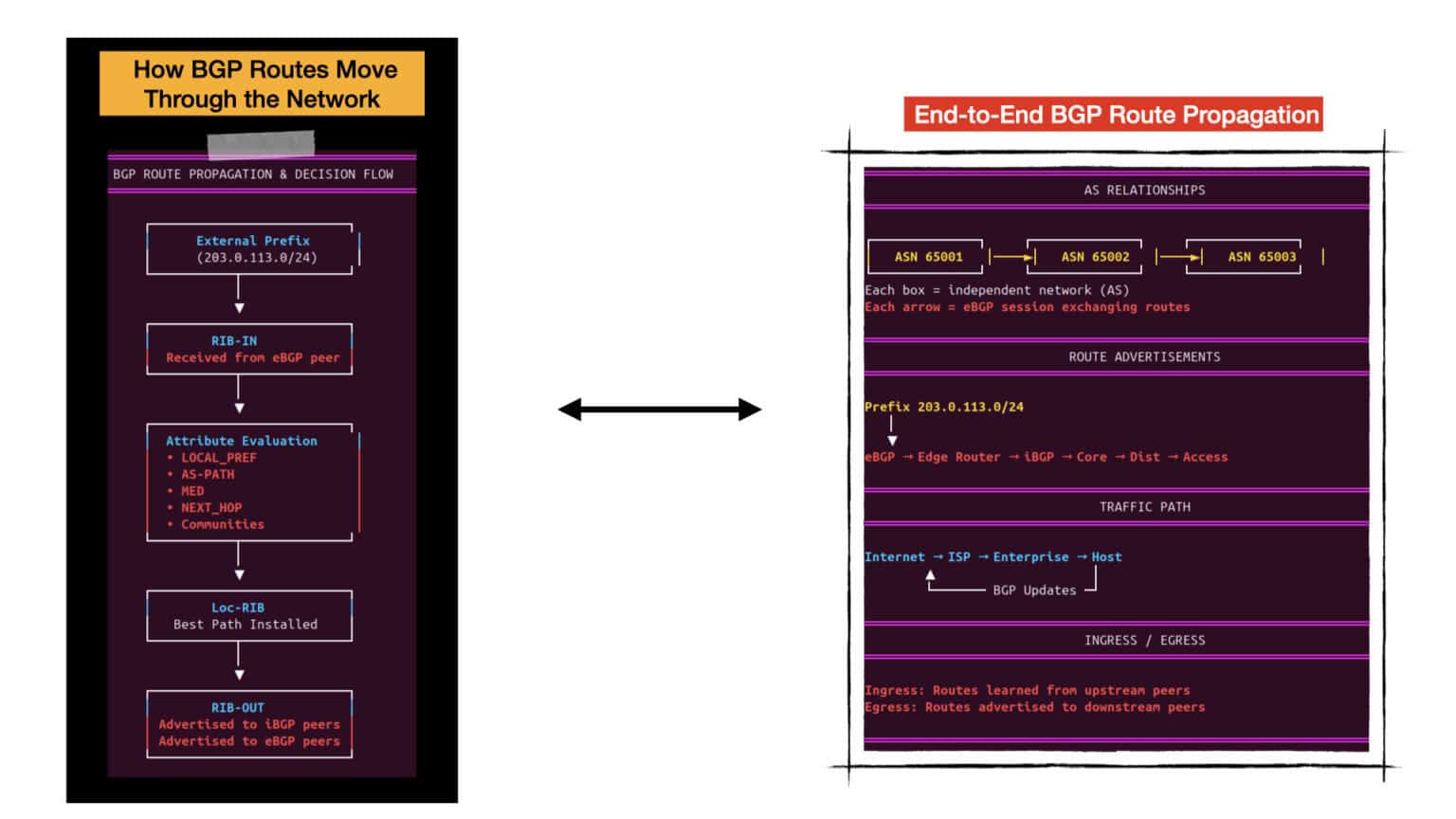
BGP routes move through the network by flowing from external peers into an Autonomous System, passing through edge routers, then propagating internally via iBGP before being resolved by the IGP for final forwarding. When a prefix arrives from an eBGP neighbor, the edge router sets attributes like NEXT_HOP, AS‑PATH, LOCAL_PREF, and MED, then advertises the route to internal BGP speakers. iBGP distributes the route across the AS without changing the NEXT_HOP, so internal routers rely on OSPF or IS‑IS to find the path to that next hop. As the route travels, BGP policies—such as filtering, path selection, and route reflection—shape how it spreads. Eventually, each router selects its best path using BGP’s decision process, installs it into the routing table, and forwards traffic accordingly, allowing the prefix to move seamlessly from the global Internet into the local network and out toward its destination.
As BGP routes propagate internally, route reflectors play a critical role in scaling large autonomous systems by reducing the need for a full iBGP mesh. Instead of every router peering with every other router, reflectors redistribute routes to their clients, ensuring consistent visibility of external prefixes across the AS. However, this introduces design considerations: operators must avoid routing loops, ensure deterministic path selection, and maintain redundancy by deploying multiple reflectors. Even with these complexities, route reflection allows massive networks—ISPs, cloud providers, and large enterprises—to distribute BGP routes efficiently without overwhelming their control plane.
Once the best path is selected and installed, the router hands forwarding responsibility to the underlying IGP, which determines the physical path packets will take toward the BGP NEXT_HOP. This separation of control—BGP for reachability, IGP for forwarding—creates a stable and predictable routing environment. As traffic flows, BGP continuously monitors peer sessions, updates attributes, and reacts to changes such as link failures, policy updates, or new route advertisements. This dynamic behavior ensures that BGP routes remain accurate and that traffic can adapt in real time, allowing the network to maintain seamless connectivity from the global Internet all the way down to individual hosts inside the AS.
How BGP Connects the Internet
The Internet is not one network. It is a collection of independently operated networks that exchange reachability information and forward traffic between autonomous systems.
How BGP Routes Move Through the Network
A route begins as reachability information in one network. BGP carries that information between autonomous systems, adding context such as AS_PATH and other attributes as the advertisement moves through the Internet.
How BGP Selects a Path
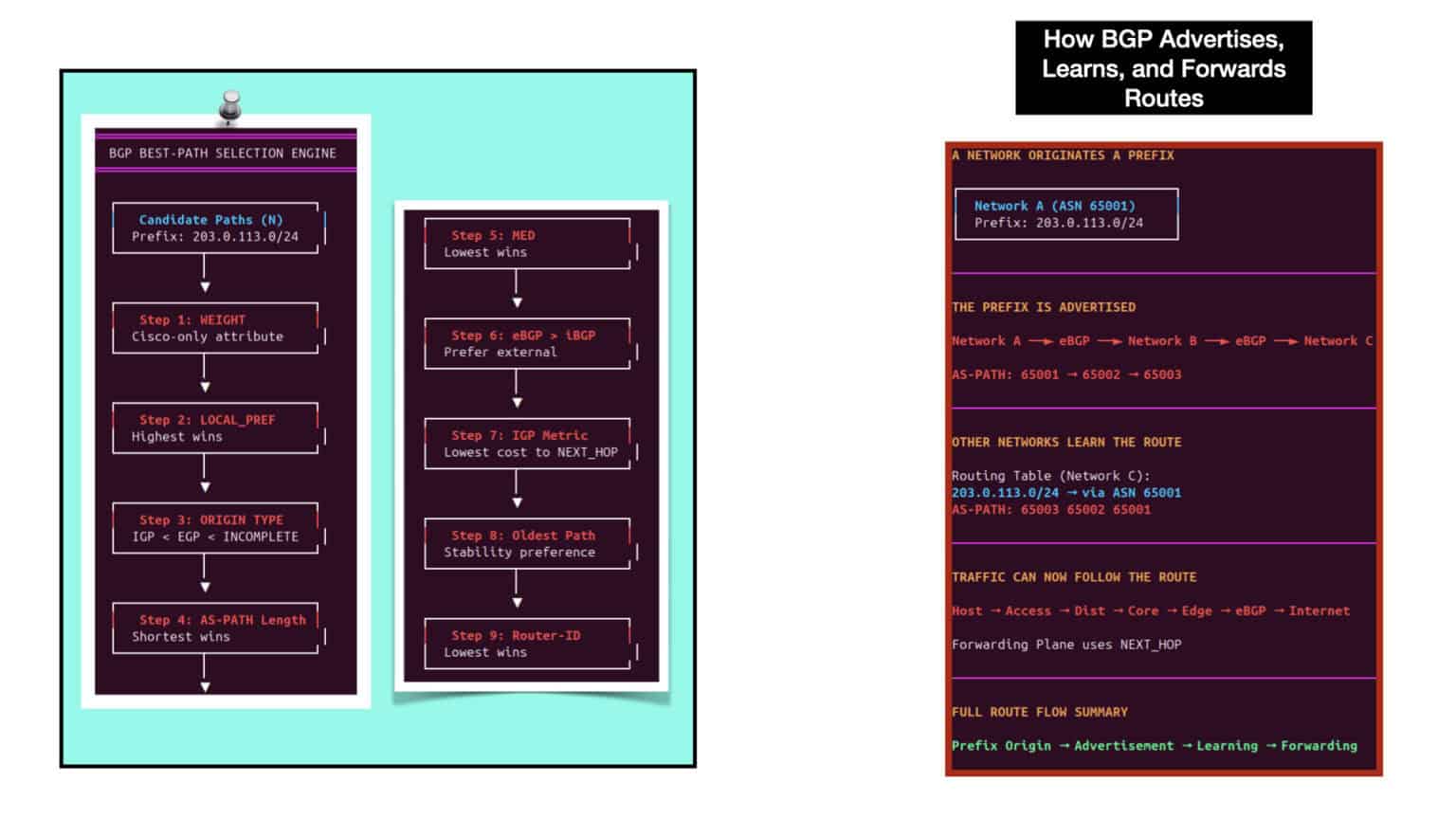
BGP selects a path by running a strict, step‑by‑step decision process that compares multiple attributes to determine the single best route for each prefix. It begins by choosing the path with the highest WEIGHT (Cisco‑only) and then the highest LOCAL_PREF, ensuring local routing policy dominates. Next, it prefers routes with the shortest AS‑PATH, followed by the lowest ORIGIN type and lowest MED when comparing paths from the same neighboring AS. If a tie remains, BGP prefers eBGP over iBGP, then selects the path with the lowest IGP metric to the NEXT_HOP. As a final tie‑breaker, it chooses the oldest path for stability and, if needed, the lowest router ID. This deterministic sequence ensures every router in the AS converges on the same best path, producing consistent, predictable routing behavior across the network.
Because BGP evaluates paths using such a strict hierarchy of attributes, operators can precisely influence routing behavior by adjusting LOCAL_PREF, manipulating AS‑PATH, or tuning MED values. These attributes act as policy levers, allowing networks to prefer cheaper transit providers, steer traffic toward higher‑capacity links, or avoid unstable peers. In large autonomous systems, these policies become essential for maintaining predictable routing, ensuring that traffic follows business and engineering priorities rather than simply the shortest AS‑PATH. This level of control is what makes BGP uniquely suited for interdomain routing across thousands of independently operated networks.
Once a router selects its best path, it advertises that decision to its BGP peers, allowing the chosen route to propagate outward and influence path selection across the wider network. This creates a distributed, cooperative routing system where each AS applies its own policies yet still converges on a stable global routing state. Even though BGP does not react instantly to changes, its deliberate, policy‑driven nature prevents oscillations and ensures that the Internet remains stable despite constant updates, link failures, and shifting traffic patterns. The end result is a routing fabric that is both flexible and resilient, capable of adapting to real‑world conditions while maintaining consistent reachability across the entire Internet.
How Networks Learn About Each Other
BGP allows autonomous systems to exchange information about which IP networks they can reach. This is the foundation of Internet-scale routing.
How Networks Learn About Each Other — and Select a Path
BGP networks first exchange reachability information. Once multiple routes are available, BGP evaluates the candidates and selects the path that will be used for the destination.

- BGP Solutions and Insights - September 30, 2026
- DMVPN - May 20, 2023
- Computer Networking: Building a Strong Foundation for Success - April 7, 2023