
network server room with computers for digital tv ip communications and internet

Stateless Network Functions

Stateless Network Functions

In the ever-evolving world of networking, the concept of stateless network functions has emerged as a game-changer. This revolutionary approach to network architecture is transforming the way we design, deploy, and manage networks. In this blog post, we will delve into the intricacies of stateless network functions and explore their profound impact on the networking landscape.

Stateless network functions (SNFs) are a paradigm shift from traditional network architectures. Unlike their stateful counterparts, SNFs do not store session-specific information, making them highly scalable and agile. These functions process packets independently, without relying on the state of previous packets, enabling faster processing and reduced latency.

Enhanced Scalability: By eliminating the need to maintain session state, SNFs can handle a significantly larger number of concurrent sessions. This scalability is crucial in modern network environments where the number of connected devices and data traffic is growing exponentially.

Flexibility and Modularity: Stateless network functions promote flexibility and modularity in network design. Each function can be developed, deployed, and updated independently, allowing network operators to adapt to changing requirements quickly. This modular approach also fosters innovation and encourages the development of specialized network functions.

Improved Fault Tolerance: With SNFs, network failures and disruptions can be contained more effectively. Since stateless functions do not rely on session-specific information, failures in one function do not impact the entire network. This fault-tolerant characteristic ensures more resilient and reliable network operations.

Software-Defined Networking (SDN): Stateless network functions play a pivotal role in SDN deployments. By decoupling control and data planes, SDN architectures can leverage the agility and scalability of SNFs. This enables efficient traffic management, dynamic resource allocation, and rapid network provisioning.

Network Function Virtualization (NFV): In the realm of NFV, stateless network functions are instrumental in achieving network virtualization and service chaining. By encapsulating network functions in virtualized environments, SNFs enable on-demand scaling, improved resource utilization, and simplified network management.

Stateless network functions are revolutionizing network architecture by offering enhanced scalability, flexibility, and fault tolerance. With their applicability in SDN, NFV, and beyond, SNFs are driving the transformation of the networking landscape. As we embrace this paradigm shift, we can expect more agile, scalable, and efficient networks that can meet the demands of the digital age.

NETWORK FUNCTIONS • ARCHITECTURE DECISION

Stateless Network Function Decision Lab

Determine whether a network function is a good candidate for stateless processing. The objective is not to remove all state, but to identify which state is required for packet processing and where that state can safely live.

Scenario: You are designing a cloud-scale network service. Select a network function, inspect its state requirements, and decide whether its processing can be separated from connection-specific state.
Network Function Under Review
Architecture Assessment
Stateless Fit
HIGH
State Dependency
LOW
PACKET Input traffic
→
PROCESSING Independent evaluation
→
DECISION Policy / attributes
Where Does the State Live?
DYNAMIC STATE Connection/session information
STATIC STATE / POLICY Configuration, rules or signatures
Architecture Decision Console
[LAB] Network function assessment ready.
[MODEL] Select a network function and traffic model.
[OBJECTIVE] Determine whether packet processing can be decoupled from session-specific state.
Engineering Takeaway

A stateless network function does not mean that the overall architecture contains no state. The design objective is to separate packet processing from tightly coupled dynamic state wherever practical. Functions such as routing or some forms of inspection may be good candidates, while NAT and stateful firewalling normally require connection-specific information somewhere in the system.

Highlights: Stateless Network Functions

**The Basics: What Does Stateless Mean?**

To grasp the significance of stateless network functions, it’s essential to understand what “stateless” entails. In a stateless system, each request from a client is treated independently, without relying on stored information from previous interactions. This approach contrasts with stateful systems, where previous interactions influence current actions. Statelessness enhances network efficiency by reducing dependencies, allowing for seamless scaling and improved fault tolerance.

**Benefits of Stateless Network Functions**

One of the primary advantages of stateless network functions is their scalability. Since each request is independent, adding more resources to handle increased load is straightforward. This flexibility is vital for networks experiencing unpredictable traffic patterns. Additionally, statelessness enhances fault tolerance. In the event of a failure, the system can easily reroute requests without worrying about lost state information, ensuring consistent service availability.

**Challenges in Implementing Stateless Network Functions**

While the benefits are clear, transitioning to stateless network functions presents challenges. One significant hurdle is the need for efficient data storage solutions to handle the information typically maintained by stateful systems. Developers must also address security concerns, as stateless systems can be more vulnerable to malicious attacks if not properly secured. Despite these challenges, the potential for improved performance makes the effort worthwhile.

Understanding Stateless Network Functions

Stateless network functions, also known as SNFs, represent a paradigm shift in network architecture. Unlike their traditional counterparts, which rely on maintaining and managing session states, SNFs operate independently, without knowledge of prior interactions. This statelessness increases scalability, flexibility, and simplicity in network design.

The adoption of stateless network functions brings forth an array of advantages. Firstly, SNFs reduce complexity and enhance overall system performance by eliminating the need for session state management. Additionally, the statelessness enables horizontal scalability, empowering networks to handle an ever-increasing number of requests without compromising efficiency. Moreover, SNFs facilitate faster network deployment, as their independence from the session state eliminates the need for complex configurations.

Use Cases and Applications:

A- Stateless network functions find applications across various domains. In cloud computing, SNFs enable efficient load balancing and dynamic resource allocation. They also prove invaluable in network security, as their statelessness mitigates the risk of session-based attacks. Furthermore, SNFs are leveraged in content delivery networks (CDNs) to optimize content routing and improve user experience.

B- While stateless network functions offer immense potential, specific challenges must be addressed. One such concern is the loss of session-related information, which might be crucial in particular scenarios. Additionally, transitioning from traditional architectures to stateless paradigms requires careful planning and potential modifications to existing infrastructure.

Benefits of Stateless Network Functions:

1. Enhanced Scalability: SNFs offer improved scalability by eliminating the need to store session state information. Network devices can handle more packets and perform better, making them ideal for large-scale deployments and high-traffic scenarios.

2. Simplified Network Management: Stateless network functions simplify network management by reducing the complexity associated with session state maintenance. This streamlined approach allows for more straightforward configuration, troubleshooting, and monitoring, improving operational efficiency.

3. Increased Flexibility: SNFs enable more flexible network architectures that can be easily deployed and scaled without session state limitations. This flexibility allows organizations to rapidly adapt their networks to changing demands and deploy new services.

4. Enhanced Security: Stateless processing enhances network security by reducing potential attack vectors. Since SNFs do not rely on session state information, they minimize the risk of session hijacking or data leakage, leading to more robust and secure networks.

Applications of Stateless Network Functions:

1. Load Balancing: Stateless network functions are well-suited for load-balancing applications. They enable efficient network traffic distribution across multiple servers or resources, ensuring optimal resource utilization and improved application performance.

2. Deep Packet Inspection: SNFs can be used for deep packet inspection (DPI), a technique that analyzes the content of network packets for security or application identification purposes. The stateless nature of SNFs allows for faster and more efficient DPI, enabling real-time threat detection and network optimization.

3. Network Function Virtualization (NFV): Stateless network functions are foundational to network function virtualization (NFV) architectures. By decoupling network functions from dedicated hardware, NFV leverages SNFs to achieve greater flexibility, scalability, and cost-effectiveness in network deployments.

**Tight State and Processing**

New technology is needed, and it’s time to break the tight state and processing. This involves decoupling the existing network function design into a stateless processing component ( stateless network functions) and a data store layer. Doing this and breaking the tight coupling enables a more elastic and resilient network functions infrastructure.


NETWORK FUNCTIONS • STATE DECOUPLING

State Decoupling & Performance Investigation Lab

A stateless processing tier can improve elasticity and failure isolation, but moving state outside the network function introduces its own engineering trade-offs. Investigate latency, consistency, availability and recovery before choosing an architecture.

Incident: A network service is being scaled across multiple processing instances. Engineers have externalised connection state, but packet processing is now dependent on a shared state service. Determine whether the architecture remains viable.
State Location
Event
Consistency
Processing Architecture
TRAFFIC Packets / flows
→
STATELESS PROCESSING Any healthy instance can process traffic
→
STATE Shared state service
Scale-Out
HIGH
Failure Recovery
HIGH
State Dependency
EXTERNAL
Main Risk
LATENCY
Evidence
Processing Instance NF-01 can process the packet without owning the session state.
State Availability Required state is available from the shared state layer.
Scaling Impact A new processing instance can join without inheriting local session state.
Architecture Risk The external state service becomes a dependency.
Investigation Console
[LAB] State-decoupling investigation ready.
[MODEL] External distributed state selected.
[OBJECTIVE] Determine whether the architecture improves scale and recovery without introducing unacceptable dependencies.
Engineering Takeaway

Externalising state can make processing instances easier to scale, replace and recover. It does not make the architecture dependency-free. The state service introduces latency, availability, consistency and failure-domain considerations that must be engineered explicitly.

Stateless Network Functions

The Role of Networks

Let’s face it. Networks need to be both scalable and sophisticated. To be successful, you need to completely redesign the network functions, such as routing and firewall functions, along with the underlying platforms that manage and orchestrate these functions. However, to accomplish this, you need to create an entirely new architecture and adapt the existing technology to this new architecture.

If you look at technologies used for cloud storage, no one has ever used them for networks. Why is this? The reason is mainly down to performance requirements, such as throughput and latency in distributed systems.

One can understand that the industry will be very pushy with this type of disruptive technology, saying that it is just impossible. But we need to give the world something new. It deserves the ability to customize networks on-demand. It would help to have a logical place to start with a new architecture.

Stateless Network Functions: Changing the environment

Decentralized workloads, the decline of on-premise, and the increase in multi-cloud deployments have created one of the most extensive connectivity challenges for data centers. A key finding is that colocation providers, traditionally serving as space, power, and physical network connectivity resources, should not become the hub for all traffic as workloads decentralize.

The problem is these colocation providers have not focused on connectivity that requires multi-tenancy and routing, and they usually have physical cloud connects; this has introduced growing management and operational challenges, which will only increase in large-scale deployments.

Cloud Connect is where you need to connect multiple enterprises, where these enterprises need to connect to various cloud providers. All of these tenants need BGP routing, firewall functions, and NAT, but to do this on a larger scale with a solution that couples the state cannot scale and be reliable.

New technologies come in waves – some appear, and others disappear.

The market needs a new type of technology, a software-defined interconnect like the Internet exchange. This came to light in 2016 when Laurent Vanbever proposed a software-defined internet exchange based on OpenFlow ( what is OpenFlow ) known as SDX; software-defined internet exchange is an SDN solution originating from the combined efforts of Princeton and UC Berkeley. It aims to address IXP pain points by deploying additional SDN controllers and OpenFlow-enabled switches. It doesn’t try to replace the entire classical IXP architecture with something new; rather, it augments existing designs with a controller.

Software-defined interconnect (SDIX)

However, a software-defined interconnect (SDIX) is a new category of offering that allows colocation providers to manage their cloud connects via software and extend their connectivity control. It should cover the cloud connection and multiple data center interconnects. In the past, the colocation providers focused on space and power. However, in today’s world, they have new responsibilities. The responsibilities now extend to new types of connectivity for customers. Customers now have new requirements.

They must move their data from one colocation facility to another to avoid latency or backup purposes. For these cases, colocation providers need a new type of platform to direct all of their different tenant’s tasks and requirements to a software-based platform.

The Tight Coupling

Why is this different? The underlying technology concerns network functions such as firewalls, routers, and load balancers; regardless of the application architecture and requirements, these network functions are physical boxes. The challenge is that traffic that flows through these boxes is tightly coupled with the box.

The physical box, virtual machine, or container performing a network function is coupled with the state. What happens with the state when you launch a new network function or redirect the traffic to a backup device? This will affect the application. This might be acceptable for a single application but not for a large-scale deployment when you have millions of connections and applications running on top of network functions.

Network Function Virtualizaton

Network function virtualization (NFV) and NFV use cases didn’t help here. All it did was change the physical boxes to virtual ones. It’s like changing a physical appliance in Dublin to a cloud-based provider. Is this the future? NFV inherits the same design and features as the physical box. But what needs to be done is realizing that the problem is the state. You need to decouple the dynamic state from each network function and put them in a high-performance data store within a cluster of commodity hardware and switches—a hardware-agnostic solution with code that is not open source.

Network function stateless

Then, you can make the network function stateless, so it’s physically just a thread. It doesn’t affect application performance if it fails, as the state is collected from the data store. This is needed as an underlying design, but does it seem possible? There will be overheads from decoupling the state.

The state can be put into a cluster of servers. Some servers maintain some of the state, and some of the other servers can be the network functions. The state is not physically in another data center or location. Every type of dynamic state, such as counters, timers, and handshaking that you see in the TCP flow, all of which is state, is a challenge to decouple without breaking application performance. However, this can be done by adapting technology-distributed systems—a database to store the state needed that is designed for high-performance computing. A read for a state should be around 5 microseconds.  

An algorithm is needed to read and write the state in a way that reads multiple packets simultaneously. This enables you to overcome any latency issues and achieve better performance than traditional appliances that have the state coupled.

Stateless network functions are revolutionizing networking infrastructure by offering enhanced scalability, simplified management, increased flexibility, and improved security. SNFs are paving the way for more agile and efficient networks with their wide range of applications. As organizations embrace digital transformation, understanding and harnessing the potential of stateless network functions will be vital to building resilient and future-proof network architectures.

NETWORK FUNCTIONS • SDIX • CLOUD CONNECTIVITY

Software-Defined Interconnect Architecture Lab

Bring stateless network functions, multi-tenant connectivity, orchestration and cloud interconnection together. Design a service that can steer traffic across locations while keeping processing components independently scalable.

Scenario: A tenant needs connectivity between two data centres and a cloud environment. The service must dynamically steer traffic through network functions such as firewalling, NAT or inspection while allowing processing capacity to scale independently.
Deployment Model
Service Chain
Traffic Event
Software-Defined Interconnect
TENANT / SITE A Enterprise workload
→
SERVICE CHAIN Firewall → Router
→
CLOUD / SITE B Application workload
Connectivity
READY
Processing
ELASTIC
Orchestration
ACTIVE
Main Dependency
POLICY
Connectivity Layer
UNDERLAY / INTERCONNECT Provides reachability between sites, clouds and service insertion points.
CONNECTIVITY
TRAFFIC STEERING Selects the appropriate service path for the tenant.
STEERING
Service Layer
NETWORK FUNCTIONS Processing functions can be deployed as independently scalable components.
PROCESSING
ORCHESTRATION Applies tenant intent, service policy and placement decisions.
CONTROL
Investigation Evidence
Tenant Connectivity Tenant traffic has an available service path.
Service Processing Processing instances can be added without redesigning the interconnect.
Orchestration Policy determines where traffic is steered.
Failure Domain A processing instance can fail without necessarily removing the underlying connectivity.
Architecture Event Console
[LAB] Software-defined interconnect ready.
[MODEL] Multi-data-centre + cloud selected.
[SERVICE] Firewall → Router
[CONTROL] Orchestration is active.
[READY] Run an architecture event and investigate the resulting traffic path.
Engineering Takeaway

A software-defined interconnect can coordinate connectivity, traffic steering and service insertion across data centres and cloud environments. Stateless processing can make individual network-function tiers easier to scale, but the complete system still depends on routing, policy, orchestration, service-state requirements and the availability of the underlying connectivity.
open vswitch

OVS Bridge and Open vSwitch (OVS) Basics

 Open vSwitch (OVS) is an open-source multilayer virtual switch that provides a flexible and robust solution for network virtualization and software-defined networking (SDN) environments. It’s versatility and extensive feature set make it an invaluable tool for network administrators and developers. In this blog post, we will explore the world of Open vSwitch, its key features, benefits, and use cases.

Open vSwitch is a software switch designed for virtualized environments, enabling efficient network virtualization and SDN. It operates at layer 2 (data link layer) and layer 3 (network layer), offering advanced networking capabilities that enhance performance, security, and scalability.

Highlights: Open vSwitch

  • Barriers to Network Innovation

There are many barriers to network innovation, which makes it difficult for outsiders to drive features and innovate. Until recently, technologies were largely proprietary and controlled by a few vendors. The lack of tools available limited network virtualization and network resource abstraction. Many new initiatives are now challenging this space, and the Open vSwitch project with the OVS bridge, managed by the Open Network Foundation (ONF), is one of them. The ONF is a non-profit organization that promotes adopting software-defined networking through open standards and open networking.

  • The Role of OVS Switch

Since its release, the OVS switch has gained popularity and is now the de-facto open standard cloud networking switch. It changes the network landscape and moves the network edge to the hypervisor. The hypervisor is the new edge of the network. It resolves the problem of network separation; cloud users can now be assigned VMs with flexible configurations. It brings new challenges to networking and security, some of which the OVS network can alleviate in conjunction with OVS rules.

Open vSwitch • Packet Processing Lab

What Happens to This Packet?

Change the packet, datapath and flow conditions, then run the packet through OVS. Watch the processing path, datapath state, telemetry and engineering diagnosis change together.
READY
Packet Type
Datapath Mode
Flow Table
Controller
LIVE OVS DATAPATH NORMAL PROCESSING
P
INPUT
VM / Container
Workload traffic enters through an OVS-connected virtual interface.
READY
K
DATAPATH
Kernel Datapath
Performs the flow lookup and handles packets matching installed datapath rules.
WAITING
U
USERSPACE
ovs-vswitchd
Handles control and flow-management work when datapath processing requires userspace.
BYPASSED
C
CONTROL
SDN Controller
Provides external control-plane decisions when the deployment requires controller interaction.
STANDBY
Packet Processing Result
Ready to simulate the selected scenario.
Component Inspector CLICK A COMPONENT
VM / Container Traffic This is where workload traffic enters the virtual switching layer before the datapath determines how the packet should be handled.
Datapath Telemetry LIVE
Flow Cache
HIT
Path
FAST
Packets/sec
148K
Latency
8 µs
Run Simulation ENGINE
Event Console TRACE
[READY] OVS datapath initialized [FLOW] Existing flow entry available [FAST] Kernel fast path ready
Engineering Diagnosis ANALYSIS
Fast-path scenario The selected packet has an established flow match, so OVS can process it through the datapath without requiring repeated userspace or controller involvement.


Back to Basics With Open vSwitch

The virtual switch

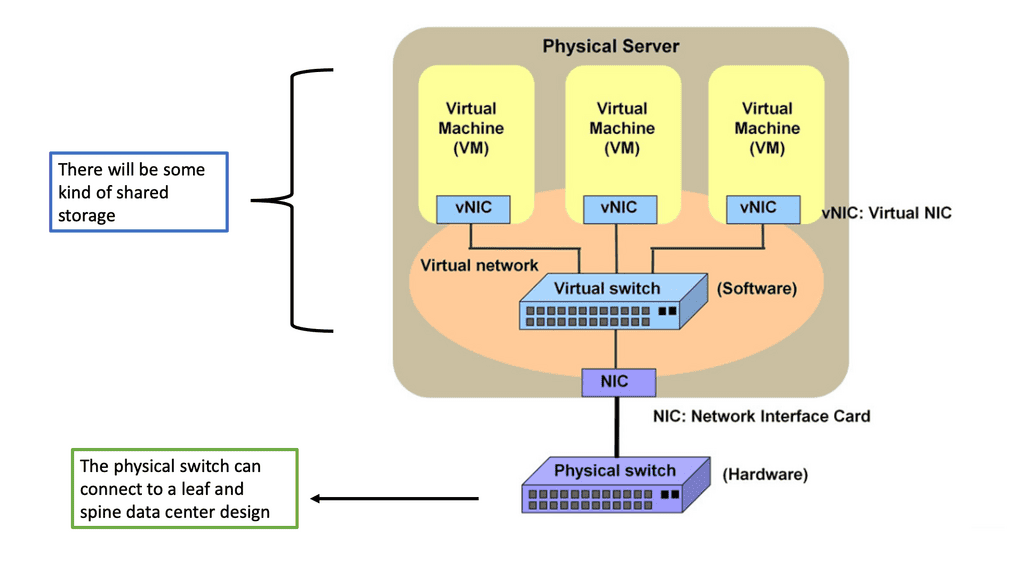
A virtual switch is a software-defined networking (SDN) device that enables the connection of multiple virtual machines within a single physical host. It is a Layer 2 device that operates within the virtualized environment and provides the same functionalities as a physical switch.

Virtual switches can be used to improve the performance and scalability of the network and are often used in cloud computing and virtualized environments. Virtual switches provide several advantages over their physical counterparts, including flexibility, scalability, and cost savings. In addition, as virtual switches are software-defined, they can be easily configured and managed by administrators.

Virtual switches are software-based switches that reside in the hypervisor kernel providing local network connectivity between virtual machines (and now containers). They deliver functions like MAC learning and features like link aggregation, SPAN, and sFlow, just like their physical switch companions have been doing for years. While these virtual switches are often found in more comprehensive SDN and network virtualization solutions, they are a switch that happens to be running in software.

Virtual Switch
Diagram: Virtual Switch. Source Fujitsu.


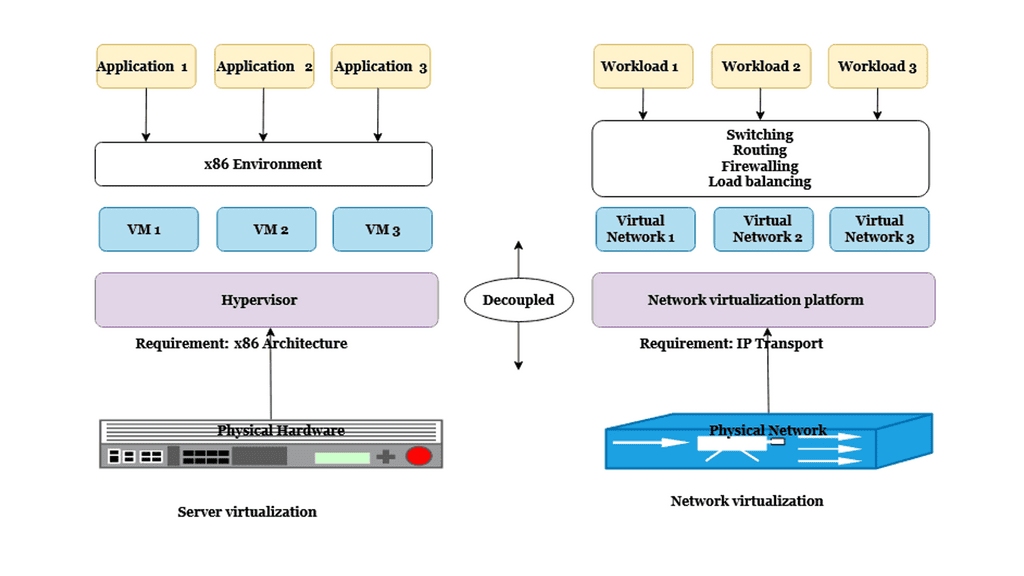
Network virtualization

network virtualization can also enable organizations to improve their network performance by allowing them to create multiple isolated networks. This can be particularly helpful when an organization’s network is experiencing congestion due to multiple applications, users, or customers. By segmenting the network into multiple isolated networks, each network can be optimized for the specific needs of its users.

In summary, network virtualization is a powerful tool that can enable organizations to control better and manage their network resources while still providing the flexibility and performance needed to meet the demands of their users. Network virtualization can help organizations improve their networks’ security, privacy, scalability, and performance by allowing organizations to create multiple isolated networks.

Network Virtualization
Diagram: Network and Server virtualization. Source Parallels.


Highlighting the OVS bridge

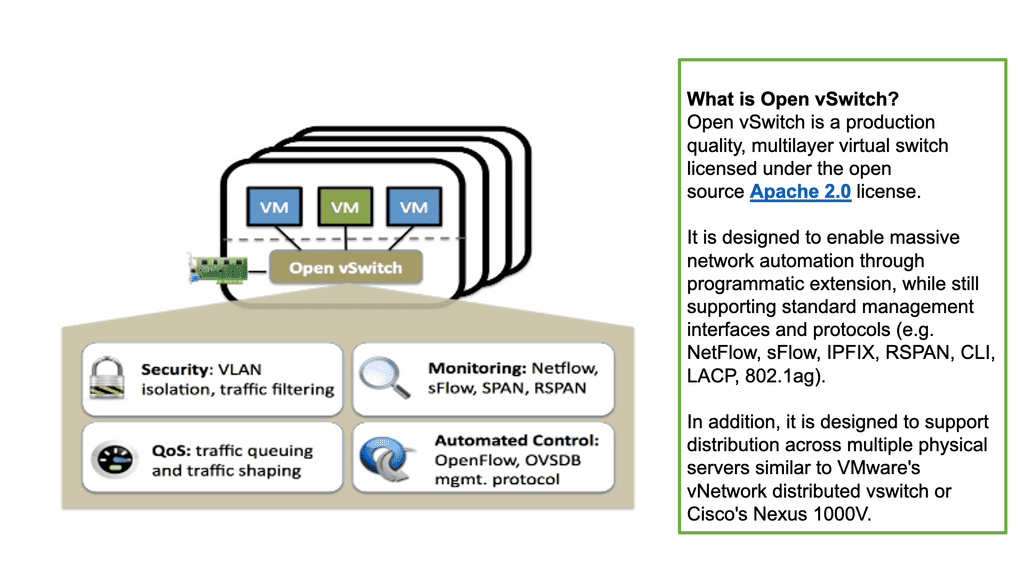
Open vSwitch is an open-source software switch designed for virtualized environments. It provides a multi-layer virtual switch designed to enable network connectivity and communication between virtual machines running within a single host or across multiple hosts. In addition, open vSwitch fully complies with the OpenFlow protocol, allowing it to be integrated with other OpenFlow-compatible software components.

The software switch can also manage various virtual networking functions, including LANs, routing, and port mirroring. Open vSwitch is highly configurable and can construct complex virtual networks. It supports a variety of features, including support for multiple VLANs, support for network isolation, and support for dynamic port configurations. As a result, open vSwitch is a critical component of many virtualized environments, providing an essential and powerful tool for managing the network environment.


  • A simple flow-based switch

Open vSwitch originates from the academic labs from a project known as Ethan – SIGCOMM 2007. Ethan created a simple flow-based switch with a central controller. The central controller has end-to-end visibility, allowing policies to be applied to one place while affecting many data plane devices. In addition, central controllers make orchestrating the network much more accessible. SIGCOMM 2007 introduced the OpenFlow protocol – SIGCOMM CCR 2008 and the first Open vSwitch (OVS) release in early 2009.


Key Features of Open vSwitch:

Virtual Switching: Open vSwitch allows the creation of virtual switches, enabling network administrators to define and manage multiple isolated networks on a single physical machine. This feature is particularly useful in cloud computing environments, where virtual machines (VMs) require network connectivity.

Flow Control: Open vSwitch supports flow-based packet processing, allowing administrators to define rules to handle network traffic efficiently. This feature enables fine-grained control over network traffic, implementing Quality of Service (QoS) policies, and enhancing network performance.

Network Virtualization: Open vSwitch enables network virtualization by supporting network overlays such as VXLAN, GRE, and Geneve. This allows the creation of virtual networks that span physical infrastructure, simplifying network management and enabling seamless migration of virtual machines across different hosts.

SDN Integration: Open vSwitch seamlessly integrates with SDN controllers, such as OpenDaylight and OpenFlow, enabling centralized network management and programmability. This integration empowers administrators to automate network provisioning, optimize traffic routing, and implement dynamic policies.

Benefits of Open vSwitch:

Flexibility: Open vSwitch offers a wide range of features and APIs, providing flexibility to adapt to various network requirements. Its modular architecture allows administrators to customize and extend functionalities per their needs, making it highly versatile.

Scalability: Open vSwitch scales effortlessly as network demands grow, efficiently handling large virtual machines and network flows. Its distributed nature enables load balancing and fault tolerance, ensuring high availability and performance.

Cost-Effectiveness: Being an open-source solution, Open vSwitch eliminates the need for expensive proprietary hardware. This reduces costs and enables organizations to leverage the benefits of software-defined networking without a significant investment.

Use Cases:

Cloud Computing: Open vSwitch plays a crucial role in cloud computing environments, enabling network virtualization, multi-tenant isolation, and seamless VM migration. It facilitates the creation and management of virtual networks, enhancing the agility and efficiency of cloud infrastructure.

SDN Deployments: Open vSwitch integrates seamlessly with SDN controllers, making it an ideal choice for SDN deployments. It allows for centralized network management, dynamic policy enforcement, and programmability, enabling organizations to achieve greater control and flexibility over their networks.

Network Testing and Development: Open vSwitch provides a powerful tool for testing and development. Its extensive feature set and programmability allow developers to simulate complex network topologies, test network applications, and evaluate network performance under different conditions.


Open vSwitch (OVS)

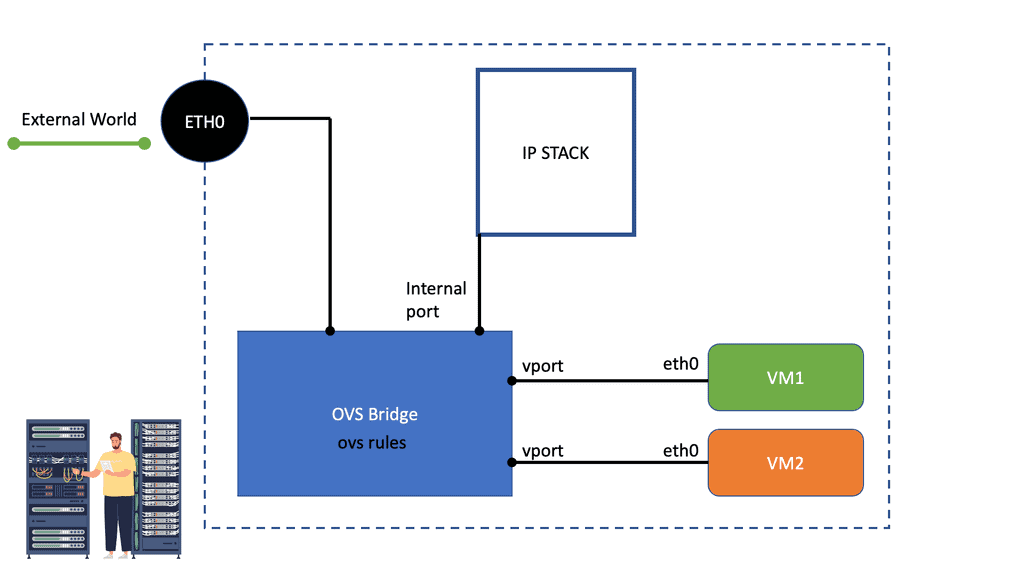
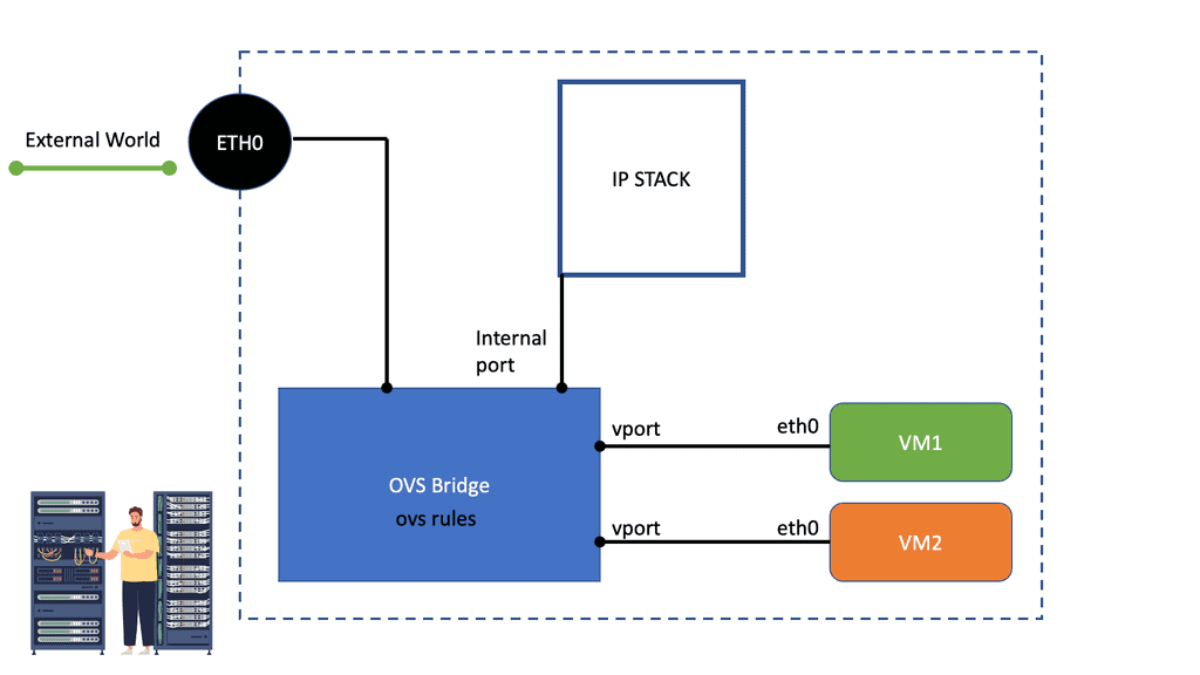
The OVS bridge is a multilayer virtual switch implemented in software. It uses virtual network bridges and flows rules to forward packets between hosts. It behaves like a physical switch, only virtualized. Namespaces and instance tap interfaces connect to what is known as OVS bridge ports.

Like a traditional switch, OVS maintains information about connected devices, such as MAC addresses. In addition, it enhances the monolithic Linux Bridge plugin and includes overlay networking (GRE & VXLAN), providing multi-tenancy in cloud environments. 

open vswitch
Diagram: The Open vSwitch basic layout.


Programming the Open vSwitch and OVS rules

The OVS switch can also be integrated with hardware and serve as the control plane for switching silicon. Programming flow rules work differently in the OVS switch than in the standard Linux Bridge. The OVS plugin does not use VLANs to tag traffic. Instead, it programs OVS flow rules on the virtual switches that dictate how traffic should be manipulated before being forwarded to the exit interface. The OVS rules essentially determine how inbound and outbound traffic should be treated. 

OVS has two fail modes a) Standalone and b) Secure. Standalone is the default mode and acts as a learning switch. Secure mode relies on the controller element to insert flow rules. Therefore, the secure mode has a dependency on the controller.

OVS bridge
Diagram: OVS Bridge: Source OpenvSwitch.


Open vSwitch Flow Forwarding.

Kernel mode, known as “fast path” processing, is where it does the switching. If you relate this to hardware components on a physical device, the kernel mode will map to the ASIC. User mode is known as the “slow path.” If there is a new flow, the kernel doesn’t know about the user mode and is instructed to engage. Once the flow is active, the user mode should not be invoked. So you may take a hit the first time.

The first packet in a flow goes to the userspace ovs-vswitchd, and subsequent packets hit cached entries in the kernel. When the kernel module receives a packet, the cache is inspected to determine if there is a flow entry. The associated action is carried out on the packet if a corresponding flow entry is found in the cache.

This could be forwarding the packet or modifying its headers. If no cache entry is found, the packet is passed to the userspace ovs-vswitchd process for processing. Subsequent packets are processed in the kernel without userspace interaction. The processing speed of the OVS is now faster than the original Linux Bridge. It also has good support for mega flows and multithreading. 

OVS rules
Diagram: OVS rules and traffic flow.


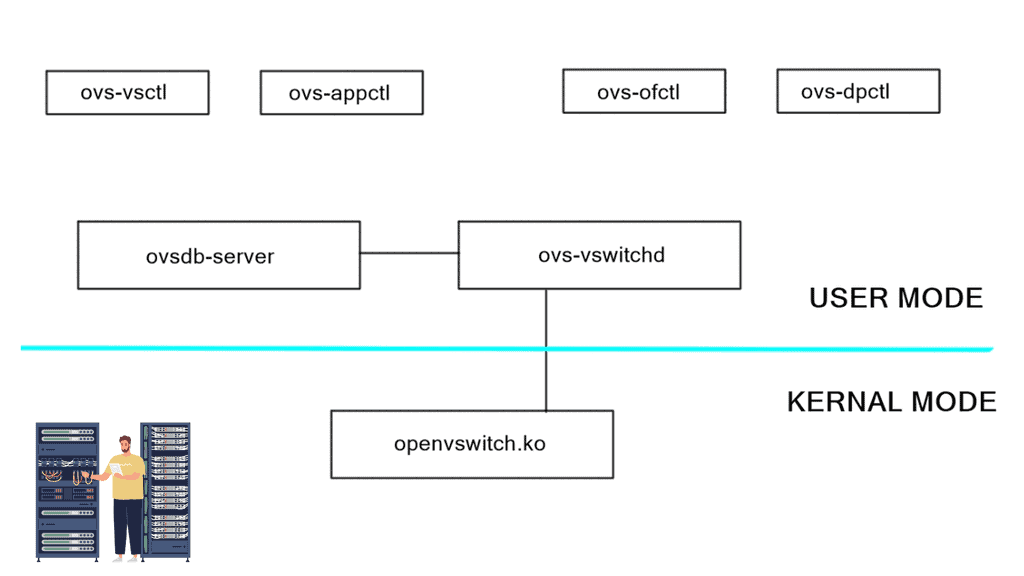
OVS component architecture

There are several CLI tools to interface with the various components:

CLI Component

OVS Component

Ovs-vsctl manages the state 

in the ovsdb-server

Ovs-appctl sends commands

to the ovs-vswitchd

Ovs-dpctl is the

Kernal module configuration

ovs-ofctl work with the 

 OpenFlow protocols


what is OVS bridge
Diagram: What is OVS bridge? The components involved.


You may have an off-host component, such as the controller. It communicates and acts as a manager of a set of OVS components in a cluster. The controller has a global view and manages all the components. An example controller is OpenDaylight. OpenDaylight promotes the adoption of SDN and serves as a platform for Network Function Virtualization (NFV).

NFV virtualized network services instead of using physical function-specific hardware. A northbound interface exposes the network application and southbound interfaces interface with the OVS components. 

  • RYU provides a framework for SDN controllers and allows you to develop controllers. It is written in Python. It supports OpenFlow, Netconf, and OF-config.

There are many interfaces used to communicate across and between components. The database has a management protocol known as OVSDB, RFC 7047. OVS has a local database server on every physical host. It maintains the configuration of the virtual switches. Netlink communicates between user and kernel modes and between different userspace processes. It is used between ovs-vswitchd and openvswitch.ko and is designed to transfer miscellaneous networking information.


OpenFlow and the OVS bridge

OpenFlow can also be used to talk and program the OVS. The ovsdb-server interfaces with an external controller (if used) and the ovs-vswitchd interface. Its purpose is to store information for the switches. Its state is persistent.

The central CLI tool is ovs-vsctl. The ovs-vswitchd interface with an external controller, kernel via Netlink, and the ovsdb server. Its purpose is to manage multiple bridges and is involved in the data path. It’s a core system component for the OVS. Two CLI tools ovs-ofctl and ovs-appctl are used to interface with this.


Linux containers and networking

OVS can make use of Linux and Docker containers. Containers provide a layer of isolation that reduces communication in humans. They make it easy to build out example scenarios. Starting a container takes milliseconds compared to the minutes of a virtual machine.

Deploying container images is much faster if less data needs to travel across the fabric. Elastic applications with frequent state changes and dynamic resource allocation can be built more efficiently with containers. 

Linux and Docker containers represent a fundamental shift in how we consume and manage applications. Libvirt is a tool used to make use of containers. It’s a virtualization application for Linux. Linux containers involve process isolation in Linux, so instead of running an entire-blown VM, you can do a container, but you share the same kernel but are entirely isolated.

Each container has its view of networking and processes. Containers isolate instances without the overhead of a VM. A lightweight way of doing things on a host and builds on the mechanism in the kernel.


Source versus package install

There are two paths for installation, a) Source code and b) Package installation based on your Linux distribution. The source code install is primarily used if you are a developer and is helpful if you are trying to make an extension or focusing on hardware component integration; before accessing the Repo-install, any build dependencies, such as git, autoconf, and libtool.

Then you pull the image from GitHub with the “clone” command. <git clone https://github.com/openvswitch/ovs>. Running from source code is a lot more difficult than installing through distribution. All the dependencies will be done for you when you install from packages. 

Conclusion:

Open vSwitch is a feature-rich and highly flexible virtual switch that empowers network administrators and developers to build efficient and scalable networks. Its support for network virtualization, flow control, and SDN integration makes it a valuable tool in cloud computing environments, SDN deployments, and network testing and development. By leveraging Open vSwitch, organizations can unlock the full potential of network virtualization and software-defined networking, enhancing their network capabilities and driving innovation in the digital era.


```
Open vSwitch • Flow Engineering Lab

Build the Flow That OVS Will Use

Construct a simplified OVS flow rule, choose what the packet should match and define the action. Then test the rule and watch how priority, matching and actions determine the datapath decision.
RULE READY
1. Define the Match FLOW KEY
Ingress Port
Ethernet Type
Transport
Priority
2. Choose the Action DATAPATH ACTION
Generated Flow OVS-STYLE
Datapath Rule READY
priority=1000, in_port=vm1, eth_type=ipv4, tcp, actions=output:uplink0
PACKET MATCH ACTION RESULT
Packet Test LIVE TEST
Ingress
vm1
Protocol
IPv4 / TCP
Match
MATCH
Result
FORWARD
Flow Table Logic DECISION
High-priority forwarding rule The rule matches the selected packet characteristics and forwards the traffic. Because the priority is high, this rule wins over lower-priority matching entries.
Event Console TRACE
[FLOW] Rule builder initialized [TABLE] Priority ordering available [READY] Waiting for packet test
Engineering Insight OVS flow rules combine match fields with actions. The important concept is not simply that a rule exists — the packet must match the rule, and competing rules are resolved according to priority.
OVS ENGINEERING LAB 03 · INCIDENT RESPONSE

Why Is This OVS Traffic Failing?

Investigate a live OVS incident. Examine the evidence, identify the failing component, then select the remediation that actually resolves the fault.

```
Diagnosis: Not completed
Live Evidence
INCIDENT ACTIVE
VM
VM / Workload
10.20.10.15
DP
Kernel Datapath
flow lookup
VS
ovs-vswitchd
userspace
SDN
Controller
OpenFlow
Investigation Findings
SELECT EVIDENCE
Choose Remediation
OVS EVENT CONSOLE MONITORING
Engineering Diagnosis
Select an incident and investigate the evidence.
A good OVS engineer does not immediately change configuration. First correlate datapath counters, flow state, userspace behaviour and controller reachability.